|
|
|
RĀRANGI TAKE
AGENDA
Te Whakaminenga o Kapiti
Tuesday, 18 February 2025
|
|
I hereby give notice that a Te Whakaminenga o Kapiti meeting will be held on:
|
|
Date:
|
Tuesday, 18 February
2025
|
|
Time:
|
9.30am
|
|
Location:
|
Council
Chamber
Ground
Floor, 175 Rimu Road
Paraparaumu
|
|
Hara Adams
Group Manager Iwi Partnerships
|
|
Te Whakaminenga o Kapiti Agenda
|
18 February 2025
|
5 Te
Whakaū i ngā Āmiki | Confirmation of Minutes
5.1 Confirmation
of Minutes
Author: Jessica
Mackman, Senior Advisor Governance
Authoriser: Hara
Adams, Group Manager Iwi Partnerships
|
Taunakitanga | Recommendations
That the minutes of the hui of
Te Whakaminenga o Kapiti of 3 Hakihea 2024 (3 December 2024) be accepted as a
true and correct record.
|
Ngā āpitihanga | Attachments
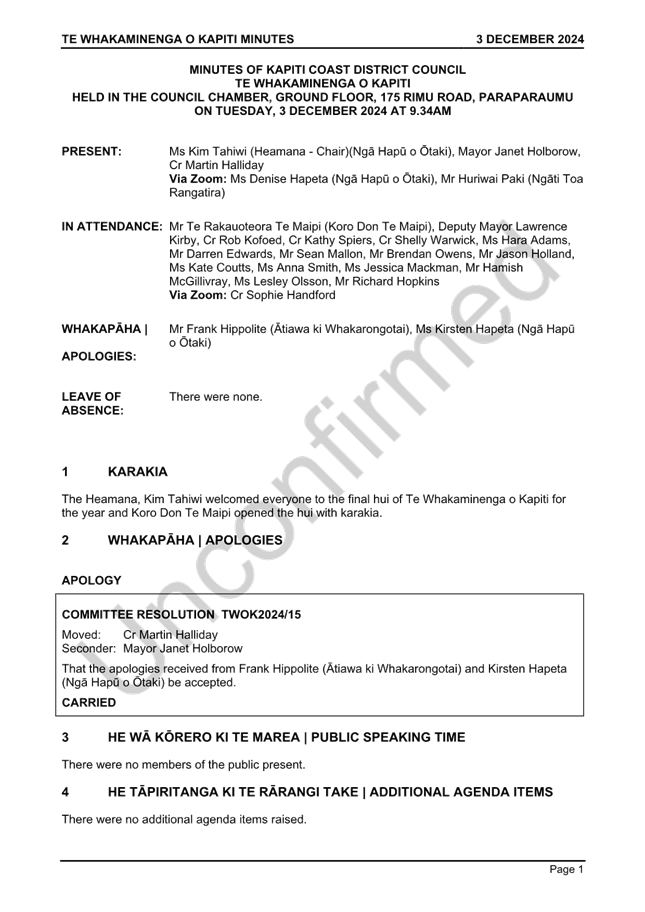
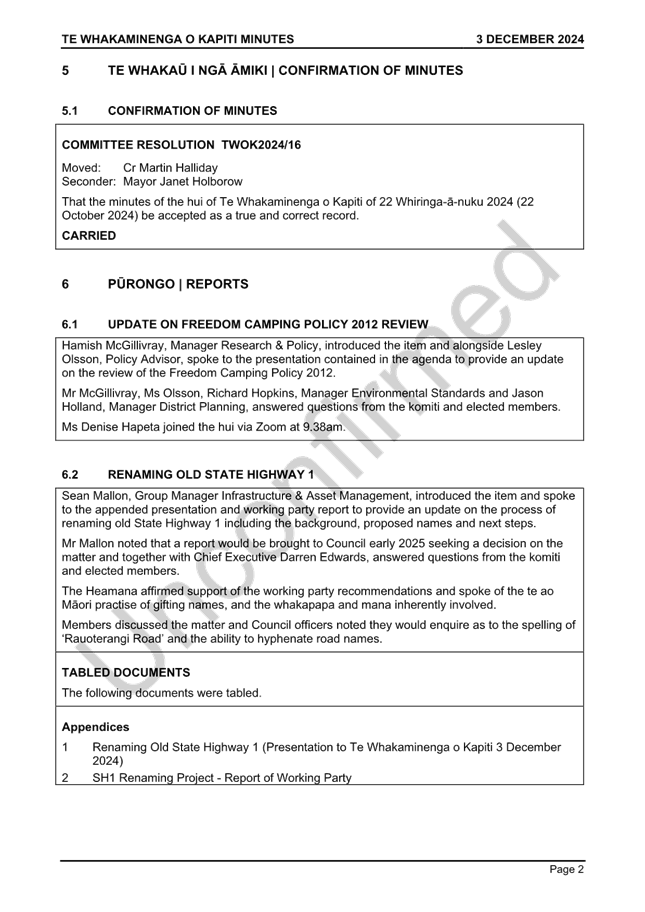
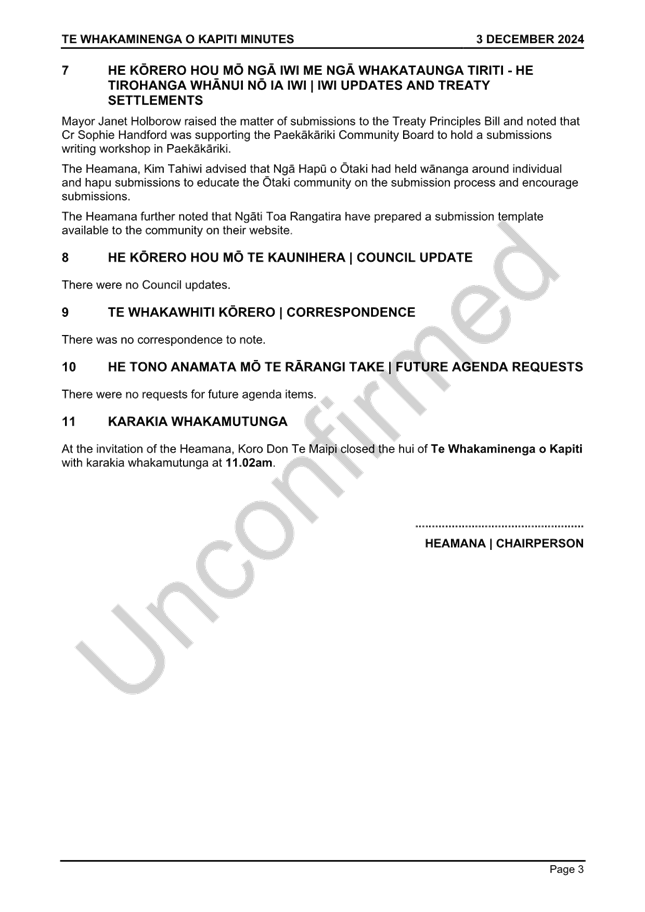
1. Te
Whakaminenga o Kapiti Minutes - 3 December 2024 ⇩ 
|
Te Whakaminenga o Kapiti Agenda
|
18 February 2025
|
|
Te Whakaminenga o Kapiti Agenda
|
18 February 2025
|
6 Pūrongo
| Reports
6.1 Update
on the Omnibus Reserve Management Plan
Kaituhi |
Author: Yolanda
Morgan, Team Leader Open Space Planning
Kaiwhakamana
| Authoriser: Morag Taimalietane, Principal Advisor Customer
and Community
Te pūtake | Purpose
1 This
report provides an update on the preparation of the Omnibus Reserve Management
Plan (RMP), including the reserve classification process.
Taunakitanga | RECOMMENDATIONS
2. That
Te Whakaminenga o Kāpiti notes the update and the next steps for the
development of the Omnibus Reserve Management Plan.
Tūāpapa |
Background
3 Council manages 125 parks
and reserves, totalling 438 hectares of open space. This includes our
destination parks, sports fields, esplanade reserves, neighbourhood parks and
playgrounds, heritage, scenic and local purpose reserves.
4 The
Open Space Planning team has been preparing to develop an omnibus RMP, covering
all 125 parks and reserves that are managed by the Council.
5 Hui with our iwi partners
have been held to co-design our approach to the development of the RMP and we
continue to work together to understand and document the special values of the
whenua which make up our parks and reserves. The next hui is scheduled to take
place on 21 February 2025.
6 Following that hui, a
recommendation will be put to Council to publicly notify our intention to
prepare the RMP. This will start the process (stipulated in the Reserves Act)
that must be followed to prepare an RMP.
He take |
issues
7 Council is required by
legislation to prepare, and keep under continuous review, a management plan for
the reserves that it manages. Council currently has management plans for only
19 reserves (out of 125), and many of these plans are more than 30 years old.
8 Reserve management plans
provide for the use, enjoyment, maintenance, protection and preservation of
reserves. Management plans provide guidance around what uses and activities are
acceptable (or not acceptable) on individual or group of reserves and ensures
transparent and consistent decision making.
9 The legal status of an
RMP varies according to the legal status of the land it covers:
9.1 For land that is held subject to the
Reserves Act, and classified according to its primary purpose, it will be a
statutory Reserve Management Plan under the Act.
9.2 For Council land that is managed for open
space purposes, that has not yet been classified, it will be a non-statutory
guiding document.
10 As part of the RMP process, Council
is also undertaking a staged process to classify the unclassified parks and
reserves, where that is appropriate. The RMP will then become a statutory
management plan under the Act for these sites.
11 Many of our unclassified reserves
can be classified without public notification. These are reserves that are
currently used and managed for the purpose for which they were acquired by
Council and are zoned Open Space in the District Plan.
12 At our February hui we will continue
to discuss and confirm those sites to be classified, along with the proposed
classifications. A recommendation to classify those reserves will be taken to
Council, along with the recommendation to notify Council’s intention to
prepare an RMP.
13 Any unclassified reserves that need
further research or additional consultation with stakeholders, and those that
need to be publicly notified due to their current use or legal status, will
continue to be discussed and will be included in a future recommendation.
Ngā
kōwhiringa | Options
14 Do
nothing - Council could continue to operate without a management plan
for its parks and reserves, or with outdated plans for those reserves where
they do exist. However, this is a breach of Council’s requirements under
the Act. Without up to date, fit for purpose management plans, decision making
around the management, use and development of Council managed parks and
reserves risks being inconsistent, not transparent and not in line with the
views and aspirations of the community.
15 Prepare an RMP for each
Reserve – Council could prepare individual management plans for
each reserve, or groups of reserves. As we currently have very few management
plans in place and 125 reserves, it is efficient to prepare one management plan
providing a consistent set of policies. Individual reserves, or groups of
reserves (e.g. neighbourhood playgrounds), will still be able to have specific
policies on their management where relevant.
16 Prepare an Omnibus RMP –
An omnibus RMP is the most efficient option to meet the Council’s
legislative requirements and enable both general provisions, as well as reserve
specific provisions, to be provided in one document. The omnibus RMP will be
made up of two sections:
A. General Policy Section
B. Reserve Specific Management Plans
17 While the document will be larger
than an individual RMP, we aim to publish the plan using the E-plan platform to
enable easy navigation. For example, users will be able to search by reserve
name or address and be provided with links to all the relevant policies for
that reserve.
Mana Whenua
18 As mentioned above, the development
of the RMP to date has followed a co-design approach with the involvement of
representatives from our three iwi partners.
19 The RMP will acknowledge the
cultural values of the whenua which make up our parks and reserves and will
recognise the intrinsic relationship of iwi with the land through enabling
appropriate practices, management provisions and storytelling.
20 We will continue to work with our
iwi partners to refine the scope of the RMP and in drafting the provisions of
the RMP.
ngā Mahi panuku | next
steps
21 The
preparation of an RMP must follow the process set out in the Reserves Act 1977.
The includes two phases of public notification and engagement.
22 Following
the February hui, a recommendation will be taken to Council to pass the
following resolutions:
o To notify the intention to
prepare an omnibus RMP for all Council managed reserves and invite feedback
from stakeholders and the wider community.
o To classify a number of
reserves (the final list of reserves to be classified will be confirmed
following the February hui).
23 If
the Council passes the resolution to notify the intent to prepare an RMP, the
next steps will be:
a. Publication
of the notice of intent
b. Stakeholder
and community engagement phase including:
i. Have your
say platform
ii. Social
media
iii. Staff
“pop-ups” at community markets, coastlands and play events
iv. Community
board meetings
v. Targeted
stakeholder engagement
c. Feedback
period closes
d. Analysis
of public feedback and drafting of the RMP
e. Draft
RMP document publicly notified and call for submissions
f. Submission
period
g. Hearings
h. Recommendation
and decision following hearings
i. Final
RMP published
24 If
the Council passes the resolution to classify any reserves, then a notice will
be placed in the gazette formalising those classifications.
Ngā
āpitihanga | Attachments
Nil
|
Te Whakaminenga o Kapiti Agenda
|
18 February 2025
|
6.2 Progress
report on Council's Flood Mapping Update Project
Kaituhi |
Author: Simon
Scott, Senior Advisor Stormwater and Coastal Assets
Kaiwhakamana
| Authoriser: Sean Mallon, Group Manager Infrastructure and
Asset Management
Te pūtake | Purpose
1 This
update is to provide a progress report to Te Whakaminenga o Kapiti on updating Council’s
district flood model and associated upcoming community engagement.
2 Council
staff will provide a brief presentation to accompany this report.
Taunakitanga | RECOMMENDATIONS
That Te
Whakaminenga o Kapiti:
A. Note
the progress on Council’s update of the district flood model and
associated flood extents mapping.
B. Note
the outline of proposed iwi engagement activities to occur during community
engagement stage, anticipated to commence in March/April 2025.
Tūāpapa |
Background
3 Council is updating flood
hazard mapping for the district, utilising the latest modelling tools and
methods, and incorporating improved topographic and environmental data.
This work builds on previous modelling undertaken in 2010-2012, which forms the
basis for the current District Plan Flood Maps.
He take |
issues
4 The updated flood model
will be a valuable tool for informing land-use planning, infrastructure
investment, and resilience. The model may also inform integrated catchment
management projects currently being scoped by Council and by Greater Wellington
Regional Council (GW), to improve water quality and ecological outcomes.
5 The updated flood model utilises
TUFLOW software, a powerful tool that simulates water movement through rivers,
floodplains, and urban areas using a “rain-on-grid” method to
better understand how runoff flows and ponds in built-up environments.
6 The model incorporates
updated local information such as detailed topographic data (LiDAR), major
infrastructure works (e.g., SH1 upgrades), improved rainfall projections
(HIRDS), and new groundwater modelling. The model also includes details
of the stormwater network, including pipes, drains, culverts, and soakage
systems.
7 The modelling methodology
includes a joint probability analysis, to account for potential combined
effects of rainfall, groundwater, and tidal influences, and examines current
flood risks and climate change forecasts for 2070 and 2130, following Ministry
for the Environment guidelines.
8 The updated flood model
has been used to produce flood extent and depth mapping for the following three
climate scenarios, as the basis for community engagement:
8.1 100-year
rainfall event (1% AEP) under current climate conditions.
8.2 100-year
rainfall event in 2070, factoring in climate change.
8.3 100-year
rainfall event in 2130, factoring in climate change.
9 Several significant regional
and national flood mapping projects are also currently underway.
10 GW is commencing an update of their major
river flooding modelling, focusing on the Ōtaki and Waikanae rivers, and rural
waterways. Initial engagement on this project began in late 2024, with GW
seeking historic flood information and photos. Draft updated major river flood
maps are expected by mid-2025.
11 The National institute for Water and
Atmospheric Research (NIWA) is also in the latter stages of a Central
Government-funded national flood mapping project, which is expected to deliver
preliminary flood mapping products in June/July 2025. The purpose of this
NIWA project is to inform national policy and emergency planning. NIWA
acknowledges that local mapping, prepared by local authorities, is more
appropriate for assessing local flood hazards.
12 Council
commenced a digital campaign from December 2024 to early March 2025, to raise
public awareness about the district’s flood risks, local and central
government roles and responsibilities, and why/how flood models are used. This
campaign highlighted the natural and historical factors contributing to local
flood conditions, such as the district’s geography, high water table, and
development history. Information was also provided about where to access current
flood information, and what actions the community can take before and during
major flood events.
Ngā
kōwhiringa | Options
13 There
are no options to be presented on this matter.
Mana Whenua
14 The
primary focus of the current project is to establish an up-to-date and accurate
flood model for areas of the Kāpiti Coast serviced by Council’s
urban stormwater network.
15 Once
updated, the model will enable the creation of various flood mapping products
to inform future decision making of interest to mana whenua. These products
will improve understanding of:
15.1 community
vulnerability to flood hazards
15.2 the
occurrence of frequent nuisance flooding
15.3 ecological
interactions with urban drainage and groundwater
15.4 potential
impacts of urban development proposals on awa
16 Addressing
these flood-related issues will require a partnership approach with mana
whenua, as well as targeted engagement with key stakeholders. This
further mahi falls outside the scope of the flood modelling update project.
17 Presently,
staff are seeking Te Whakaminenga o Kāpiti’s guidance
on mana whenua engagement to help verify the accuracy of the updated flood
model, in addition to the general activities and engagement resources outlined
later in this report.
18 Potential
mana whenua engagements could include:
18.1 staffed
drop-in sessions at local marae
18.2 flood
management hui with iwi leadership and key staff
18.3 other
engagement activities proposed by Te Whakaminenga o Kāpiti.
ngā Mahi panuku | next
steps
19 The
next phase of this project will involve using the new flood maps as the basis
for community engagement, commencing late March 2025, where local knowledge and
feedback will be used to validate and refine the updated flood model.
20 A
comprehensive communication strategy will leverage multiple channels (website,
social media, e-newsletters, radio and print), including an interactive mapping
portal to help residents understand the implications of flood risk for their
properties and local communities. Community engagement events, drop-in
sessions, and online platforms will also be available for residents and
businesses to review the maps and share their lived experiences with flooding
in the district.
21 Through
a targeted approach, Council will engage with key stakeholders, including mana
whenua, newly affected property owners, developers, and the insurance sector,
ensuring they are informed and able to provide meaningful feedback.
Owners of properties newly identified as potentially affected by flooding under
the new flood model will also be contacted directly by mail.
22 Council
is also actively engaging with the Insurance Council to ensure they have
current and accurate information about the Kāpiti Coast’s flood
risk.
23 The
project will seek to align messaging with Greater Wellington’s flood map
update project, ensuring consistent communication. This may involve joint
participation in drop-in sessions, consistent messaging, and mutual web links
and content, as appropriate.
24 Staff
are liaising with NIWA to maximise the alignment of the projects and of the
various flood mapping products and information.
25 Following
the community engagement phase, feedback will be gathered and analysed to
validate and update the flood model as required. The results of the engagement
will be summarised in a final report, which will contribute to the refinement
of the flood hazard maps.
26 If
there are changes to the District Plan because of this updated modelling, there
will be a separate public process under the RMA. This process will also
consider updated river flood mapping from GW to ensure a joined-up approach
across the district.
Ngā
āpitihanga | Attachments
Nil
|
Te Whakaminenga o Kapiti Agenda
|
18 February 2025
|
6.3 Local Water
Done Well Update
Kaituhi |
Author: Tamara
Silk, Executive Assistant
Kaiwhakamana
| Authoriser: Sean Mallon, Group Manager Infrastructure and
Asset Management
Te pūtake |
Purpose
1 This update
provides an overview of the options being explored by the Council for the
future delivery of water services (water supply/wastewater and stormwater) as
per the requirements of the Local Government (Water Services Preliminary
Arrangements) Act 2024. This update provides an opportunity to understand the
options, issues and implications.
2 The Local Water
Done Well legislation enacted in September last year introduced a new
regulatory regime that water service providers must meet. In addition to new
economic, environmental and water quality regulations, planning, and reporting
requirements, water services providers must produce a Water Services Delivery
Plan and accompanying implementation plan by 3 September 2025, demonstrating
financial sustainability by July 2028.
3 The legislation
provides for alternative water services delivery models, including establishing
a council-owned Water Services Organisation singly or jointly with other
existing providers and consumer trusts. The council must choose whether to
remain with its existing internal business unit model or commit to an
alternative delivery model in its Water Services Delivery plan.
Ngā āpitihanga | Attachments
Nil
|
Te Whakaminenga o Kapiti Agenda
|
18 February 2025
|
6.4 Māori
Economic Development Fund 2024-25
Kaituhi |
Author: Karly
Richardson, Kaitohutohu o ngā Kaupapa ā Iwi
Kaiwhakamana
| Authoriser: Hara Adams, Group Manager Iwi Partnerships
Te pūtake |
Purpose
1 This
report provides Te Whakaminenga o Kāpiti with an overview of the
Māori Economic Development Fund 2024-25.
He
whakarāpopoto | EXecutive summary
2 An
executive summary is not required.
Te tuku haepapa
| Delegation
3 Te
Whakaminenga o Kāpiti may consider this matter under the Memorandum of
Partnership. Clause 21, subclause iv) identifies the following principle: that
Council will have particular regard to the rights of tangata whenua in the
management and development of resources by recognising and providing for
rangatiratanga.
Taunakitanga | RECOMMENDATIONS
That Te
Whakaminenga o Kāpiti:
A. endorse the amount of
$________ available for the contestable grant.
B. endorse
the amount of $________ for the administration of the grant.
C. endorse
the 2024-25 grant round opening on 24 February 2025 and closing on 30 March
2025.
Tūāpapa | Background
4 In
2013, Council adopted the Māori Economic Development and Wellbeing
strategy. This strategy informs the delivery Māori Economic Development
Fund project which aims to financially assist mana whenua and
mātāwaka to stand up projects that align with one or more of the
following themes:
· Manaakitanga
– leveraging the potential of rangatahi and building whānau capacity
· Kaitiakitanga
– working with the whenua
· Kotahitanga
– supporting whānau to achieve economic wellbeing via capacity,
collaboration, innovation, and Māori business.
5 In
2023, Te Whakaminenga o Kāpiti confirmed the Māori Economic
Development Fund allocation subcommittee members for the 2022-25 triennium. The
subcommittee members are as follows: Kim Tahiwi (Ngā Hapū o
Ōtaki), Russell Spratt (Ātiawa ki Whakarongotai), Councillor Martin
Halliday, and John Barrett (Experienced in Economic Development).
6 In
2024, Te Whakaminenga o Kāpiti confirmed Waipuna Grace (Ngāti Toa
Rangatira) as a member of the Māori Economic Development Fund allocation
subcommittee for the 2022-25 triennium.
7 In
the previous grant round, a total amount of $72,000 was awarded across 4
different projects.
He
kōrerorero | Discussion
8 The
Māori Economic Development Fund 2024-25 grant round will be facilitated by
the Iwi Partnerships group in co-ordination with the allocation subcommittee
members.
He
take | Issues
9 After
taking into consideration costs associated with advertising, meetings, and
information workshops, it is proposed that part of the fund is to be allocated
as administration costs and the remainder be available for the contestable
grant amount. Suggested figures and amounts will be tabled at the
meeting.
10 The
Māori Economic Development Fund grants are to be awarded and finalised
before 30 June 2025, which is the end of the 2024-25 financial year. To meet
this target, it is proposed that the grant round will open on 24 February 2025
and close on 30 March 2025.
Ngā
kōwhiringa | Options
Mana whenua
11 Engagement
with mana whenua will continue through the Iwi Partnerships group.
Panonitanga Āhuarangi me te Taiao | Climate change
and Environment
12 Applicants
to the Māori Economic Development Fund will be encouraged to provide
details of how their project considers the effects of climate change.
Ahumoni me ngā rawa | Financial
and resourcing
13 It
is proposed that a portion of the total amount available in the Māori
Economic Development Fund 2024-25 be set aside for the administration of the
grant, which includes advertising, meetings, and information workshops; with
the remainder of the total amount be available for the contestable grant amount.
The total amount available in the Māori Economic Development Fund 2024-25
along with suggested figures and amounts will be tabled at the 18 February 2025
meeting of Te Whakaminenga o Kapiti.
Tūraru ā-Ture me te Whakahaere
| Legal and Organisational Risk
13 There
are no legal risks.
Ngā pānga ki ngā kaupapa here | Policy impact
14 There
is no policy impact.
TE whakawhiti kōrero me te
tūhono | Communications &
engagement
Te mahere tūhono | Engagement
planning
15 An
engagement plan is not needed to implement this decision. Council will
communicate details of the fund through its established communication
channels.
Whakatairanga |
Publicity
16 A
communications plan will be developed to inform the community, mana whenua,
mātāwaka, and Māori businesses of the fund.
Ngā āpitihanga | Attachments
Nil