|

|
|
RĀRANGI TAKE
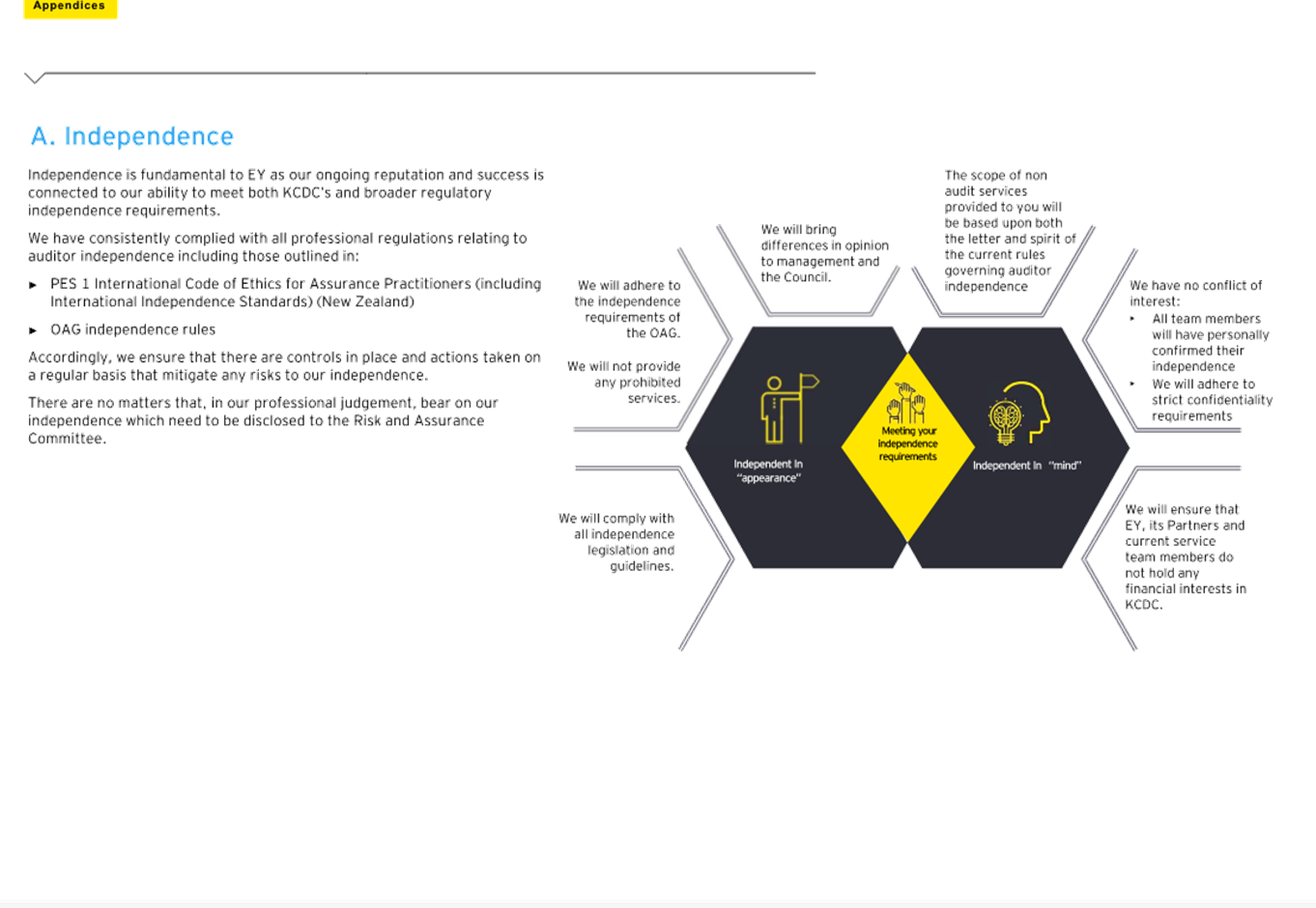
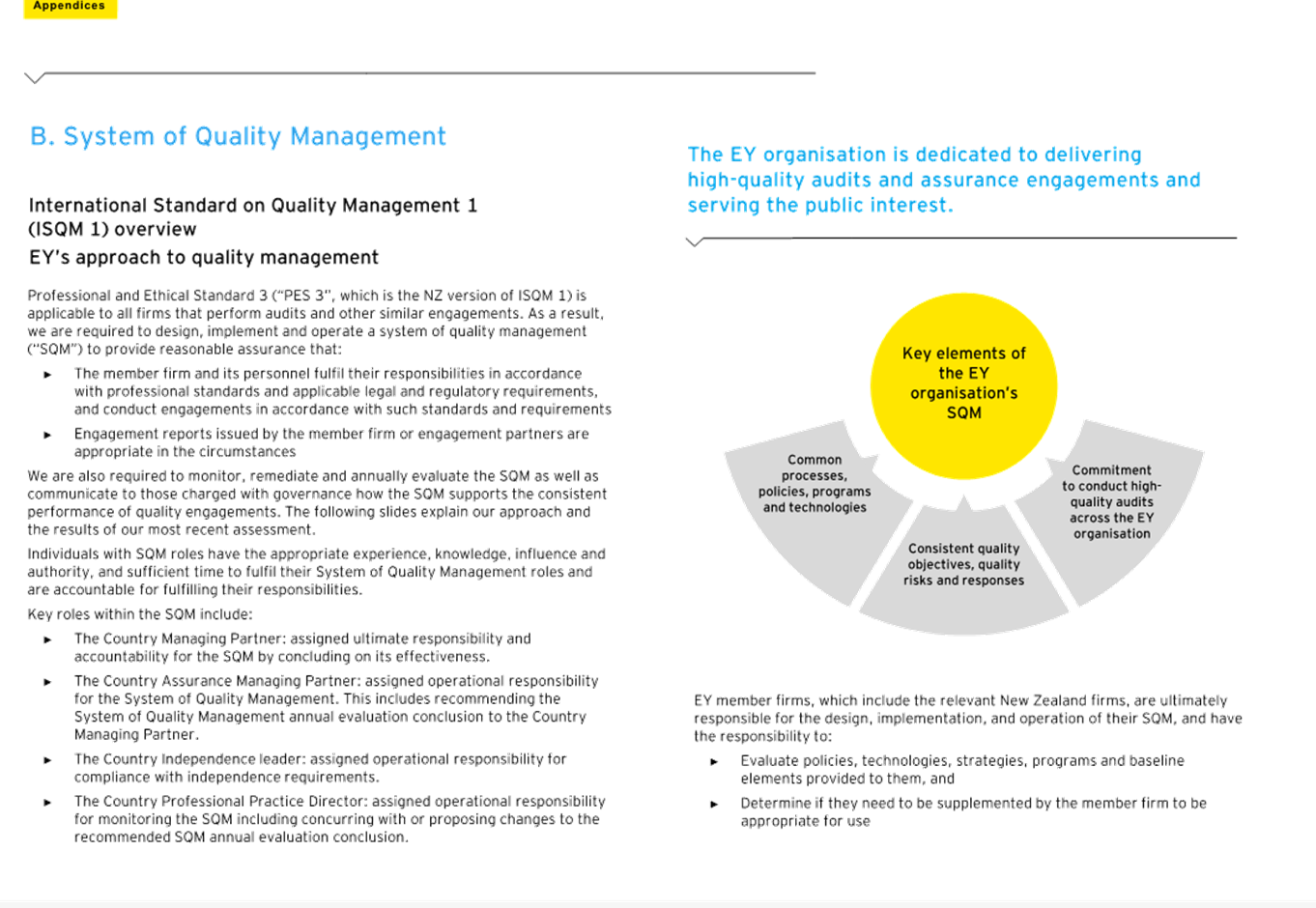
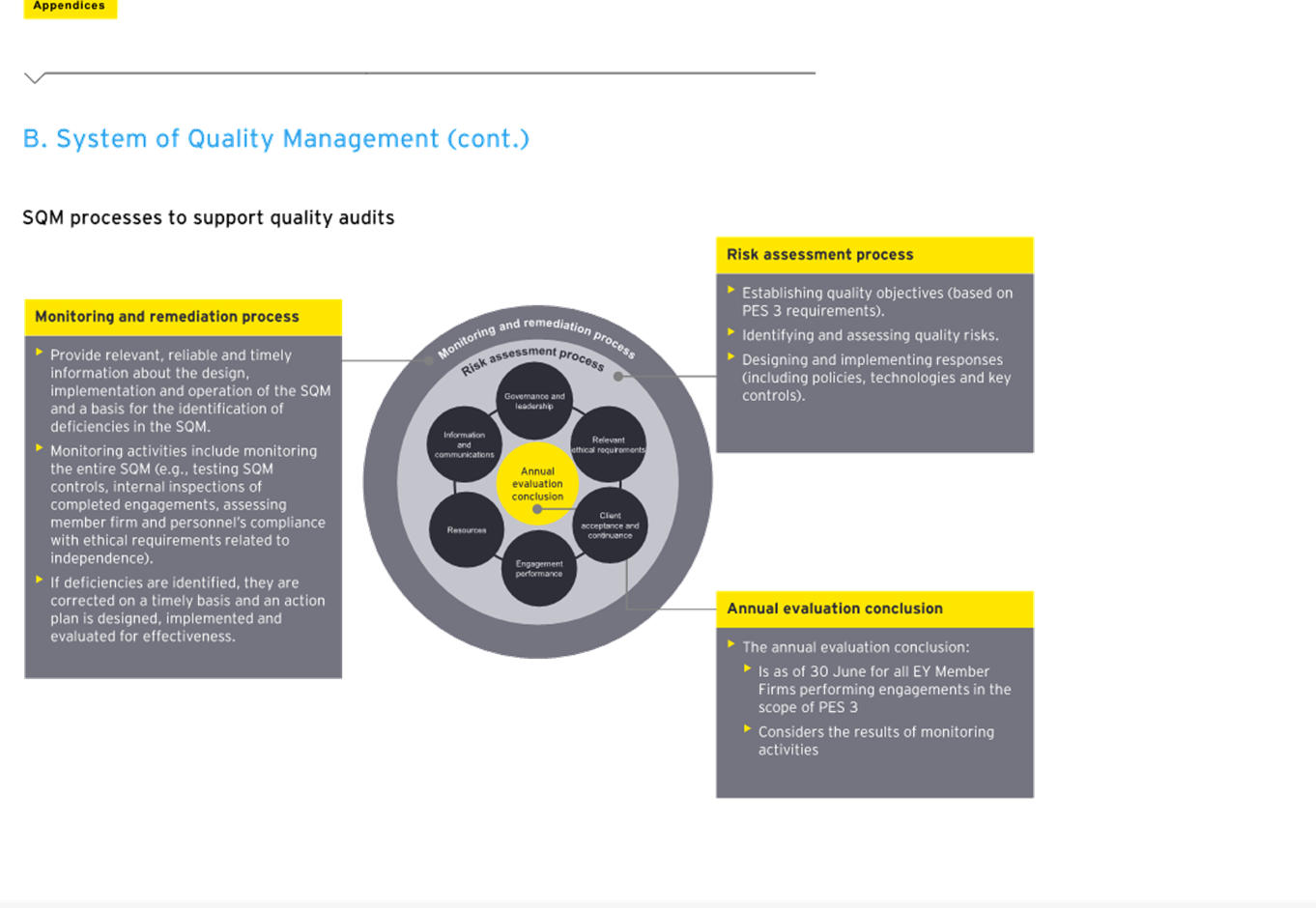
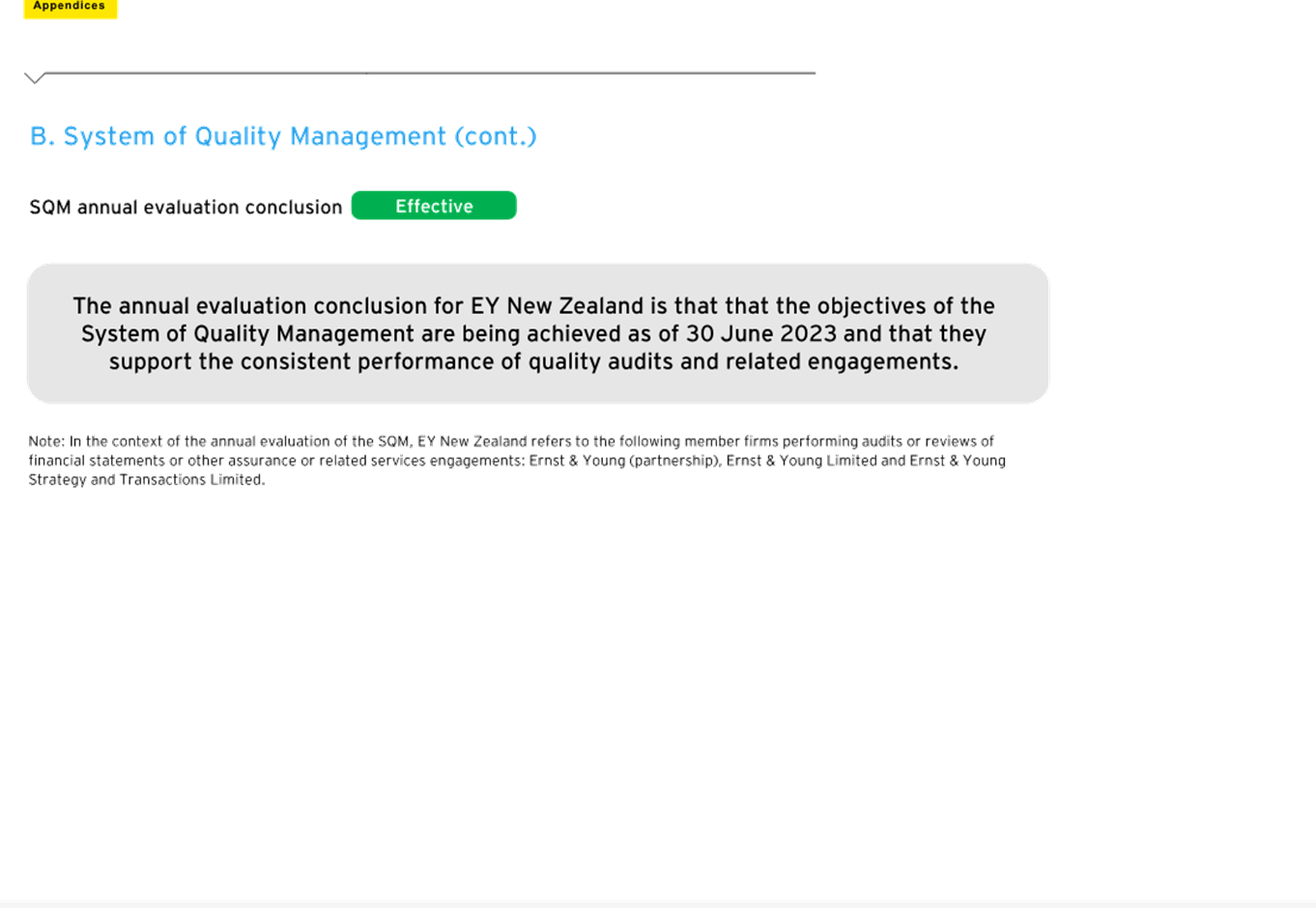
AGENDA
Te Komiti Whakamauru Tūraru | Risk and
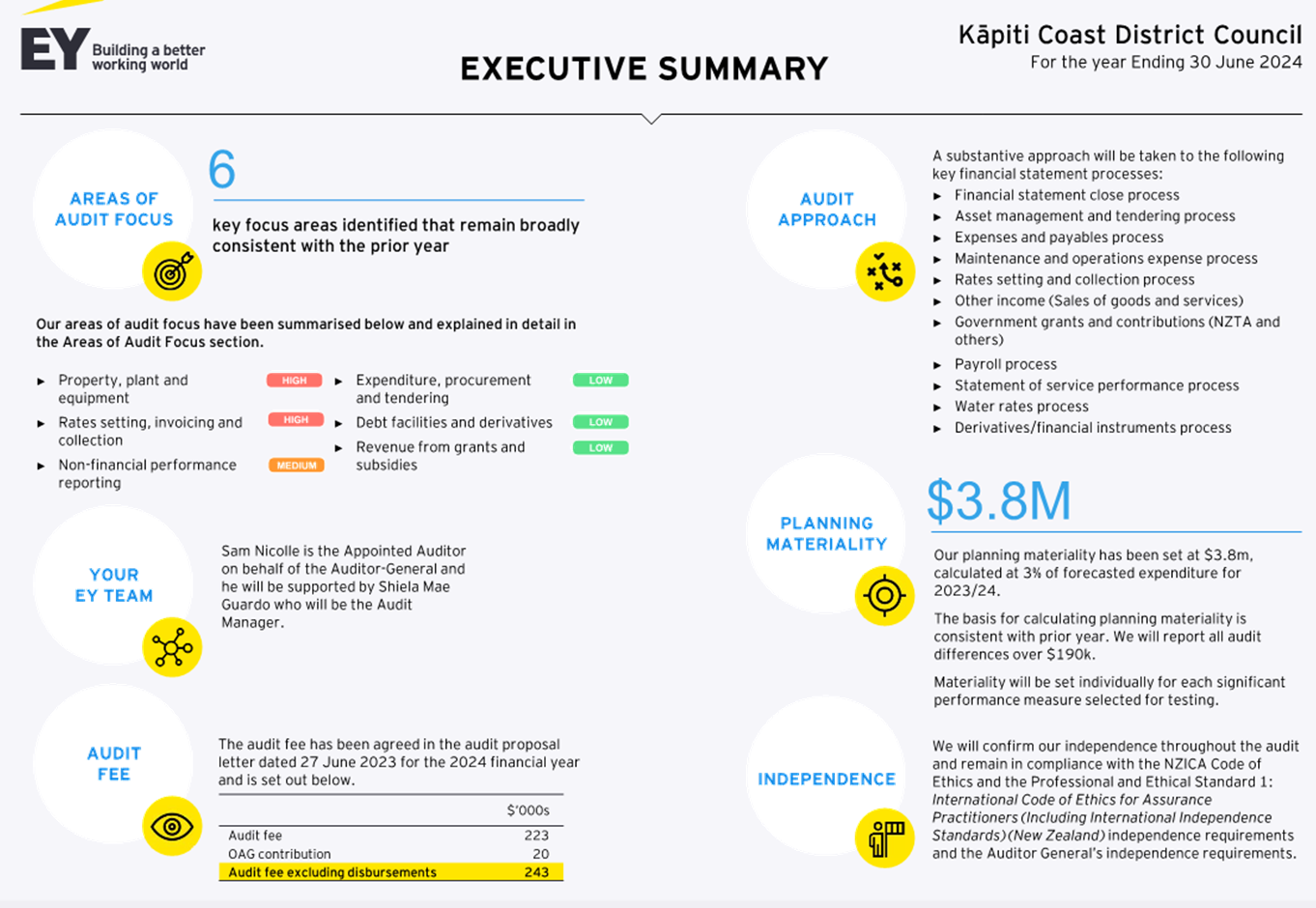
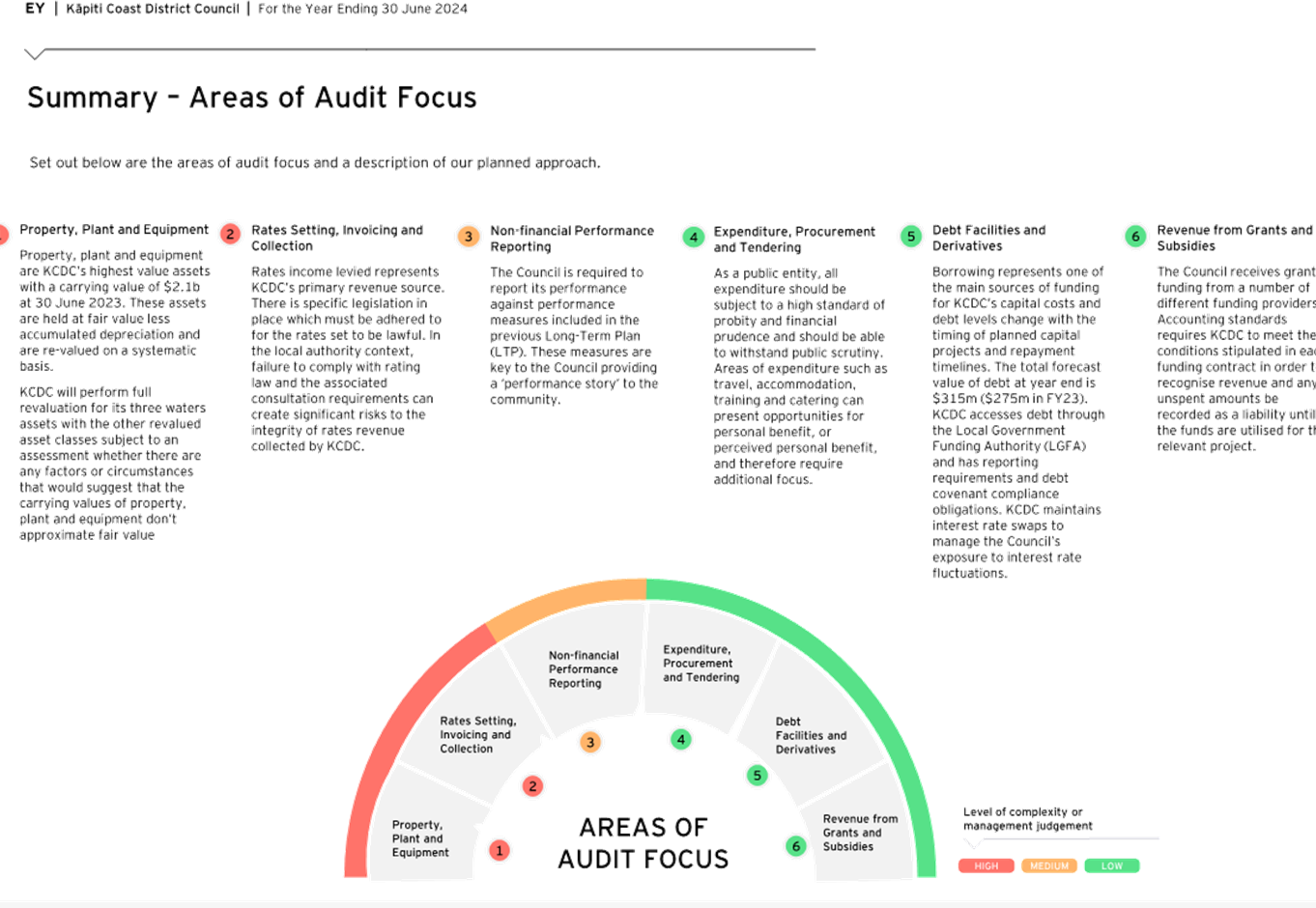
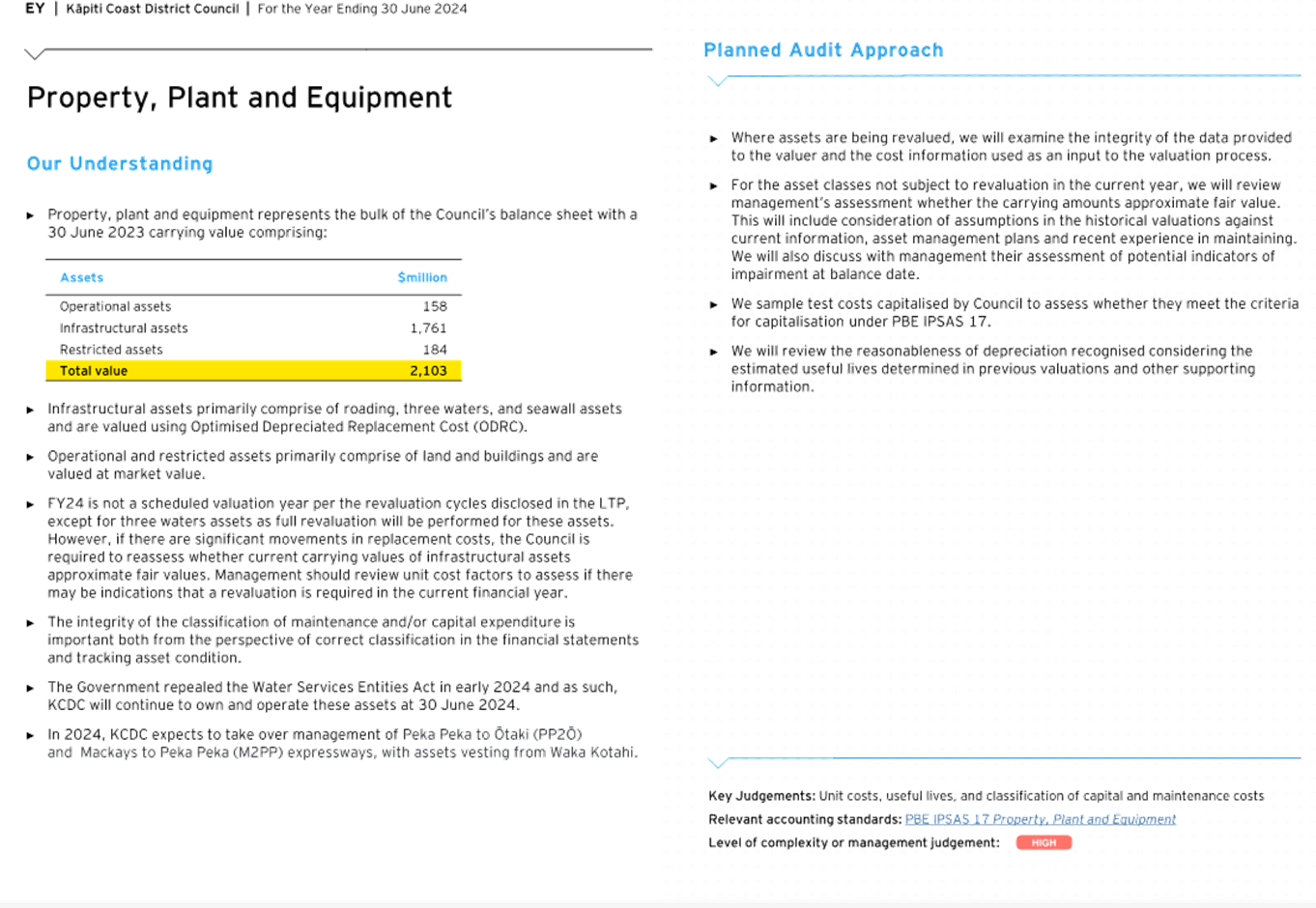
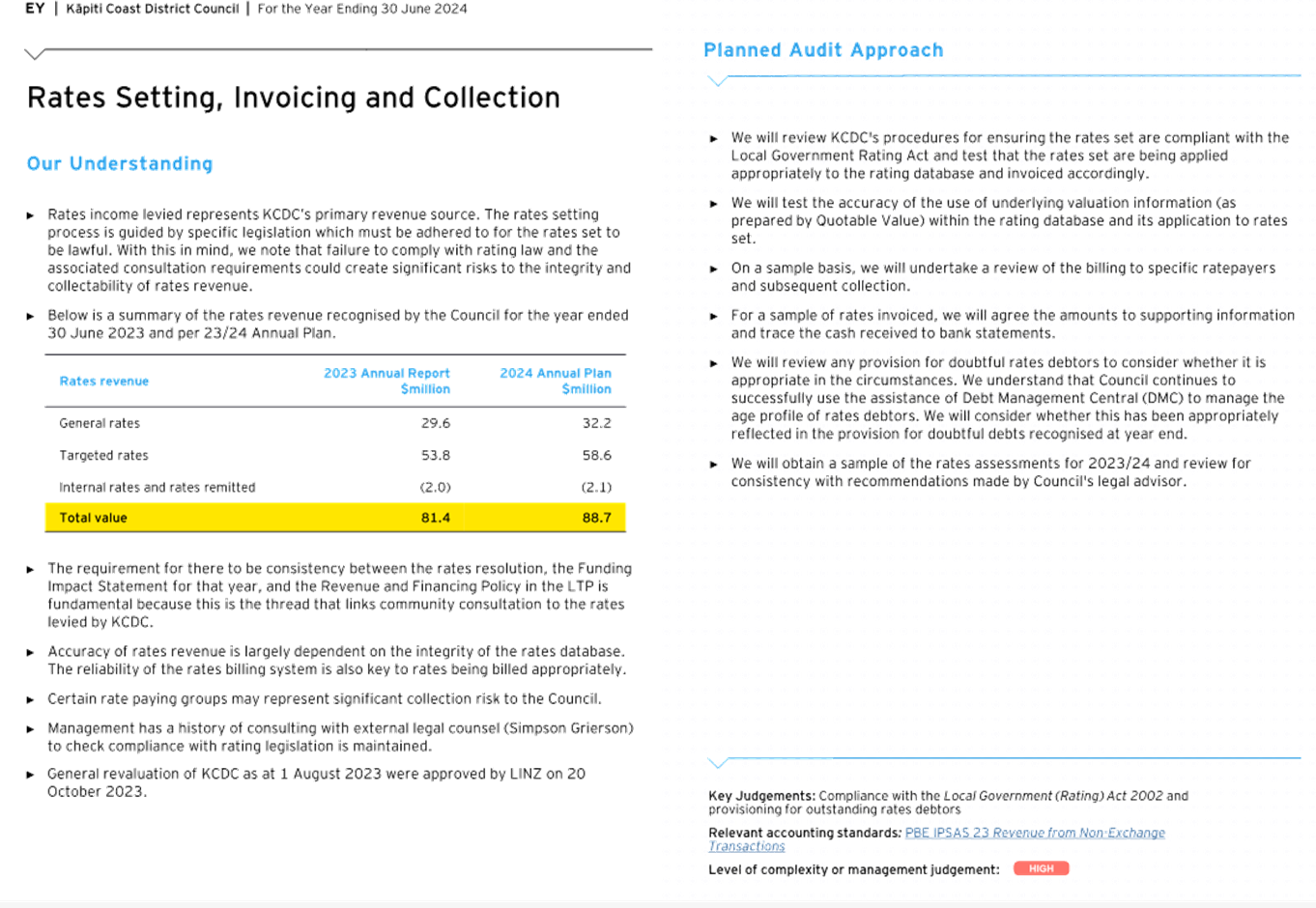
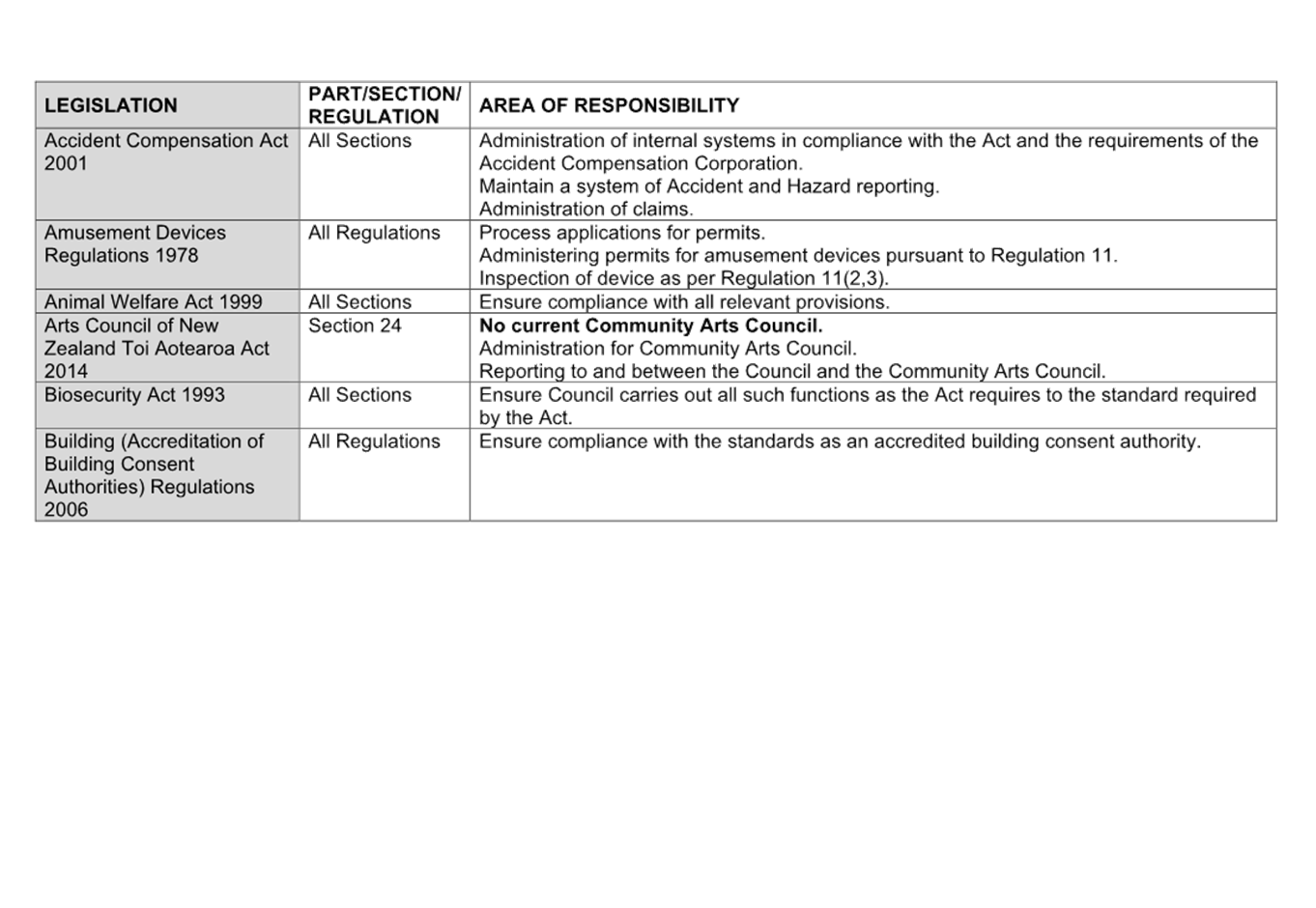
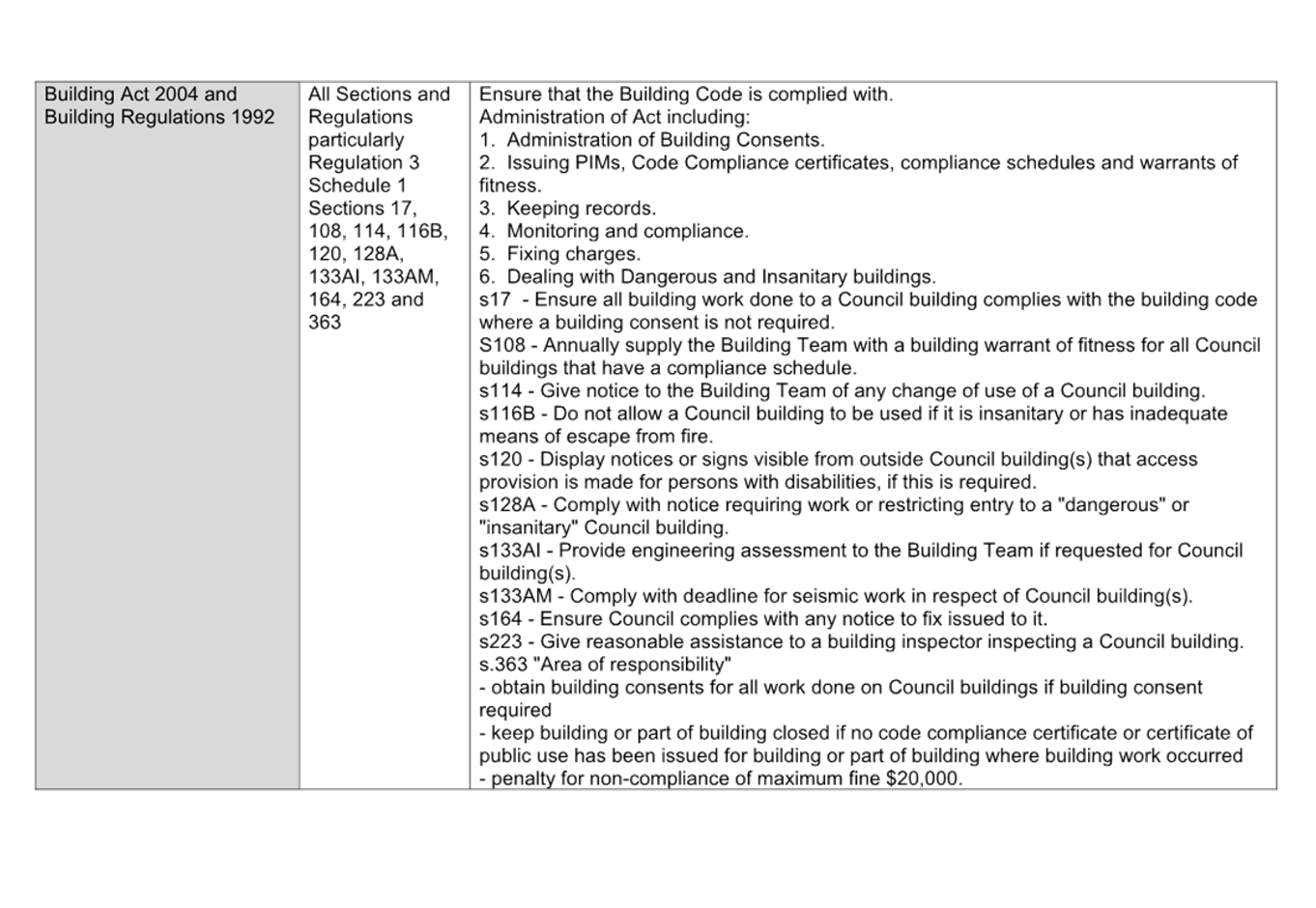
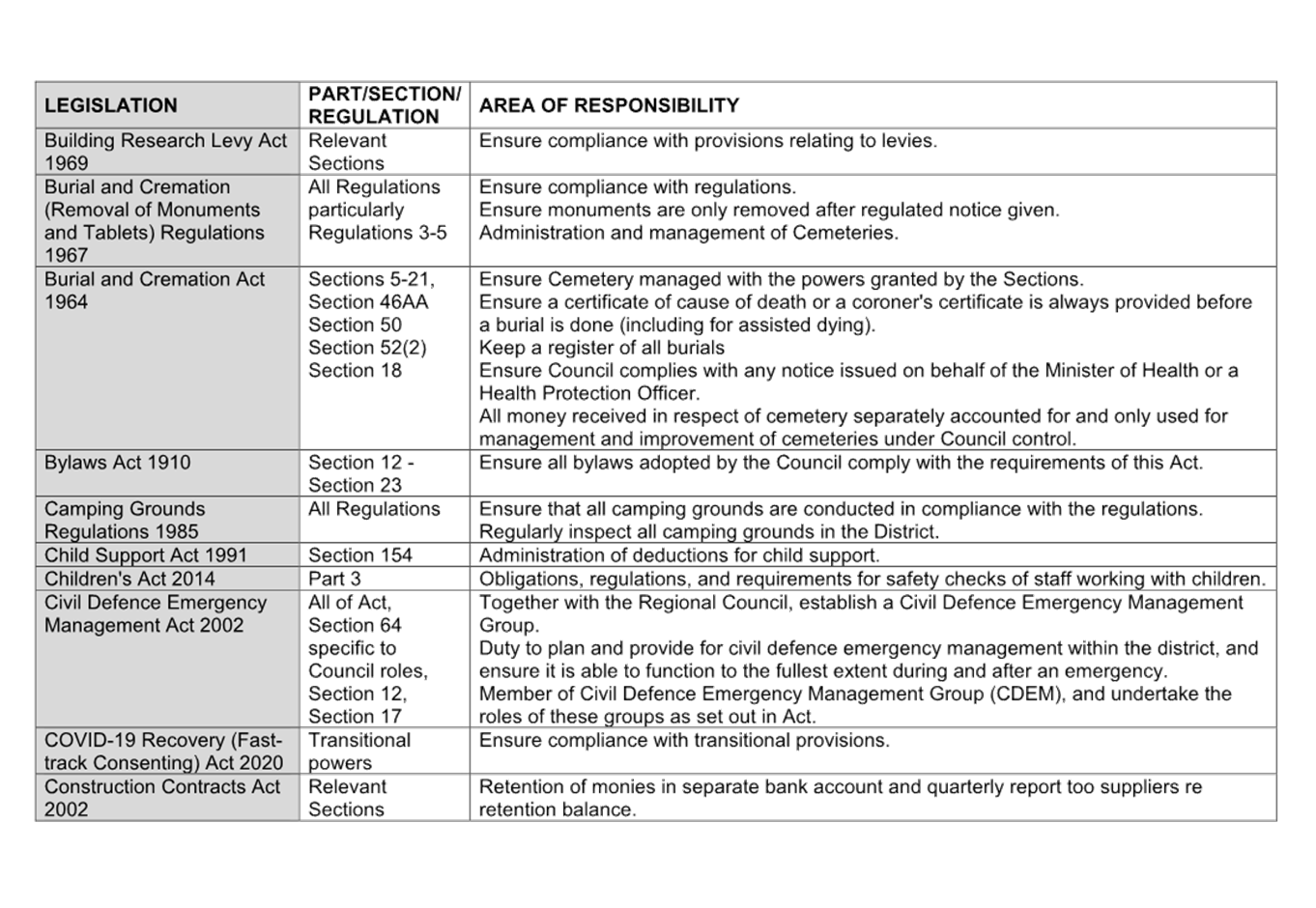
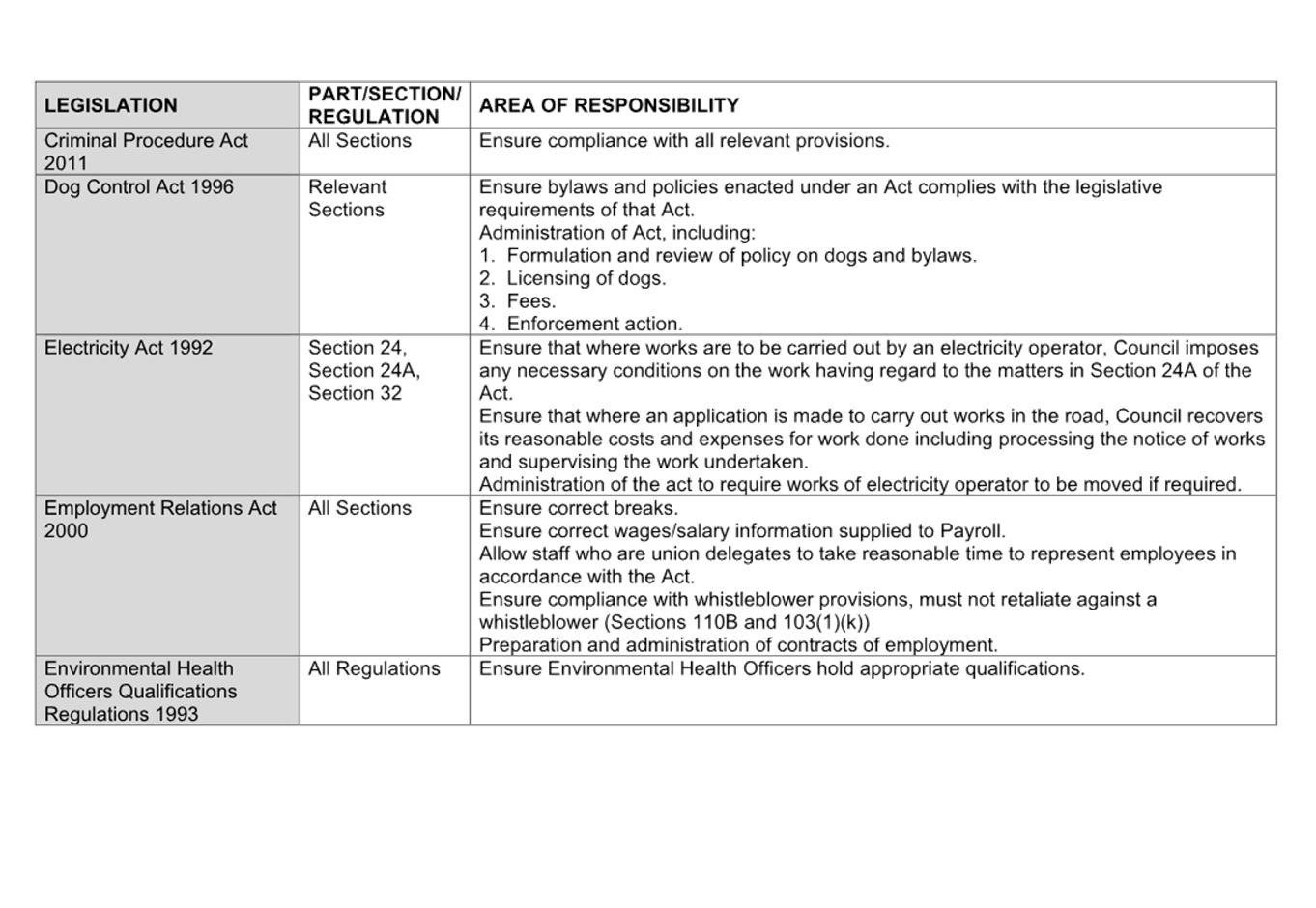
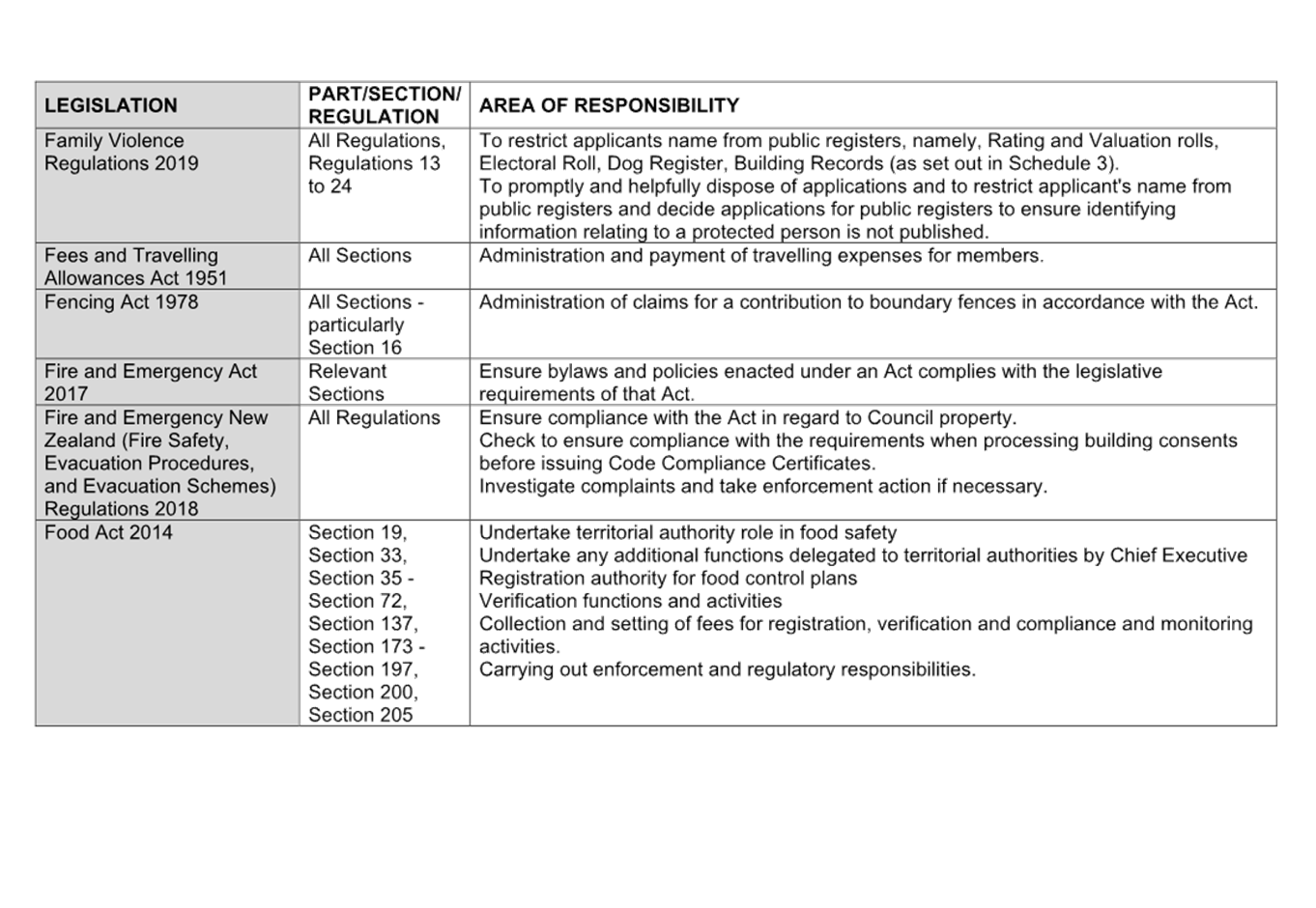
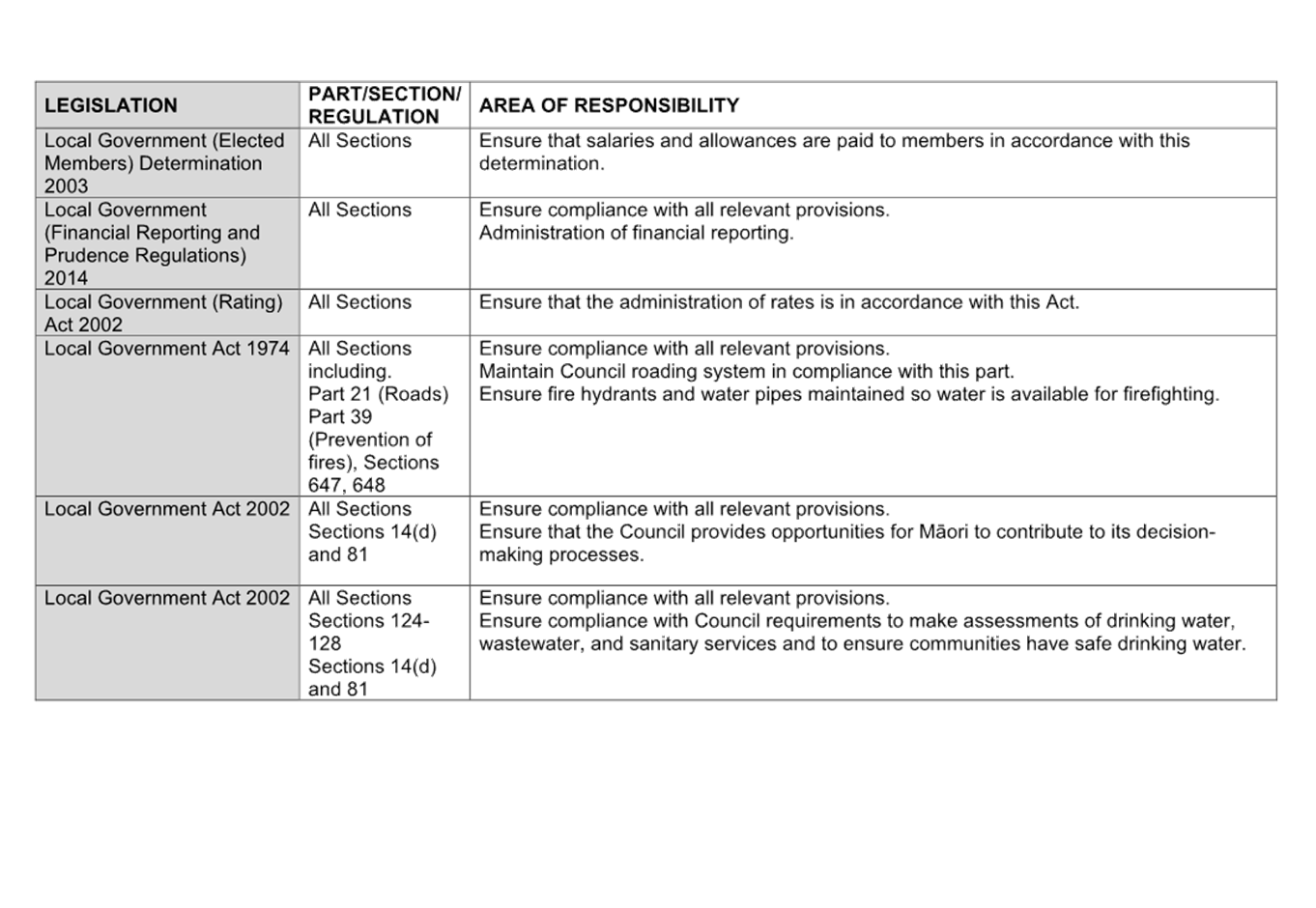
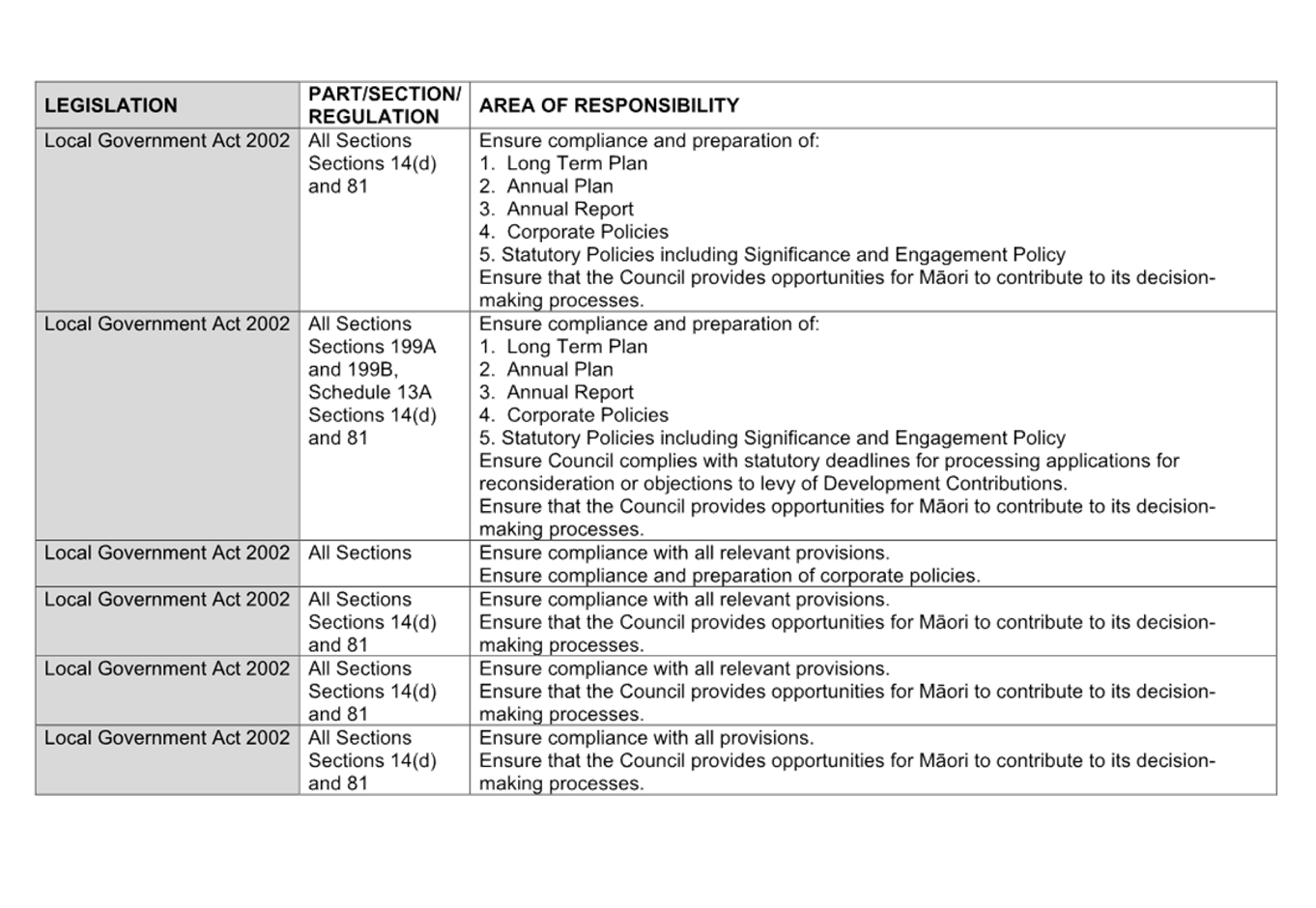
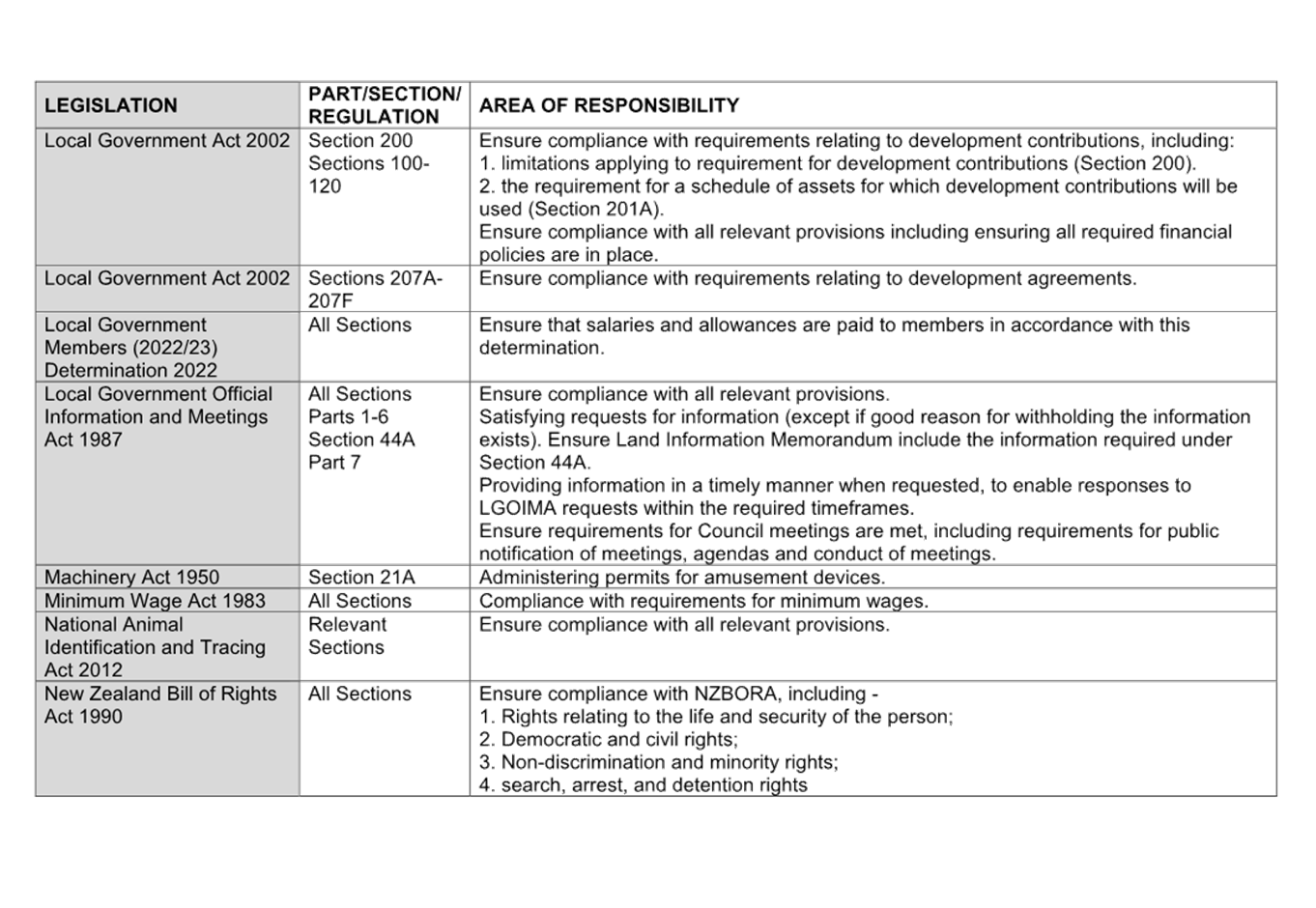
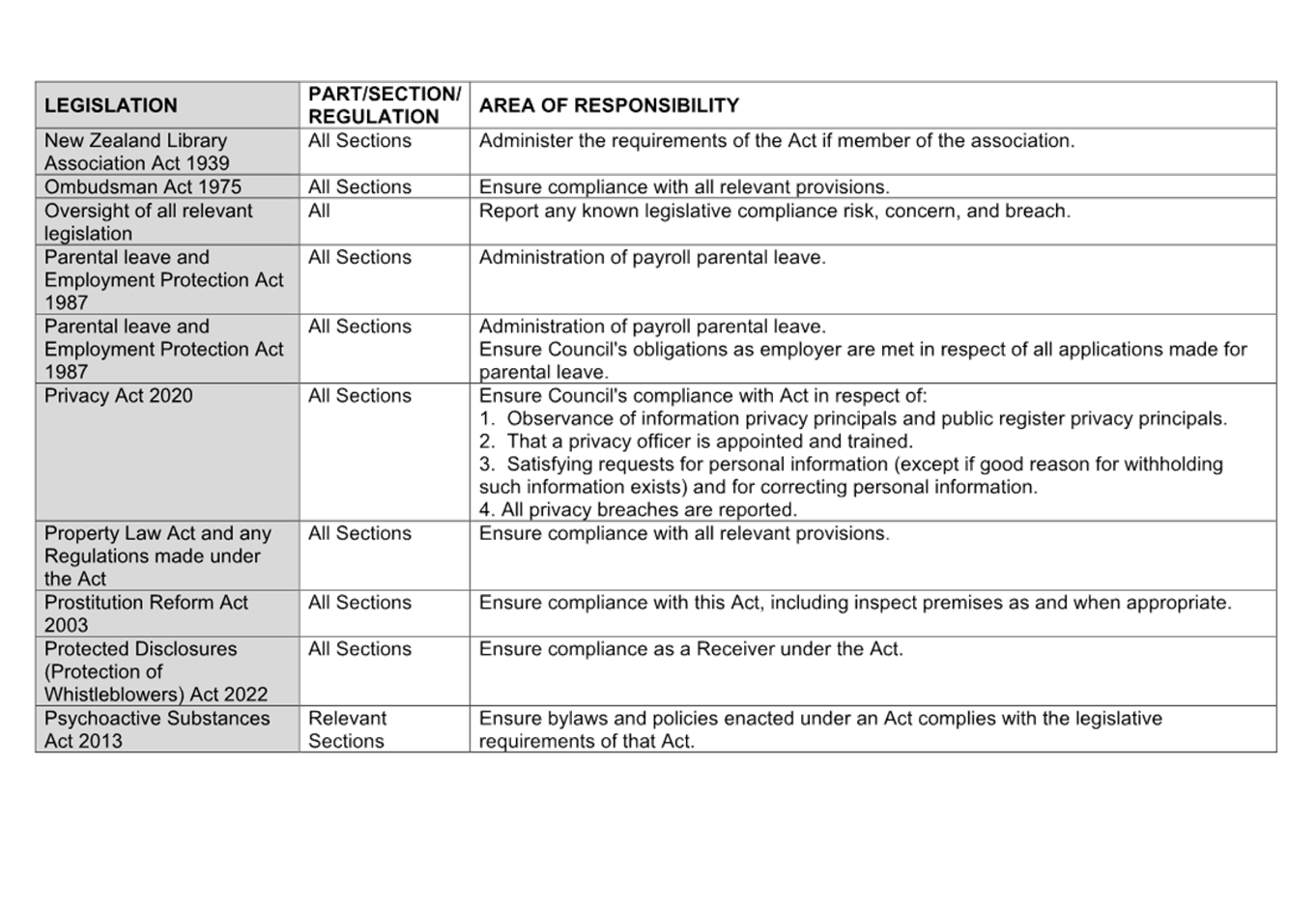
Assurance Committee Meeting
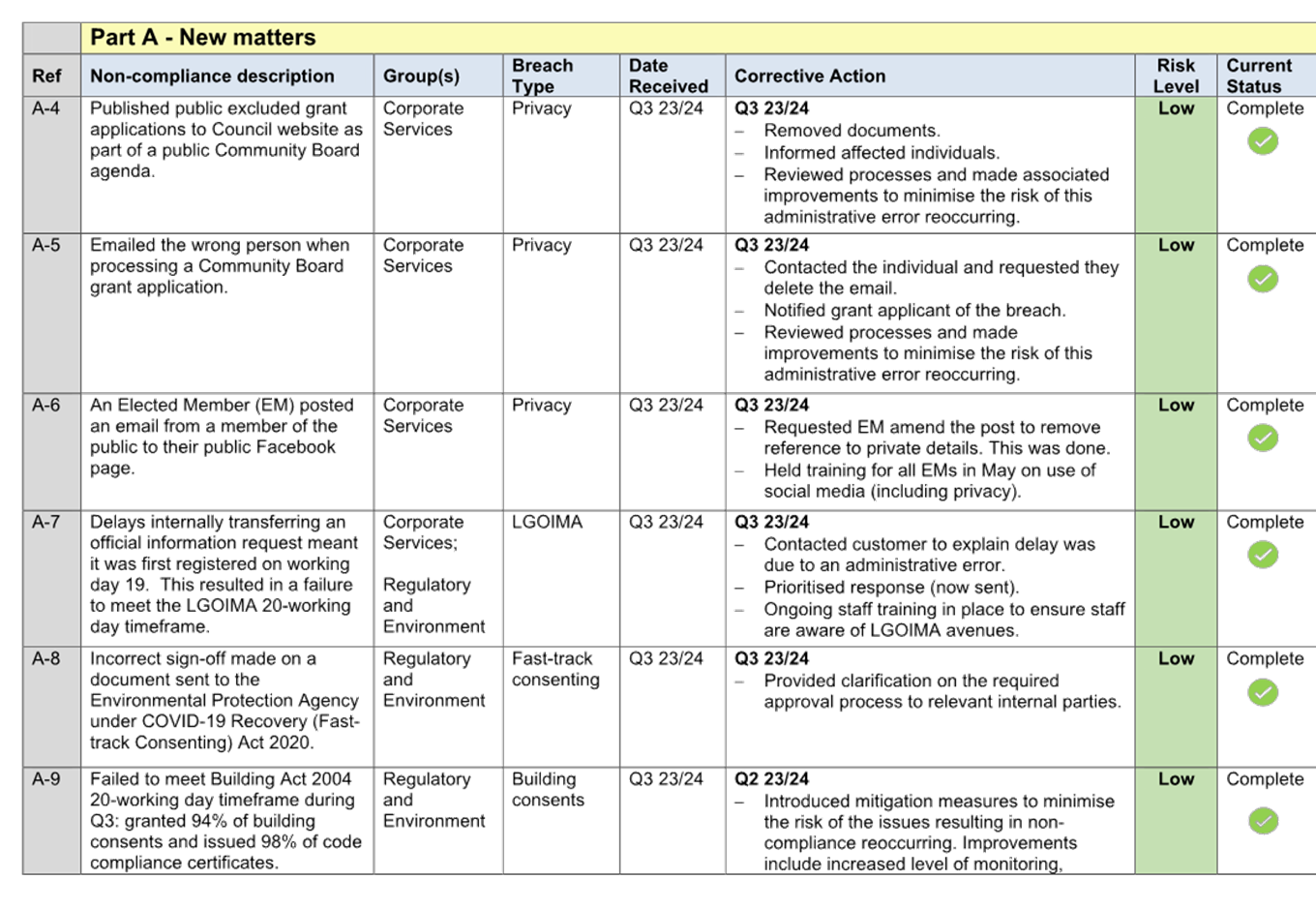
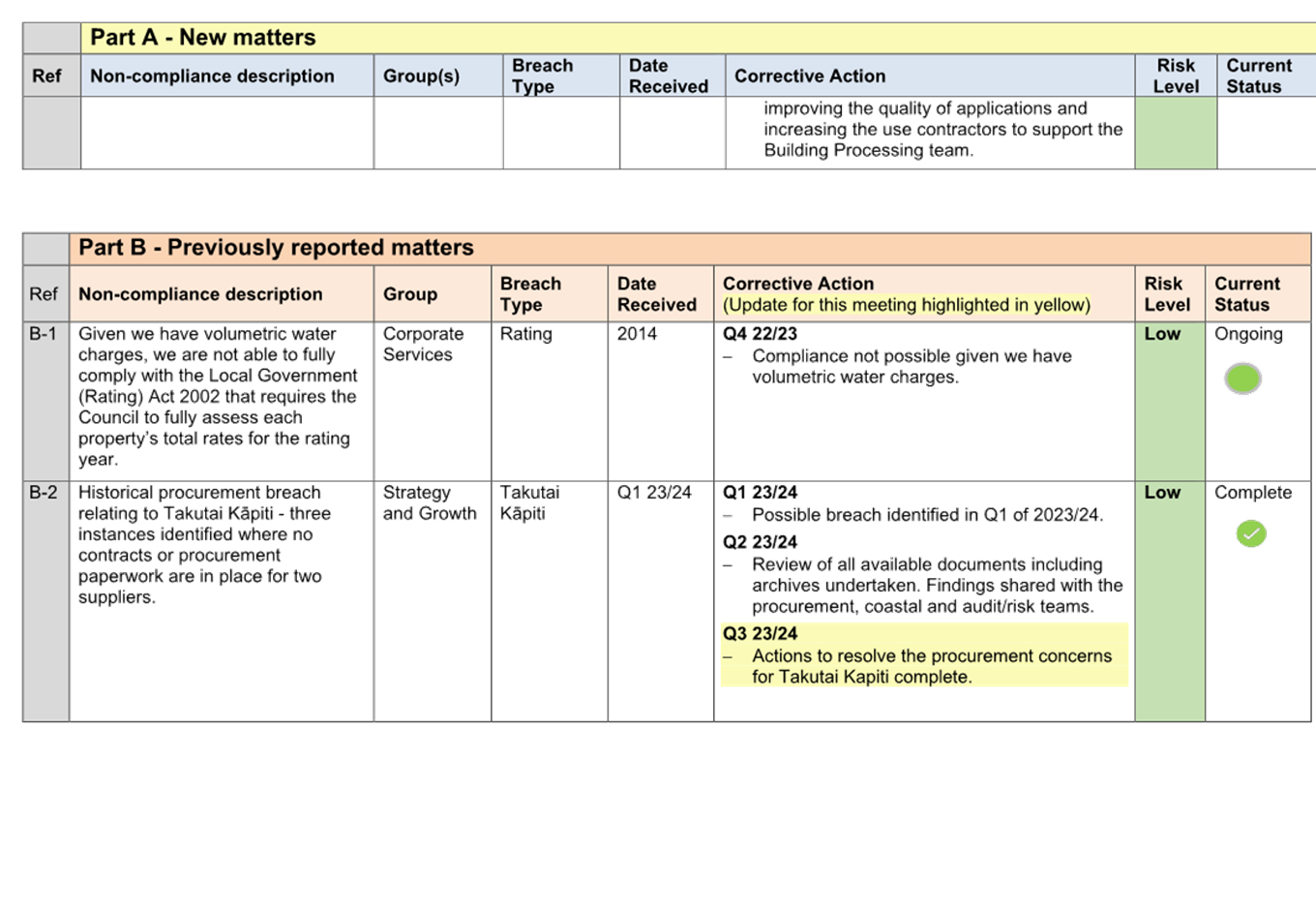
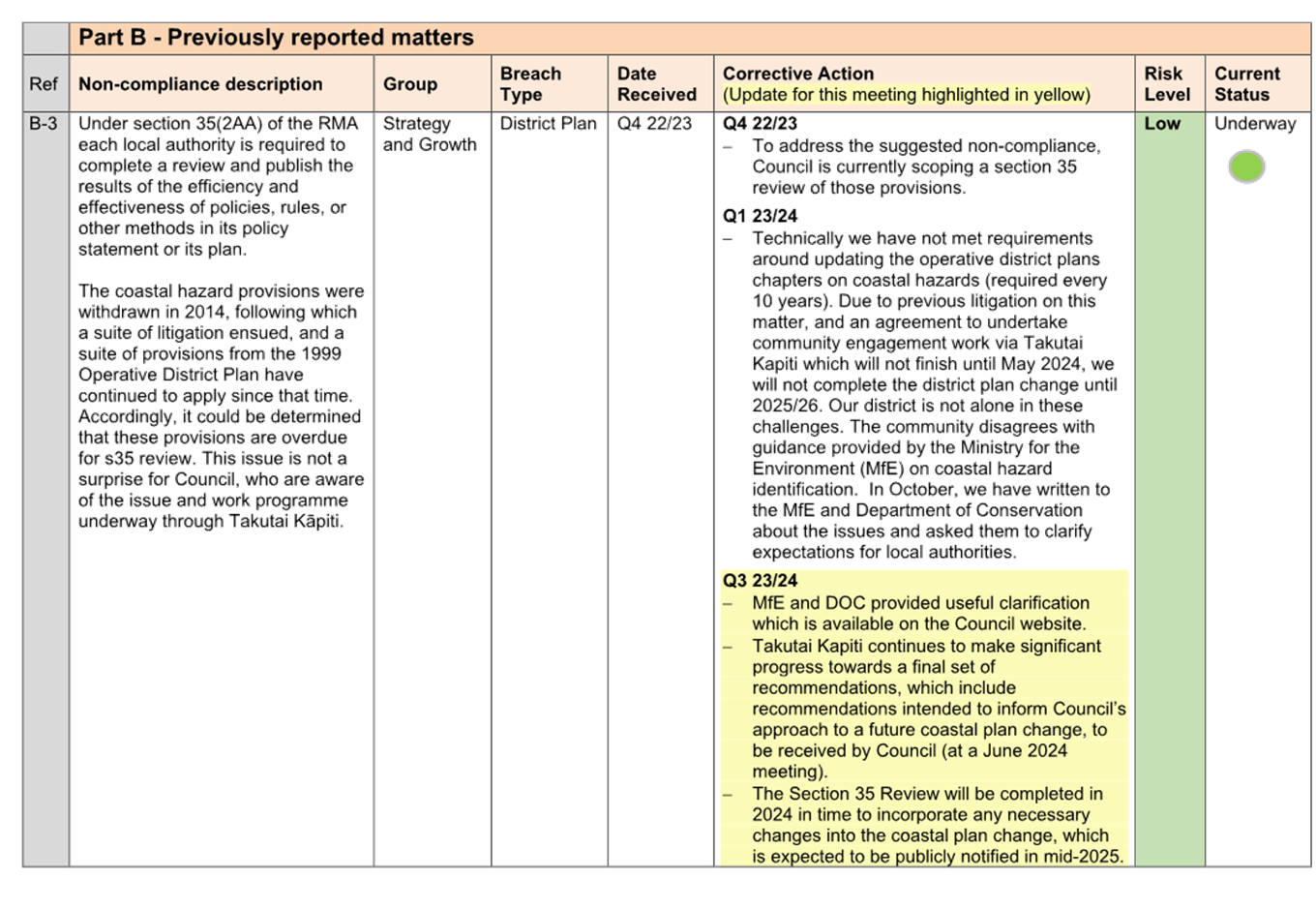
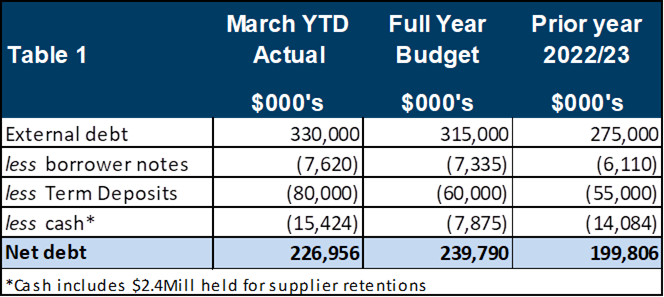
|
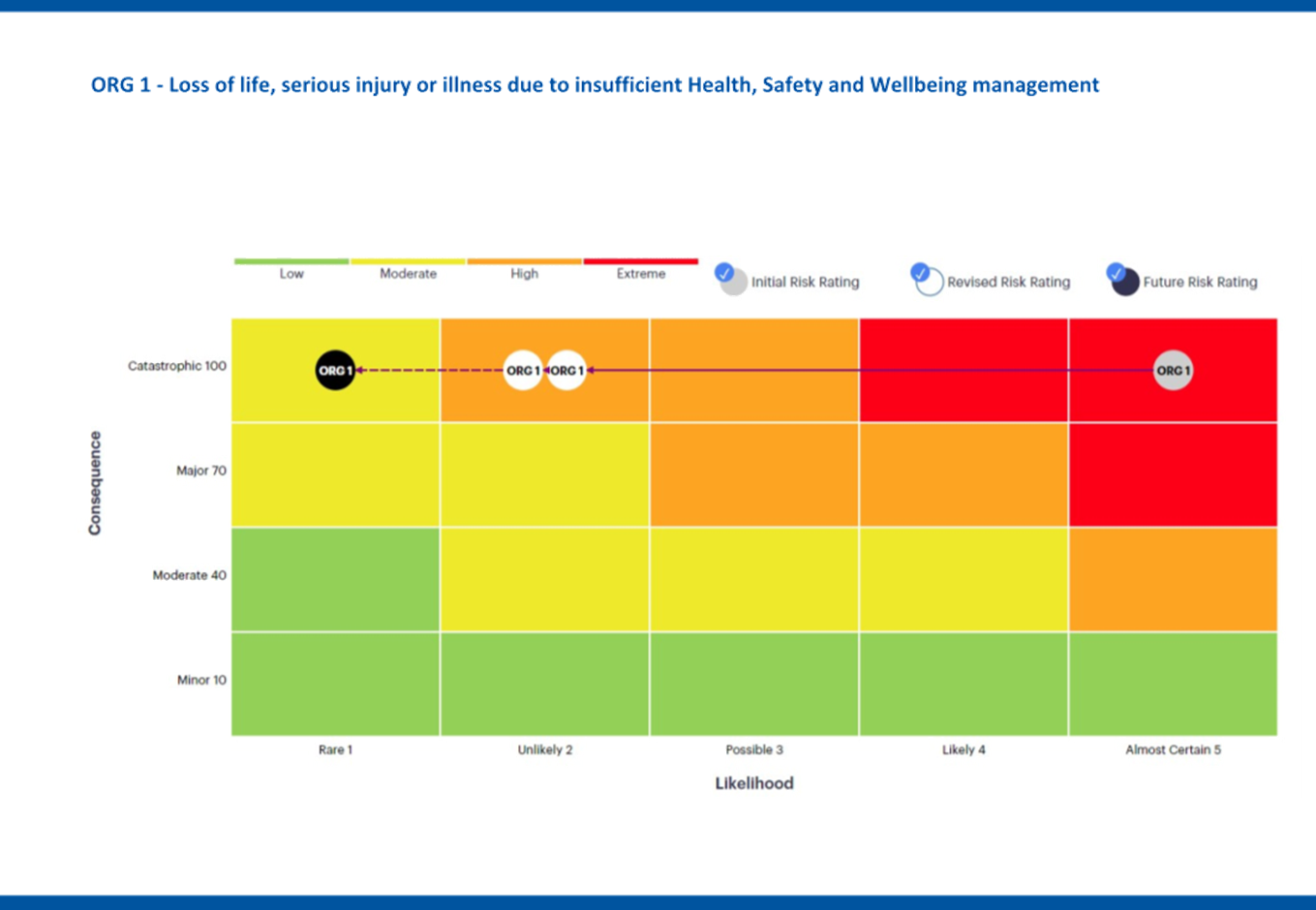
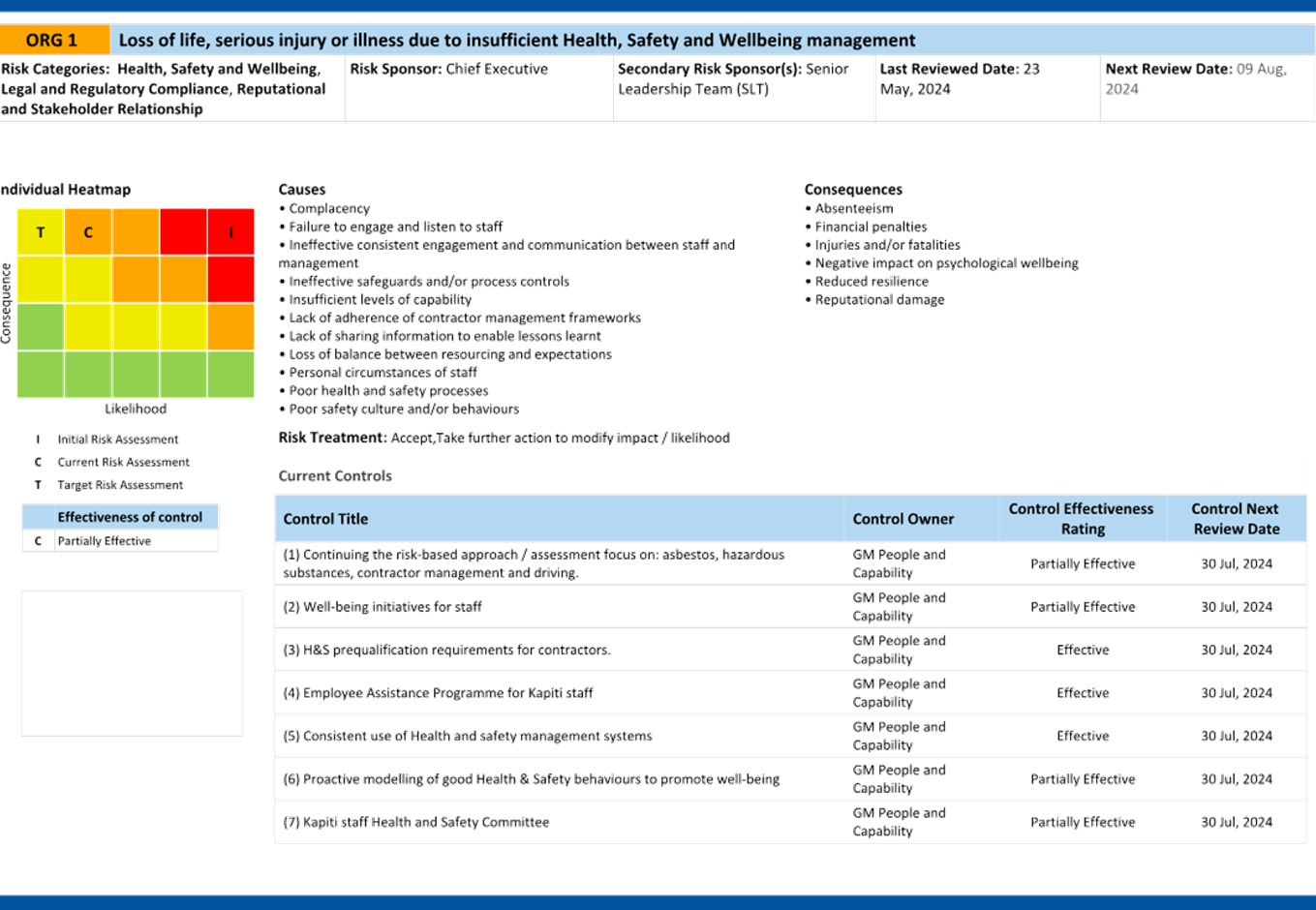
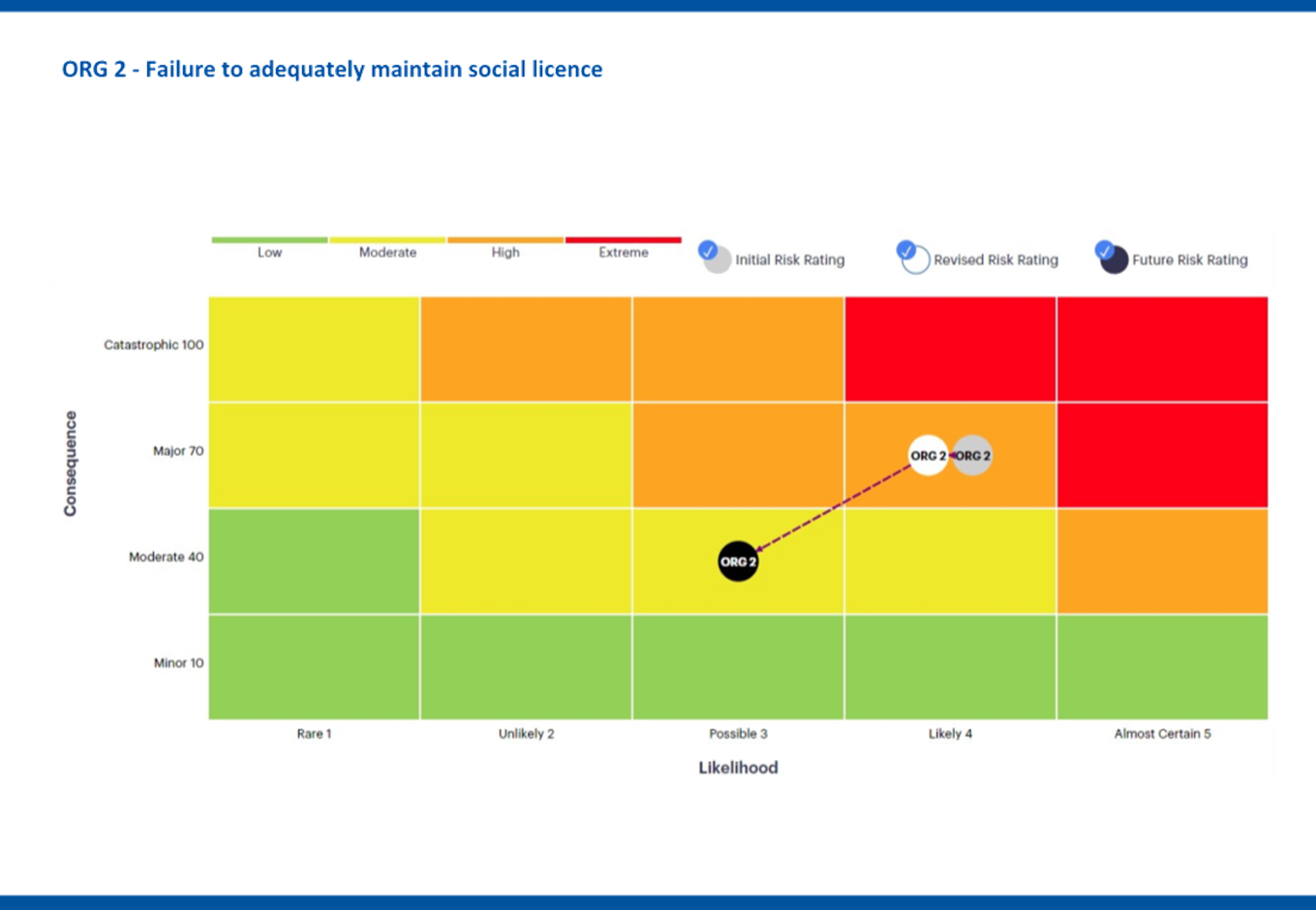
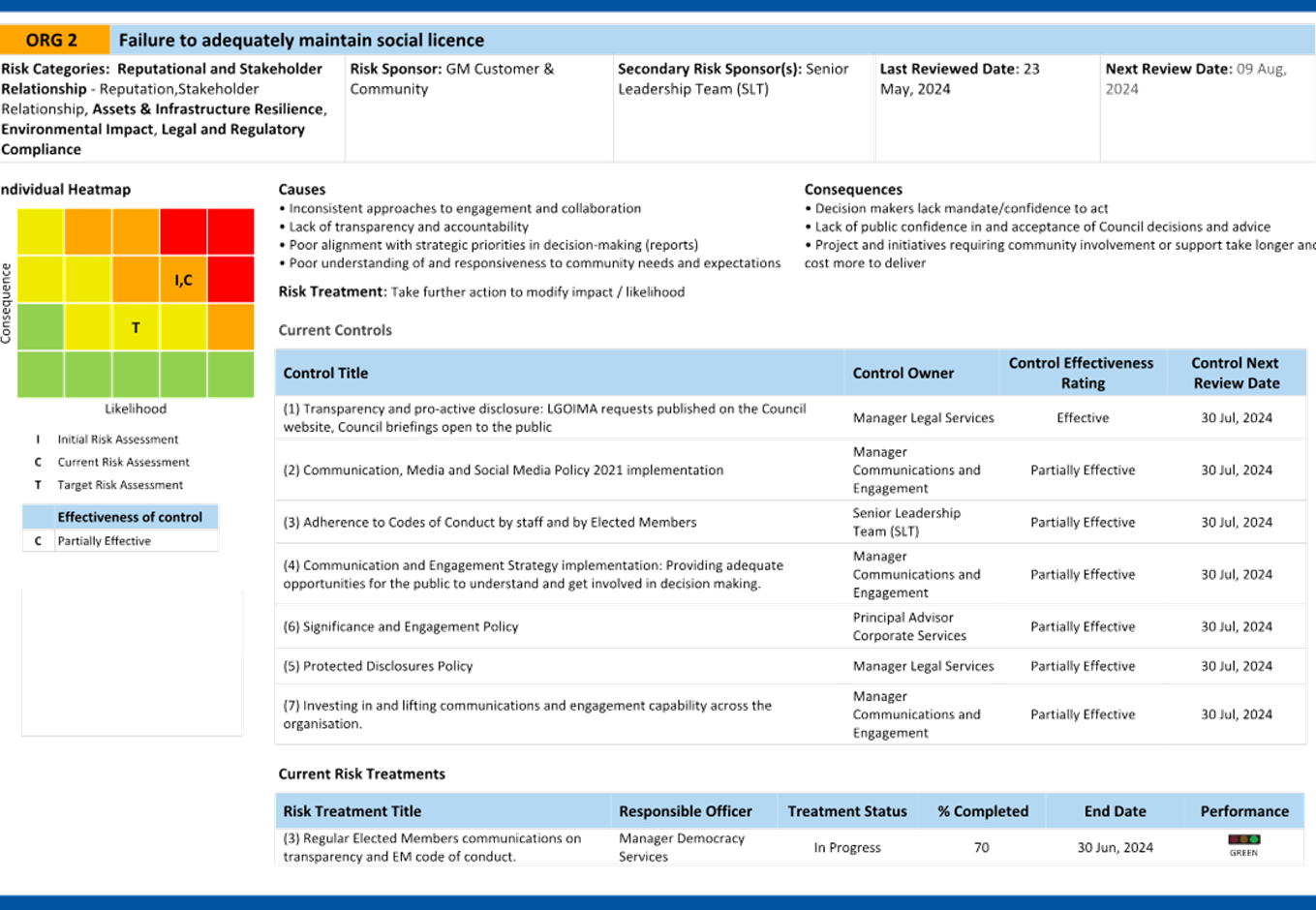
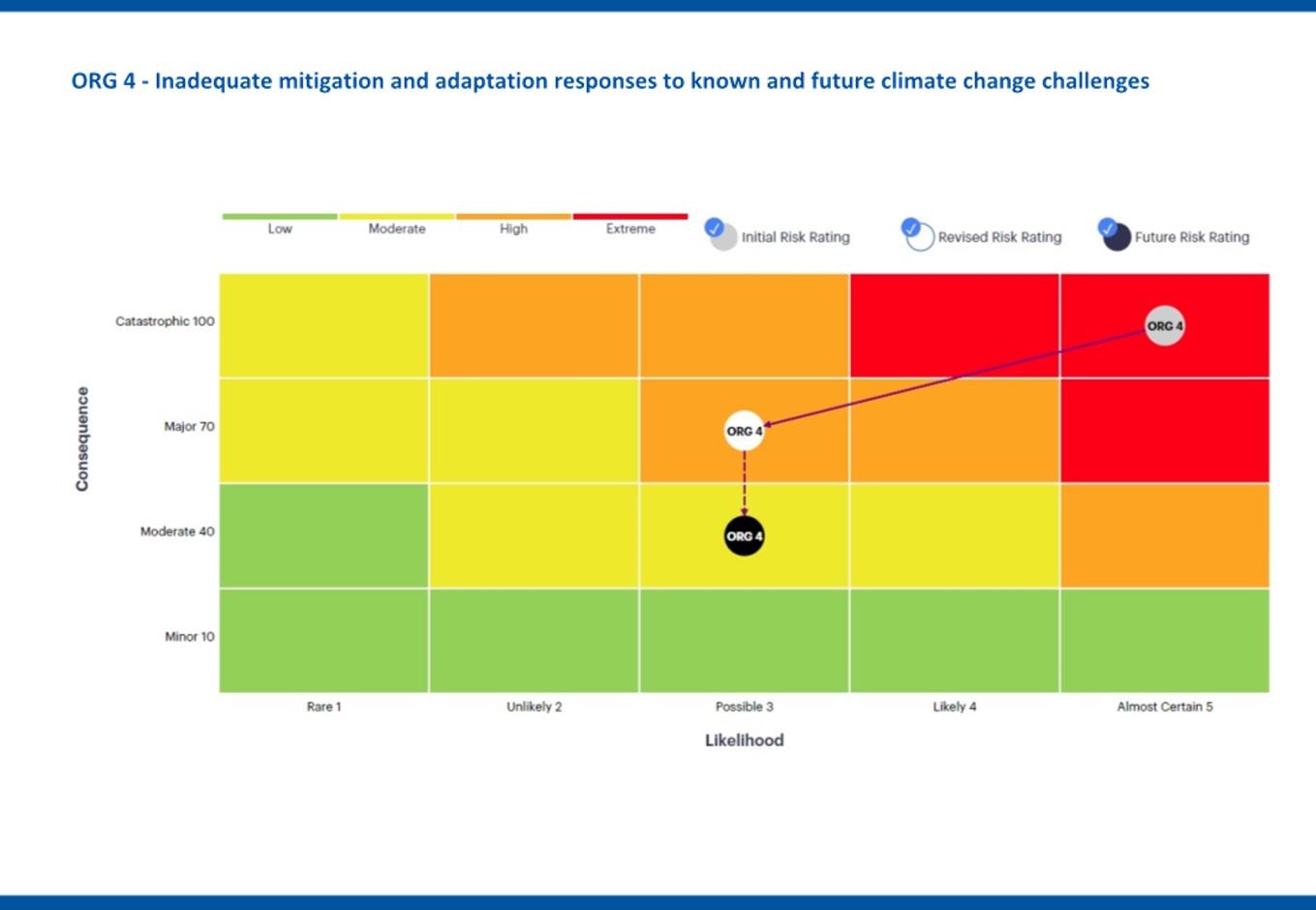
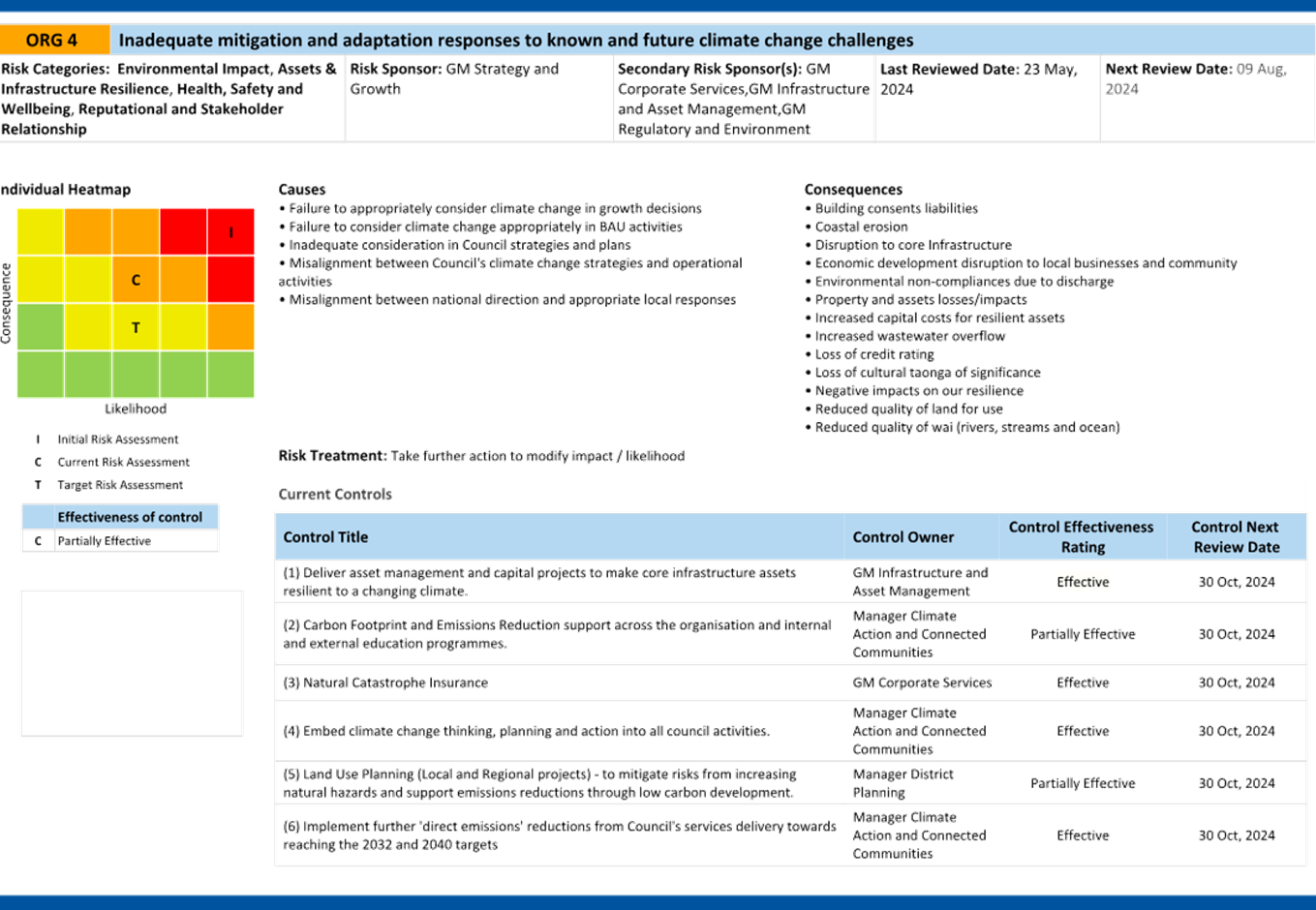
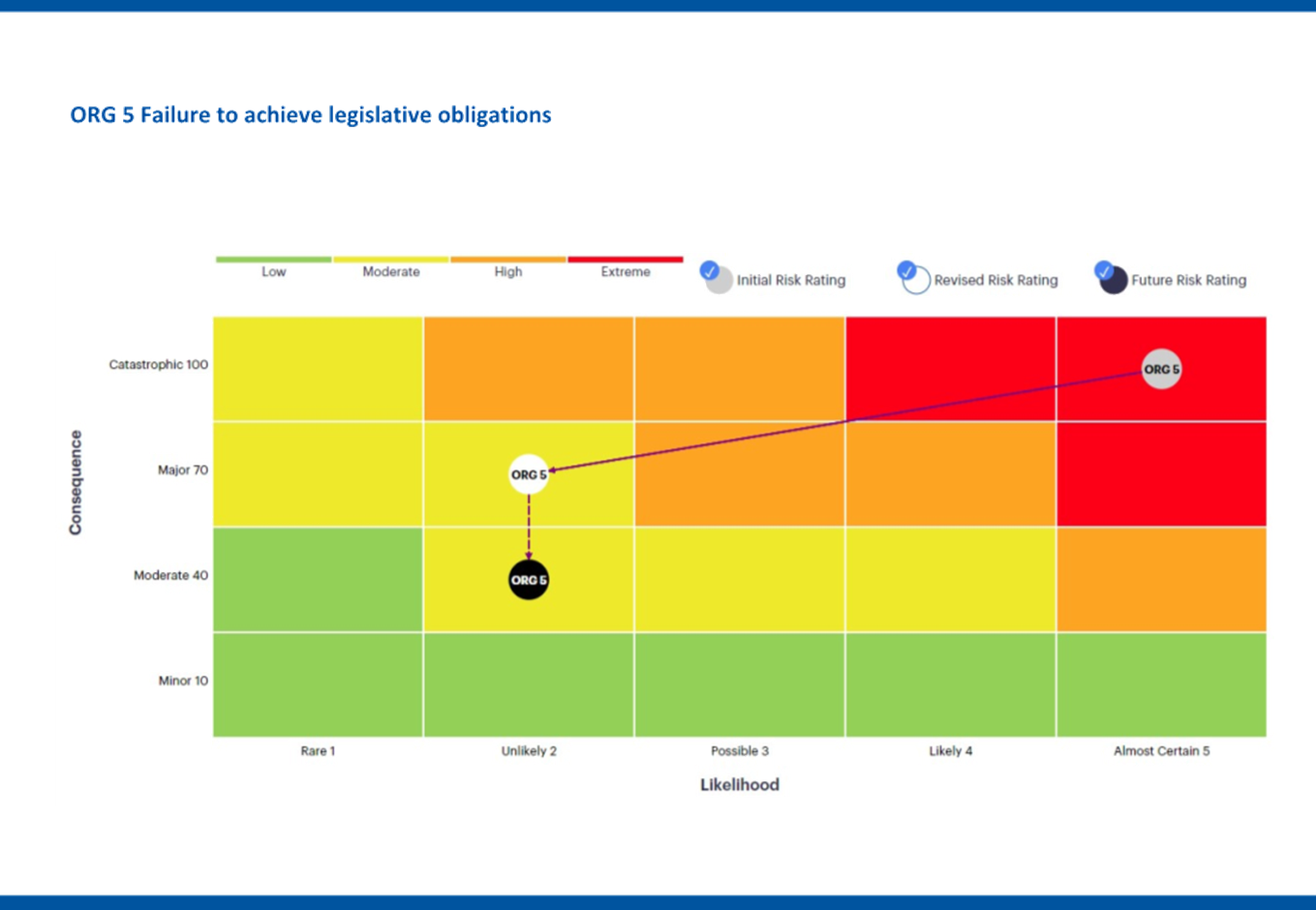
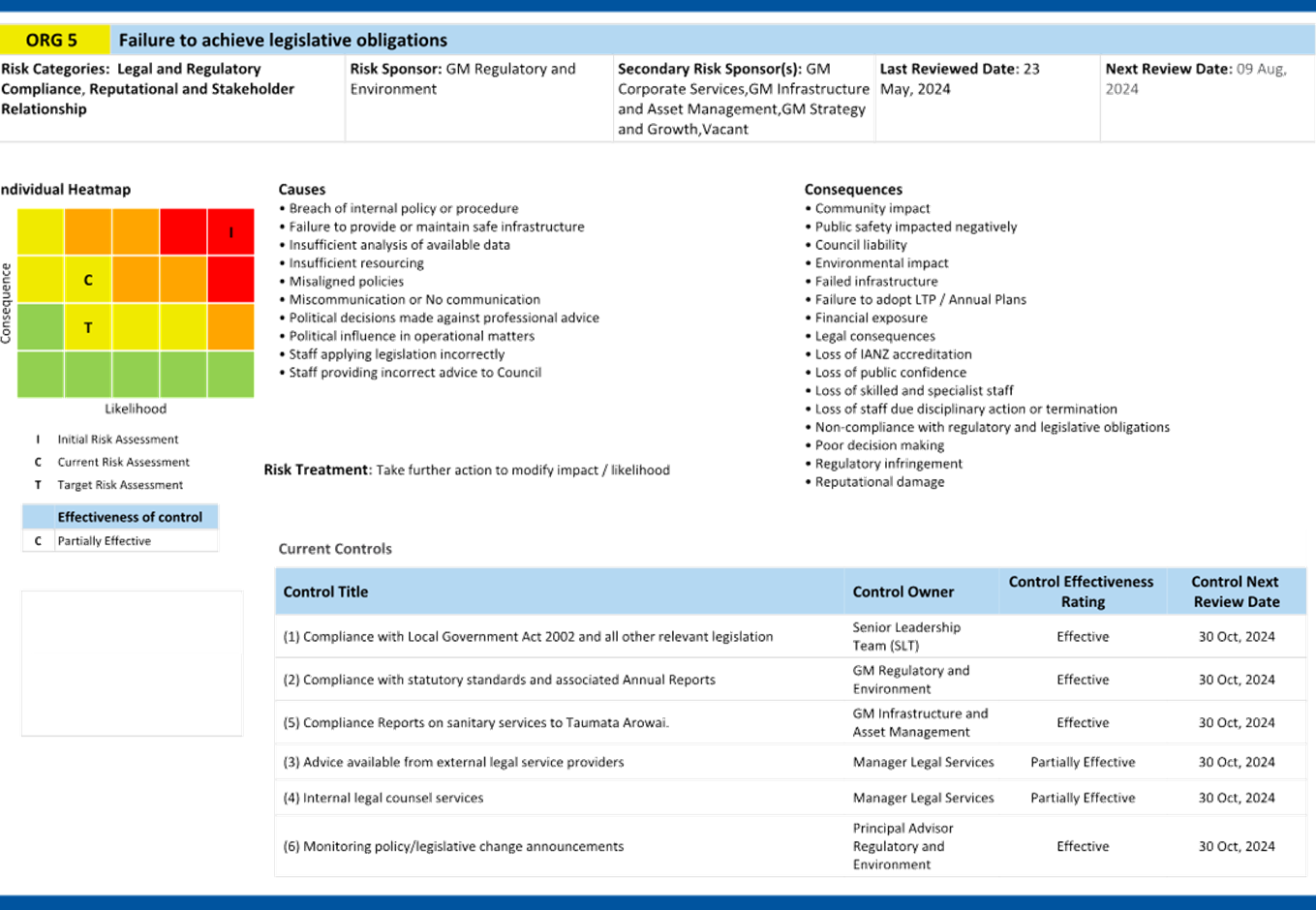
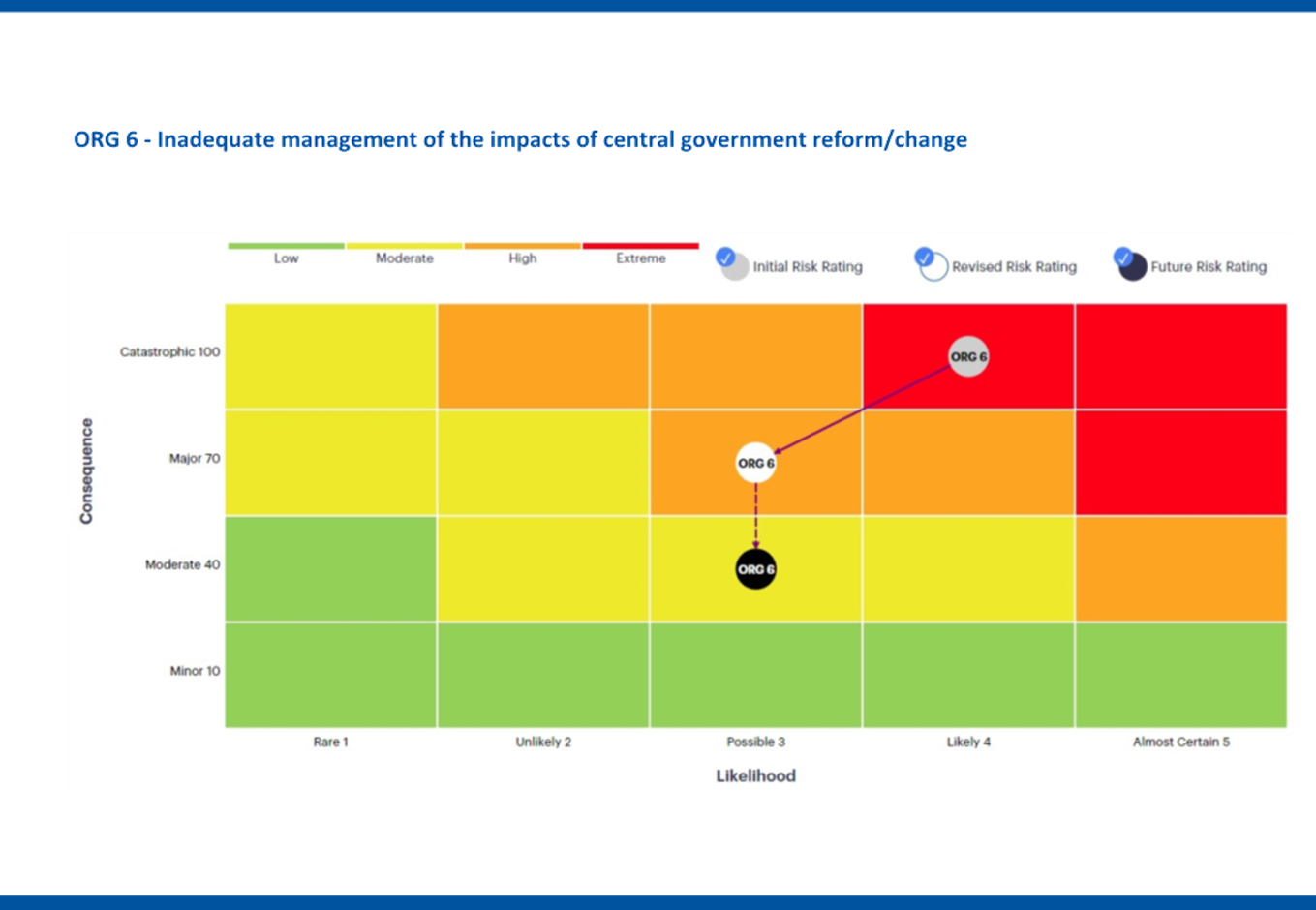
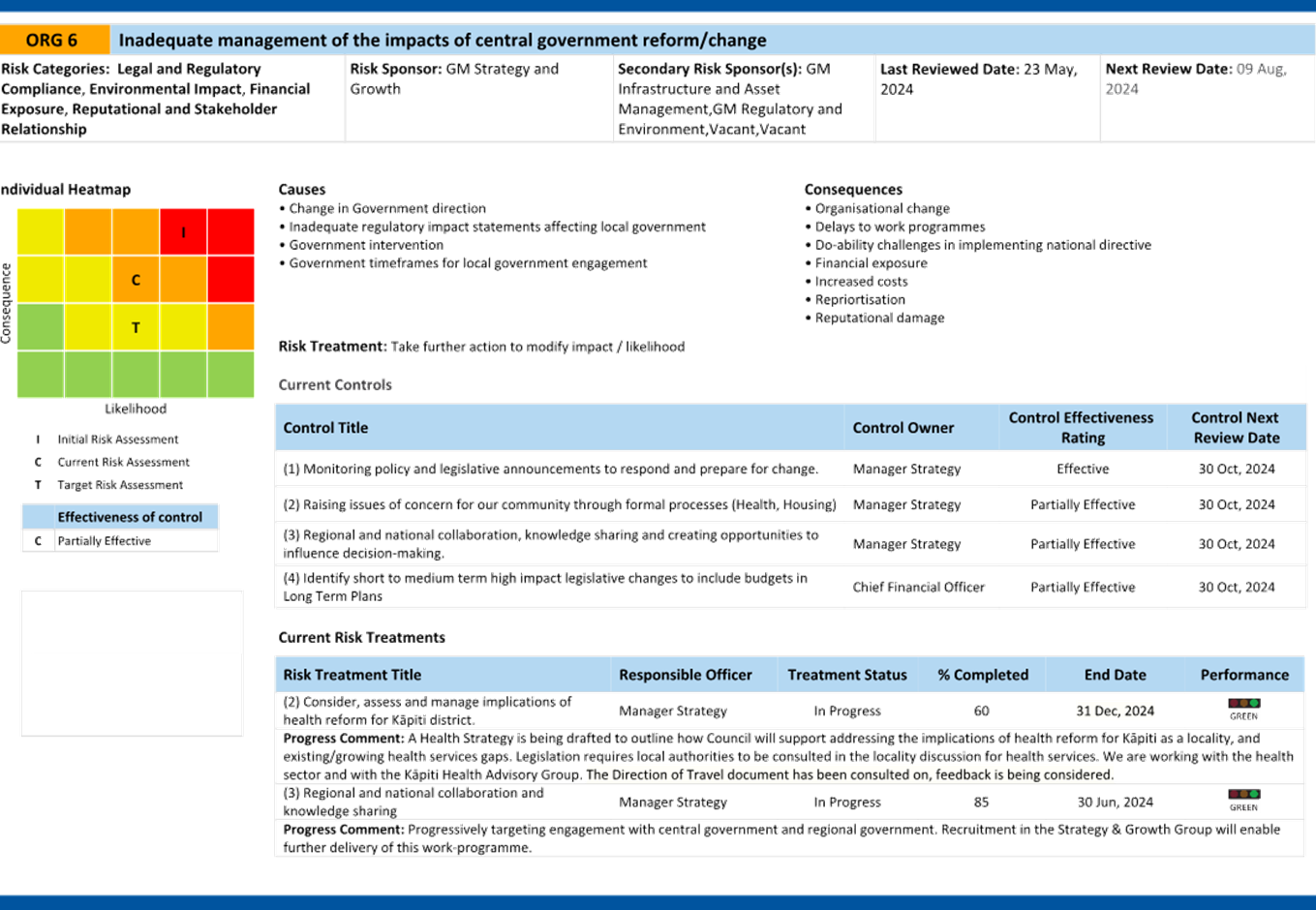
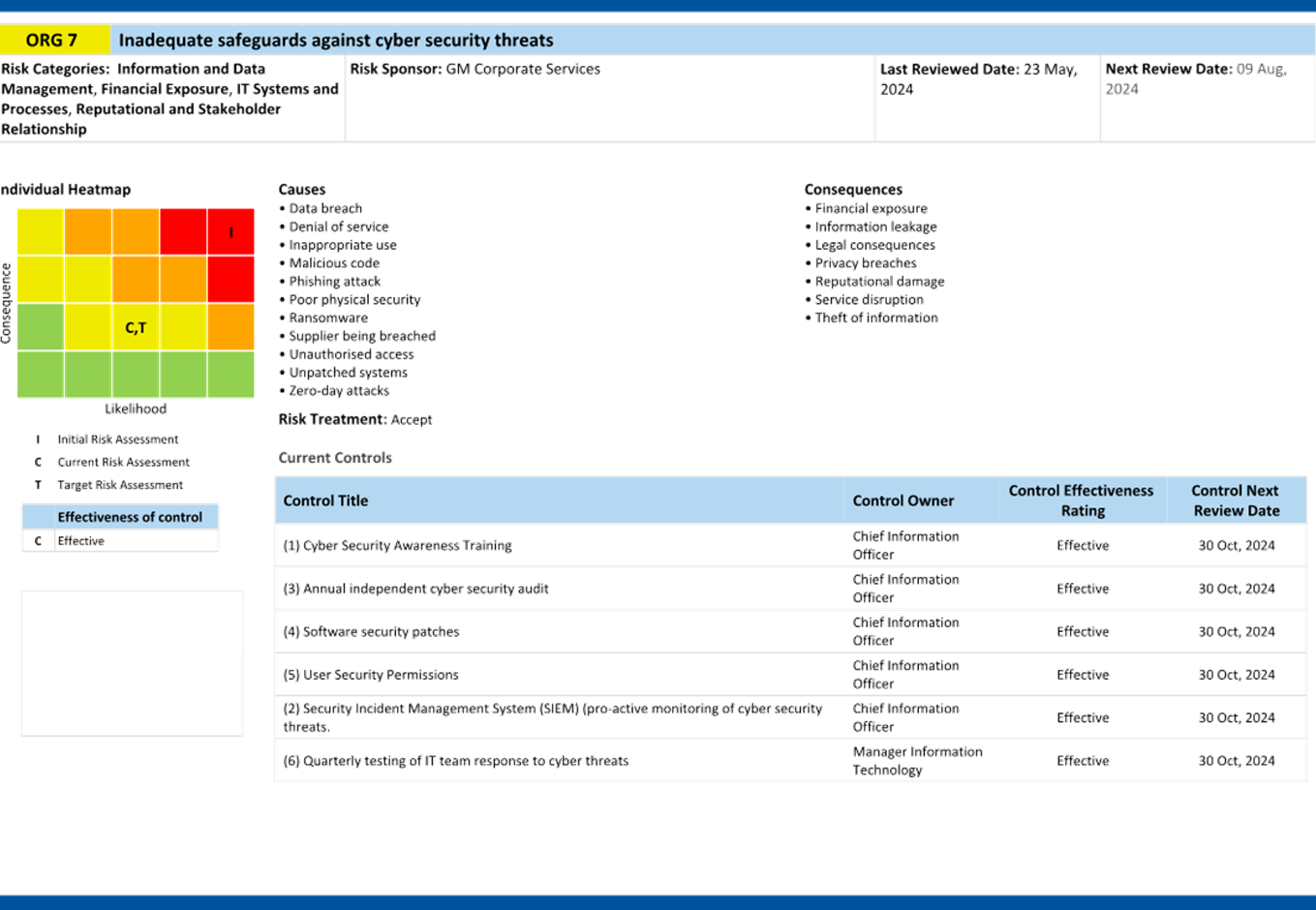
|
I hereby give notice that a Meeting of the Te Komiti Whakamauru Tūraru | Risk and
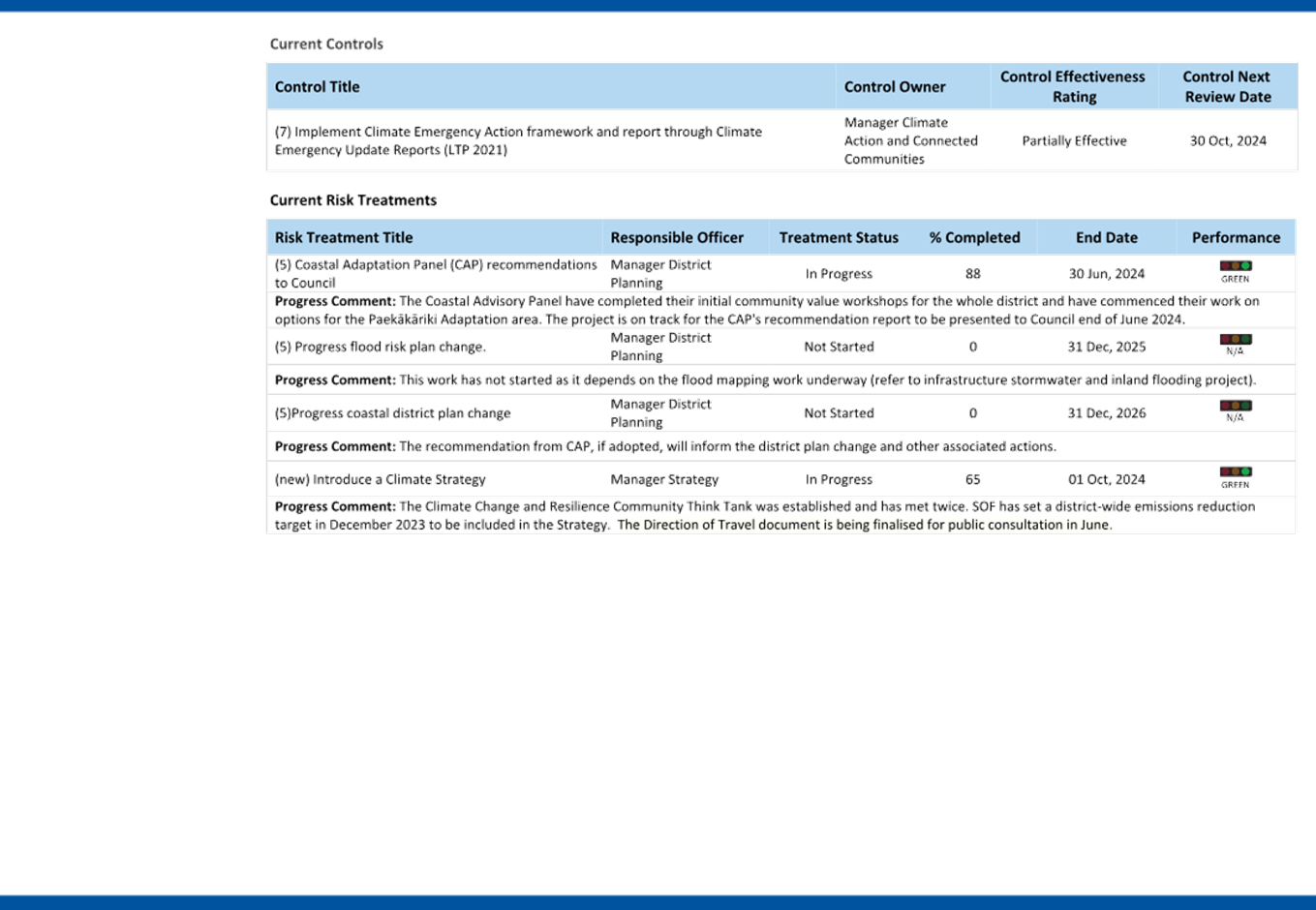
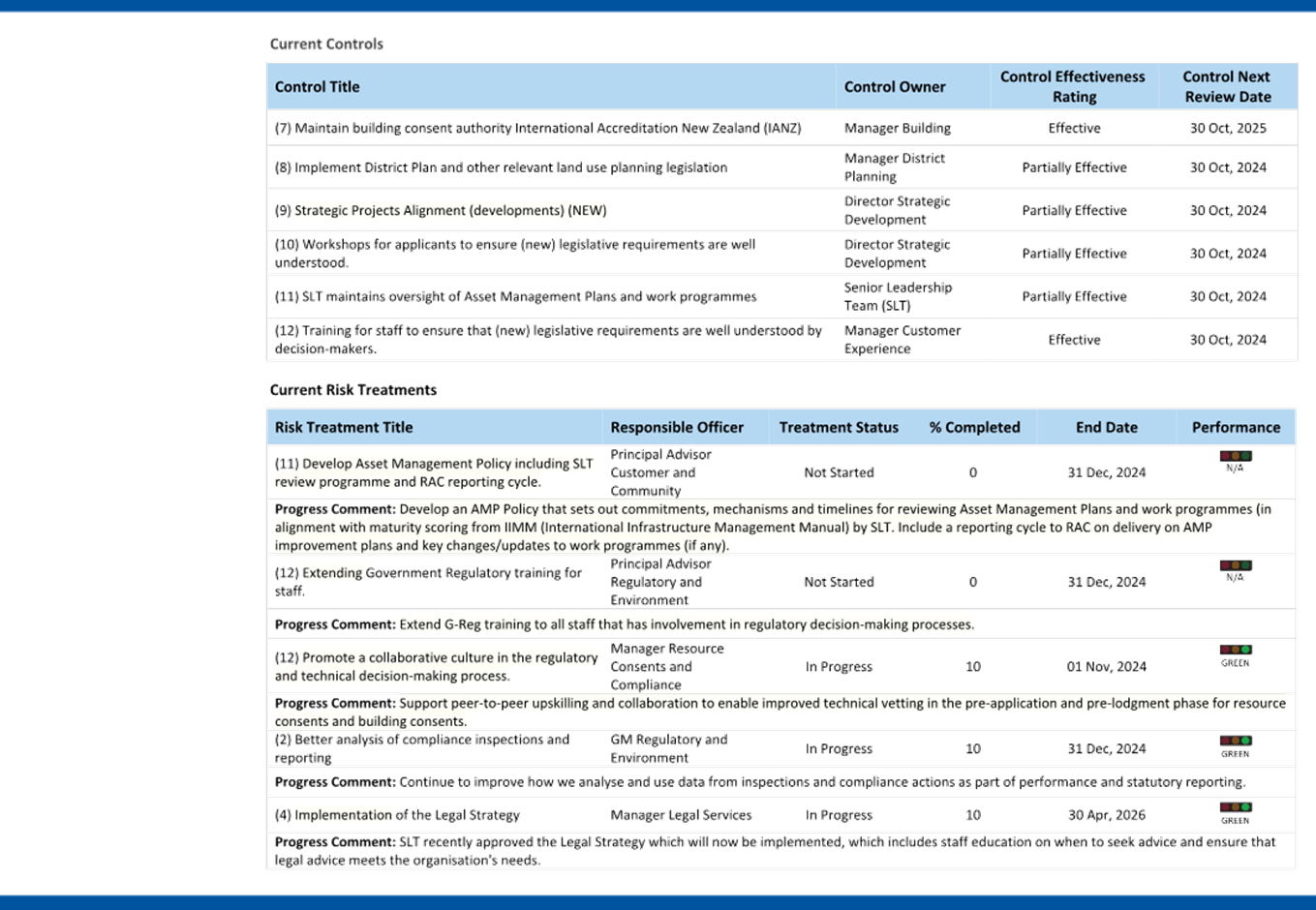
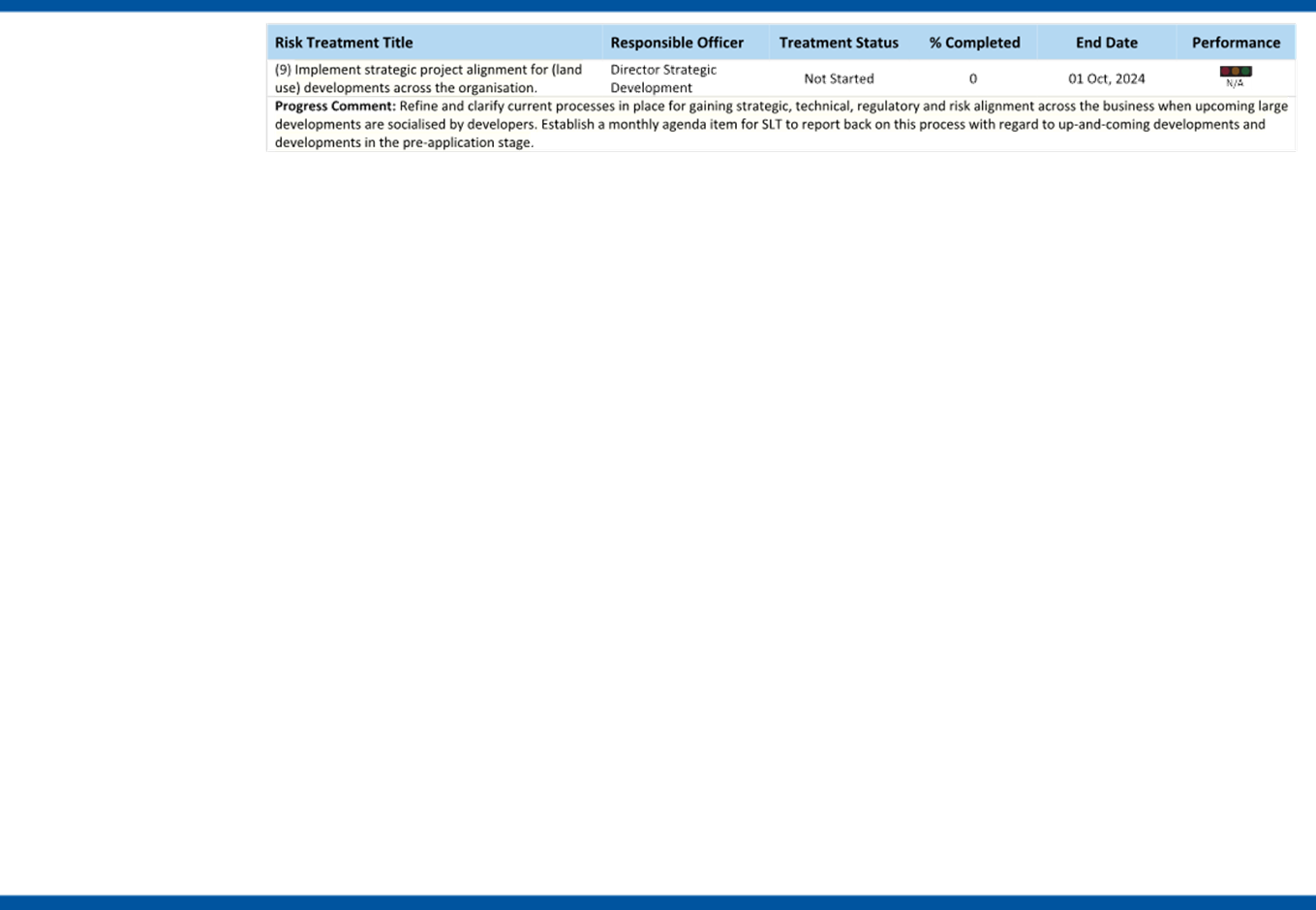
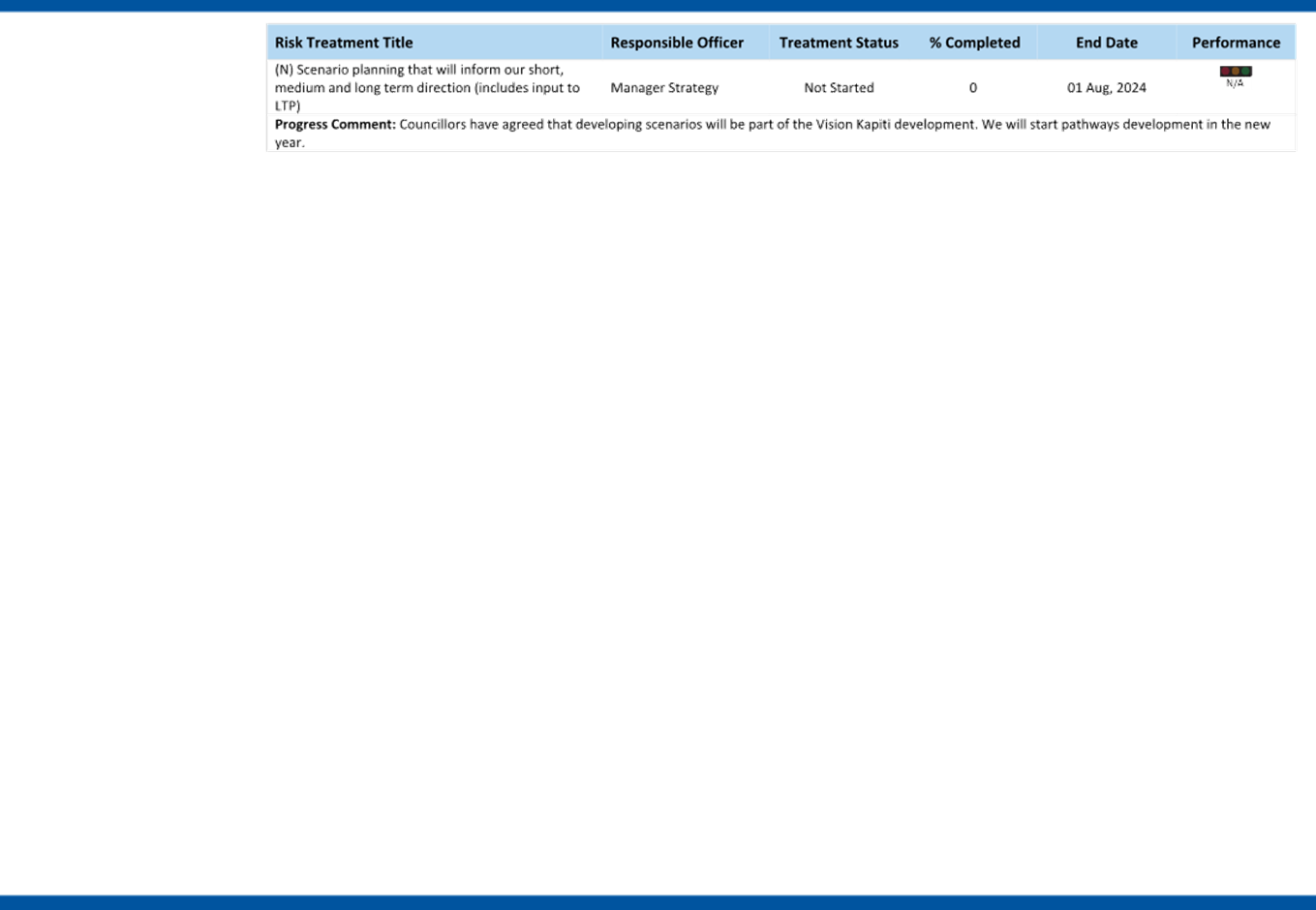
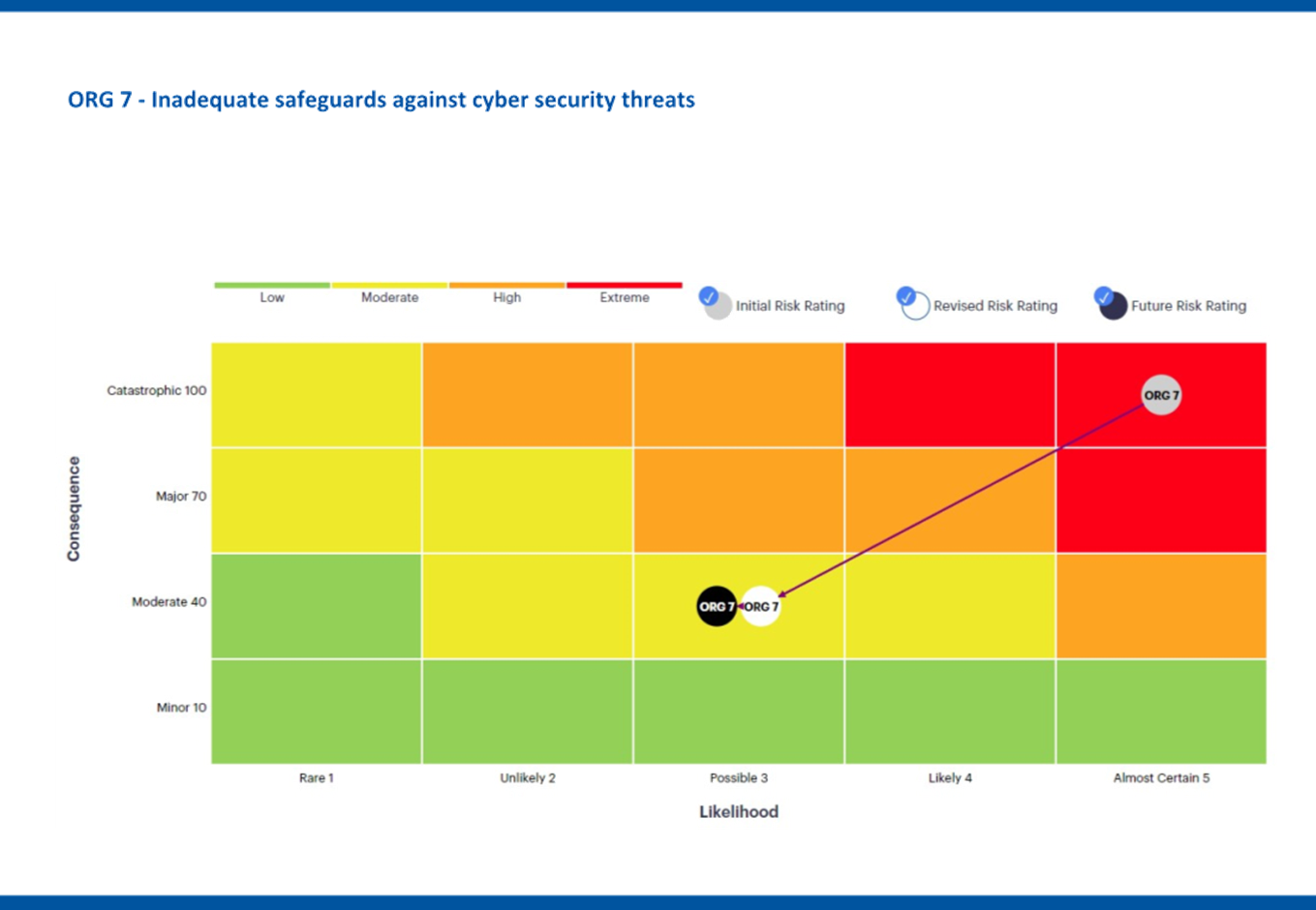
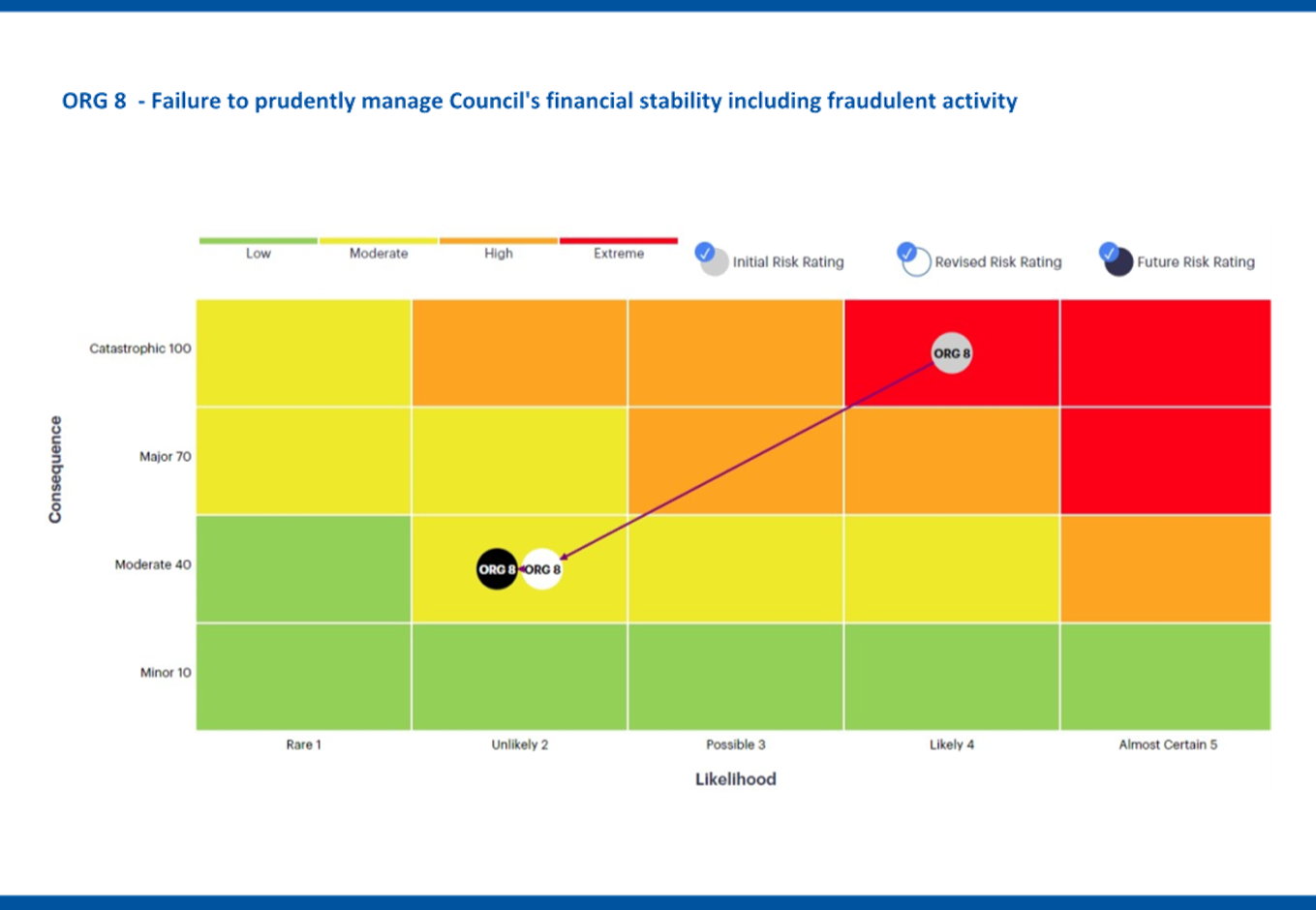
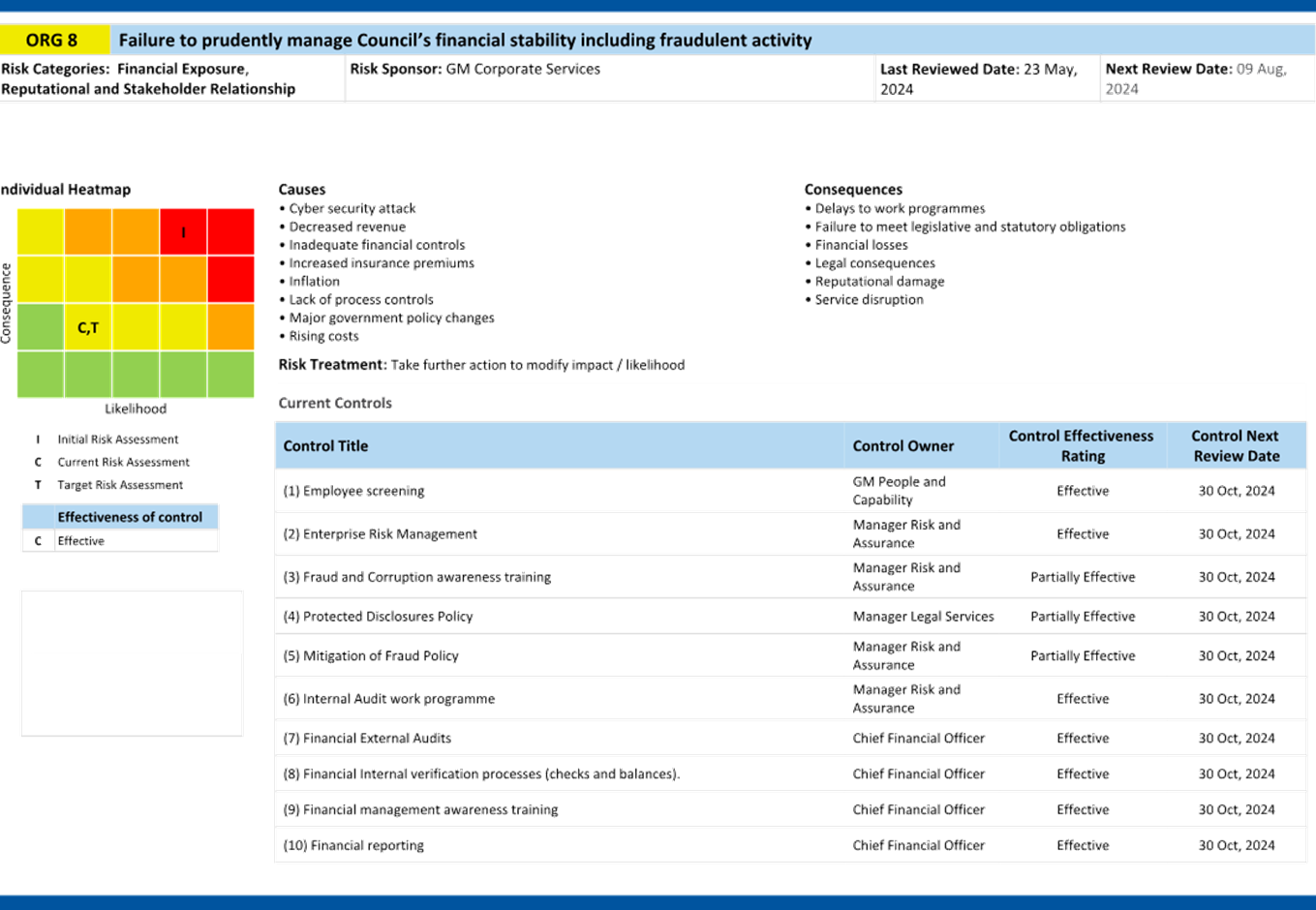
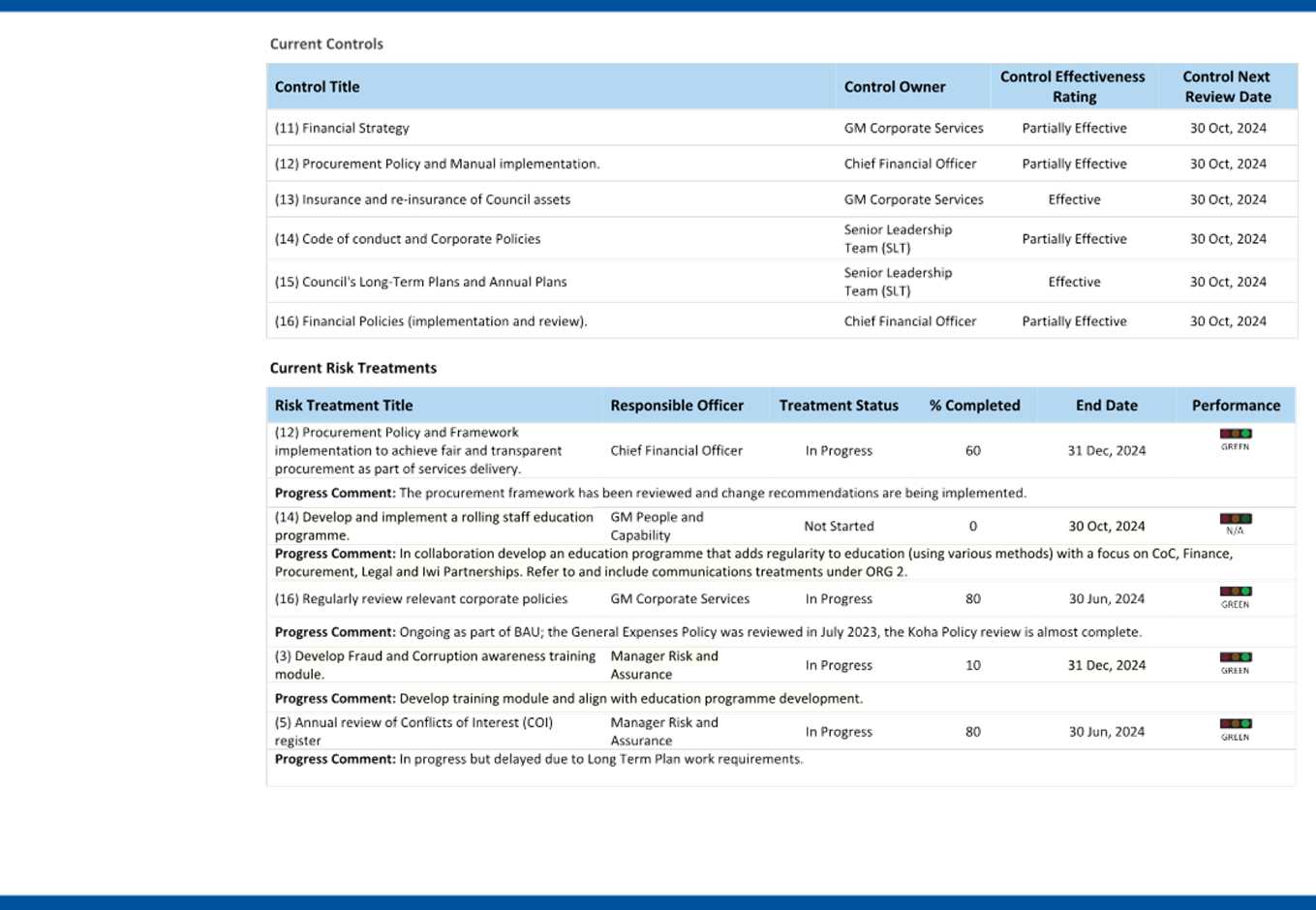
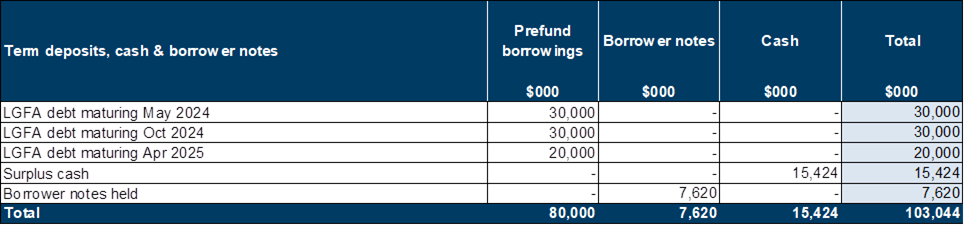
Assurance Committee will be held
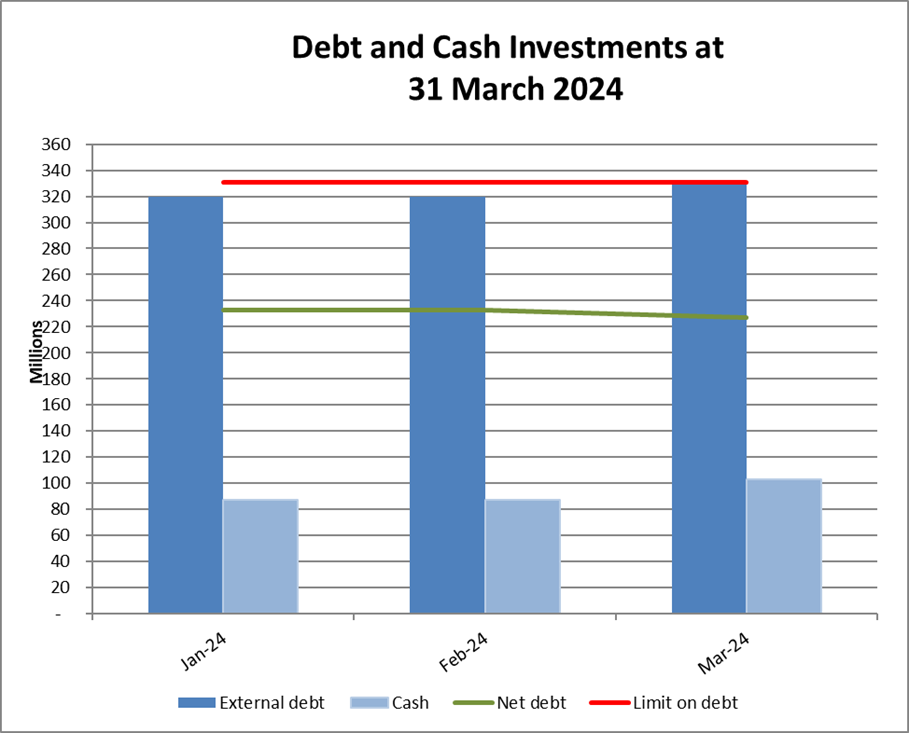
on:
|
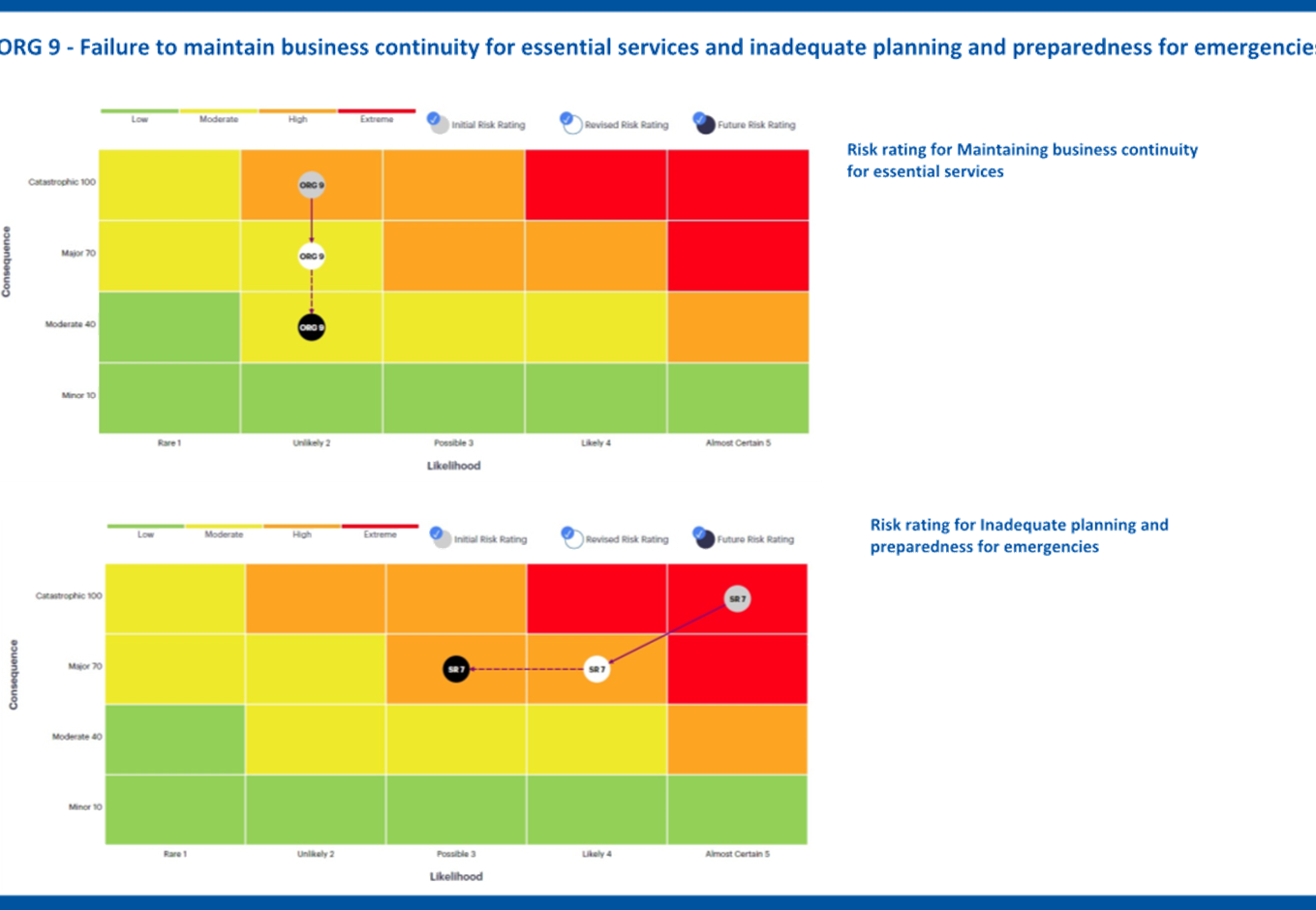
|
Te Rā | Date:
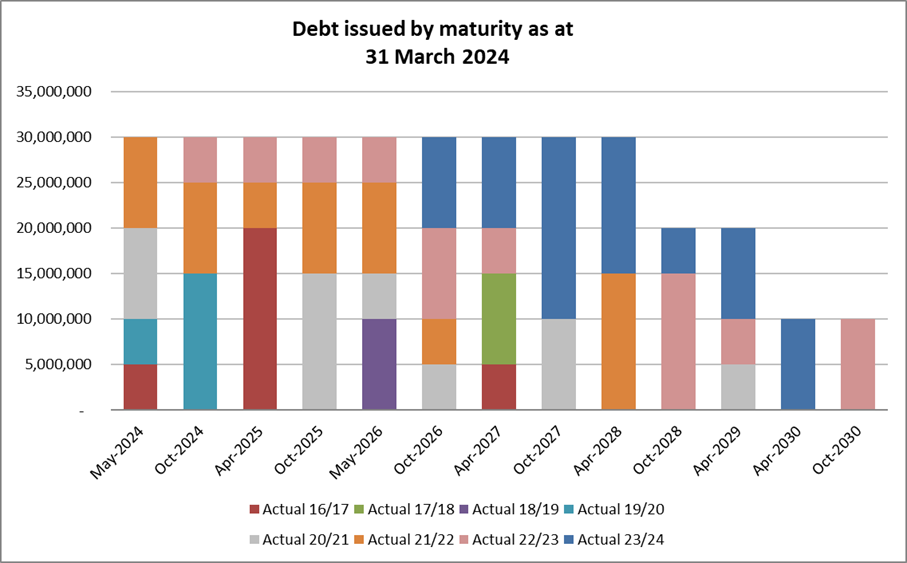
|
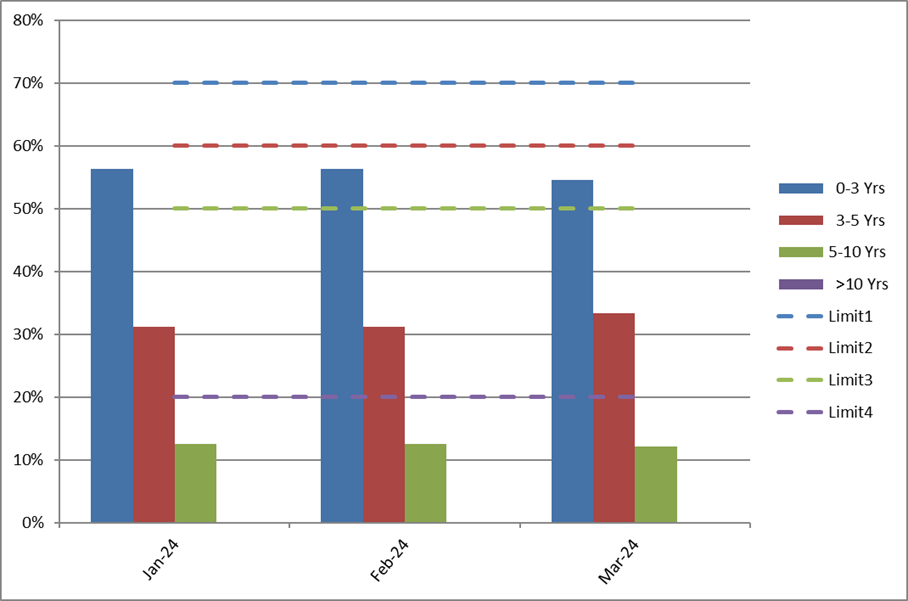
Thursday, 23 May 2024
|
|
Te Wā | Time:
|
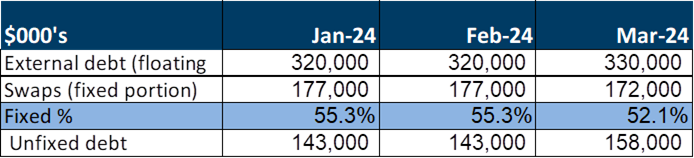
9.30am
|
|
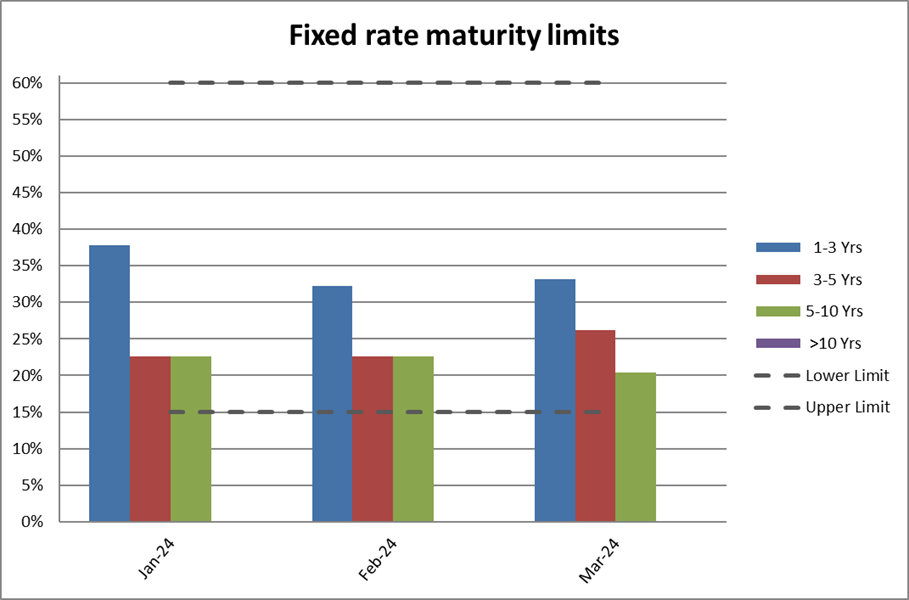
Te Wāhi | Location:
|
Council
Chamber
Ground
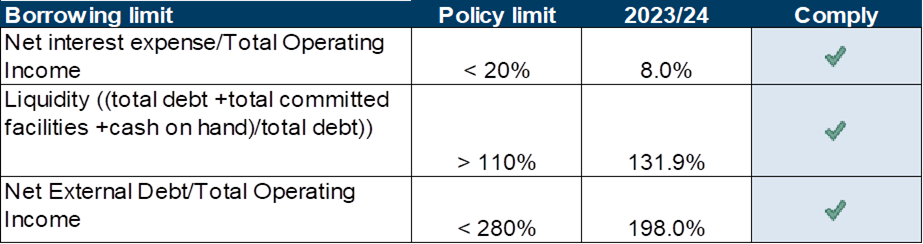
Floor, 175 Rimu Road
Paraparaumu
|
|
Mark de Haast
Group Manager Corporate Services
|
|
Risk and Assurance Committee Meeting Agenda
|
23 May 2024
|
Kāpiti Coast District Council
Notice is hereby given
that a meeting of the Te Komiti
Whakamauru Tūraru | Risk and Assurance Committee will be held in the Council Chamber, Ground Floor, 175 Rimu Road,
Paraparaumu, on Thursday 23 May 2024, 9.30am.
Te Komiti Whakamauru
Tūraru | Risk and Assurance Committee Members
|
Mr
David Shand
|
Chair
|
|
Mayor
Janet Holborow
|
Member
|
|
Lawrence
Kirby
|
Member
|
|
Cr
Liz Koh
|
Member
|
|
Cr
Jocelyn Prvanov
|
Member
|
|
Cr
Glen Cooper
|
Member
|
|
Mr
David Cochrane
|
Member
|
|
Risk and Assurance Committee Meeting Agenda
|
23 May 2024
|
9 Pūrongo
| Reports
9.1 Ernst
& Young Audit Plan for the Year ended 30 June 2024
Kaituhi |
Author: Michael
Parrish, Manager, Financial Accounting
Kaiwhakamana
| Authoriser: Mark de Haast, Group Manager Corporate Services
Te pūtake | Purpose
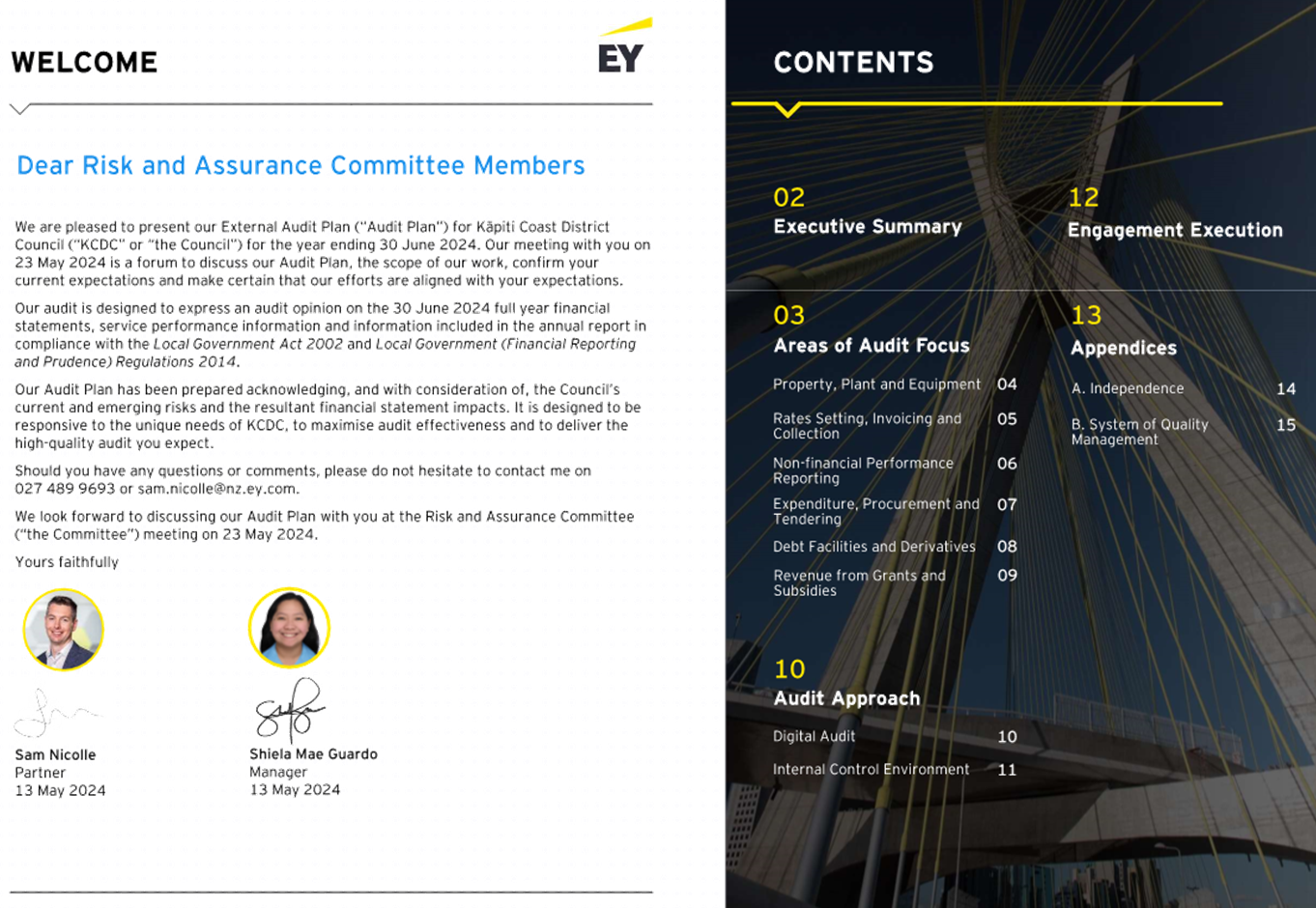
1 This
report provides the Risk and Assurance Committee with Ernst & Young’s
Audit Plan, on behalf of the Office of the Auditor General (OAG), for the year
ending 30 June 2024.
He whakarāpopoto | Executive summary
2 There
is no requirement for an Executive Summary.
Te tuku haepapa | Delegation
3 The
Risk and Assurance Committee has delegated authority to consider this report
under section C.3 of the Governance Structure and Delegations.
· Obtaining
from external auditors any information relevant to the Council’s
financial statements and assessing whether appropriate
action has been taken by management in response to the above.
Taunakitanga | Recommendations
A. That
the Risk and Assurance Committee receives and notes the Ernst & Young Audit
Plan for the year ended 30 June 2024 attached as Appendix 1 to this
report.
Tūāpapa | Background
4 The
Council’s Auditors, Ernst & Young (Audit), have been engaged to
undertake the audit of the Council’s Annual Report, including the
Council’s Summary Annual Report and compliance with its Debenture Trust
Deed, for the year ended 30 June 2024.
5 The
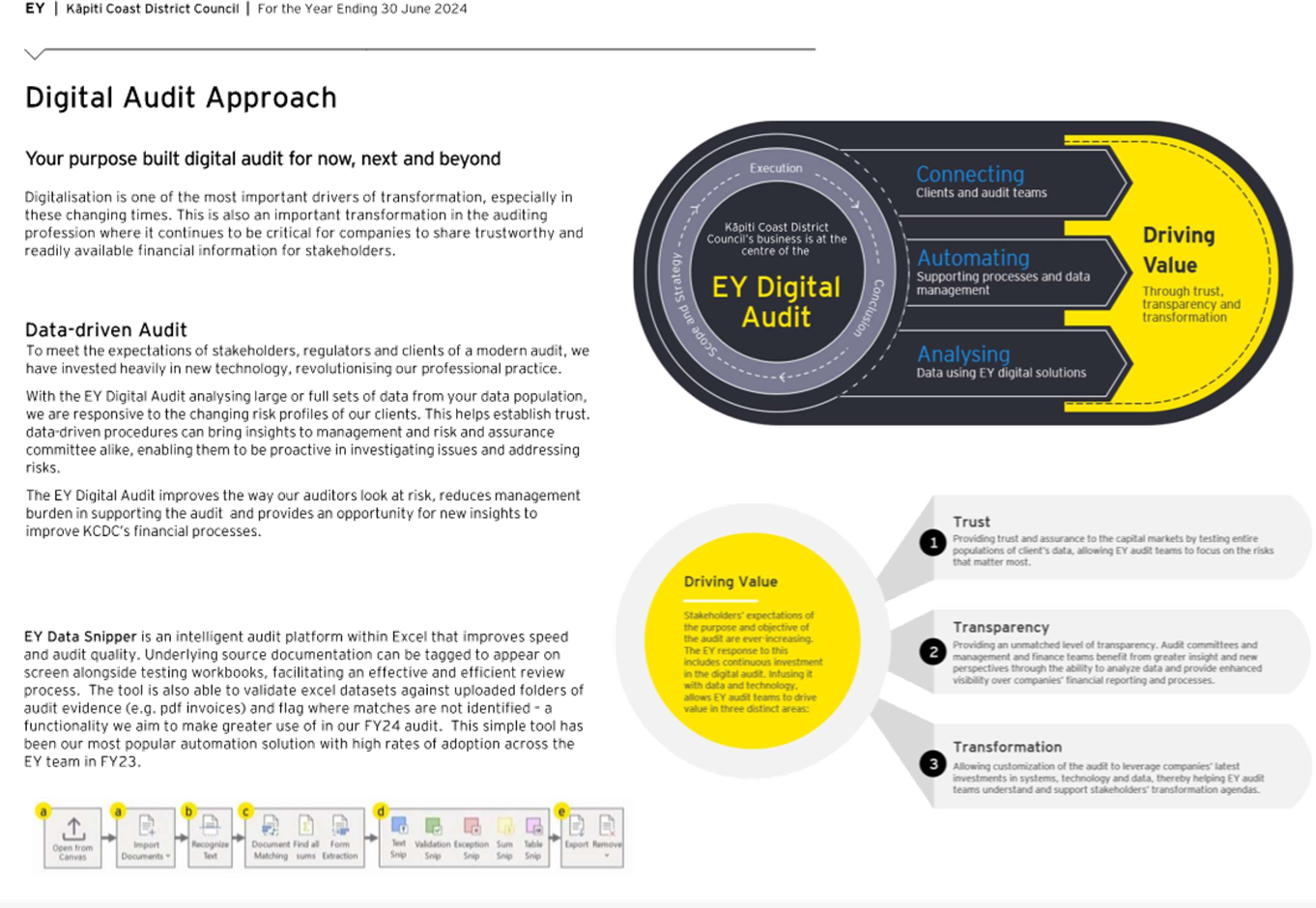
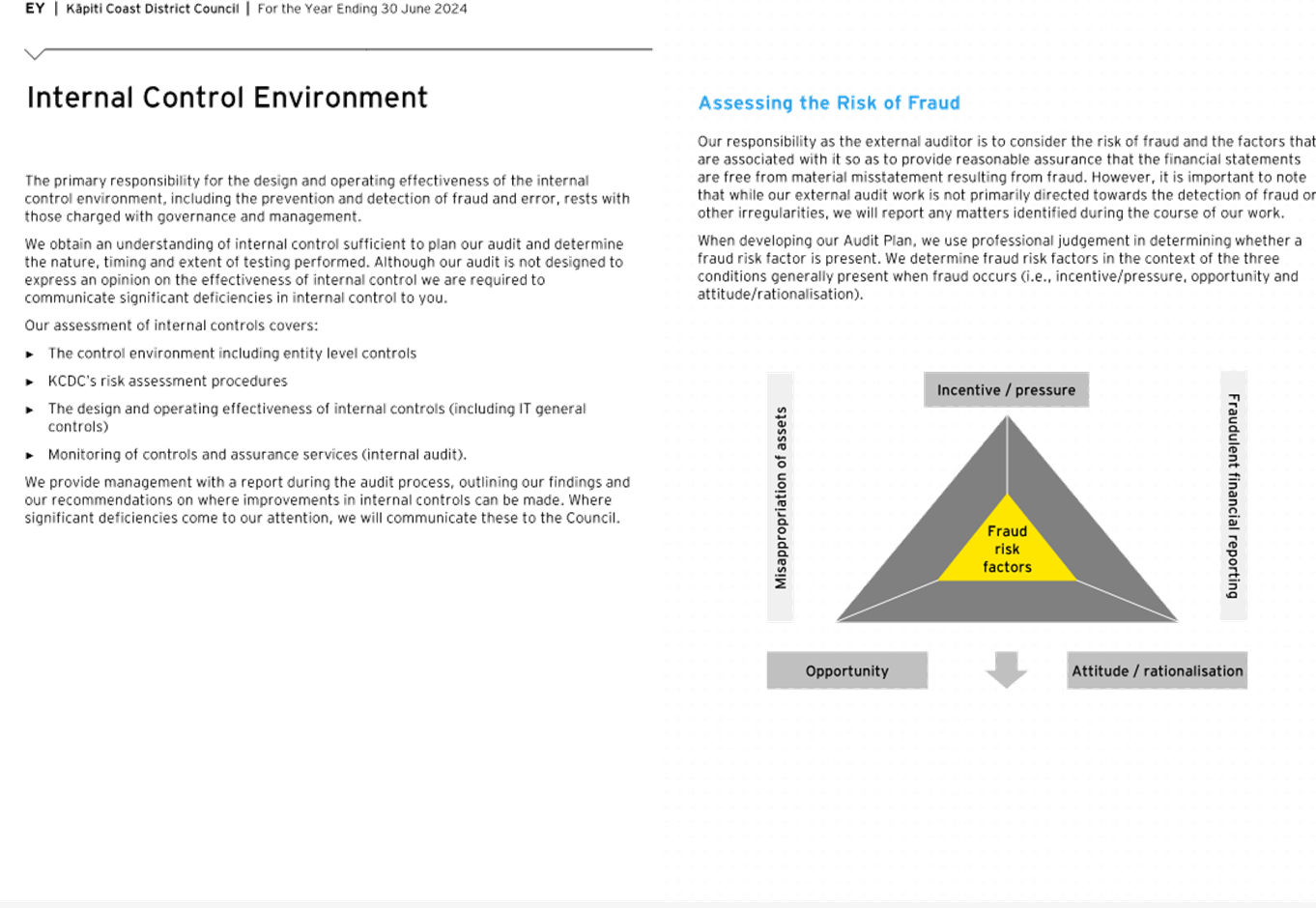
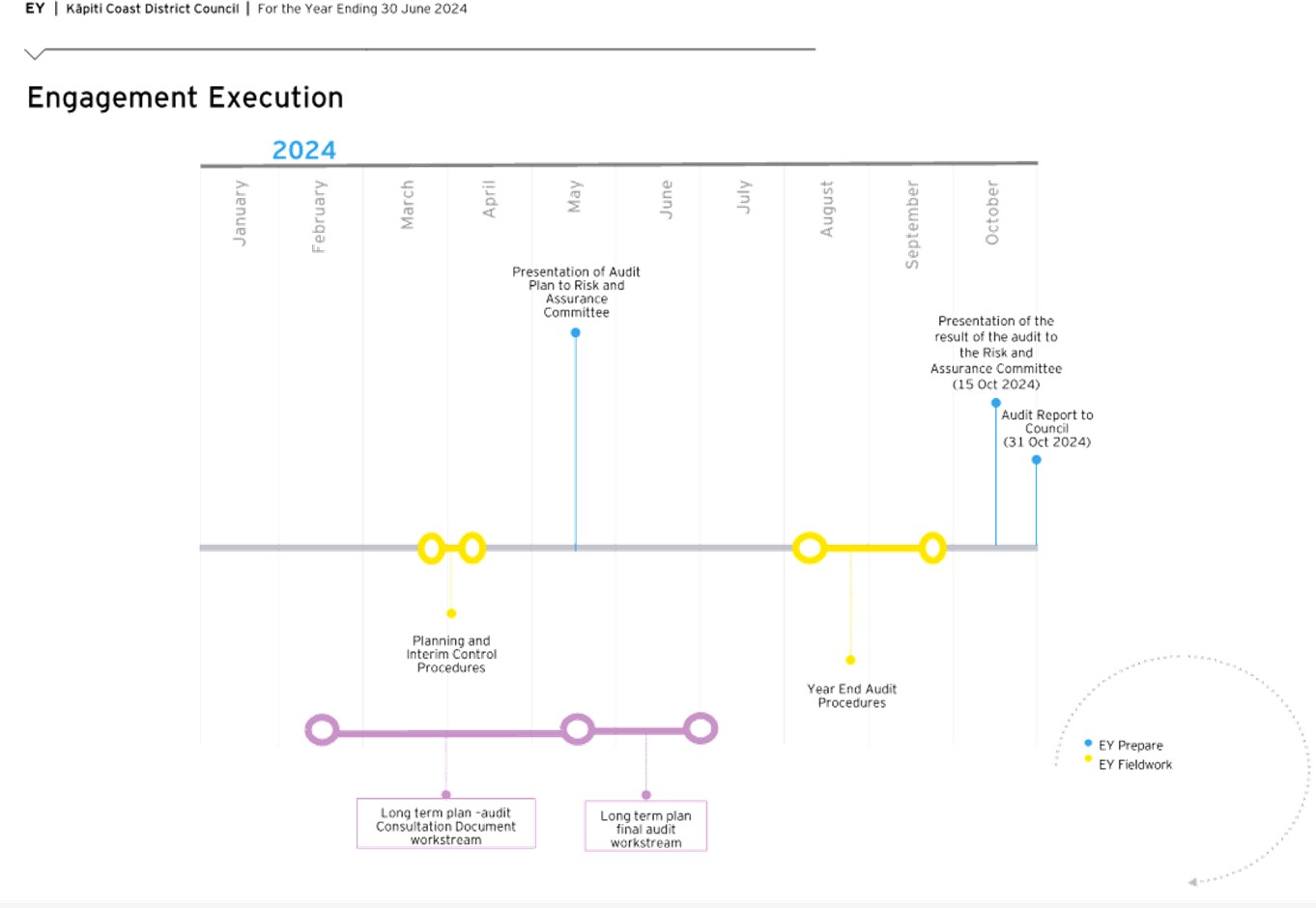
Audit Plan is attached as Appendix 1 to this report. This provides an
overview of audit’s focus areas, their risk assessment and their audit
approach for the year ended 30 June 2024.
He kōrerorero | Discussion
Audit
focus areas and risk assessment
6 The
areas of audit focus are summarised below:
· Property,
Plant and Equipment. (Council will perform a full revaluation of the three
water assets, but will need to ensure assets are held at fair value less
accumulated depreciation)
· Rates
setting and collection
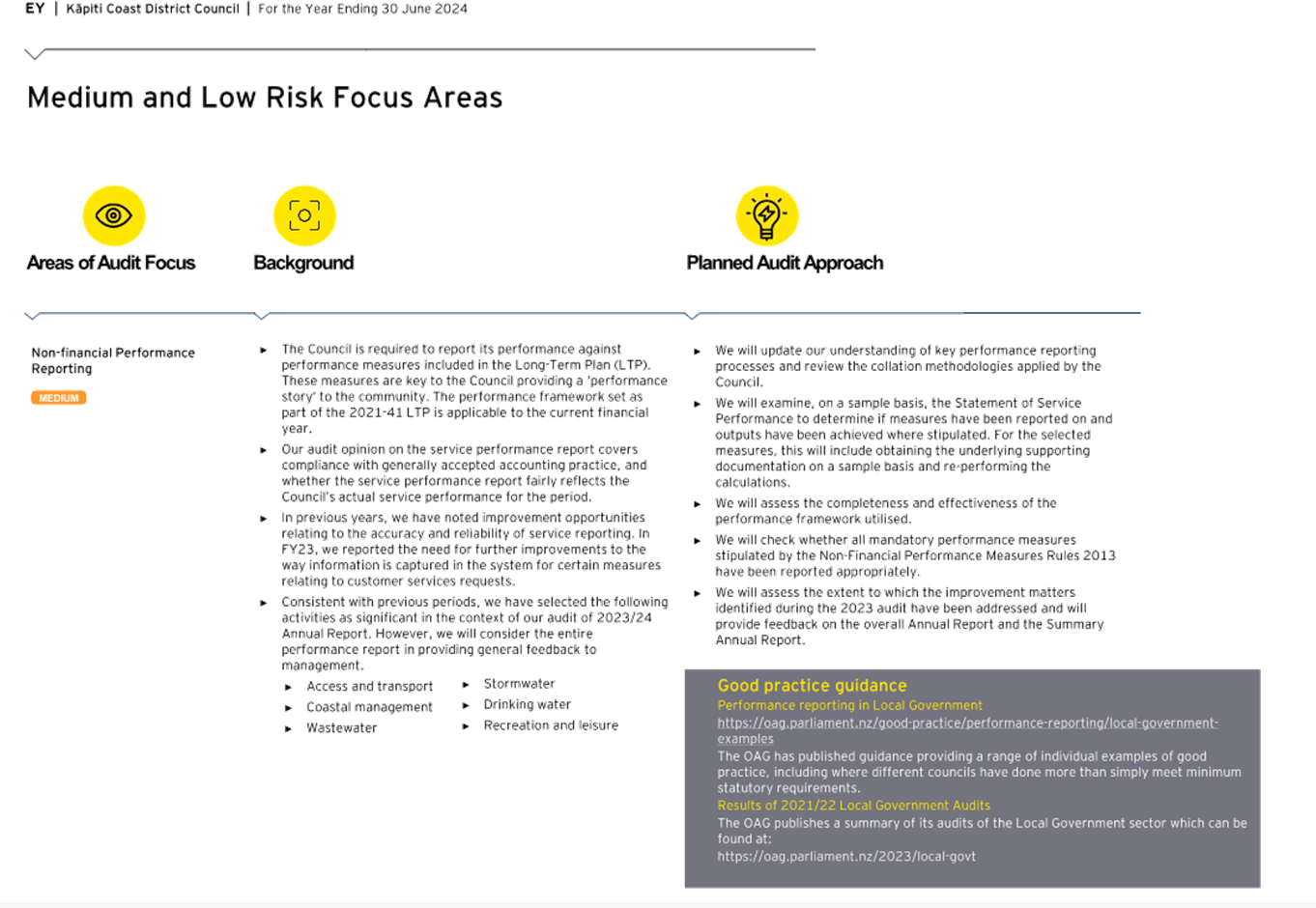
· Statement
of service performance reporting (Non-financial Performance reporting)
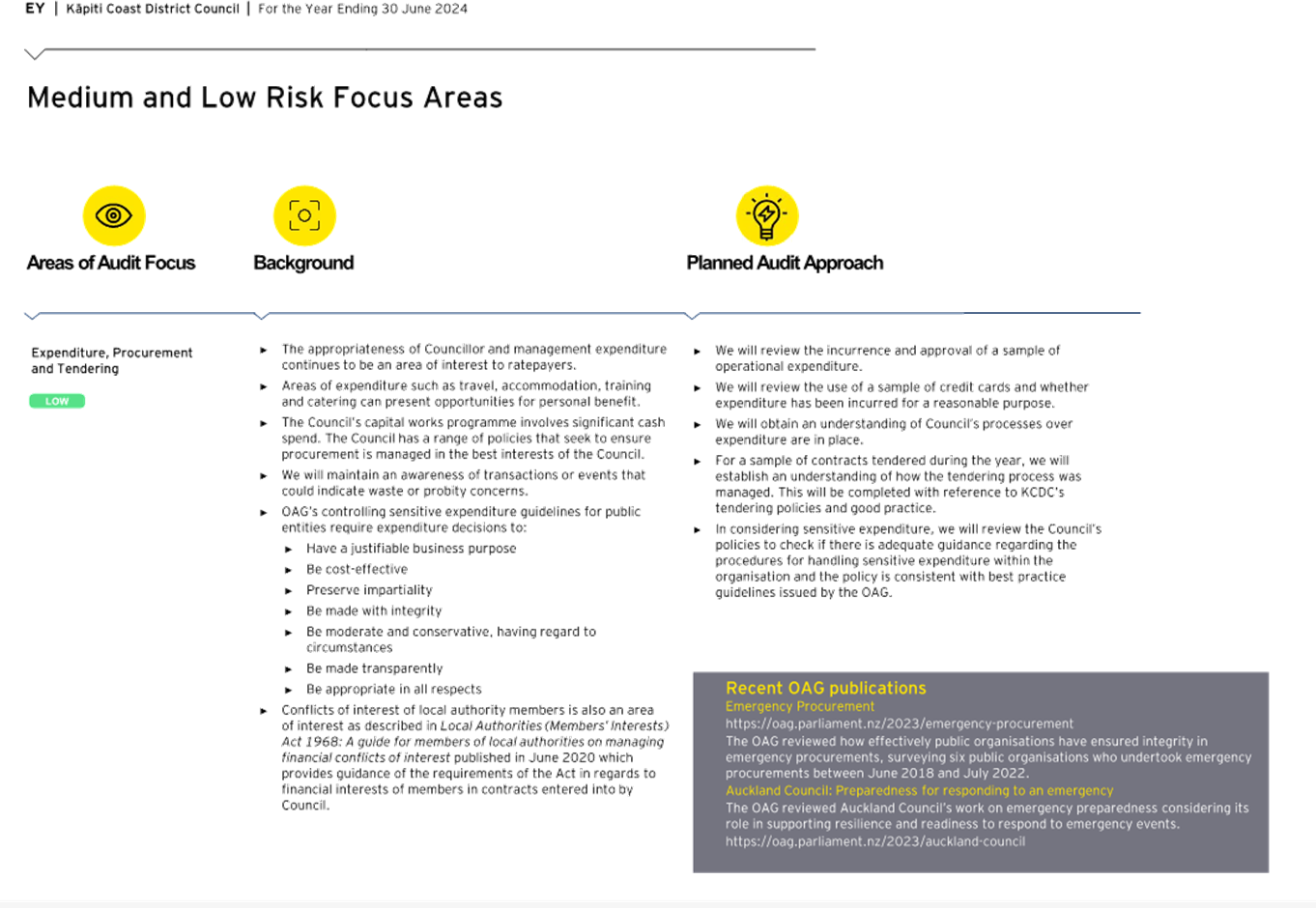
· Expenditure,
Procurement and Tendering
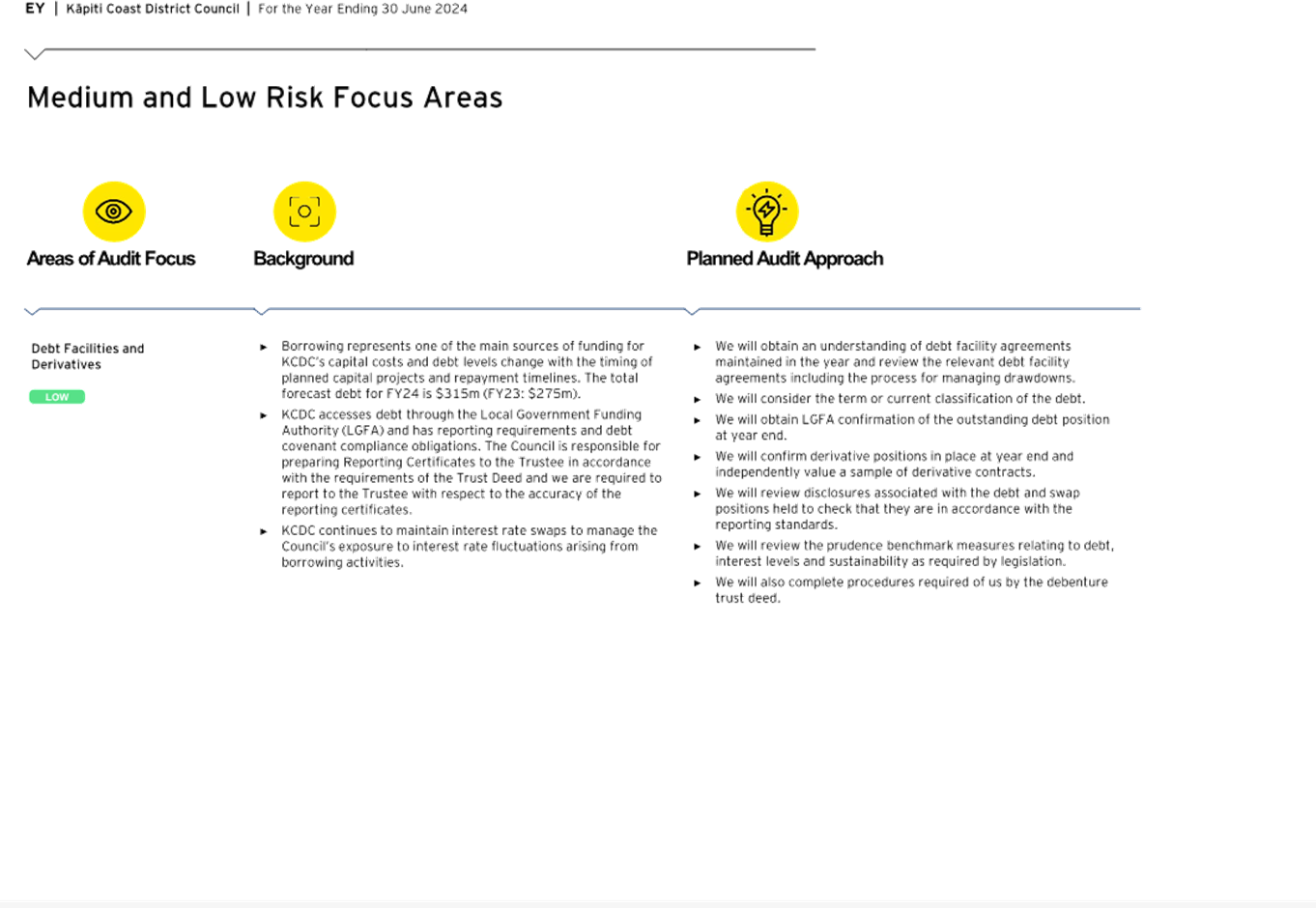
· Debt
Facilities and Derivatives
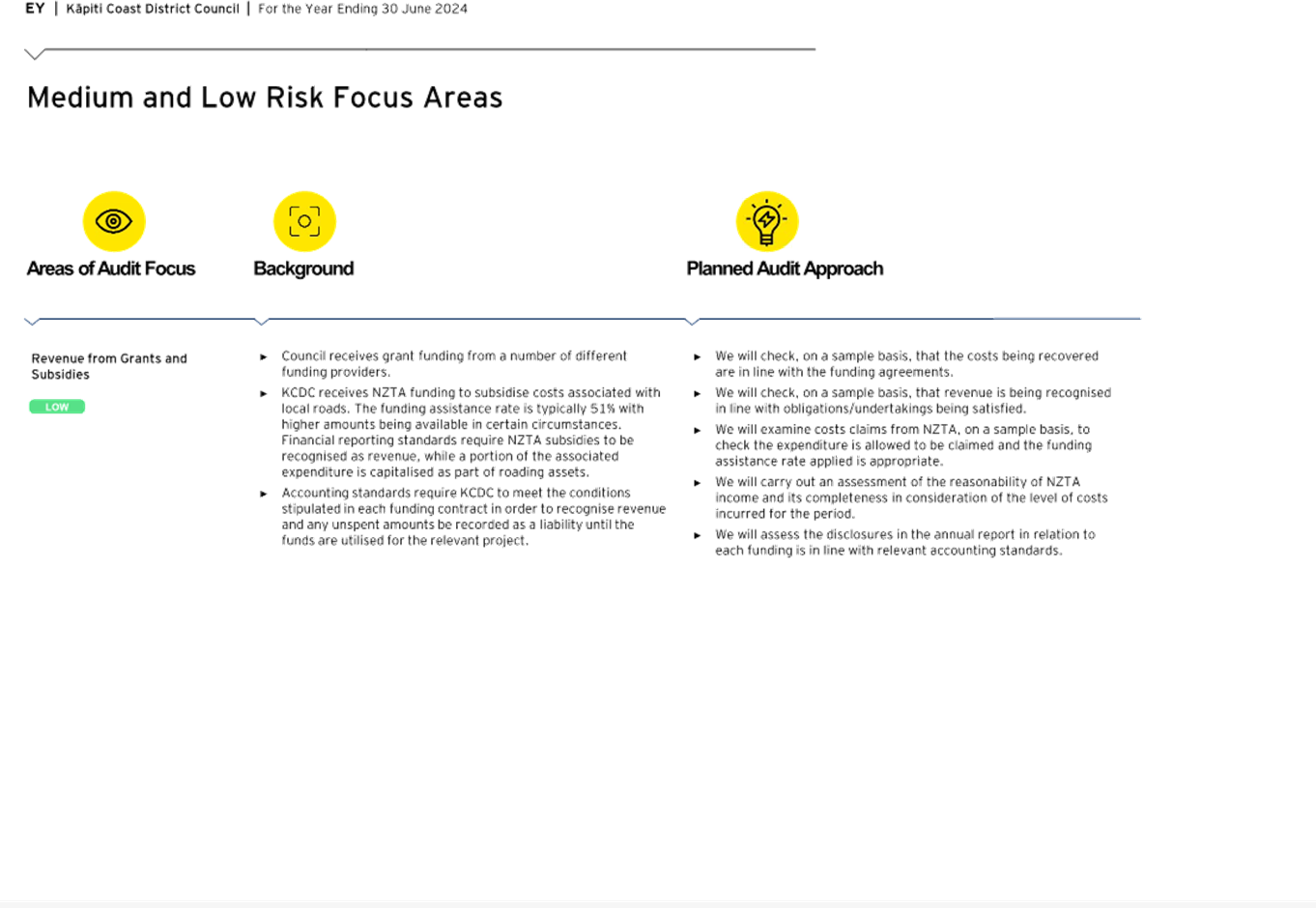
· Revenue
from Grants and Subsidies
Materiality
7 Audit
has set their materiality threshold at $3.8 million, being 3% of forecast
expenditure for 2023/24. Materiality is broadly defined as the quantum of any
misstatements (through error or otherwise), that would likely mislead users of
the financial statements. Any identified misstatements impacting on the
Council’s operating result by more than $190,000 will be reported to the
Committee by way of Audit’s Closing Report on conclusion of their audit.
He take |
Issues
8 This
matter has a low level of significance under the Council’s Significance
and Engagement Policy.
Ngā kōwhiringa | Options
9 There
are no options to be considered.
Tangata whenua
10 There
are no tangata whenua considerations arising from this report.
Panonitanga āhuarangi | Climate change
and Environment
11 There
are no climate change considerations within this report.
Ahumoni me ngā rawa | Financial
and resourcing
12 As
disclosed in the audit proposal letter dated 27 June 2023, the fees for the
period ending 30 June 2024 will equate to $243,000. This is before any
estimated disbursements and is exclusive of GST.
Ture me ngā Tūraru | Legal
and risk
13 There
are no legal and risk issues arising from this report.
Ngā pānga ki ngā kaupapa here | Policy impact
14 There
are no policy implications arising from this report.
Te whakawhiti kōrero me te
tūhono | Communications &
engagement
Te mahere tūhono | Engagement planning
15 An
engagement plan is not required for this report.
Whakatairanga |
Publicity
16 There
are no specific publicity considerations arising from this report.
Ngā āpitihanga | Attachments
1. Ernst
& Young Audit Plan for the year ended 30 June 2024 ⇩ 
|
Risk and Assurance Committee Meeting Agenda
|
23 May 2024
|


|
Risk and Assurance Committee Meeting Agenda
|
23 May 2024
|
9.2 Progress
Update Regarding Audit Control Findings 2022/23
Kaituhi |
Author: Sharon
Foss, Manager Risk and Assurance
Kaiwhakamana
| Authoriser: Mark de Haast, Group Manager Corporate Services
Te pūtake |
Purpose
1 This
report provides the Risk and Assurance Committee with a progress report on
Ernst & Young’s Report on Control Findings for the year ended 30 June
2023.
He
whakarāpopoto | Executive summary
2 There
is no requirement for an Executive Summary.
Te tuku haepapa
| Delegation
3 The
Risk and Assurance Committee has delegated authority to consider this report
under section C.3 of the Governance Structure and Delegations.
· Reviewing
and maintaining the internal control framework.
· Obtaining
from external auditors any information relevant to the Council’s
financial statements and assessing whether appropriate action has been taken by
management in response to the above.
Taunakitanga | RECOMMENDATIONS
A. That
the Risk and Assurance Committee:
A.1 notes
the progress update regarding Ernst & Young’s Report on Control
Findings for the year ended 30 June 2023, attached as Appendix 1 to this
report, and
A.2 that Ernst
& Young will re-assess these as part of their audit for the year ended 30
June 2024.
Tūāpapa | Background
4 In
accordance with NZ Auditing Standards, Ernst & Young (EY) performed a
review of the design and operating effectiveness of the Council’s
significant financial reporting processes as part of their audit for the year
ended 30 June 2023. That review is part of EY’s annual Audit Plan,
as considered by this Committee, and reflects the areas of focus set by the
Office of the Auditor General.
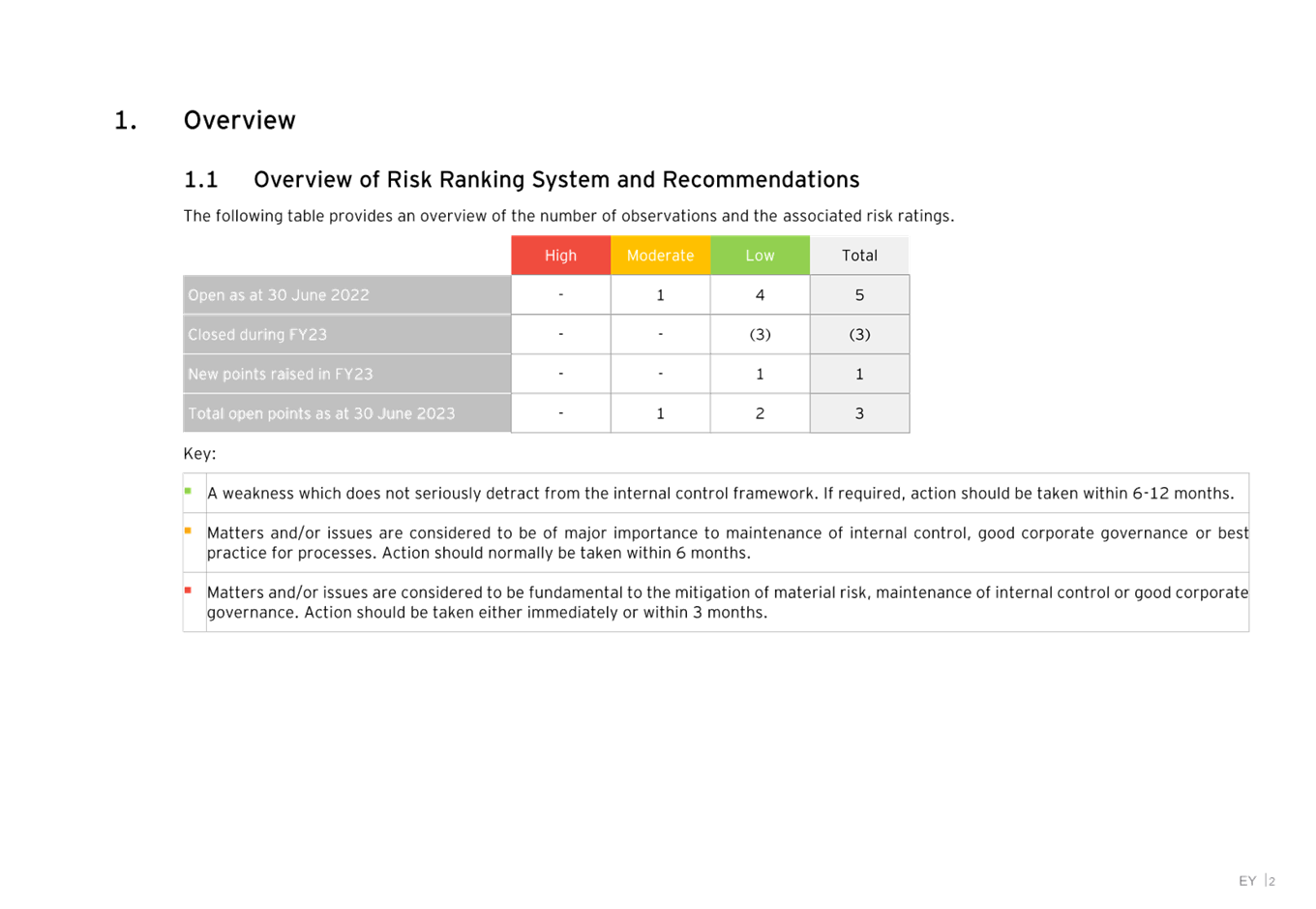
5 The
EY Report on Control Findings highlights weaknesses in our first line of
defences (controls). Of interest for the Committee are the levels that EY
classify the control risk matters they identify.
|
Ernst & Young – Risk Ranking System
|
|
High
|
Matters and/or issues considered to be
fundamental to the mitigation of material risk, maintenance of internal
control or good corporate governance. Action should be taken either
immediately or within three months.
|
|
Moderate
|
Matters and/or issues considered to be of
major importance to maintenance of internal control, good corporate
governance, or best practice for processes. Action should normally be taken
within six months.
|
|
Low
|
A weakness which does not seriously
detract from the internal control framework. If required, action should be
taken within 6 -12 months.
|
He
kōrerorero | Discussion
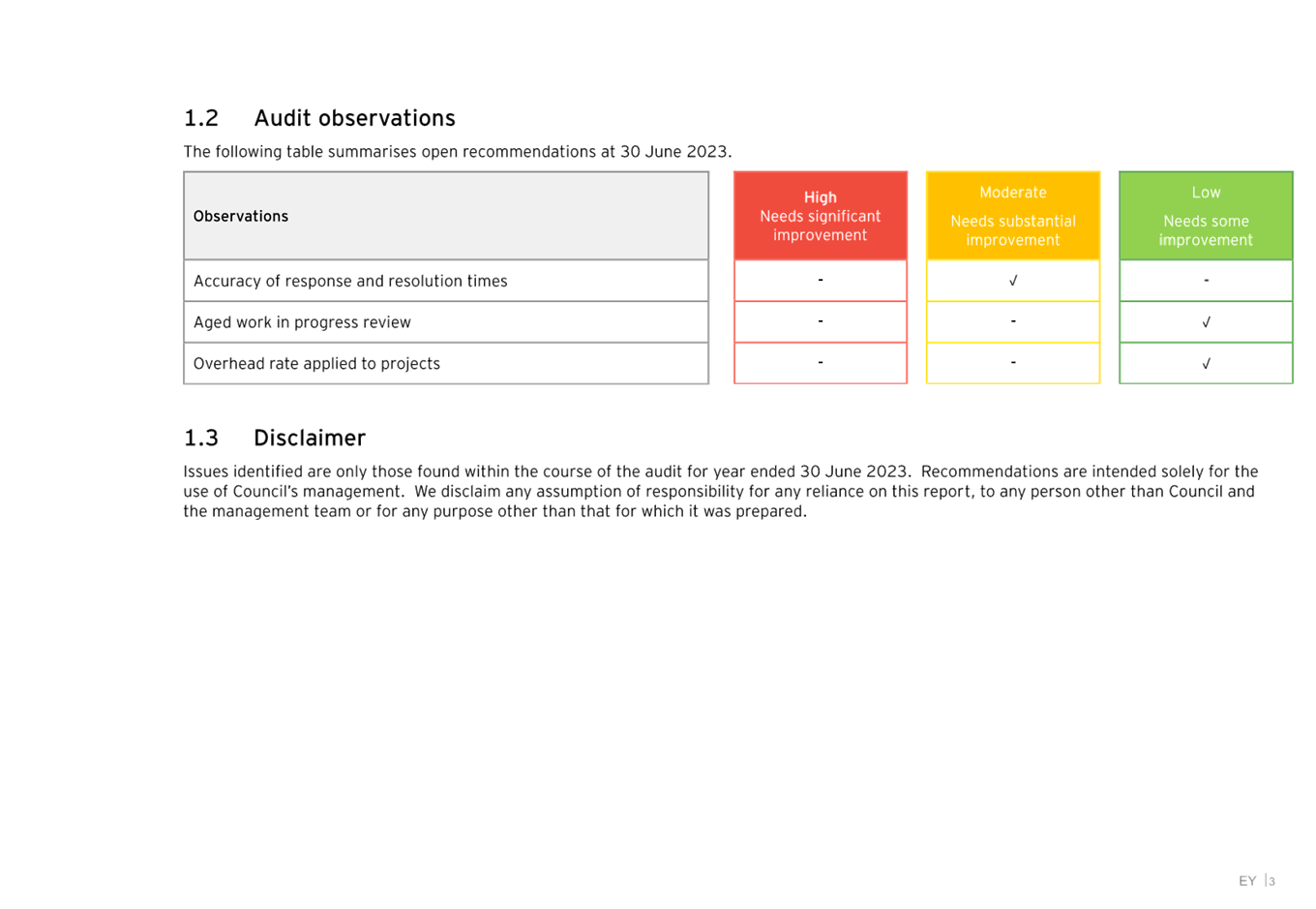
6 There
are three control findings from EY
that are open across their last two external audits. EY will consider if
these can be closed out, as part of their audit for the financial year ended 30
June 2024
|
Control
Findings open at 30 June 2023 by risk ranking
|
Risk Ranking
|
Total
|
|
High
|
Moderate
|
Low
|
|
----
|
1
|
2
|
3
|
7 The
table below details the year-to-date progress against these control findings.
|
EY Risk Ranking
|
Control Findings
at 30 June 2023
|
Summary - as at 14 May 2024
|
Completion Status
|
|
Moderate
|
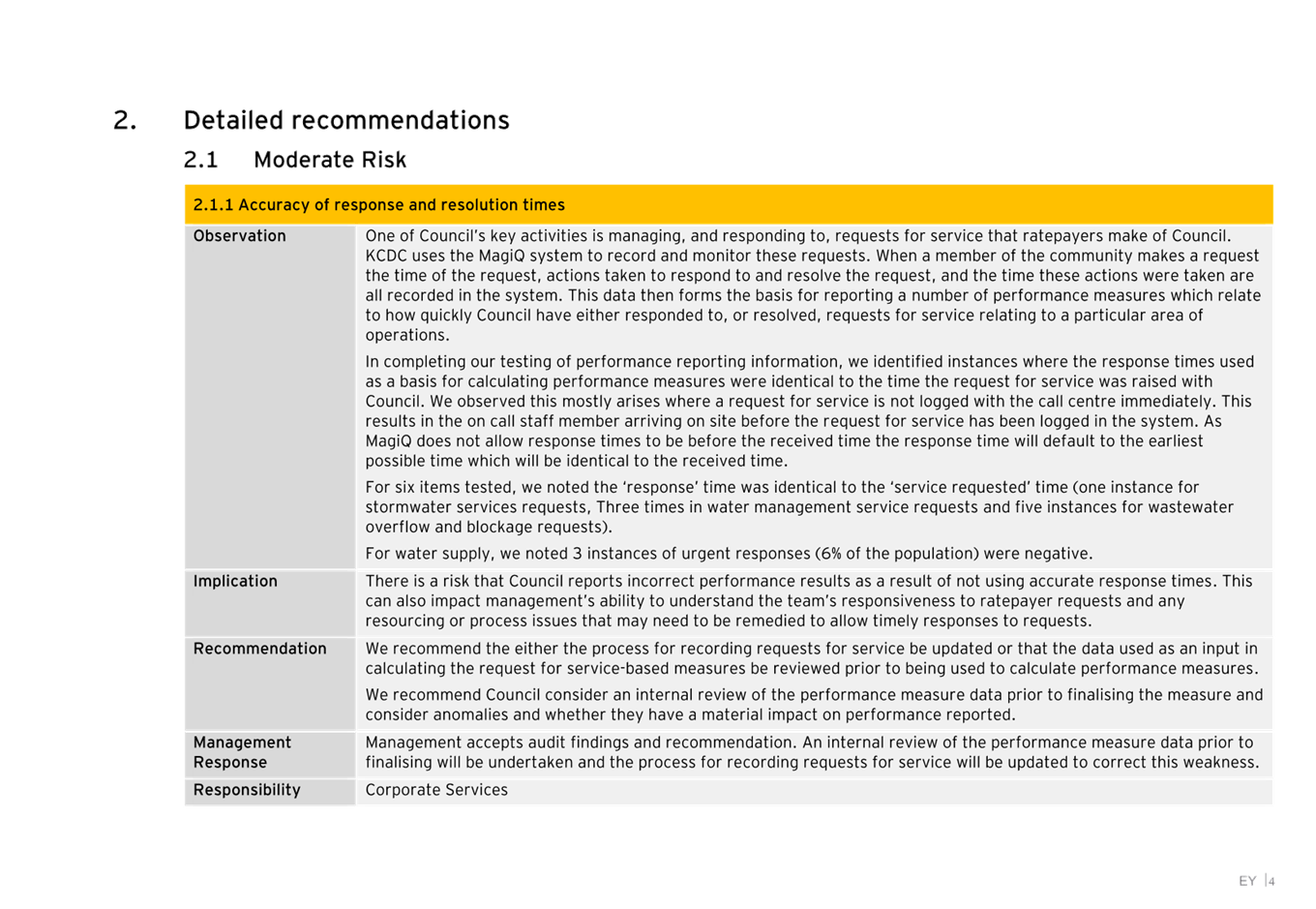
2.1.1
Accuracy
of response and resolution times
(MagiQ service request data
refers)
|
Agreed
action:
- Undertake an internal
review of the performance measure data prior to finalising.
- Update the process for recording requests for service to
correct this weakness.
Action
update:
- Work being completed to determine 1st line of defence
point of failure and associated risk treatments. Supporting documentation is
being updated and associated training provided.
|
In Progress
|
|
EY Risk Ranking
|
Control Findings
at 30 June 2023
|
Summary as at 14 May 2024
(updates on actions are highlighted)
|
Completion Status
|
|
Low
|
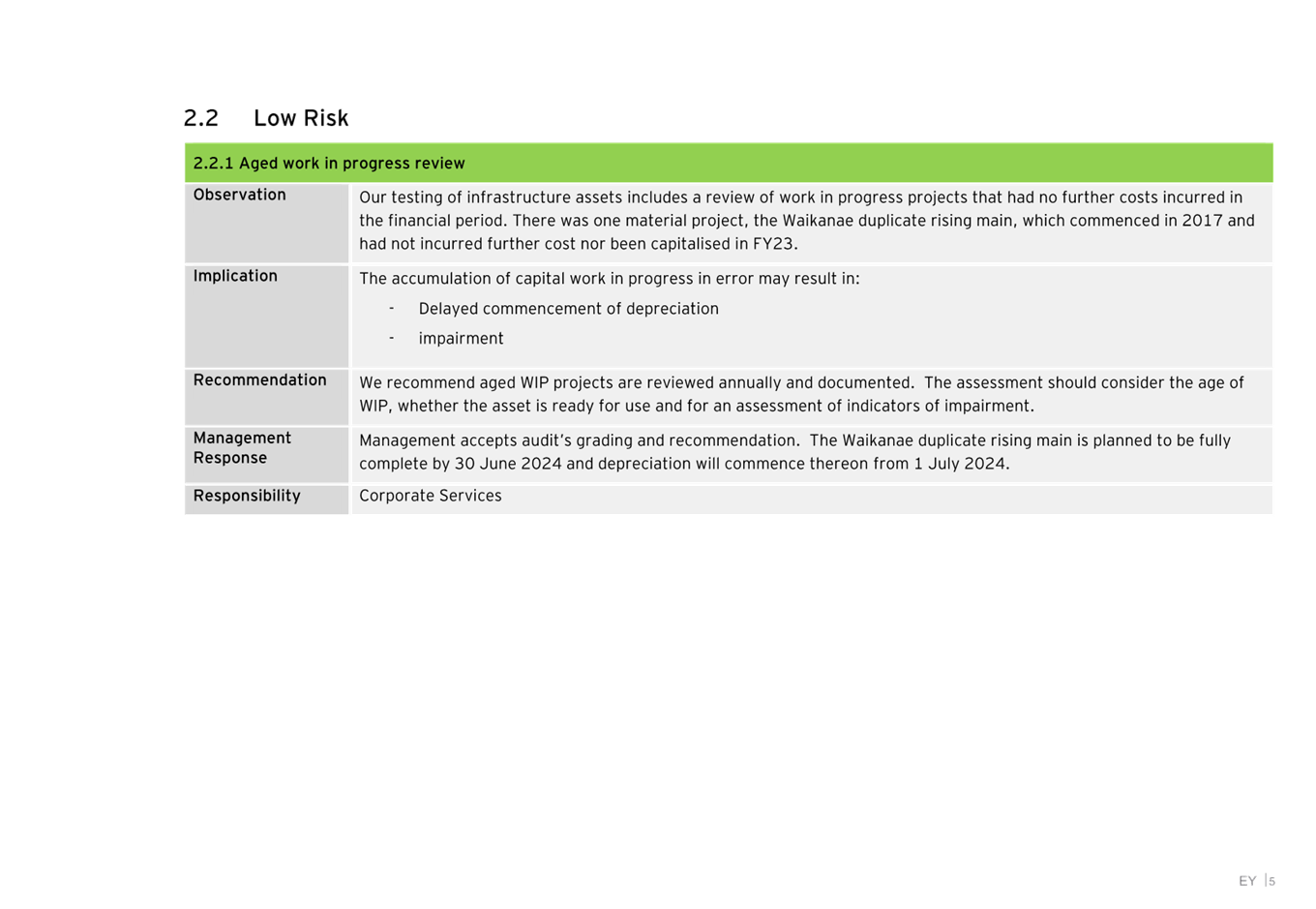
2.2.1
Aged
work in progress review
(Waikanae duplicate rising main
infrastructure project refers)
|
Agreed action:
1
- Establish annual reviews of aged work in progress
projects
2
- Document the review and ensure that the assessment
includes consideration of:
- the age of the work in progress,
- whether the asset is ready for use, and
- any indicators of impairment.
Action
update: Generic Improvement: Assurance around Aged Work in Progress (WIP)
- As part of our annual end of year review process the aged
WIP balances that are standalone projects and have had no movement in the
last 12 months will be assessed for impairment.
- The reviews will be documented in accordance with standard accounting practice.
3
Action
update: Specific Finding:
WIP - Waikanae Duplicate Rising Main Project
- Completion is still expected in 2025. Note: the original 30 June 2024 completion date was not met due to resource
consent delays.
|
In Progress
Likely be carried over to 2025
|
|
EY Risk
Ranking
|
Control Findings
at 30 June 2023
|
Summary as at 14 May 2024
|
Completion Status
|
|
Low
|
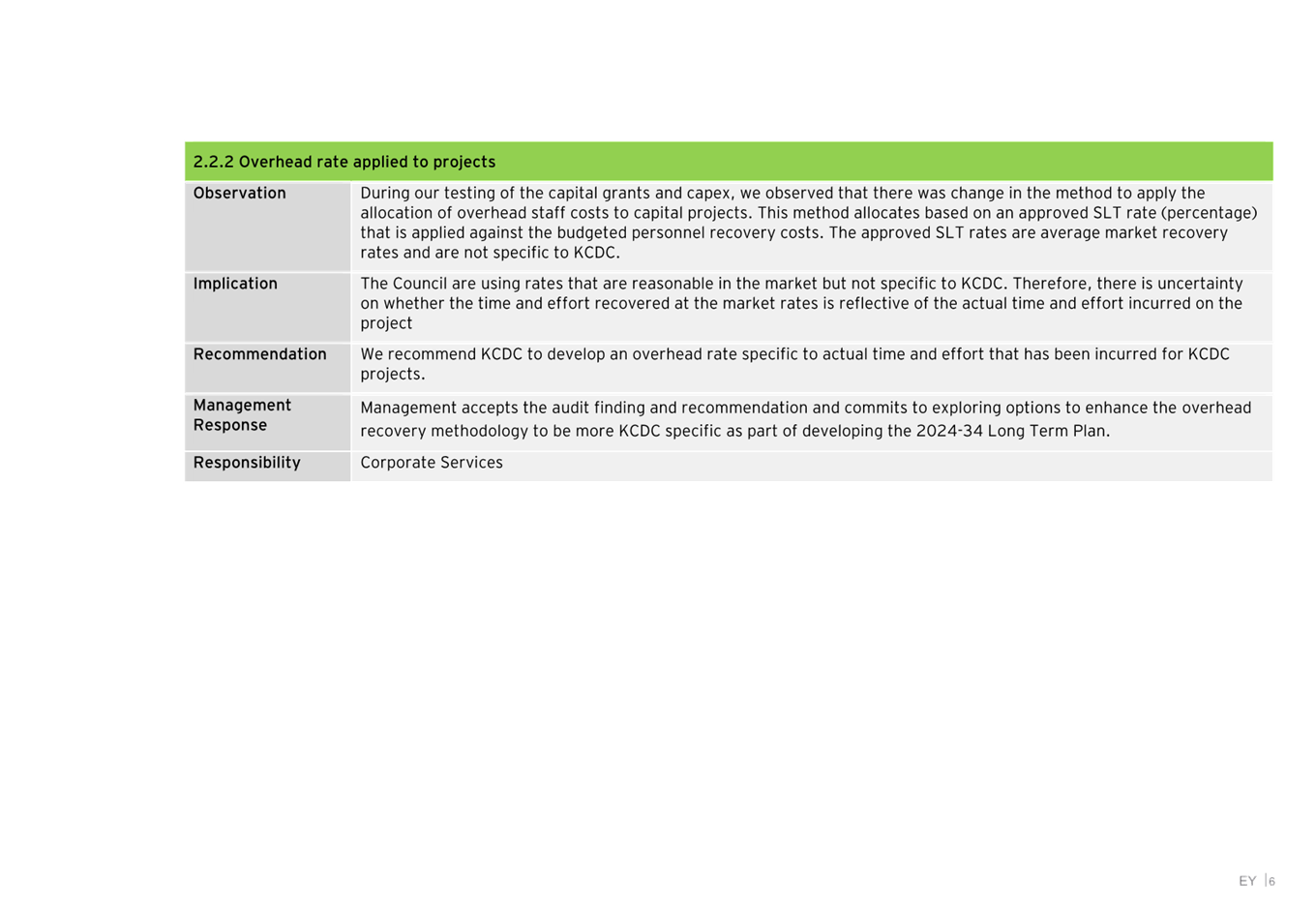
2.2.2
Overhead
rate applied to projects
|
Agreed
action:
Develop a specific overhead allocation model.
Action update:
- Last
financial year planning started on the development of a mechanism to
ensure our time and effort for projects are considered.
4
- SLT considered alternate overhead allocation models for the 2024-34
Long-Term Plan. It
was agreed that the overhead allocation model for the current Long-Term Plan
was to be applied to the 2024-34 Long Term Plan and was to be applied
correctly.
|
Complete
|
He
take | Issues
8 There
are no additional issues to be raised in this report.
Ngā
kōwhiringa | Options
9 There
are no options to be raised in this report.
Tangata whenua
10 There
are no tāngata whenua considerations arising from this report.
Panonitanga āhuarangi | Climate change
and Environment
11 There
are no climate change issues arising from this report.
Ahumoni me ngā rawa | Financial
and resourcing
12 There are no additional financial or
resource issues arising from this report.
Ture me ngā Tūraru | Legal
and risk
13 There
are no legal considerations arising from this report.
Ngā pānga ki ngā kaupapa here | Policy impact
14 There
are no policy implications arising from this report.
Te whakawhiti
kōrero me te tūhono | Communications & engagement
Te mahere tūhono | Engagement
planning
15 This
matter has a low level of significance under the Council’s Significance
and Engagement Policy.
Whakatairanga |
Publicity
16 There
are no publicity considerations.
Ngā āpitihanga | Attachments
1. Appendix
1 - Ernst & Young's Report on Control Findings for the year ended 30 June
2023 ⇩
|
Risk and Assurance Committee Meeting Agenda
|
23 May 2024
|


|
Risk and Assurance Committee Meeting Agenda
|
23 May 2024
|
9.3 Health
and Safety Quarterly Report: 1 January 2024 - 31 March 2024
Kaituhi |
Author: Rach
Wells, Group Manager People and Capability
Kaiwhakamana
| Authoriser: Darren Edwards, Chief Executive
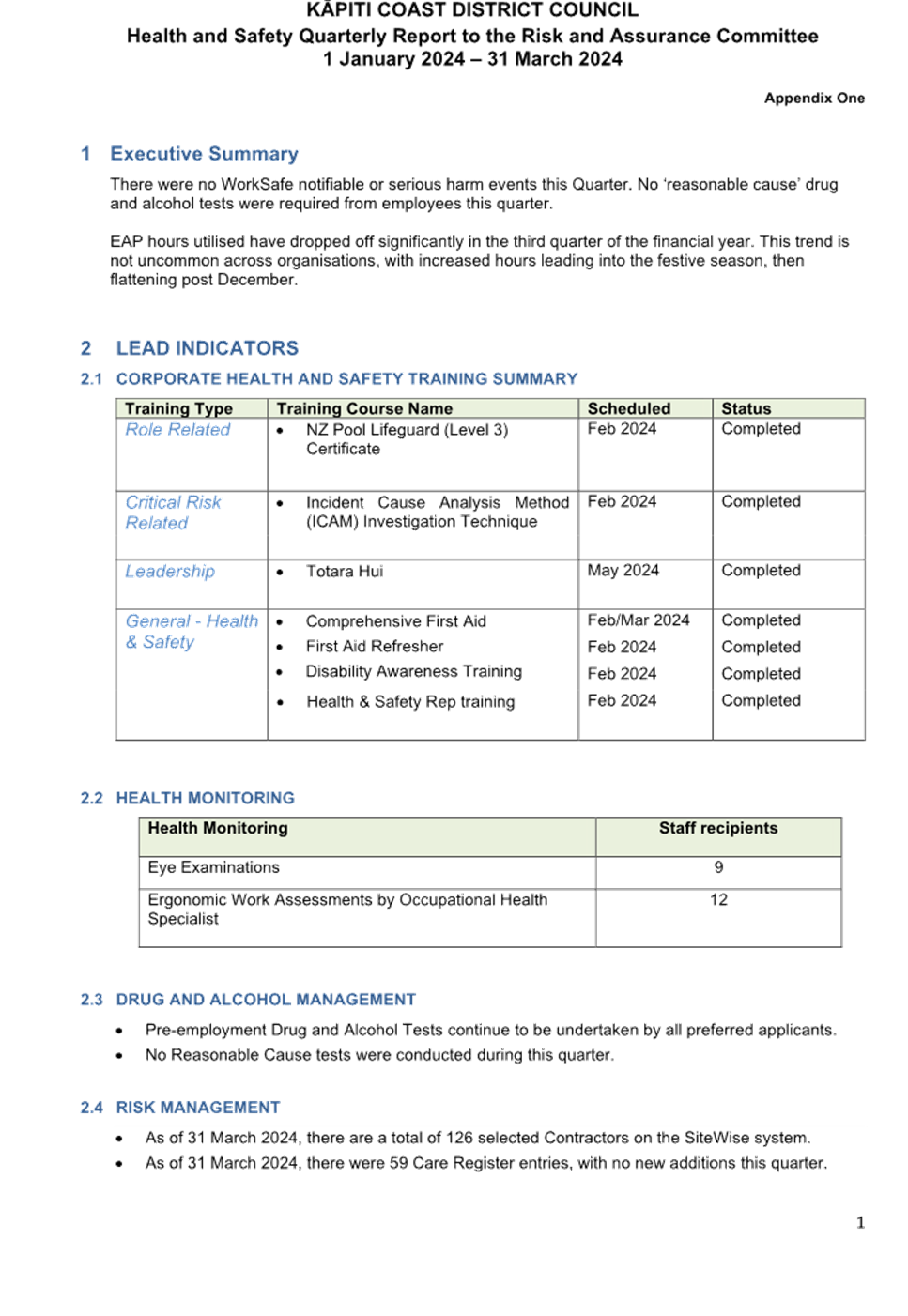
TE PŪTAKE | PURPOSE
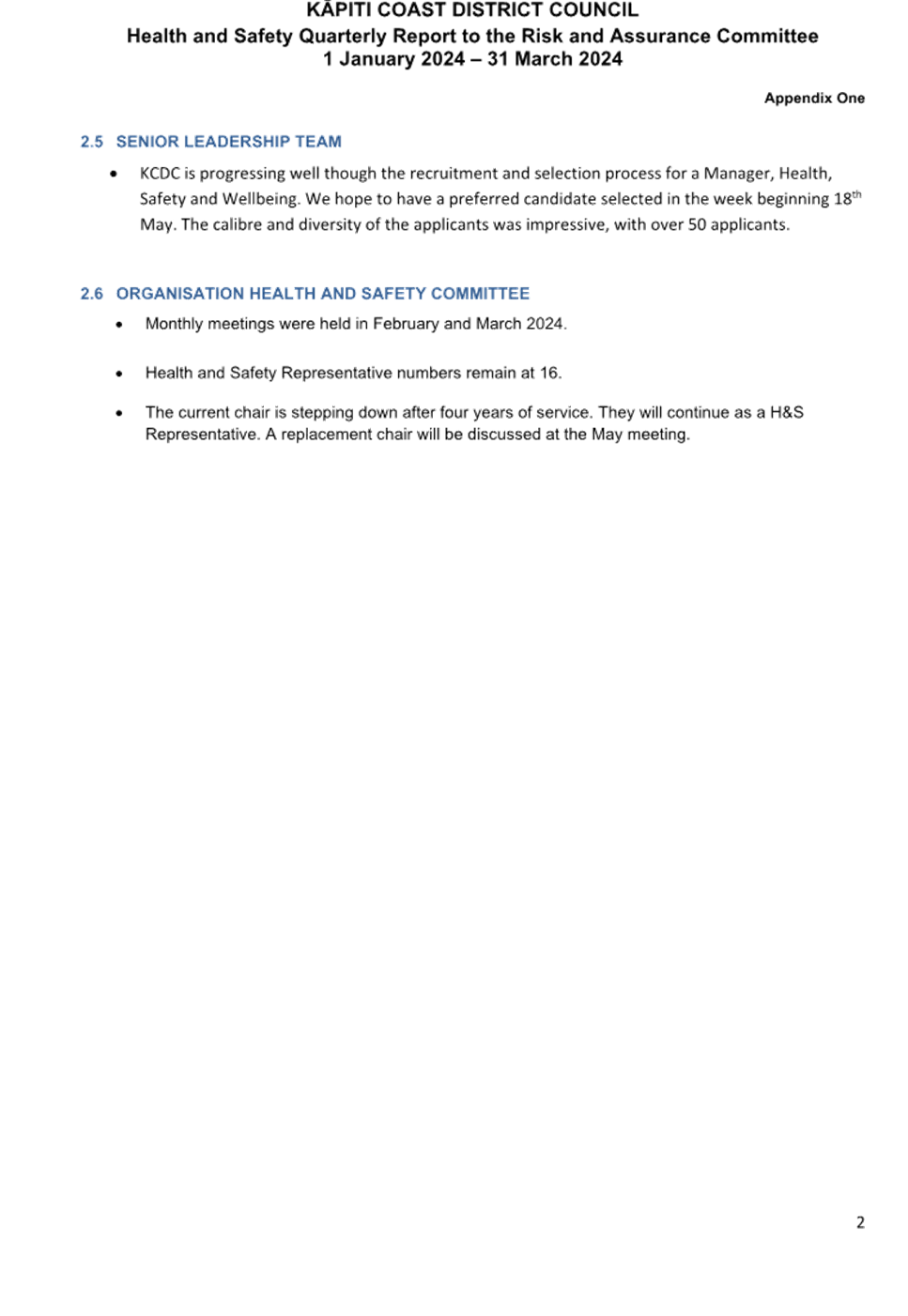
1 This
Report presents the Health and Safety Quarterly Report for the period 1 January
to 31 March 2024.
HE WHAKARĀPOPOTO | EXECUTIVE SUMMARY
2 Not
required for this report.
TE TUKU HAEPAPA | DELEGATION
3 The
Risk and Assurance Committee has delegated authority to consider this report
under the following delegation in the Governance Structure, Section C 1:
· Ensuring
that the Council has in place a current and comprehensive risk management
framework and making recommendations to the Council on risk mitigation;
· Assisting
elected members in the discharge of their responsibilities by ensuring
compliance procedures are in place for all statutory requirements relating to
their role;
· Governance
role in regard to the Health and Safety Plan.
AKITANGA | RECOMMENDATIONS
A. That
the Risk and Assurance Committee notes the Health and Safety Quarterly Report
for the period 1 January 2024 – 31 March 2024 attached as Appendix One to
this Report.
TŪĀPAPA | BACKGROUND
4 The
quarterly Health & Safety Report is intended to provide the Council with
insight into initiatives and activities and their progress, as part of our
Council’s commitment to providing a safe and healthy place to work. The
contents and any subsequent discussions arising from this report can support
Officers to meet their due diligence obligations under the Health & Safety
at Work Act (HSWA) 2015.
5 The
timing of the Health and Safety Quarterly Reports does not prevent an ‘as
and when required’ verbal update from the Chief Executive to the Mayor
and Council regarding serious or high-profile risk events. Such events would be
recorded and retrospectively included in the next available Quarterly Report.
HE KŌRERORERO | DISCUSSION
He take |
Issues
6 There
are no issues to highlight in addition to those included in Appendix One to
this report.
Ngā kōwhiringa | Options
7 There
are no options arising from this report.
Tangata whenua
8 There
are no mana whenua considerations arising from this report.
Panonitanga āhuarangi | Climate change
9 There
are no climate change considerations arising from this report.
Ahumoni me ngā rawa | Financial
and resourcing
10 There
are no financial or resourcing considerations arising from this report.
Ture me ngā Tūraru | Legal
and risk
11 There
are no legal and risk considerations in addition to those already noted in this
report.
Ngā pānga ki ngā kaupapa here | Policy impact
12 There
are no policy considerations arising from this report.
TE WHAKAWHITI KŌRERO
ME TE TŪHONO | COMMUNICATIONS & ENGAGEMENT
13 There
are no communication and engagement considerations arising from this report.
Te mahere tūhono | Engagement
planning
14 An
engagement plan is not needed regarding this report.
Whakatairanga |
Publicity
15 There
are no publicity considerations.
NGĀ ĀPITIHANGA
| ATTACHMENTS
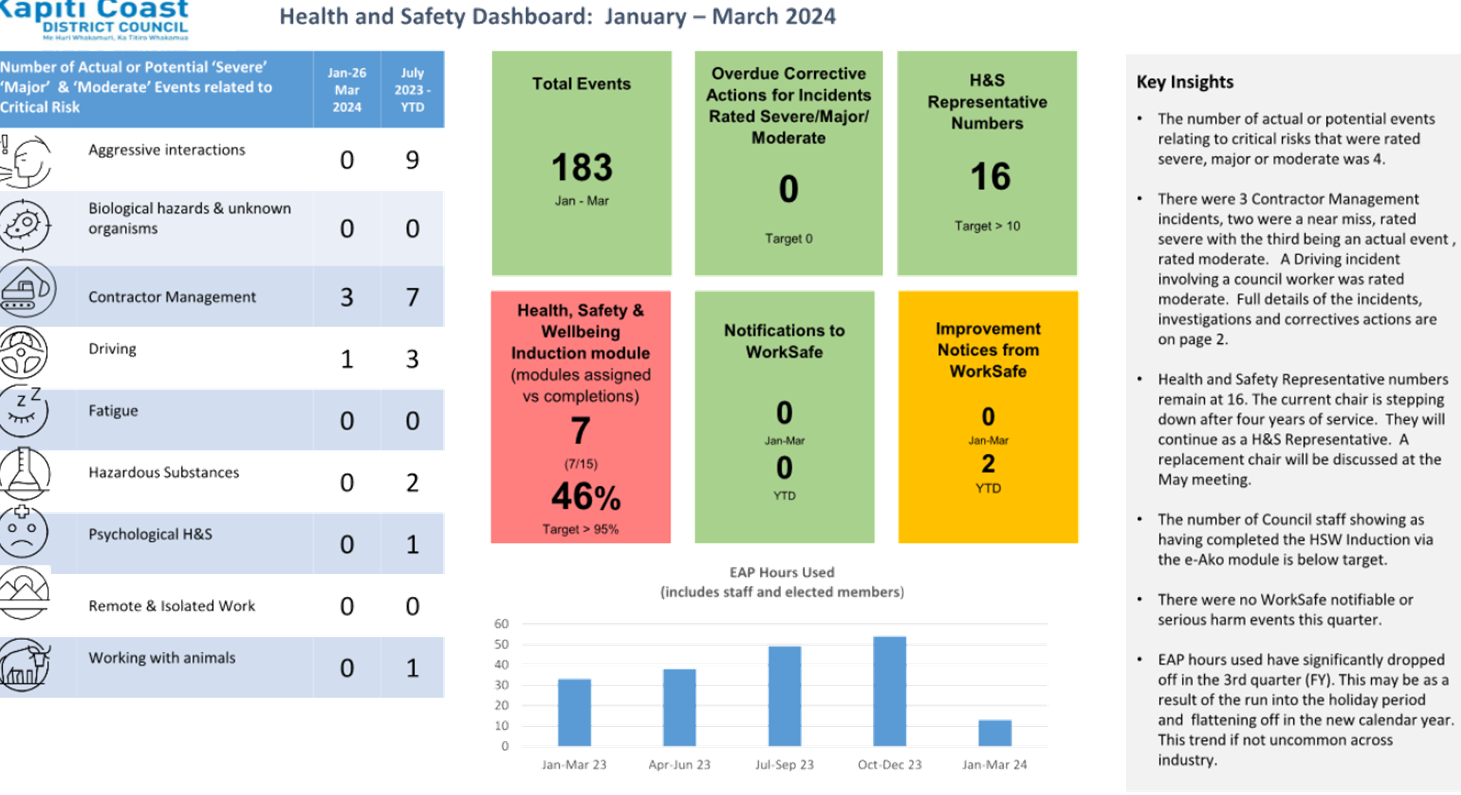
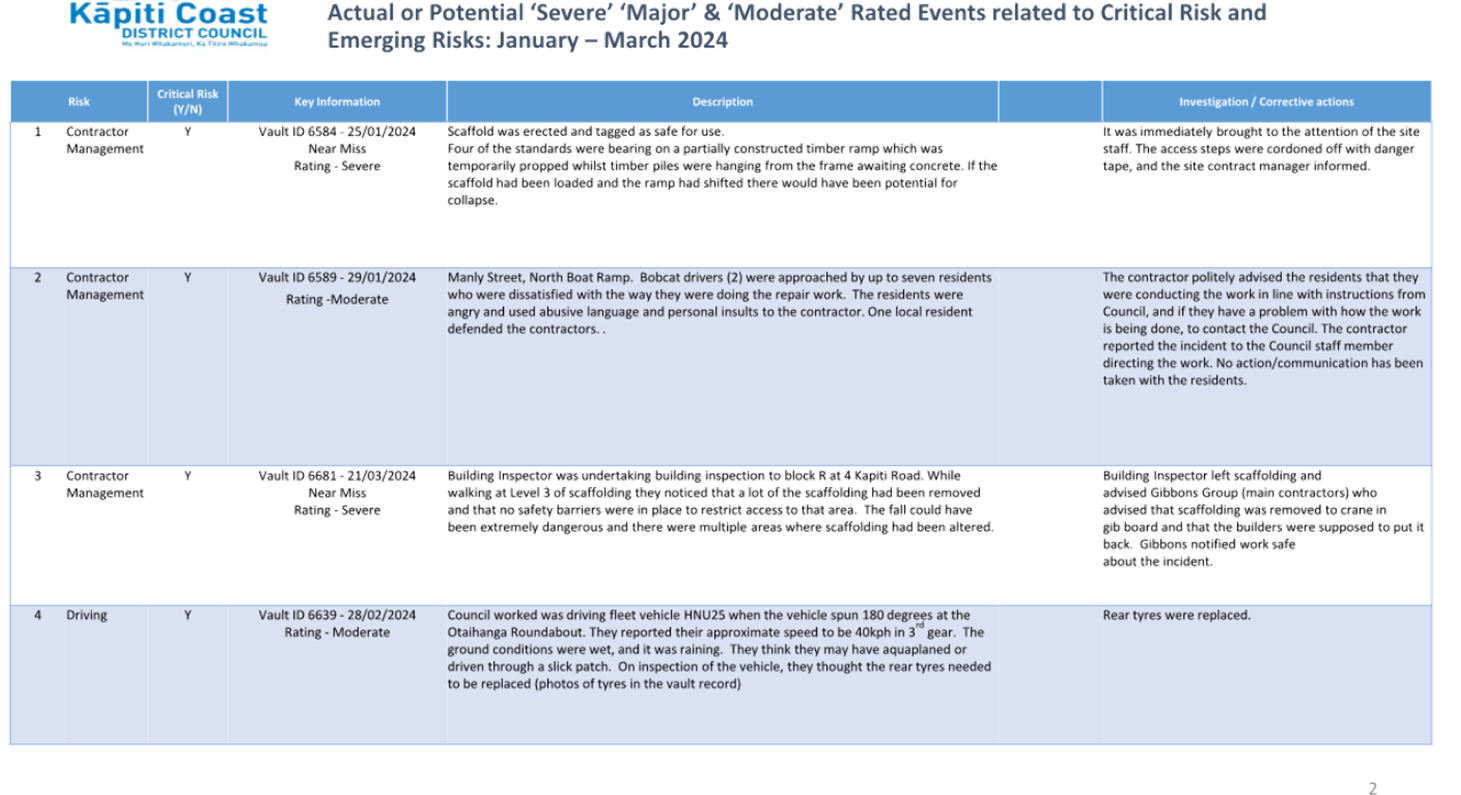
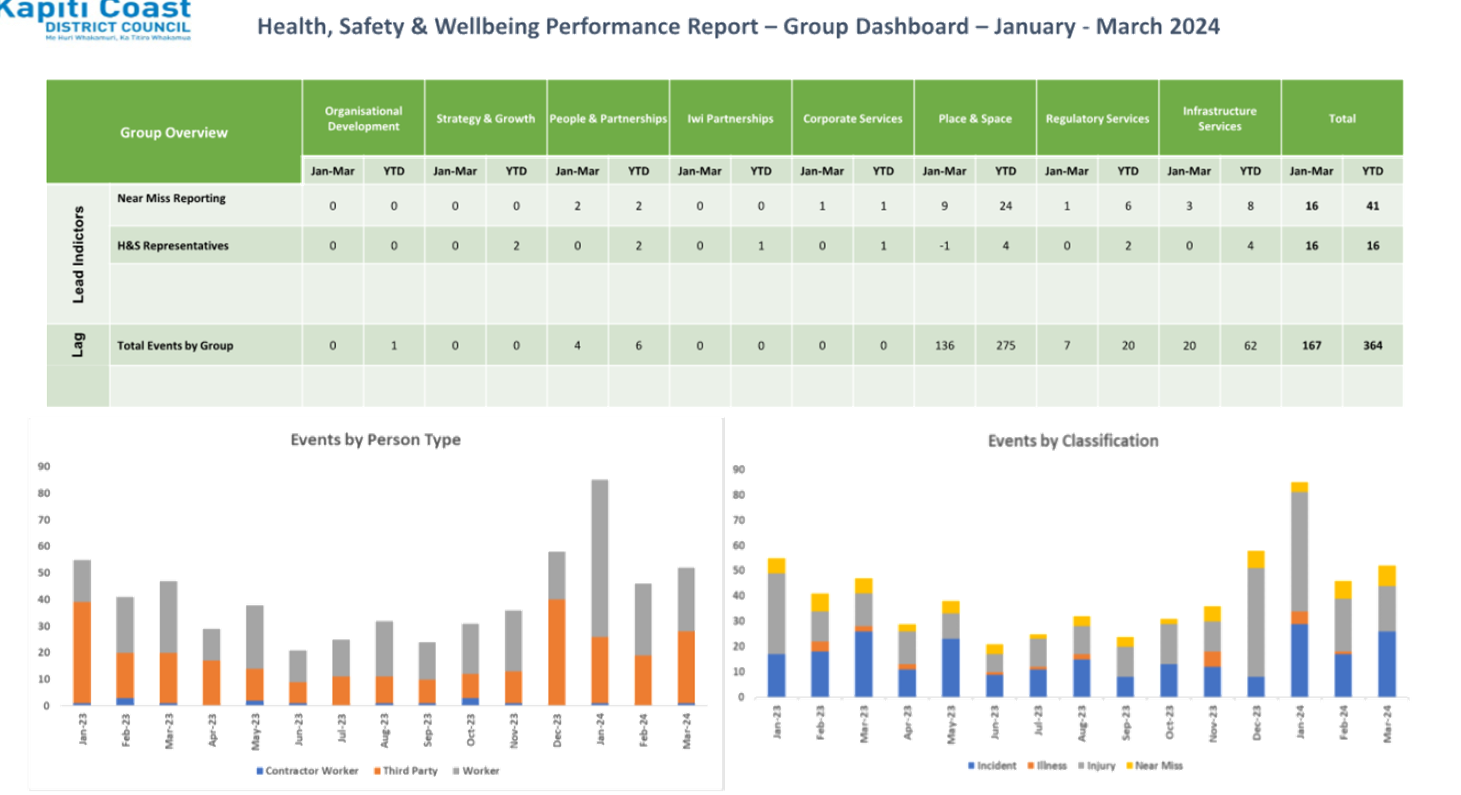
1. Health
& Safety Quarterly Report for the period of 1 January to 31 March 2024 ⇩
|
Risk and Assurance Committee Meeting Agenda
|
23 May 2024
|
|
Risk and Assurance Committee Meeting Agenda
|
23 May 2024
|
9.4 Top
10 Organisational Risk Report
Kaituhi |
Author: Nienke
Itjeshorst, Lead Risk and Assurance Advisor
Kaiwhakamana
| Authoriser: Mark de Haast, Group Manager Corporate Services
Te pūtake |
Purpose
1 This
report updates the Risk and Assurance Committee on the Top 10 Organisational
Risks currently facing the organisation.
He
whakarāpopoto | Executive summary
2 This
report does not require an Executive Summary.
Te tuku haepapa
| Delegation
3 The
Risk and Assurance Committee has delegated
authority to consider this report under section C.3 of the Governance Structure
and Delegations.
· Ensuring
that Council has in place a current and comprehensive risk management framework
and making recommendations to the Council on risk mitigation.
Taunakitanga | RECOMMENDATIONS
A. That the Risk and
Assurance Committee receives and notes this report, including Appendix 1 to
this report.
Tūāpapa | Background
4 The
Top 10 Organisational Risks (Top 10 Risks) are aimed at setting a clear
direction for staff as to what the Senior Leadership Team (SLT) have identified
as the highest areas of potential risk for the organisation to being able to
successfully achieve its objectives.
5 “Risk”
for the management of the council organisation is defined as:
5.1 the
impact of uncertain events that can happen in the future on the planned
objectives that SLT wants the organisation to deliver and/or achieve (short,
medium and long term), and
5.2 includes
strategic, reputational, regulatory, legal, security, change and operational
risks.
6 The
current Top 10 Risks are managed in a risk register in our Enterprise Risk
Management software: Camms Risk. It is important to note that these risk
listings are:
6.1 not
ranked in order of severity,
6.2 capped
at 10, to provide a clear focus for SLT and this Committee,
6.3 not
‘set in stone,” emerging organisational risks can be brought
forward to replace an existing risk when required and/or relevant.
7 Engagement
on the organisational risk profile is through on-going conversations with SLT
and activity managers about these risks, the controls to prevent or mitigate
these risks and status of risk treatments that are underway to implement the
controls to achieve the target risk level. These conversations ensure each risk
is regularly reviewed providing assurance that the treatments are being
conducted to further mitigate the risk.
8 The
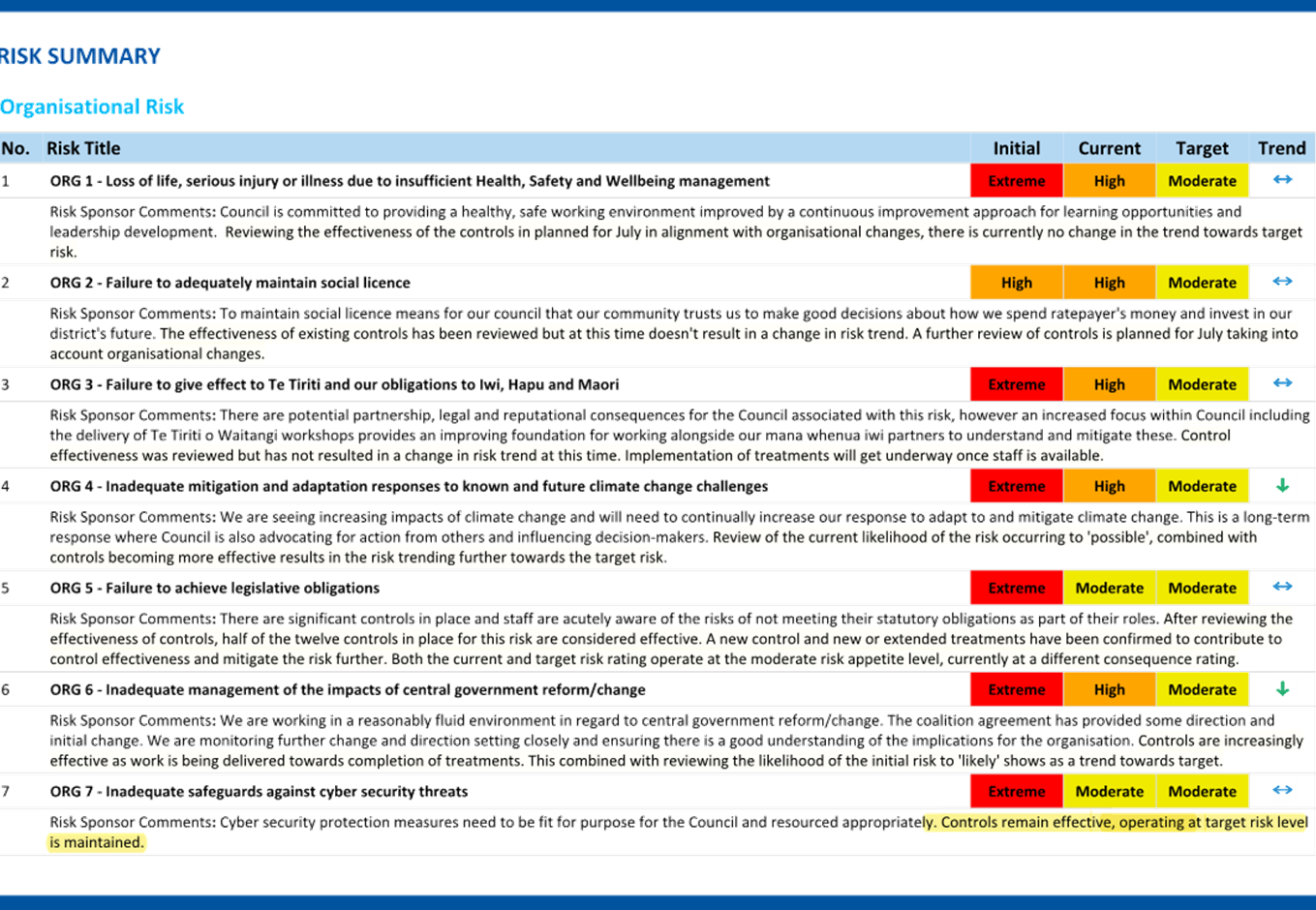
next table identifies the current Top 10 Organisational Risks.
|
Risk No.
|
Risk Title
|
|
ORG 1
|
Loss of life, serious injury or illness due to
insufficient Health, Safety and Wellbeing management.
|
|
ORG 2
|
Failure to adequately maintain social licence.
|
|
ORG 3
|
Failure to give effect to Te Tiriti and our obligations to
Iwi, Hapu and Māori.
|
|
ORG 4
|
Inadequate mitigation and adaptation responses to known
and future climate change challenges.
|
|
ORG 5
|
Failure to achieve legislative obligations.
|
|
ORG 6
|
Inadequate management of the impacts of central government
reform/change.
|
|
ORG 7
|
Inadequate safeguards against cyber security threats.
|
|
ORG 8
|
Failure to prudently manage Council’s financial
stability including fraudulent activity.
|
|
ORG 9
|
Failure to maintain business continuity for our core services
and inadequate planning and preparedness for emergencies.
|
|
ORG 10
|
Inability to attract and retain sufficient capacity to
deliver Council’s objectives.
|
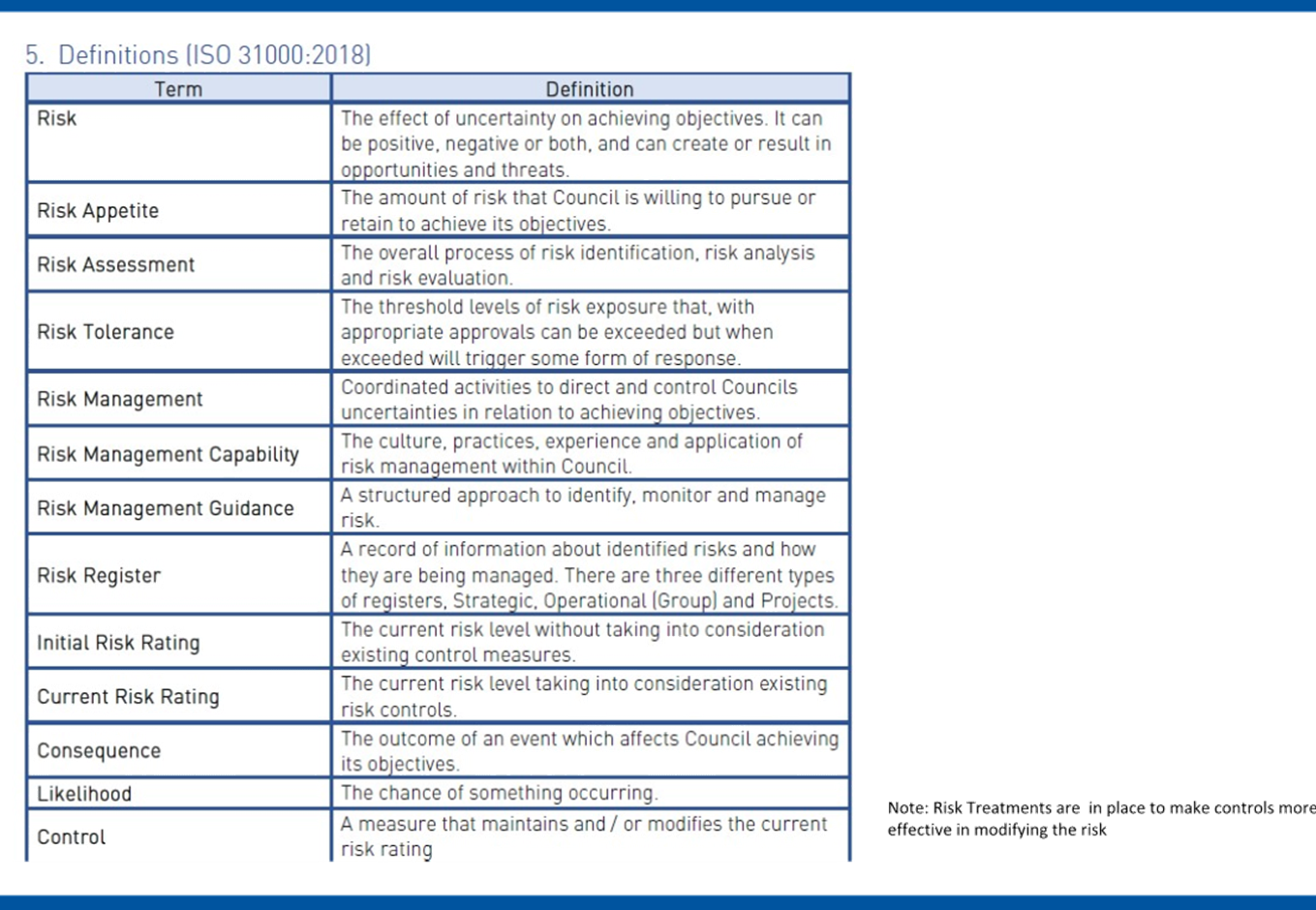
9 A
list of AS/NZ/ISO 3100:2018 Standard: Risk Management – Guidelines
definitions is included in the Heatmap Report on the last page.
He
kōrerorero | Discussion
10 This
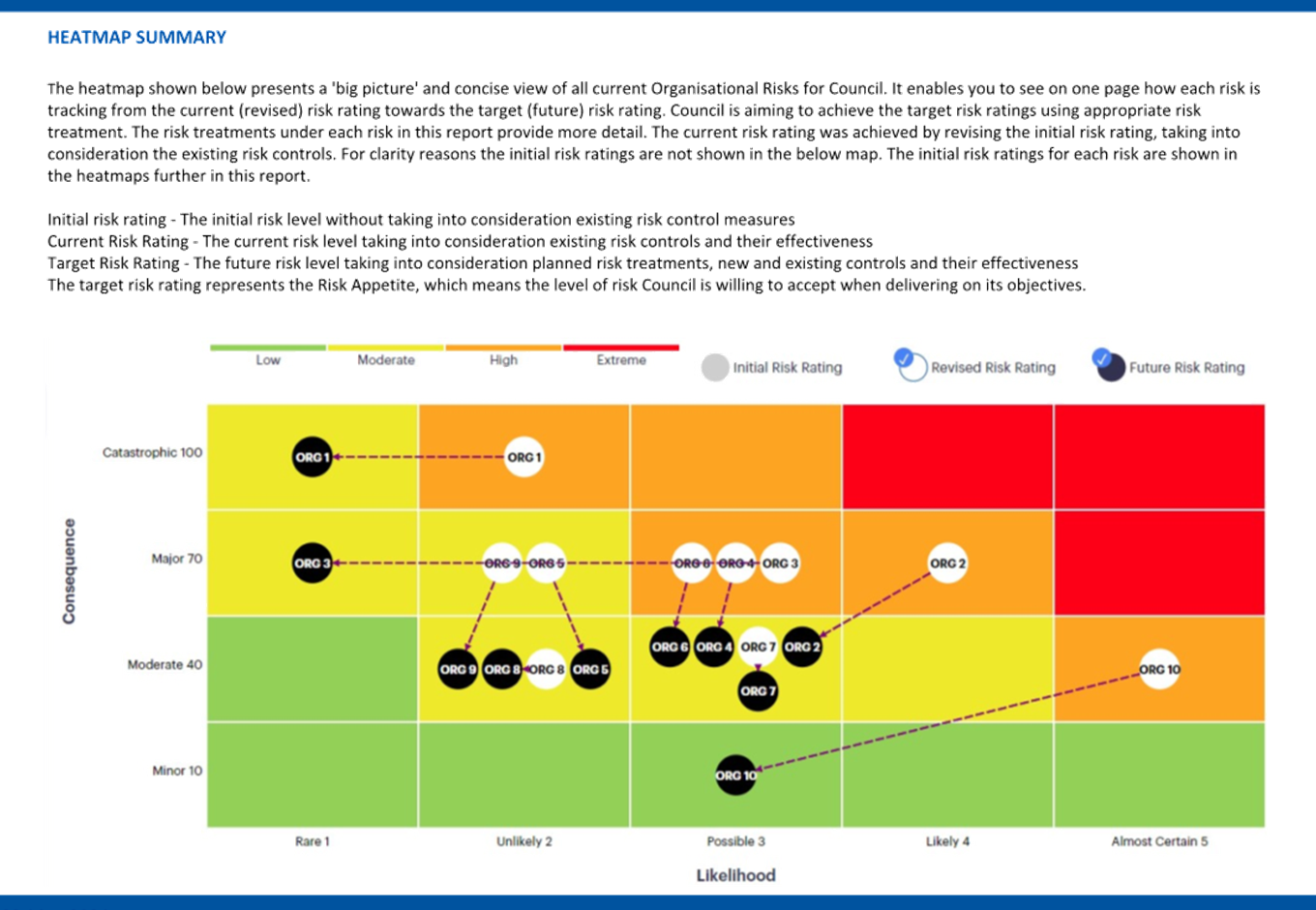
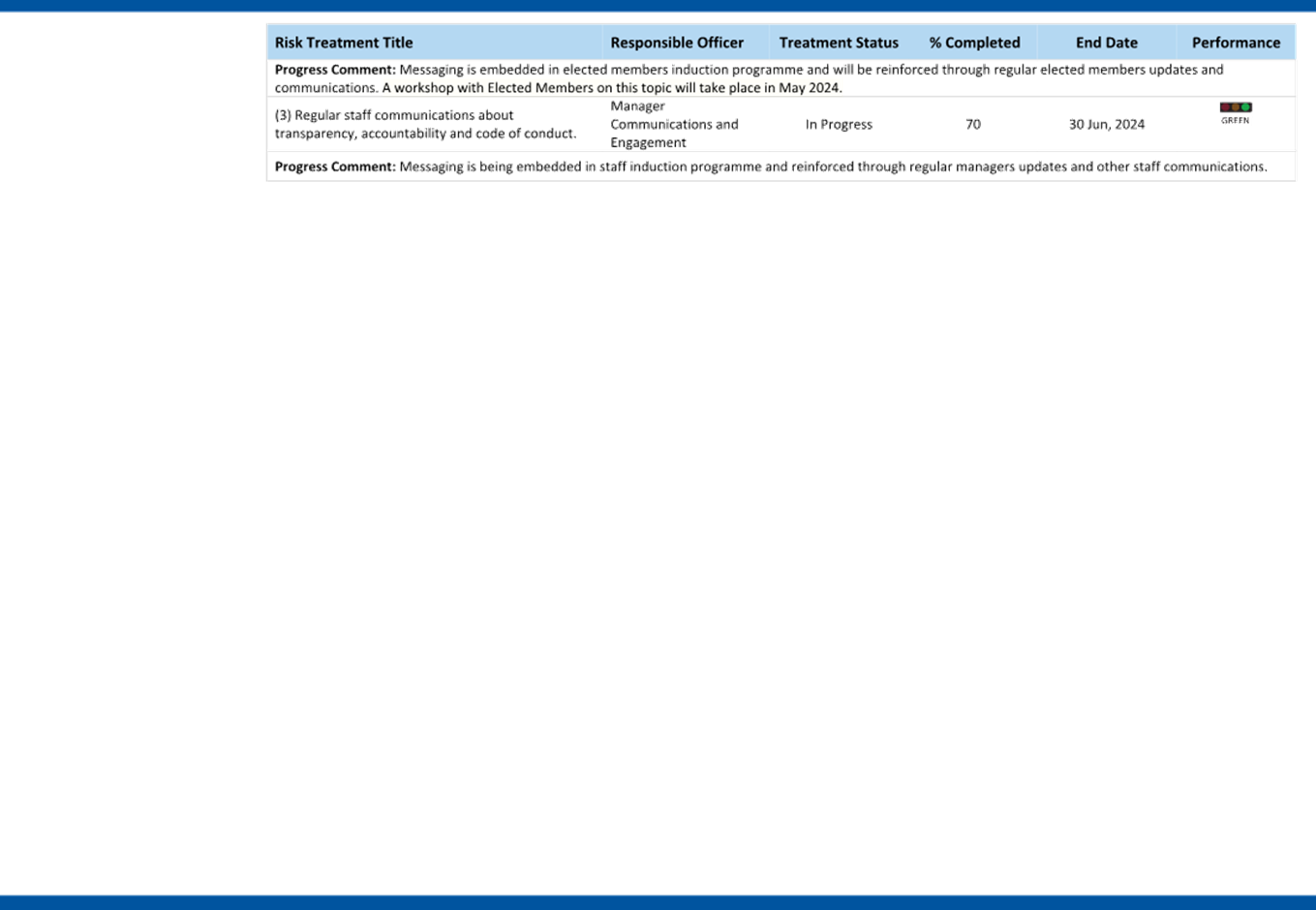
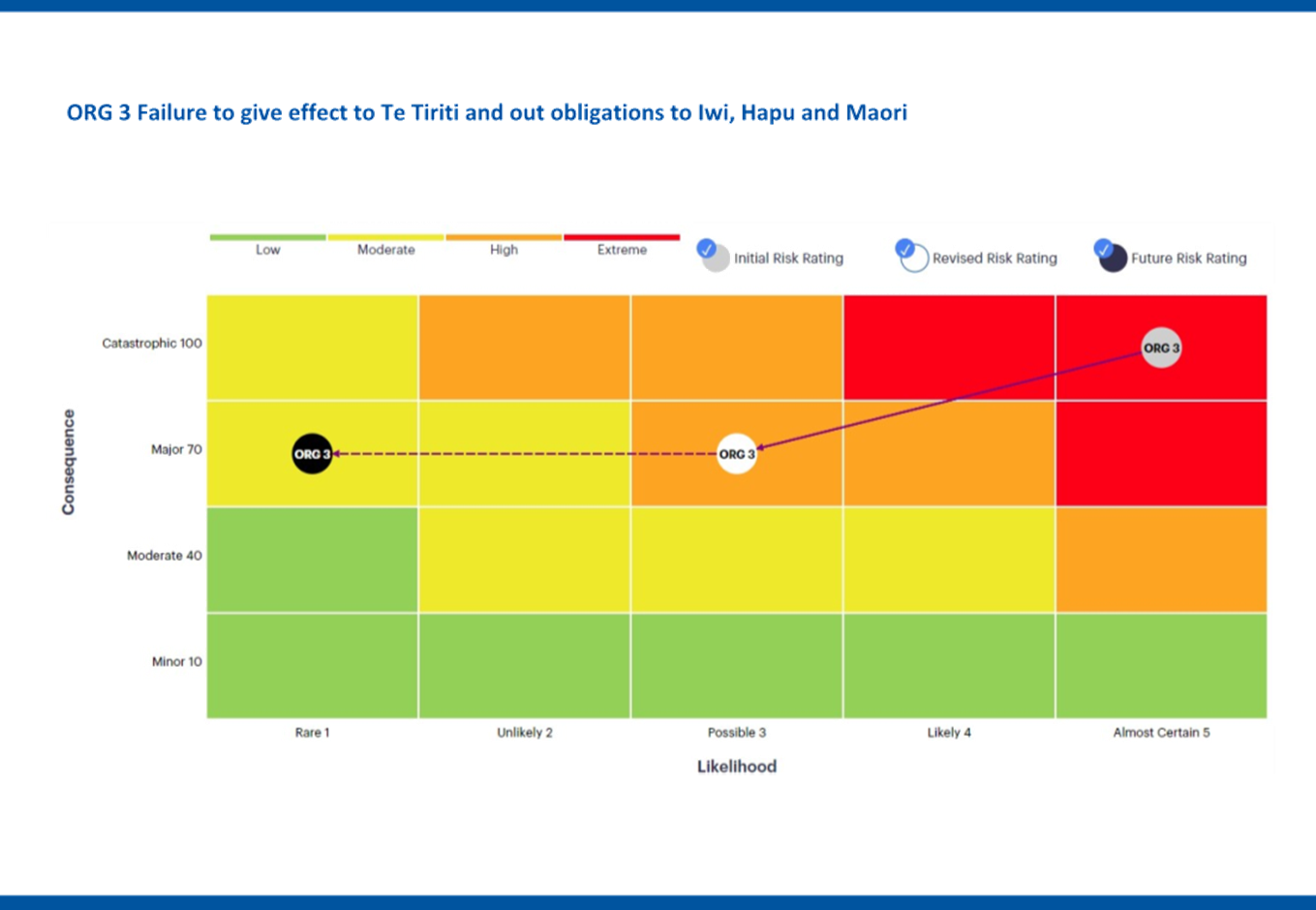
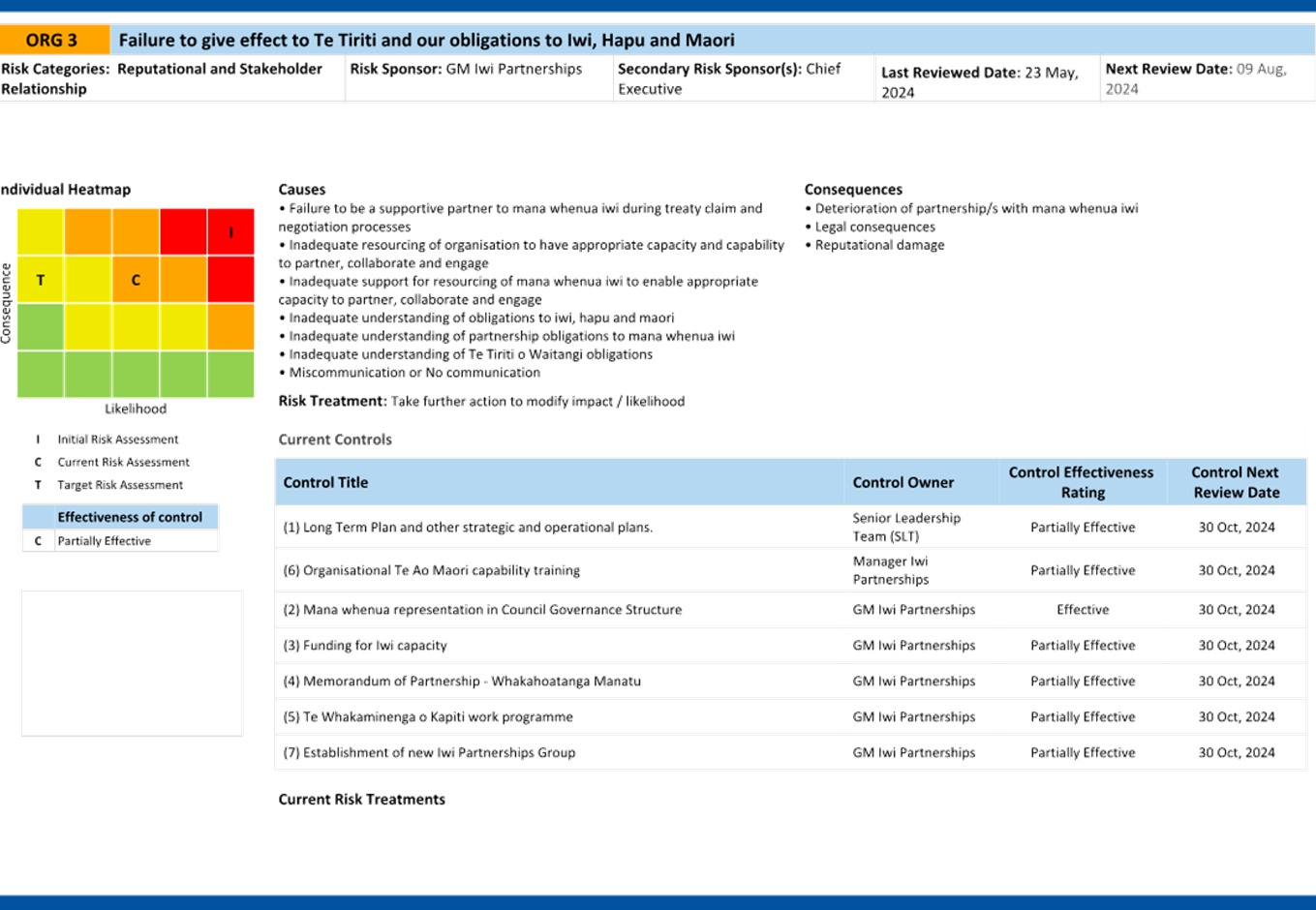
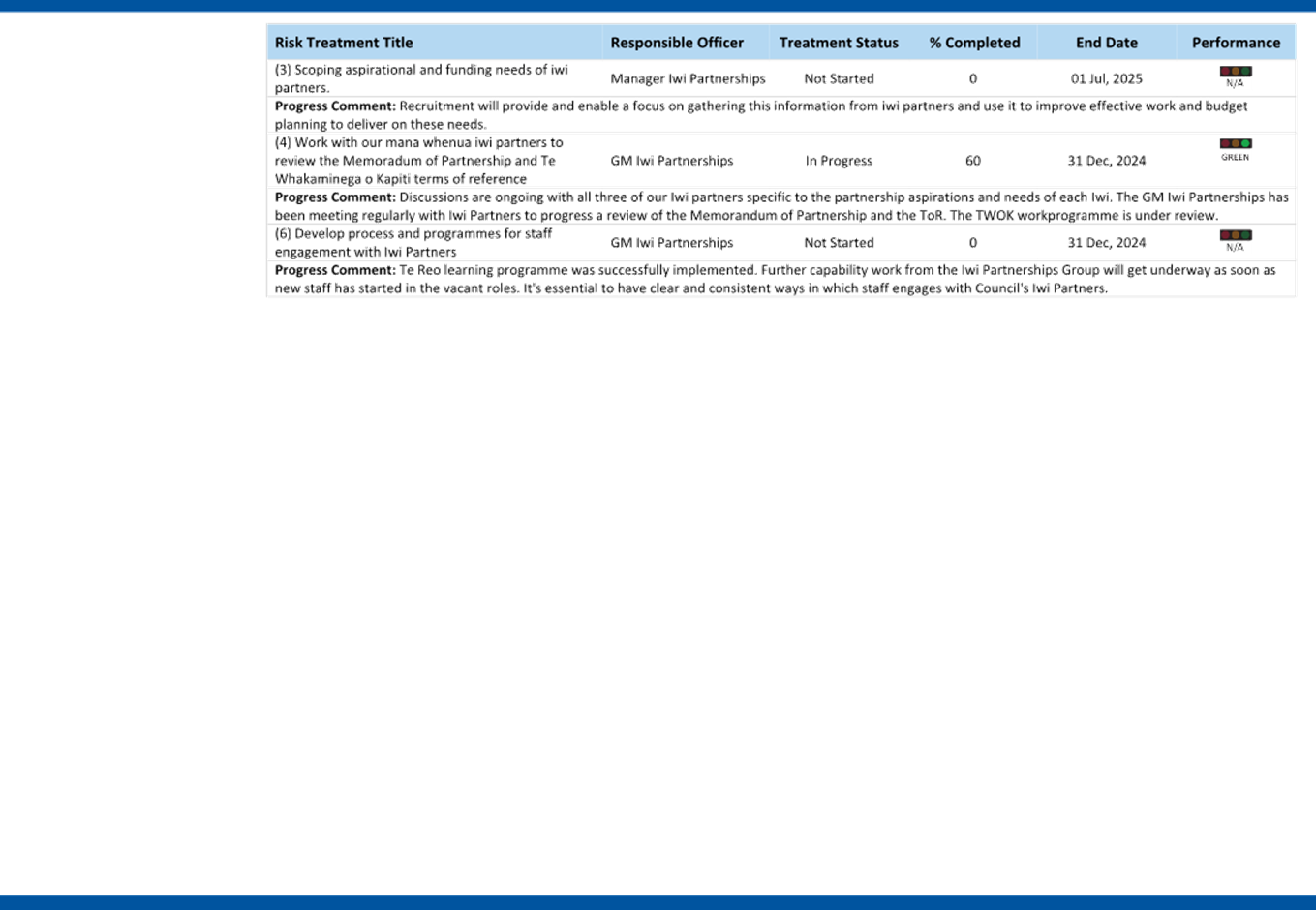
report provides an update of the current Top 10 Risks. The associated Risk
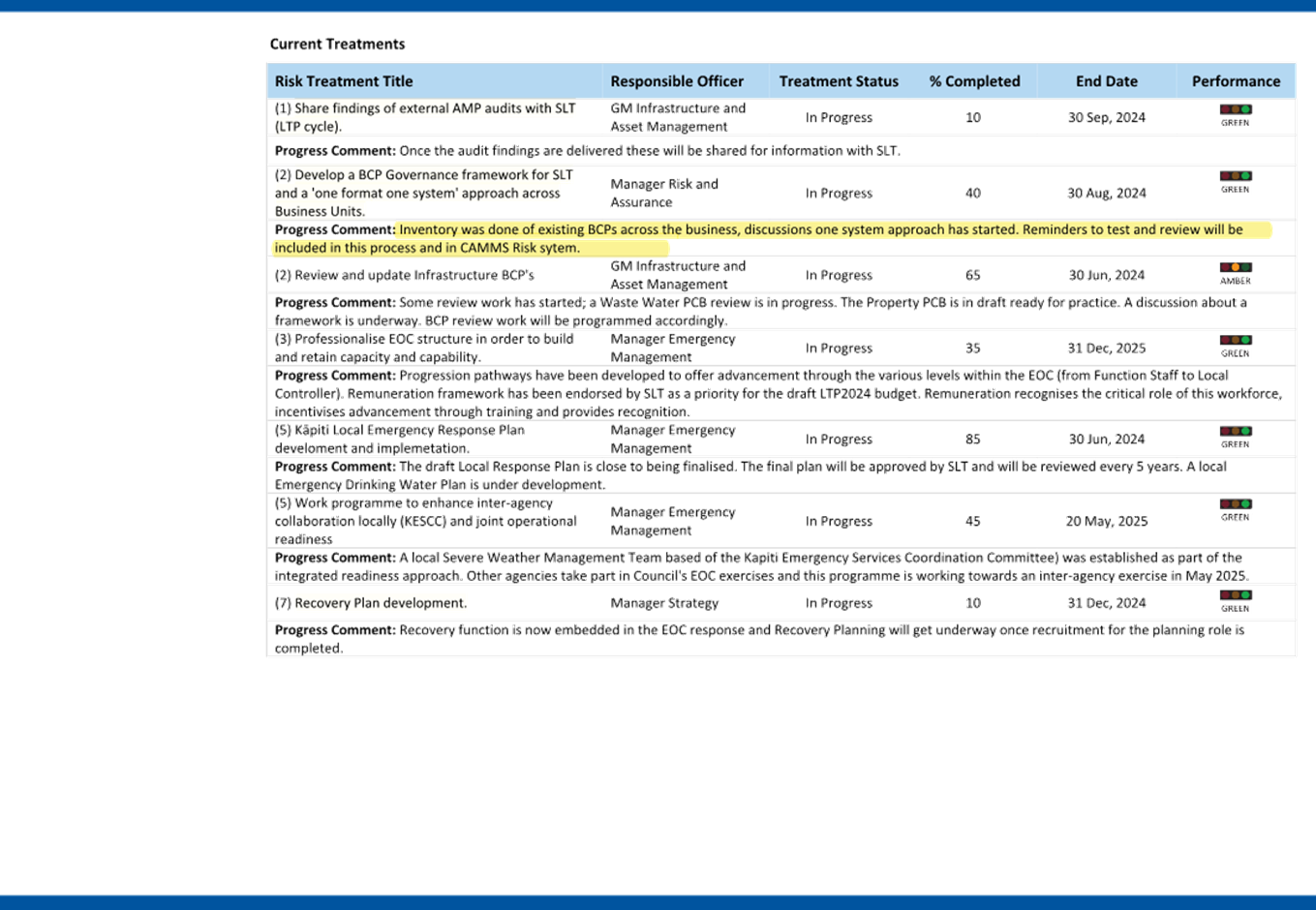
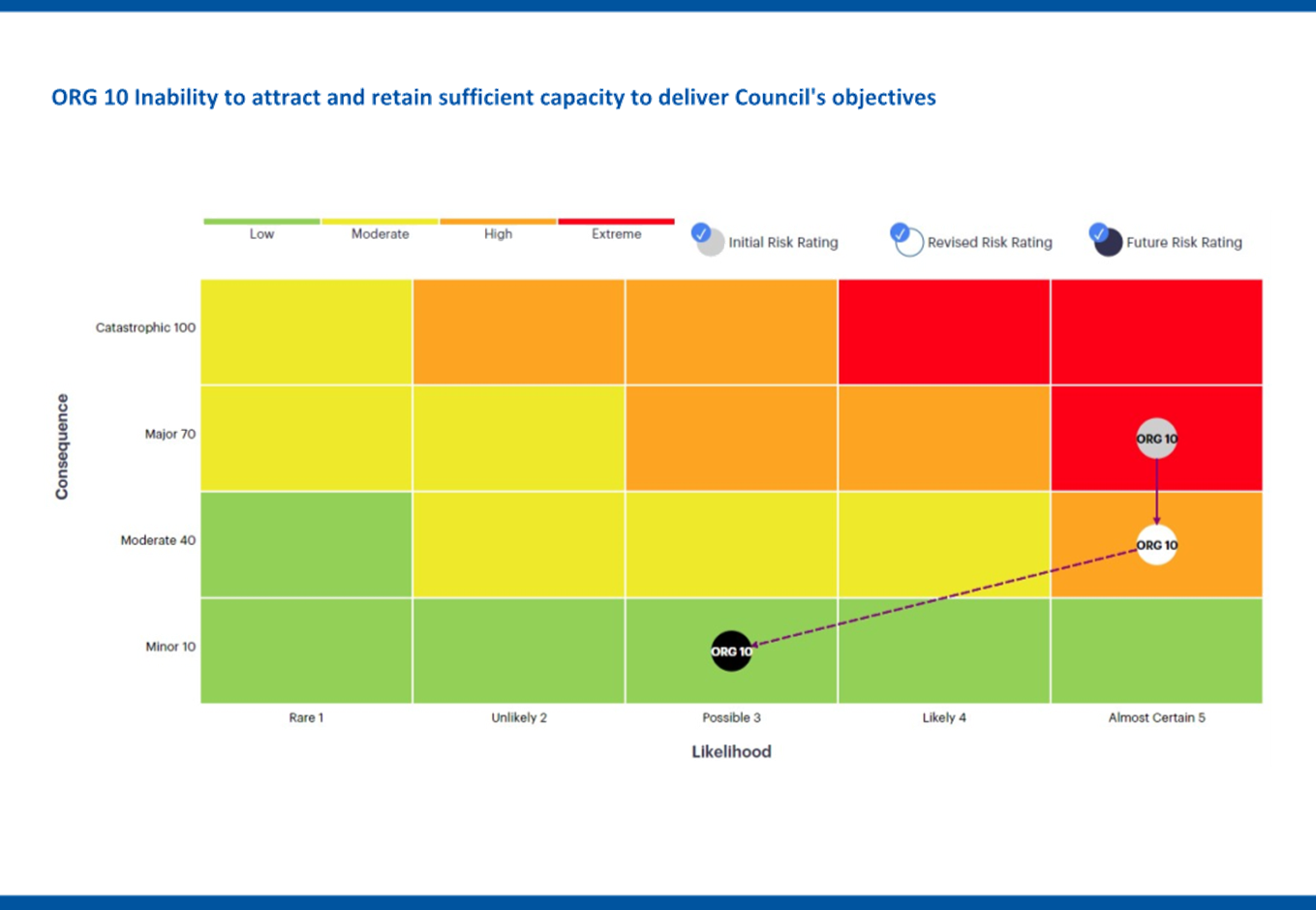
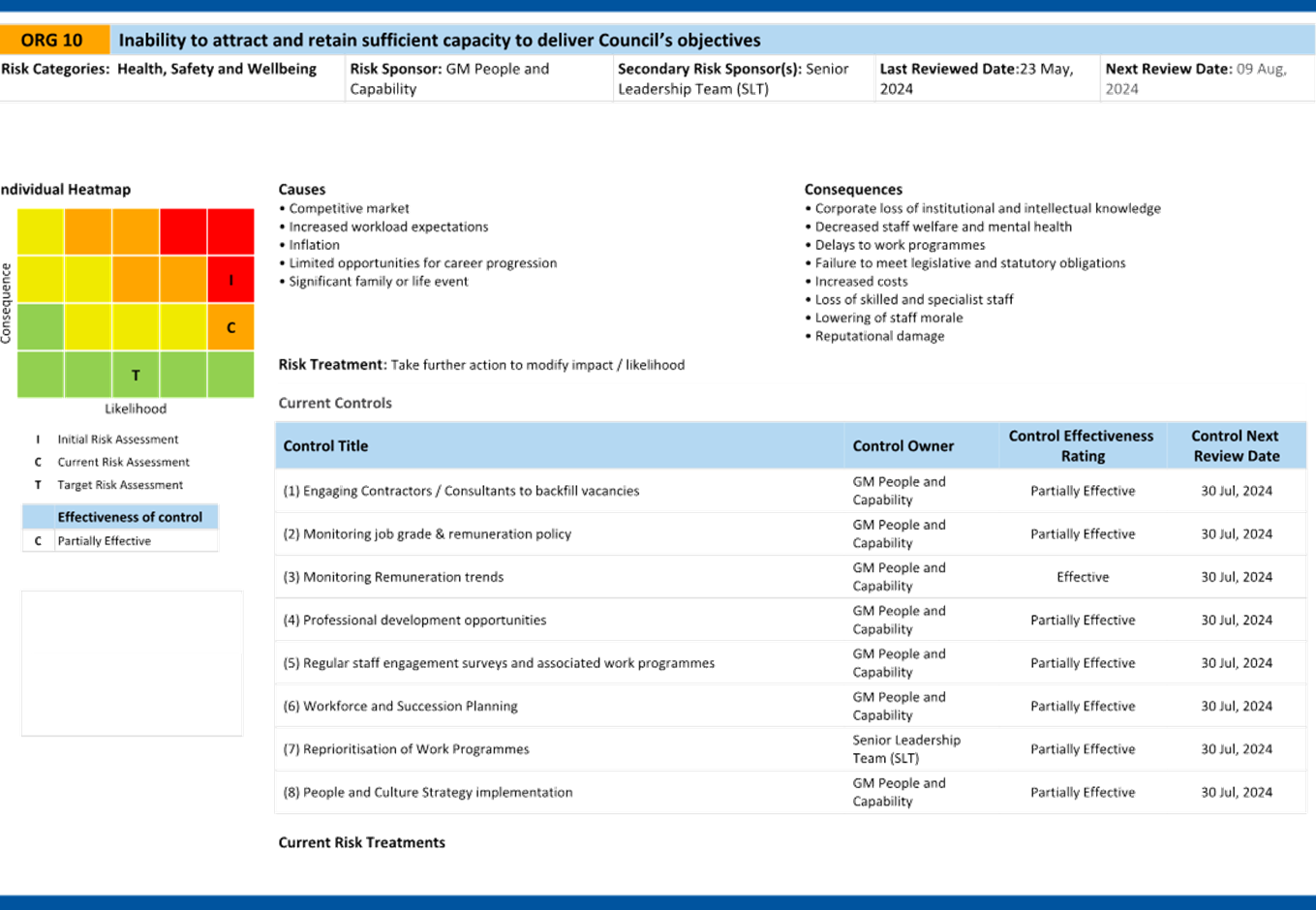
Heatmap Report (Appendix 1 to this report), details how the organisation
is treating and mitigating these risks, with progress updates against each of
the individual risk treatments.
Changes to Top 10 Organisational Risks
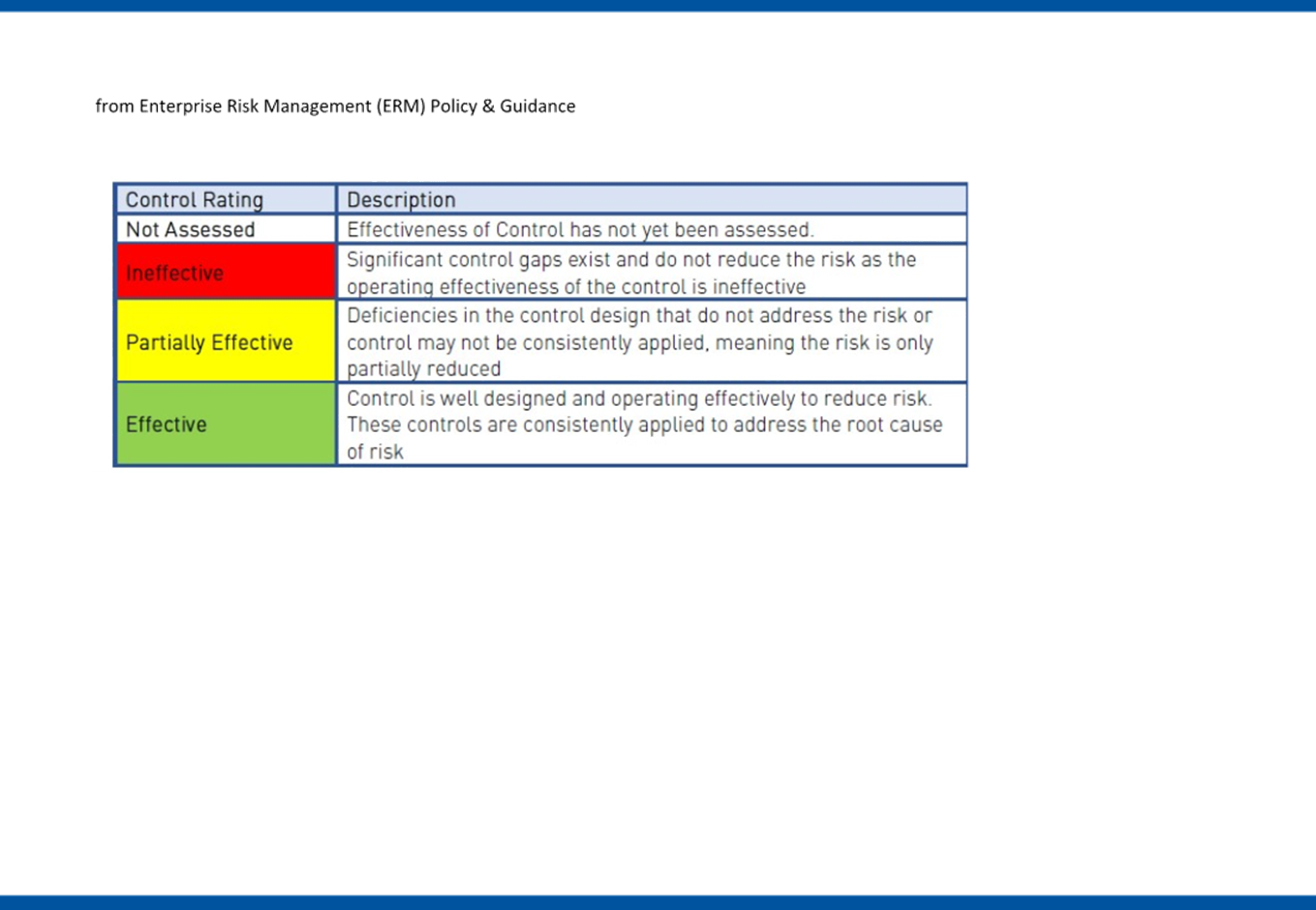
11 A
workshop with SLT in March 2024 discussed the effectiveness of controls in
place to mitigate the Top 10 Risks. For each control SLT considered whether a
control was operating as was intended, which is to reduce the likelihood and/or
impact of the risk. Controls rated ‘partially effective’ had new
treatments included and/or existing treatments extended to support increasing
the effectiveness of the control. These effectiveness ratings are included on
the last page of the Risk Heatmap Report in Appendix 1 to this report.
12 The
changes highlighted in the Risk Heatmap Report mainly relate to three themes
that emerged from the review and further discussions.
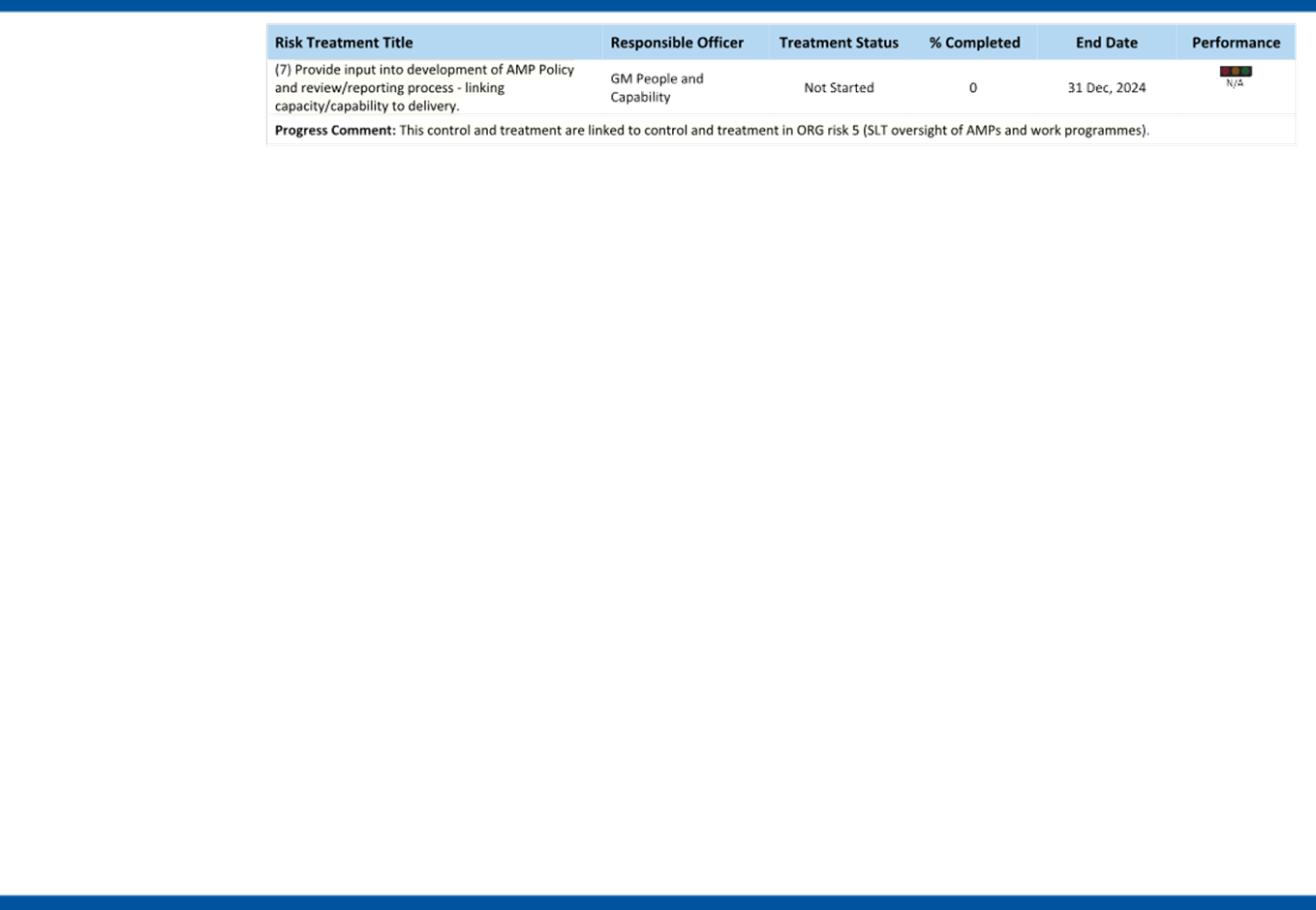
12.1 SLT oversight of Asset
Management Planning (AMP) should be improved and a new treatment has been added
to ensure this happens. The treatment includes developing an AMP Policy that
has a review and regular reporting process to SLT and this Committee.
12.2 Strategic alignment on large
(land) developments across the organisation is important and a treatment has
been put in place to refine and clarify current processes.
12.3 Continuous
staff education is required regarding key components of best practice work
delivery in alignment with policies and organisational values.
13 Also
changed are the likelihood ratings for Top 10 Risks’ 4 and 6, resulting
in these risks trending towards target in the Risk Summary Overview. The reason
for SLTs’ reconsideration was that the likelihood ratings seemed to
connect more with the actual event of climate change and government reform,
rather than with the risk that our organisation ‘fails to prepare for or
manage change.’
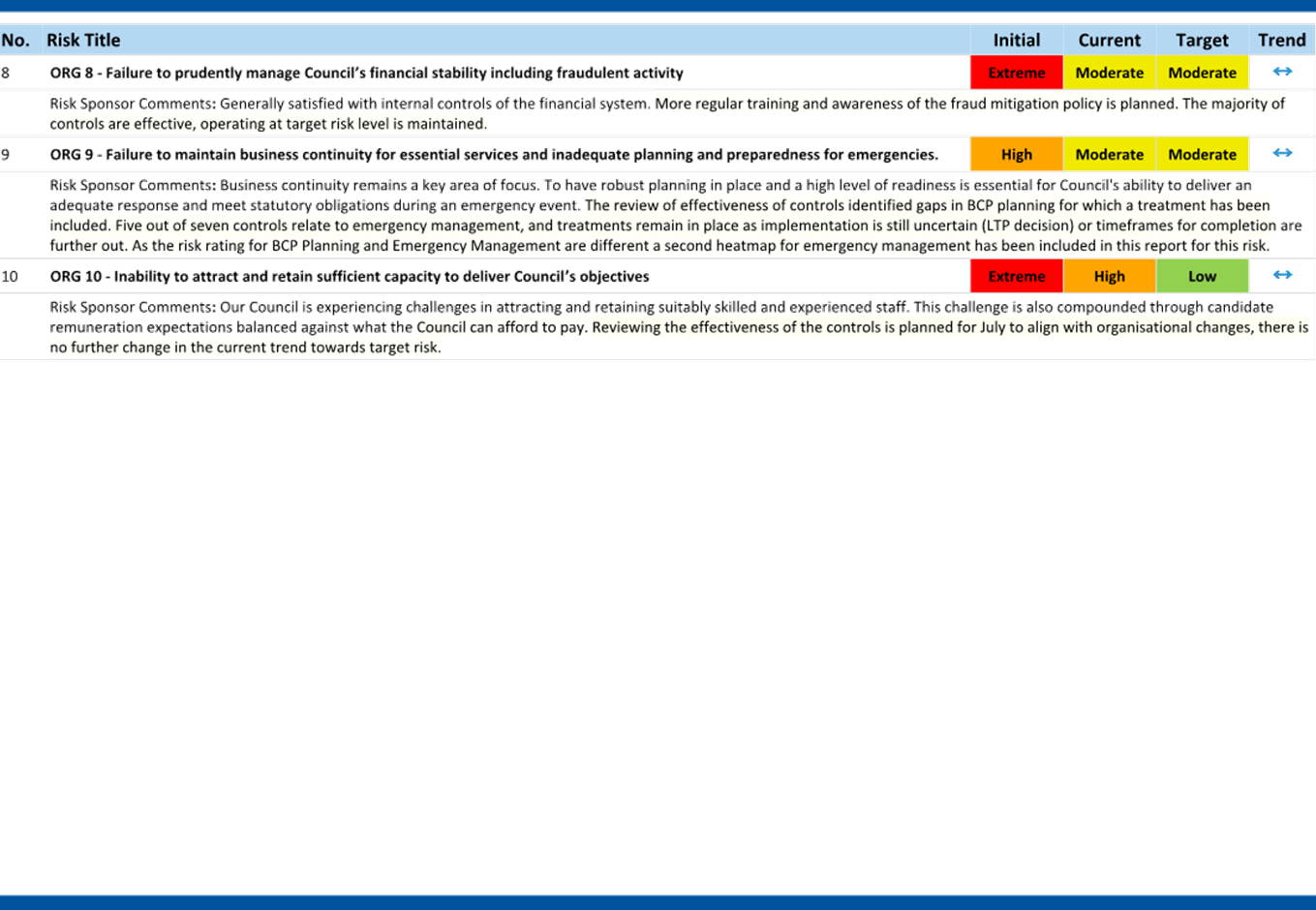
14 Following
inclusion of the risk of “inadequate planning and preparedness for
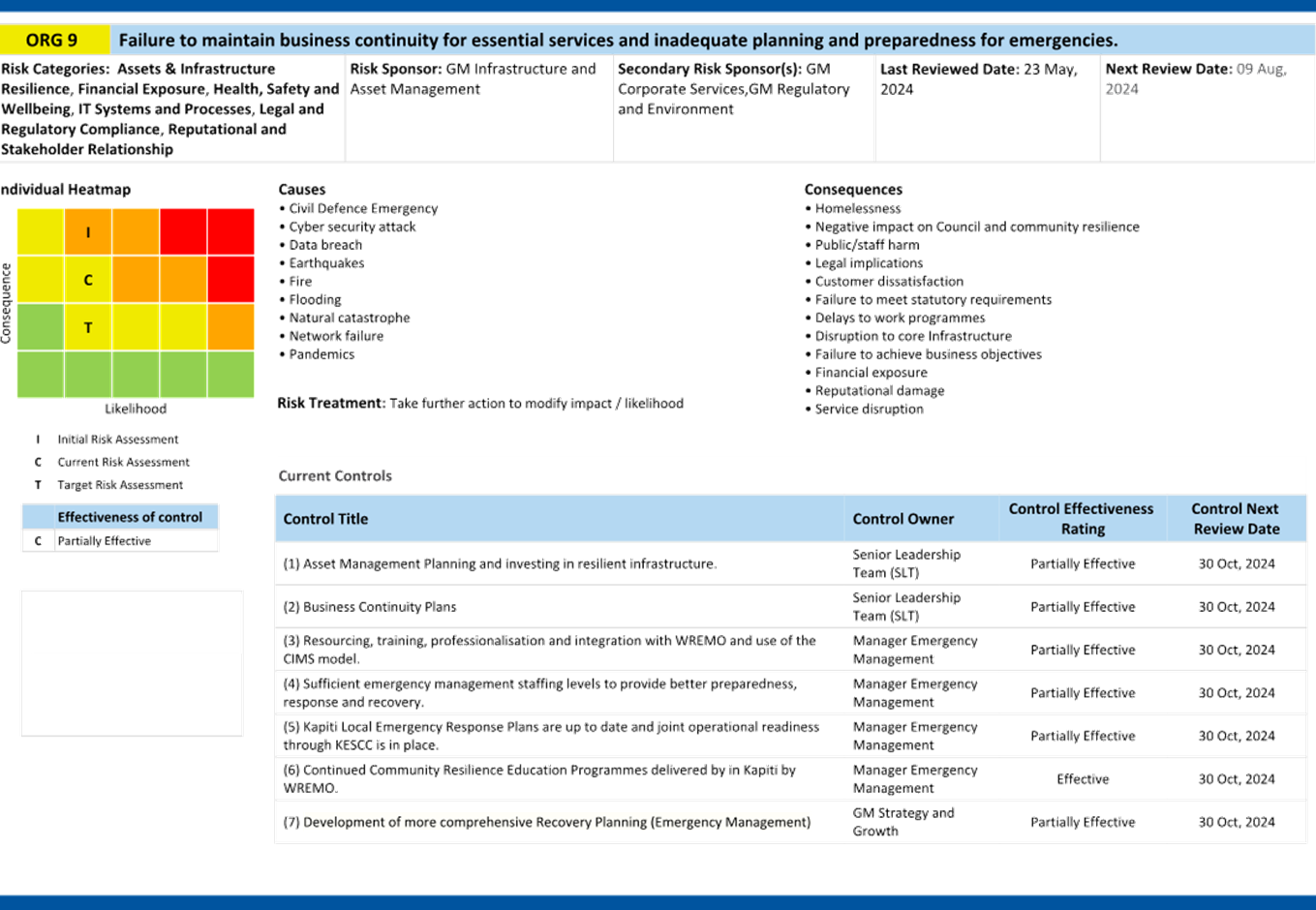
emergencies” into ORG 9 (as reported in February), the Risk Heatmap
Report has been updated. It now includes an additional heatmap as the
likelihood rating for Business Continuity Planning is different than for
Emergency Management given these processes are in different stages of
development.
He
take | Issues
15 There
are no issues to be raised in this report.
Ngā
kōwhiringa | Options
16 There
are no options to be raised in this report.
Tangata whenua
17 There
are no tangata whenua considerations arising in addition to those included in
Appendix 1 to this report.
Panonitanga āhuarangi | Climate change
18 There
are no climate change considerations arising in addition to those included in
Appendix 1 to this report.
Ahumoni me ngā rawa | Financial
and resourcing
19 There
are no further financial and resourcing considerations arising from this
report.
Ture me ngā Tūraru | Legal
and risk
20 There
are no further legal considerations arising from this report.
Ngā pānga ki ngā kaupapa here | Policy impact
21 There
are no further policy implications arising from this report.
Te whakawhiti
kōrero me te tūhono | Communications & engagement
Te mahere tūhono | Engagement planning
22 This
matter has a low level of significance under the Council’s Significance
and Engagement Policy.
Whakatairanga |
Publicity
23 There
are no publicity considerations.
Ngā āpitihanga | Attachments
1. Organisational
Top 10 Risk Heatmap Report 23 May 2024 ⇩
|
Risk and Assurance Committee Meeting Agenda
|
23 May 2024
|

|
Risk and Assurance Committee Meeting Agenda
|
23 May 2024
|
9.5 Internal Audit Work Programme - Progress Update
Kaituhi | Author: Sharon
Foss, Manager Risk and Assurance
Kaiwhakamana | Authoriser: Mark de Haast, Group Manager Corporate Services
Te
pūtake | Purpose
1 This report updates the Risk and Assurance Committee on the Internal Audit
function of Council.
He
whakarāpopoto | Executive
summary
2 This
report does not require an Executive Summary.
Te
tuku haepapa | Delegation
3 The Risk and Assurance Committee has
delegated authority to consider this report under section C.3 of the Governance
Structure and Delegations.
· Ensuring that Council has in place a current and comprehensive risk
management framework and making recommendations to the Council on risk
mitigation.
Taunakitanga | RECOMMENDATIONS
A. That
the Risk and Assurance Committee receives and notes the Internal Audit progress
update on the work programme for 2023/24.
Tūāpapa | Background
4 Internal
audit is line three of the ‘Four Lines of Defence’ model used in
the Risk and Assurance workstream.

5 Each of the four sources of assurance in the table above contribute
to the overall level of assurance provided and importantly by breaking them
down into four categories they can be integrated into everyday life at Council.
First line: Risks
are managed and controlled day-to-day. Assurance comes directly from those
responsible for delivering specific objectives or processes.
Second line: Council oversees the
control framework so that it operates effectively.
Third line: Internal
audit, providing reasonable (not absolute) assurance of the overall
effectiveness of governance, risk management and controls.
Fourth line: Assurance
from external independent bodies such as the external auditors and other
external bodies.
6 The 2024 internal audit work programme approved in February this
year by this Committee was set with reference to a range of sources including:
· the Office of the Auditor-General published resources and guidance,
· Audit NZ published resources and guidance,
· Ernst and Young (our “appointed auditor” appointed by
the Auditor-General) independent recommendations and control findings, and
· other observations made from internal audits.
7 In addition to the work programme, this
Committee receives two other reports on internal audits:
· this progress report on the internal audits
within the work programme; and
· a final outcomes report on the internal audits
completed in the past calendar year. This will report on internal audits
completed in 2024.
He
kōrerorero | Discussion
Third Line of
Defence (Internal Audit)
8 In accordance with both
the NZ Auditing Standards and our external auditors, EY, we use the following
risk ranking system when selecting which internal audits to conduct.
|
Internal Audit
- Risk Ranking System
|
|
High
|
Matters
and/or issues considered to be fundamental to the mitigation of
material risk, maintenance of internal control or good corporate governance.
|
|
Moderate
|
Matters
and/or issues considered to be of major importance to maintenance of
internal control, good corporate governance, or best practice for processes.
|
|
Low
|
A weakness which does not seriously
detract from the internal control framework.
|
Progress
9 The
following status categories update this Committee on progress made on the
internal audit work programme at the time of finalising this report.
|
Progress Status Categories
|
|
 Planned Planned
|
 Underway Underway
|
 Completed Completed
|
10 The progress on the Internal Audit
Work Programme is noted below.
|
Internal Audit Work Programme 2024
|
|
Risk Ranking
|
Activity
|
Status
|
Progress Status as of 14 May 2024
|
|
High
|
Compliance with Mitigation of Fraud Policy.
|

|
Completed
|
|
High
|
Compliance with Procurement Policy Framework.
|
|
Completed
|
|
High
|
Compliance
with Employee Code of Conduct document.
Audit
scope - Test the
fundamental principles and high-level rules that apply to employee conduct.
|

|
In progress
It was decided to separate this audit from the Conflict
of Interest audit.
The draft
report on Compliance with the Employee Code of Conduct is with the Group Manager, People and Capability for
consideration.
|
|
High
|
Review of
Employee Conflict of Interest Declarations.
Audit
scope - Test the fundamental
principles and high-level rules that apply to conflicts of interest.
|
|
In progress
It was decided to separate this audit from the Employee
Code of Conduct audit.
The draft report on the review of Employee Conflict of Interest is with the GM, People and Capability for
consideration.
|
|
High
|
Compliance with General Expenses Policy.
Audit
scope - Test compliance
with selected internal controls within the General Expenses Policy
|
|
In
progress
|
|
Moderate
|
Compliance
with Receipt of Gifts and Hospitality Policy.
Audit scope - Test compliance with rules that apply
to Receipt of Gifts and Hospitality.
|
|
In progress
|
|
Moderate
|
Compliance
with Protected Disclosures (Protection of Whistleblowers) Policy.
Audit scope - Test the rules that apply to protecting
disclosures (protection of whistleblowers).
|
|
Planned for June 2024.
|
|
Moderate
|
External Audit (Ernst & Young) 2022/23 - Control Findings.
Follow up on
recommendations.
|
|
Ongoing F/Y 2022/23
See Progress Update Regarding Audit
Control Findings 2022/23 report on this agenda.
|
|
Low
|
Review preparedness for business interruption and
continuously improve.
|
|
Ongoing.
|
He take | Issues
11 There
are no issues to be raised in this report.
Ngā kōwhiringa | Options
12 There
are no options to be raised in this report.
Tangata whenua
13 There
are no tāngata whenua considerations arising from this report.
Panonitanga āhuarangi | Climate change
14 There are no climate change issues arising
from this report.
Ahumoni me ngā rawa | Financial and resourcing
15 There are no further financial and resourcing considerations
arising from this report.
Ture me ngā Tūraru | Legal and risk
16 There
are no legal considerations arising from this report.
Ngā pānga ki ngā kaupapa here | Policy impact
17 There
are no policy implications arising from this report.
Te
whakawhiti kōrero me te tūhono |
Communications & engagement
Te
mahere tūhono | Engagement planning
18 This
matter has a low level of significance under the Council’s Significance
and Engagement Policy.
Whakatairanga | Publicity
19 There
are no publicity requirements or considerations arising from this report.
Ngā āpitihanga |
Attachments
Nil
|
Risk and Assurance Committee Meeting Agenda
|
23 May 2024
|
9.6 Legislative
Compliance 1 January to 31 March 2024
Kaituhi |
Author: Sarah
Wattie, Governance & Legal Services Manager
Kaiwhakamana
| Authoriser: Mark de Haast, Group Manager Corporate Services
Te pūtake |
Purpose
1 The
purpose of this report is to notify the committee of legislative non-compliance
in the third quarter of the financial year, 1 January 2024 to 31 March 2024.
He
whakarāpopoto | EXecutive summary
2 An
executive summary is not required.
Te tuku haepapa
| Delegation
3 The
Risk and Assurance Committee has delegated authority to consider this report
under section C3 of the Governance Structure and Delegations document for the
2022-2025 triennium. These delegations include:
3.1 ensuring
that Council has in place a current and comprehensive risk management framework
and making recommendations to the Council on risk mitigation.
3.2 assisting
elected members in the discharge of their responsibilities by ensuring
compliance procedures are in place for all statutory requirements relating to
their role.
Taunakitanga | RECOMMENDATIONS
A. That
the Committee:
A.1 notes
legislative non-compliance for the third quarter of the financial year from 1
January 2024 to 31 March 2024 as outlined in Attachment 1 to this report.
Tūāpapa | Background
4 Local
government is governed by a complex statutory framework with the Council
responsible for a range of legislative requirements. Legislative compliance is
important to Council carrying out its functions under the Local Government Act
2002 in a fair and effective manner that is accountable to the local community.
Failure to achieve Council’s legislative obligations has also been
identified as one of Council’s top 10 risks.
5 Each
quarter key Council staff responsible for Council’s compliance with legal
obligations under different Acts are asked to complete a quarterly declaration
of known non-compliance with legislative requirements and key assurance areas
being privacy, procurement, authorised expenditure, cyber security and Local
Government Official Information and Meetings Act 1987 (LGOIMA) requirements.
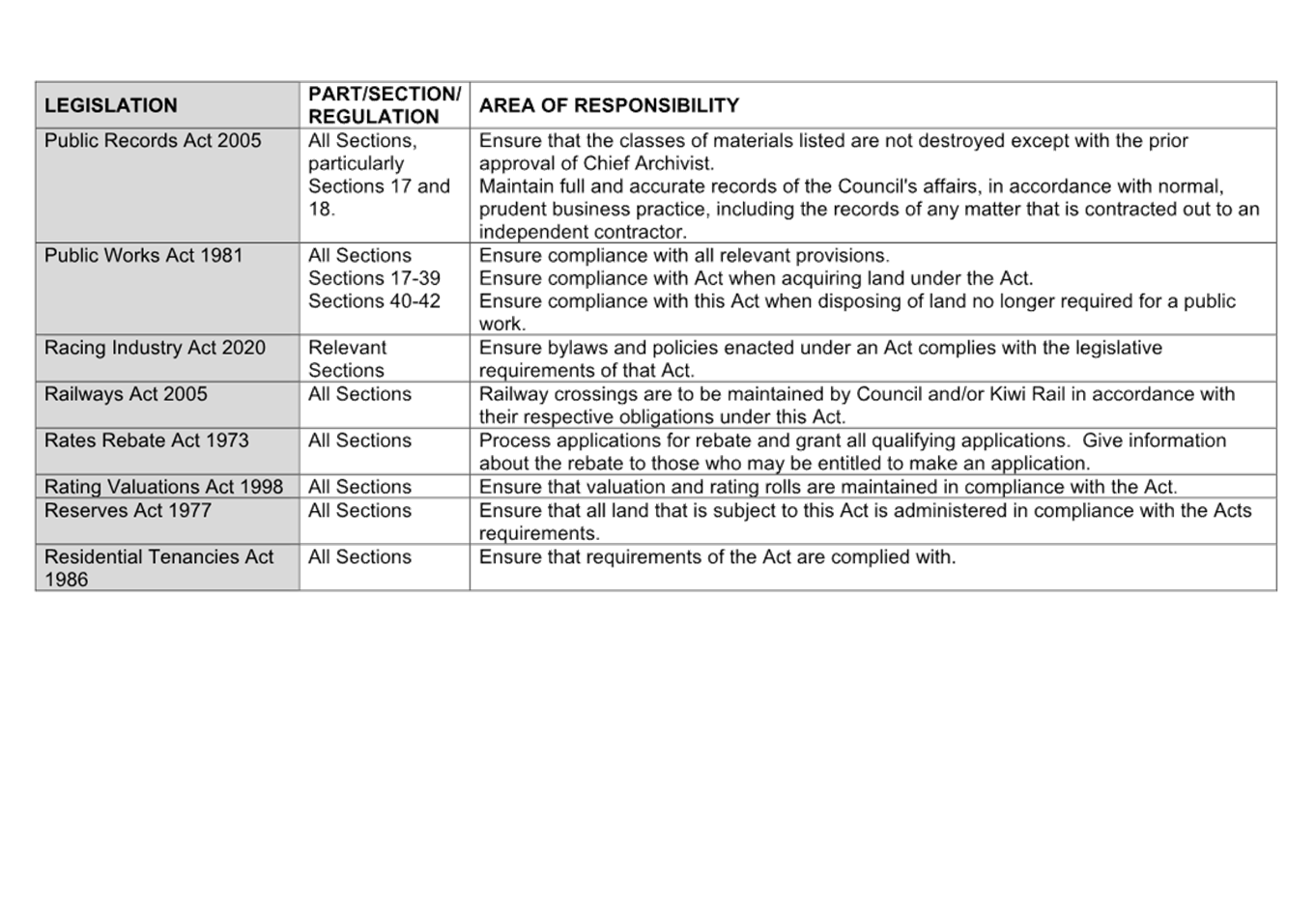
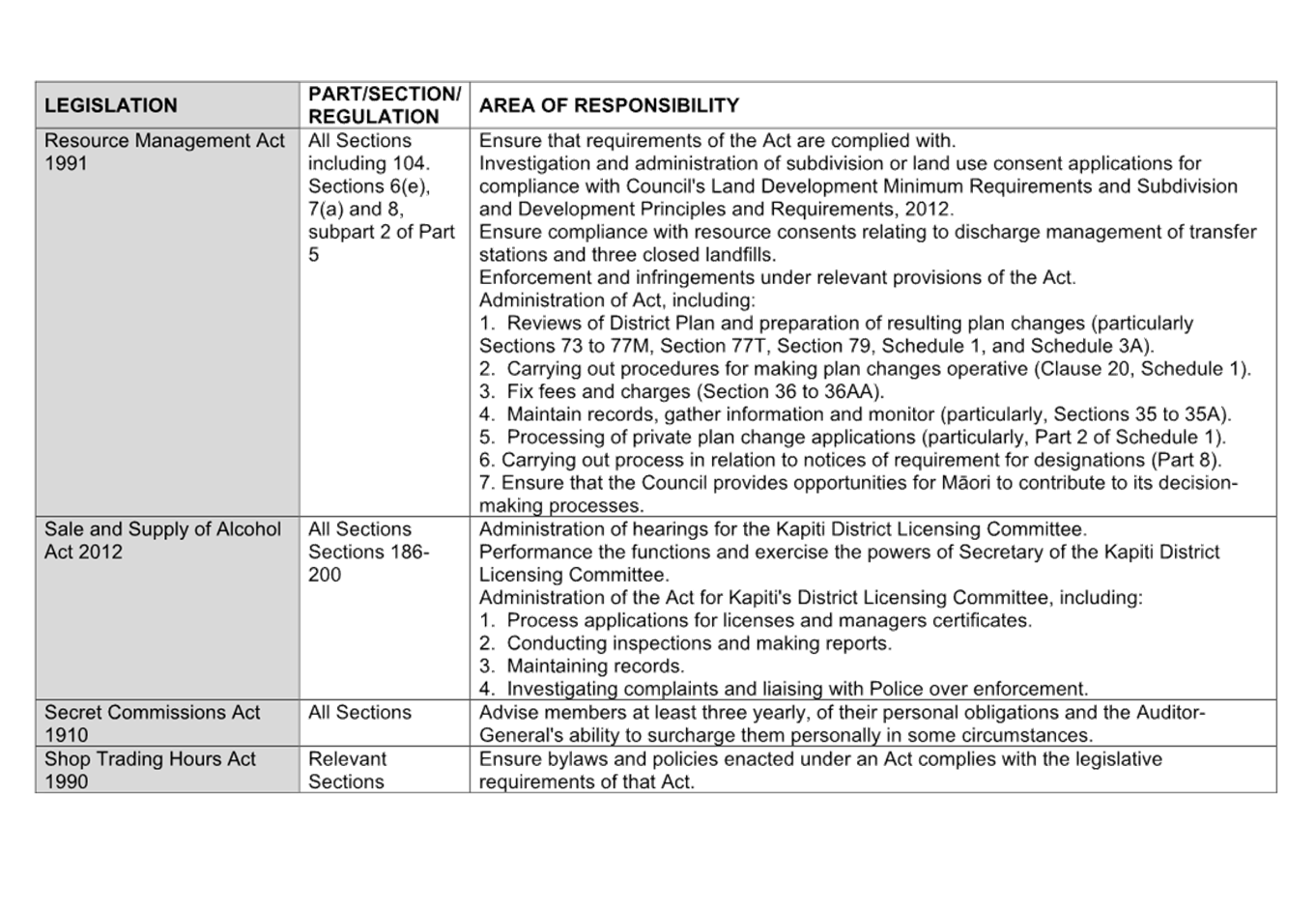
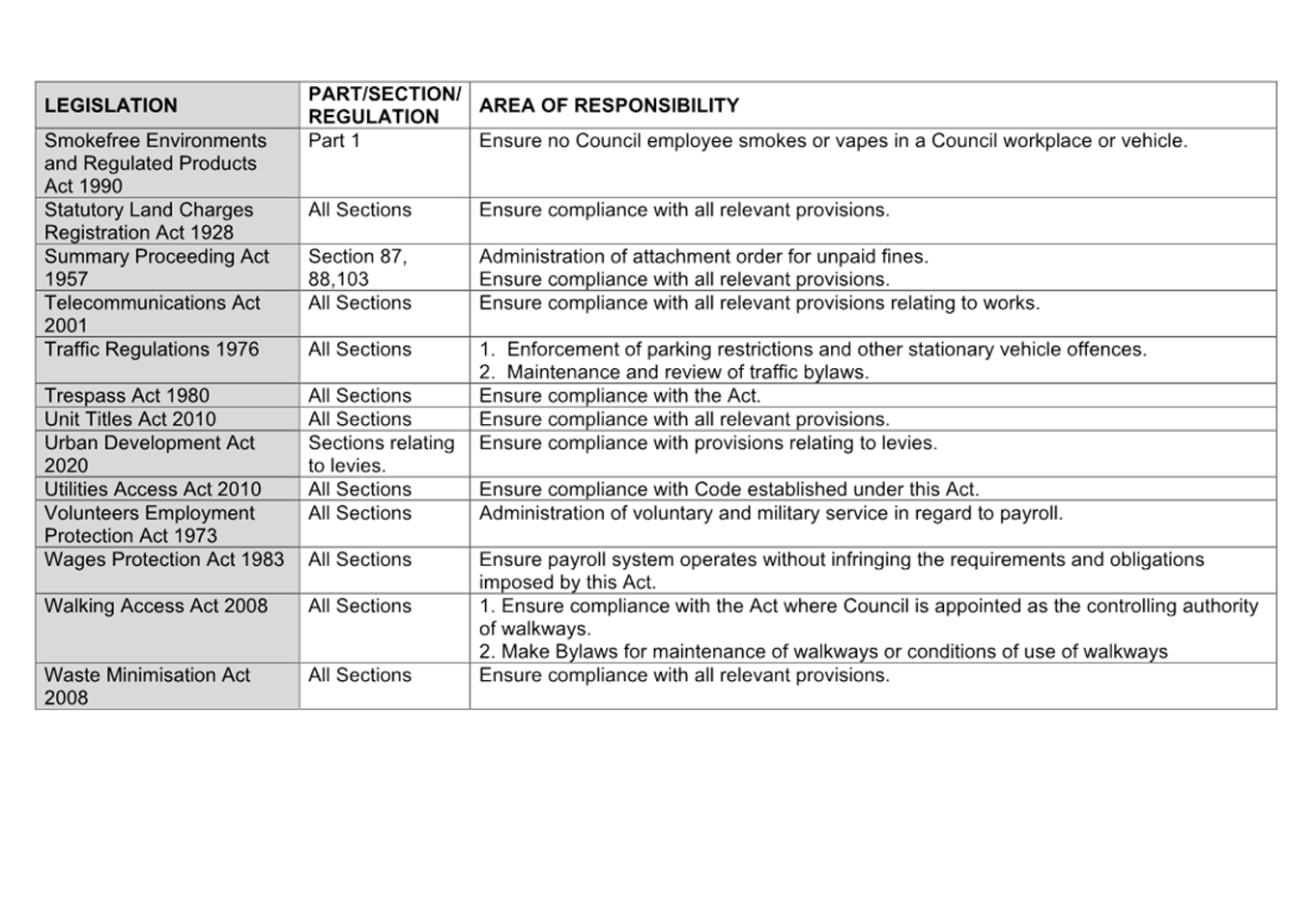
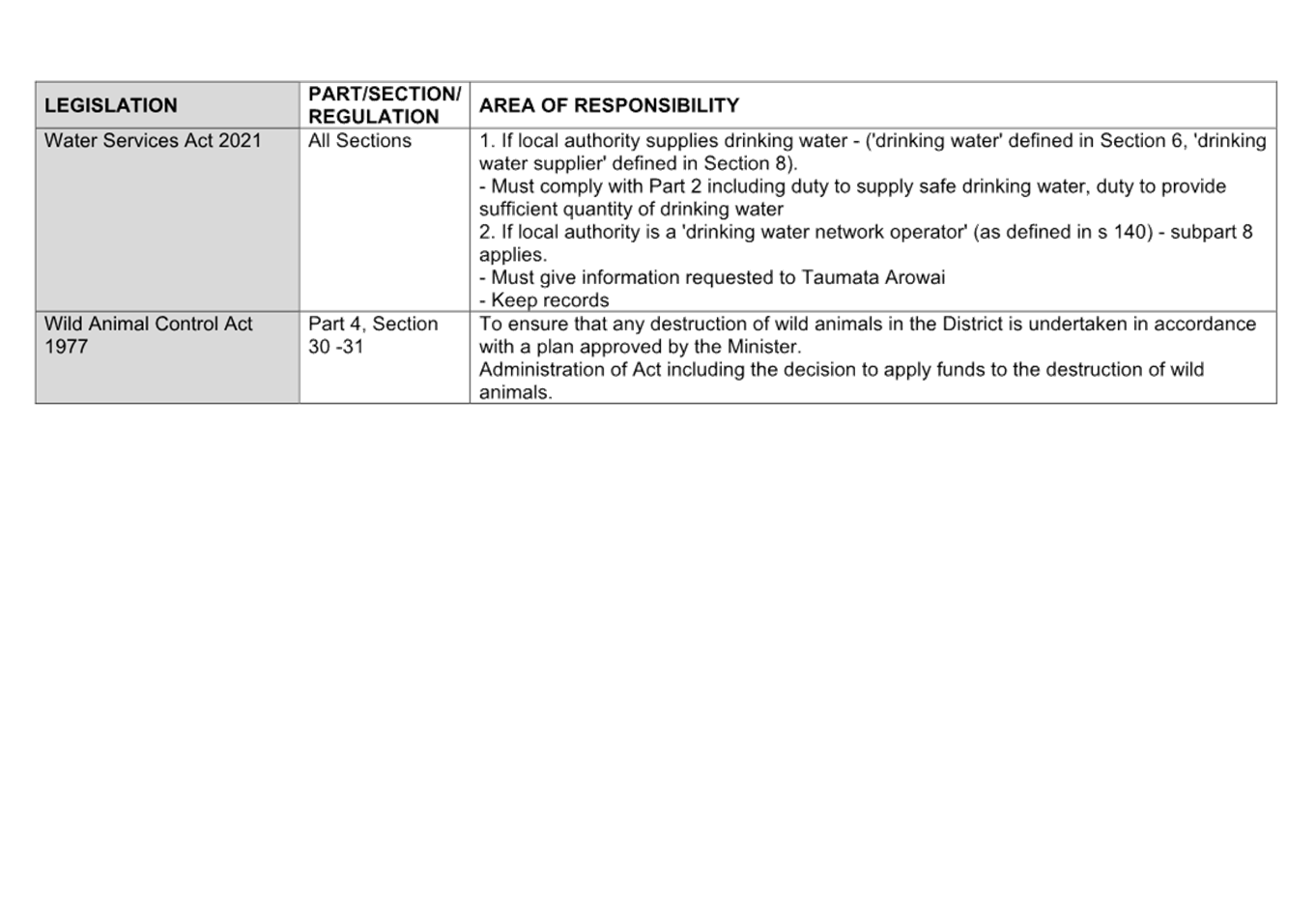
6 Council
staff are asked to report against all applicable legislation. A legislative
compliance schedule exists to assist staff in completing this declaration, set
out in Attachment 2 to this report. Council’s external auditors have
identified the following legislation and regulations where non-compliance could
have a fundamental effect on operations:
· Local Government
Act 2002
· Local Authorities
(Members’ Interests) Act 1968
· Local Government
(Rating) Act 2002
· Local Government
(Financial Reporting and Prudence) Regulations 2014
· Building Act 2004
· Resource
Management Act 1991.
He
kōrerorero | Discussion
7 This
section sets out legislative compliance breaches for the third quarter of the
financial year, 1 January 2024 to 31 March 2024, against all applicable
legislation with risk ratings, corrective actions and status assigned for each
breach. It also provides an assurance against key assurance areas outlined
above being privacy, procurement, authorised expenditure, cyber security and
LGOIMA.
Organisational
Risk Levels
8 Organisational
risks levels have been assigned to legislative compliance breaches reported to this
Committee based on Council’s organisational risk framework. The risk
levels are set out below:
|
Organisational Risk Levels
|
|
High
|
· Matters and/or
issues considered to be fundamental to the mitigation of material risk,
maintenance of internal control or good corporate governance.
|
|
Moderate
|
· Matters and/or
issues considered to be of major importance to maintenance of internal
control, good corporate governance, or best practice for processes.
|
|
Low
|
· A weakness which does not seriously detract from the internal
control framework.
|
Key
Assurance Areas
9 The
Risk and Assurance Committee has requested the following key assurance areas be
reported on in additional to legislative compliance:
· Privacy
breach: A privacy breach is not meeting the requirements of the Privacy Act
2020 which may include releasing personal information to someone not authorised
to receive it or using personal information in an unauthorised way.
· Procurement
breach: A procurement or probity breach is a failure to follow the
requirements of Council’s procurement policy, which sets out the
requirements for our staff to ensure they carry out procurement in a way that
is transparency, accountable, impartial and equitable.
· Unauthorised
expenditure: Unauthorised expenditure is expenditure that breaches
Council’s finance and purchasing policies, such as a staff member
spending money without the appropriate financial delegation.
· Cyber
security breach: A cyber security breach is a breach of Council’s
information security systems which may result in the disclosure of sensitive,
personal or commercial information to persons who are not authorised to receive
the information or members of the public.
· Local
Government Official Information and Meetings Act 1987 (LGOIMA): A breach of
this act relates to failure to meet deadlines or requirements for official
information requests or transparency and notification requirements relating to
Council meetings.
10 Confidential
investigations are not included in this legislative compliance report and will
be reported in public excluded where required.
11 Table
1: Assurance against key risk areas
|
Risk area
|
Description
|
|
Privacy
|
There were six privacy breaches reported in the period,
two of which were related to breaches by other organisations.
|
|
Procurement
|
There were no reported procurement breaches in the period.
|
|
Unauthorised expenditure
|
There was no reported unauthorised expenditure in the
period.
|
|
Cyber security
|
There were no reported cyber security breaches in the
period.
|
|
LGOIMA
|
There was one breach of requirements under the LGOIMA
(official information and meeting requirements) in the period.
|
12 The
Privacy Commissioner’s Privacy Week 2024 took place from the13 -17 May
2024 and a series of communications, guidance and events accessible to all
staff were provided to highlight the importance of privacy.
Legislative
Compliance Breaches
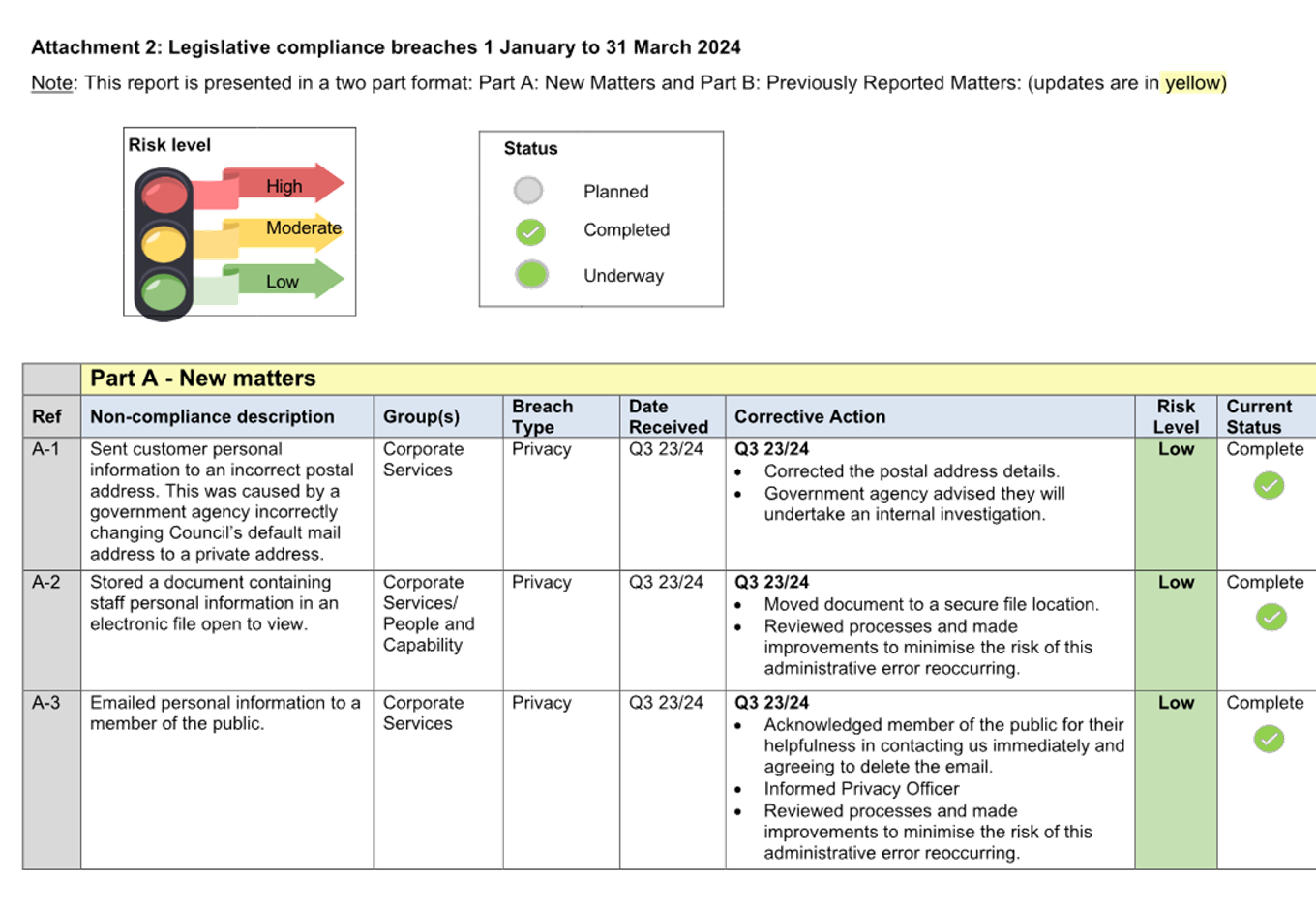
13 Legislative
compliance breaches for the third quarter of the financial year are set out in
Attachment 1 to this report. These include ongoing
breaches previously reported to this Committee.
He
take | Issues
14 There
are no issues for this report.
Ngā
kōwhiringa | Options
15 There
are no options required for this report.
Mana whenua
16 Council
has a partnership with local iwi and hapū on the Kāpiti Coast
District represented by Te Rūnanga O Toa Rangātira, Ngā
Hapū o Ōtaki and Āti Awa ki Whakarongotai Charitable Trust.
17 Council’s
accountability to the community on legislative compliance extends to its
partnership with iwi and commitments made to reflect the obligations under Te
Tiriti o Waitangi, as well as other obligations to Māori, mana whenua and
tangata whenua under the Local Government Act 2002, Resource Management Act
1987 and other legislation.
Panonitanga āhuarangi | Climate change
18 There
are no climate change implications arising directly from this report.
Ahumoni me ngā rawa | Financial
and resourcing
19 There
are no financial implications arising directly from this report.
Tūraru ā-Ture me te Whakahaere
| Legal and Organisational Risk
20 Except
for the issues noted in this report, there are no other legal or risk
implications.
Ngā pānga ki ngā kaupapa here | Policy impact
21 There
are no policy implications arising directly from this report.
TE whakawhiti kōrero me te
tūhono | Communications &
engagement
22 This
report is for the purpose of providing information only and does not trigger
the Council’s Significance and Engagement policy.
Te mahere tūhono | Engagement
planning
23 There
is no requirement for engagement planning.
Whakatairanga |
Publicity
24 There
are no additional publicity considerations arising directly from this
report.
Ngā āpitihanga | Attachments
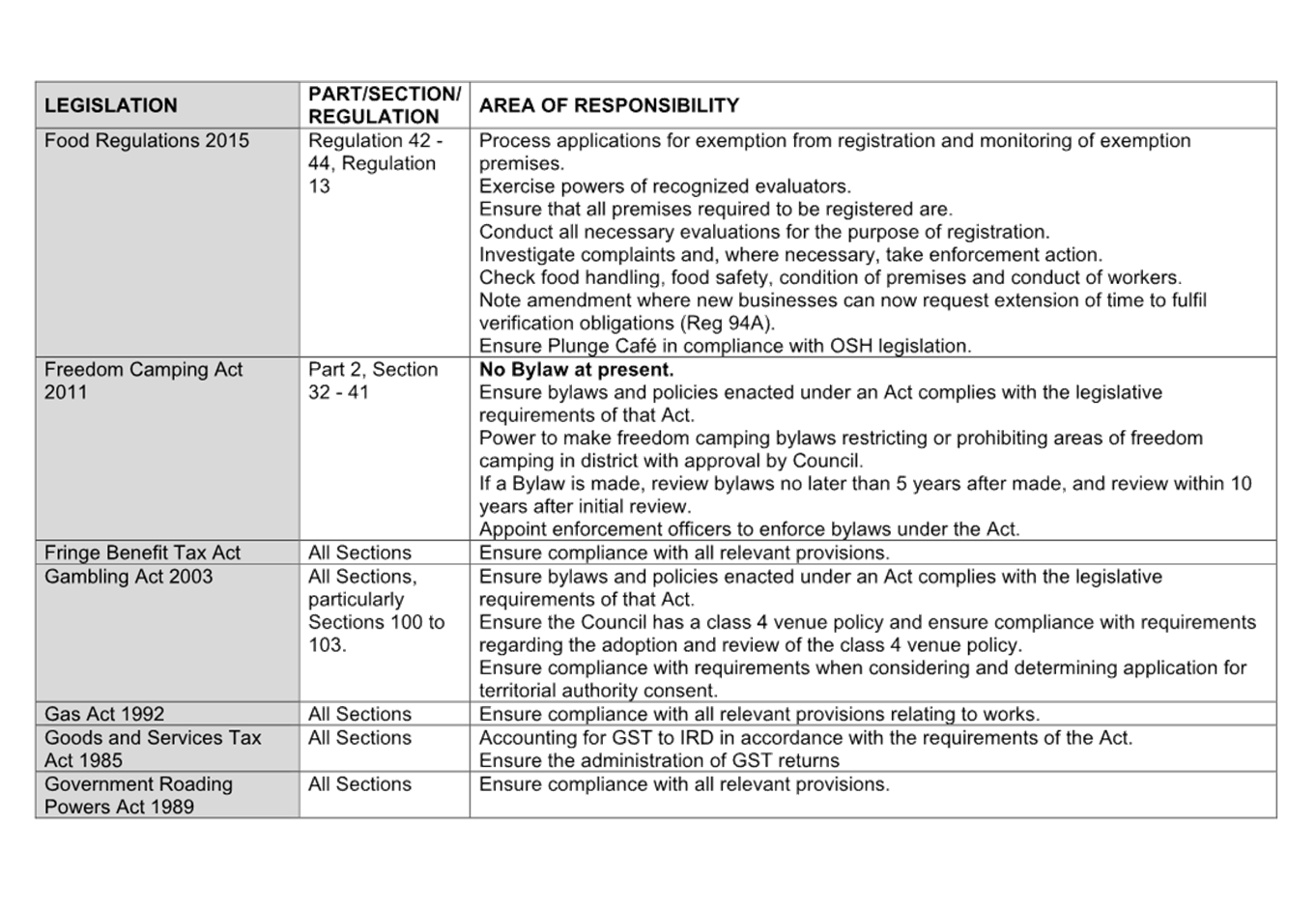
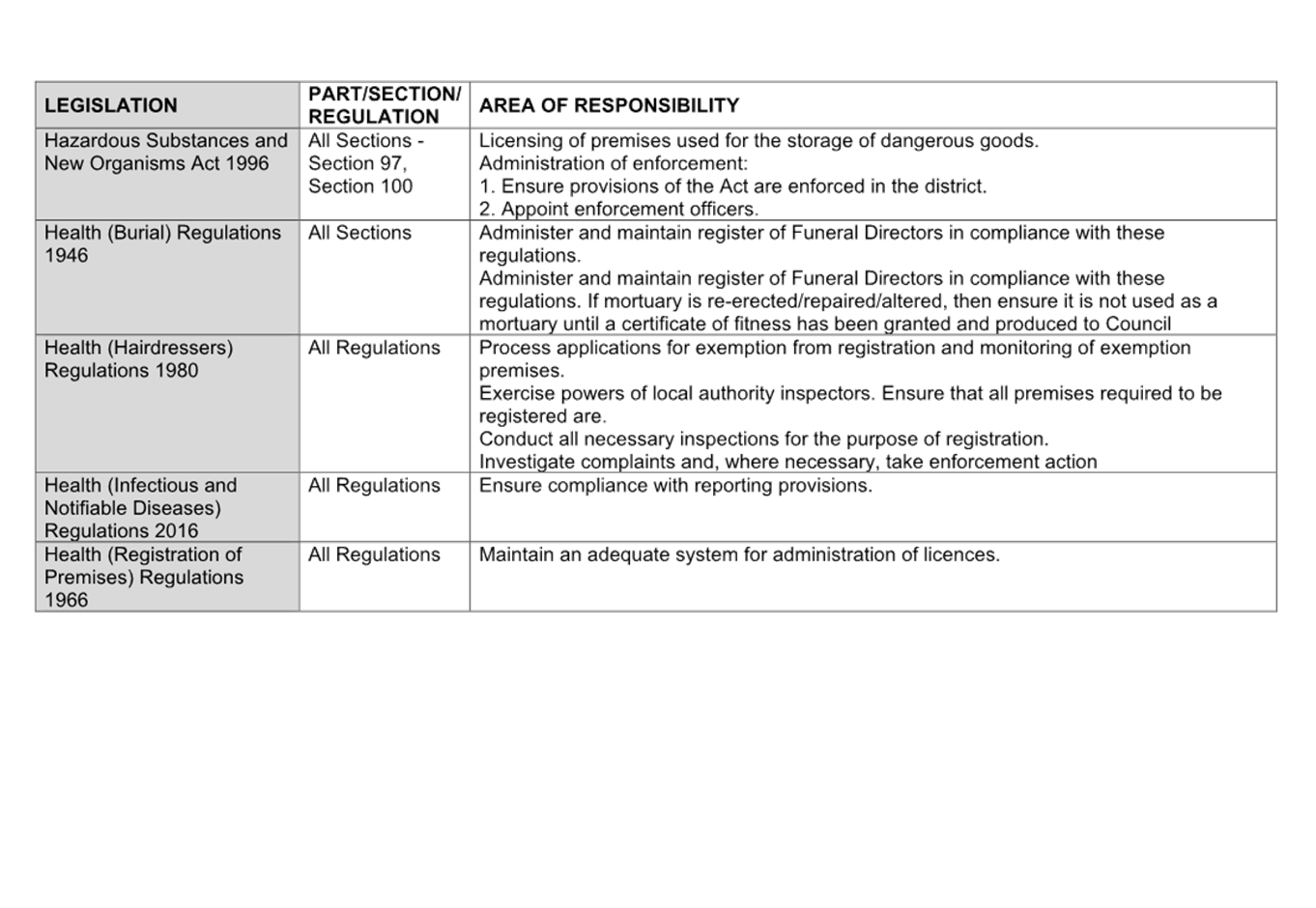
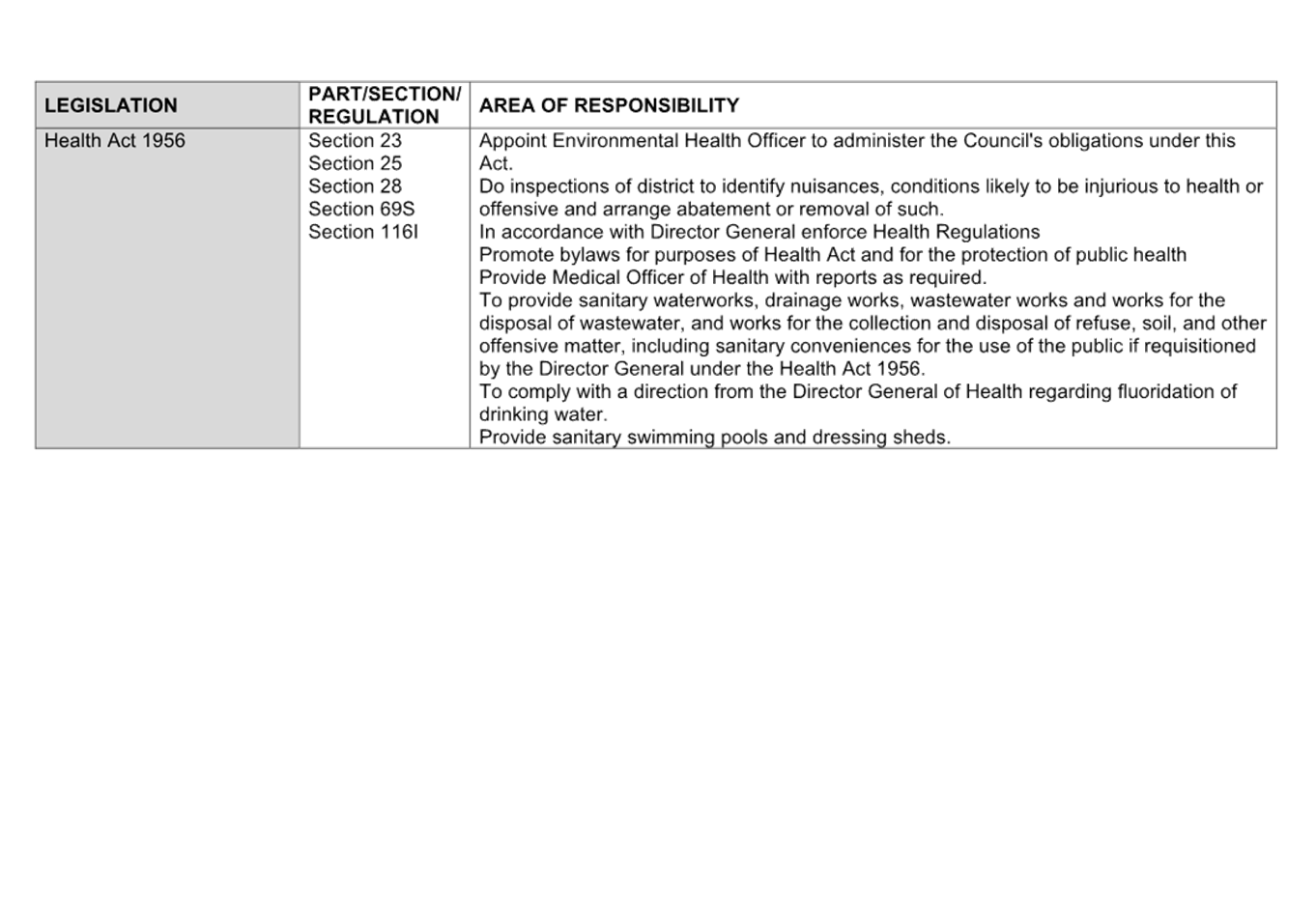
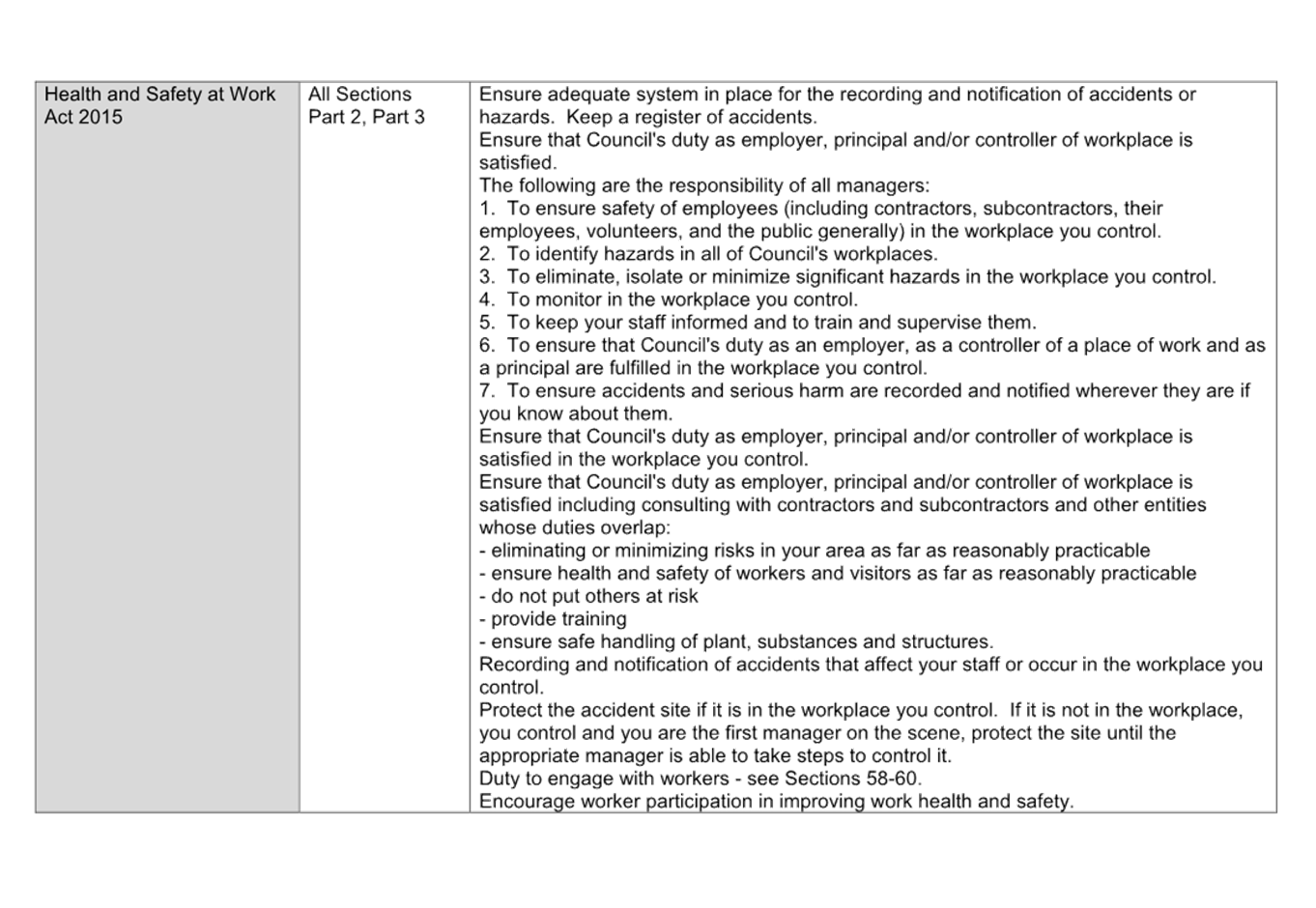
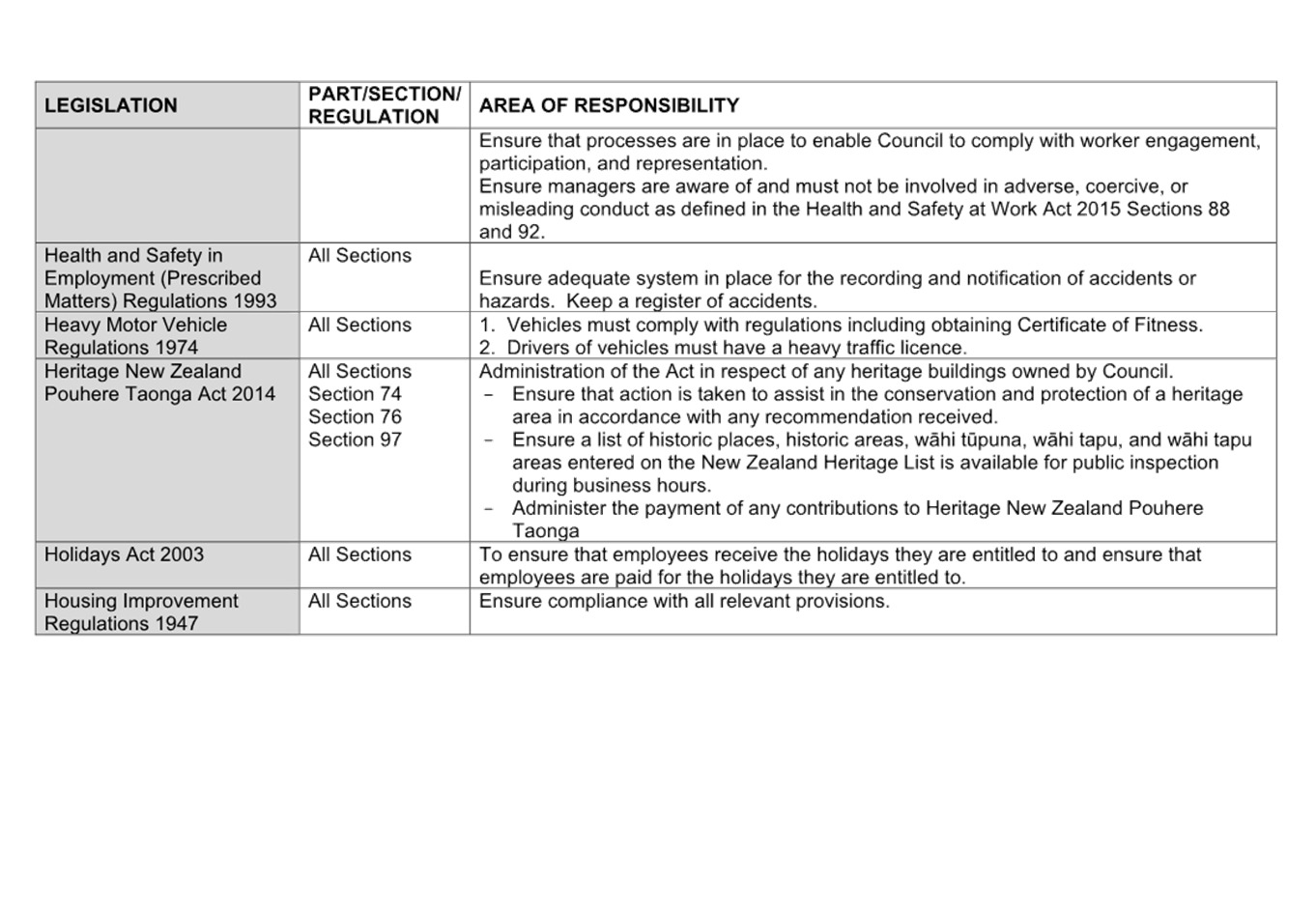
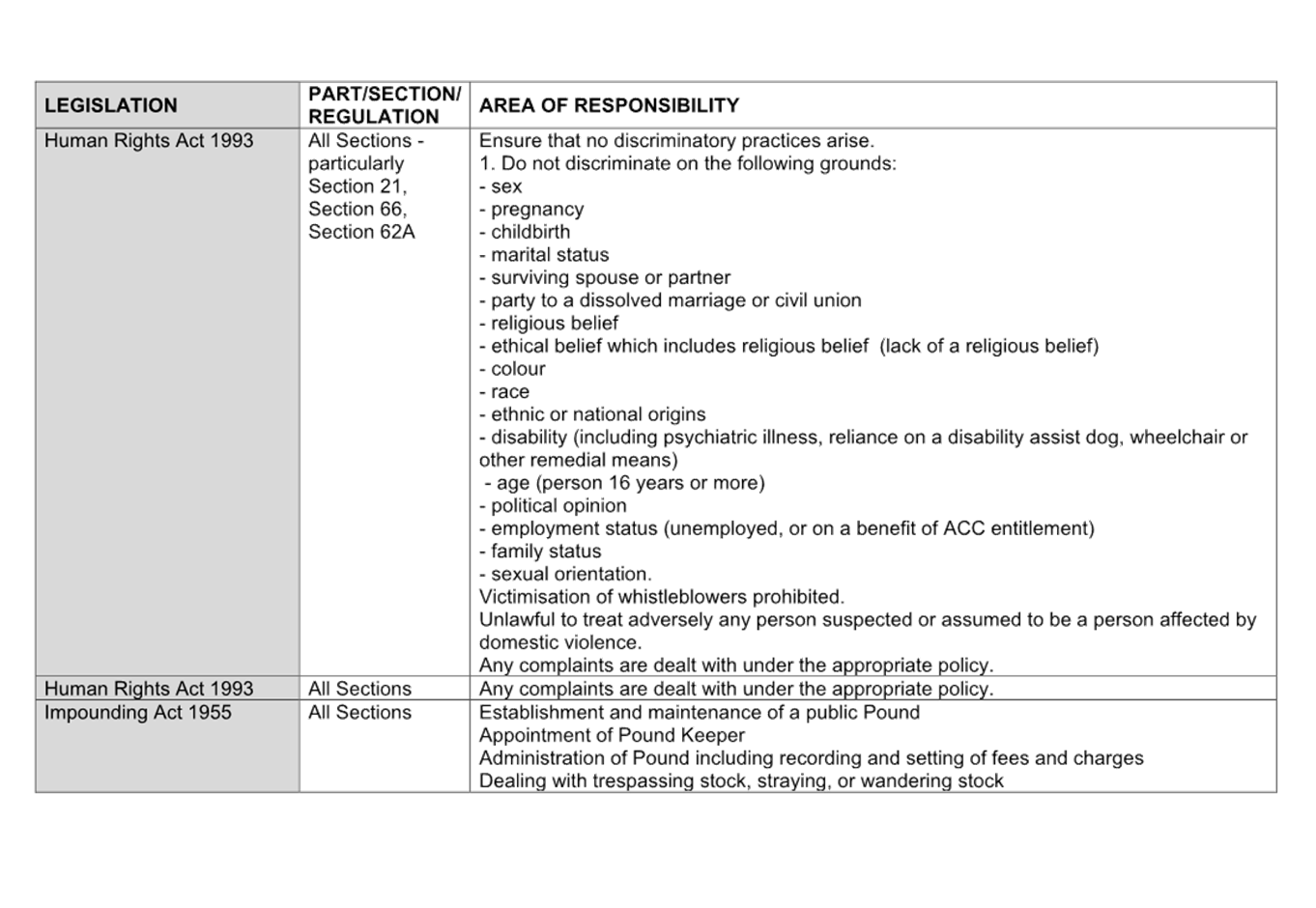
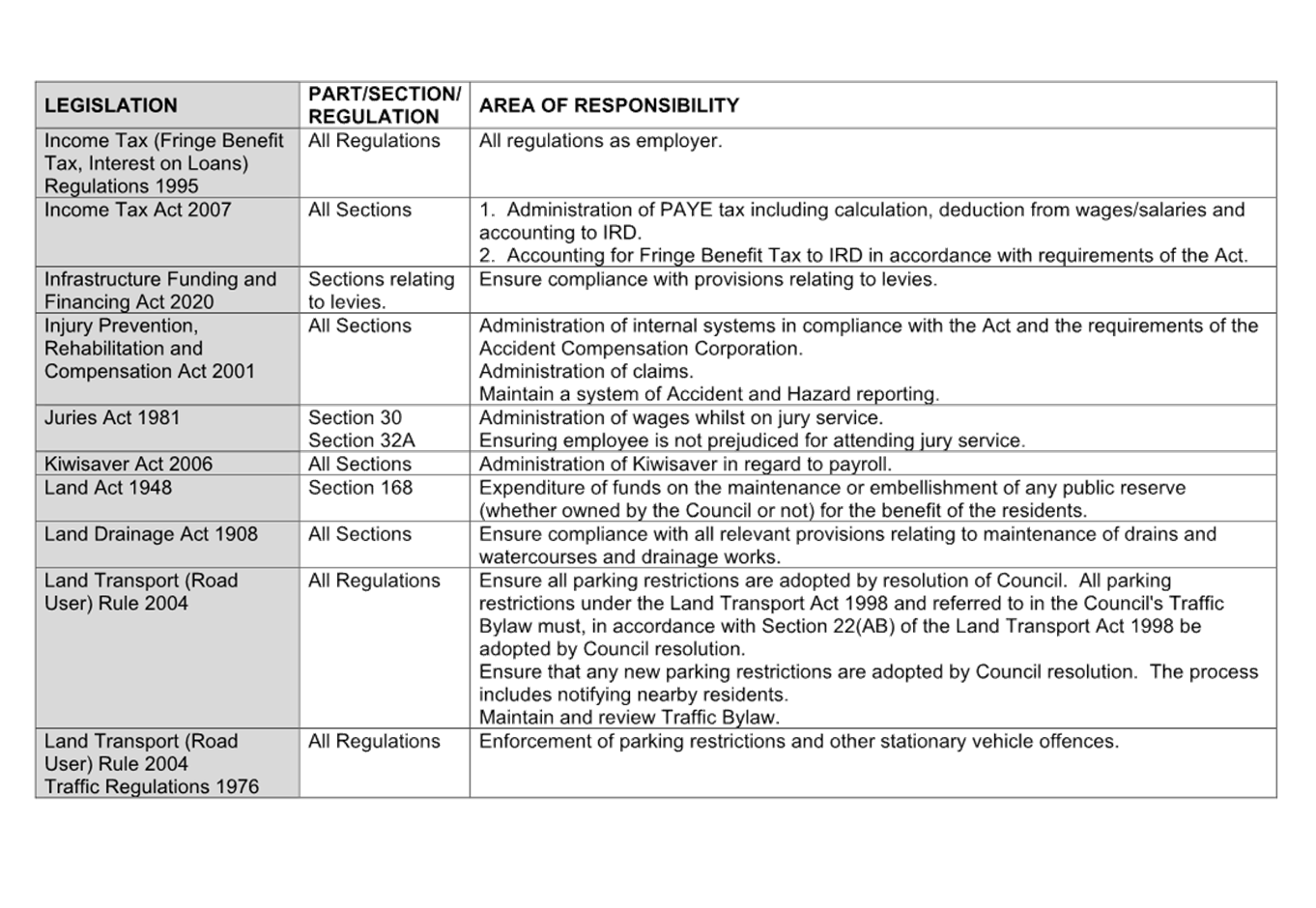
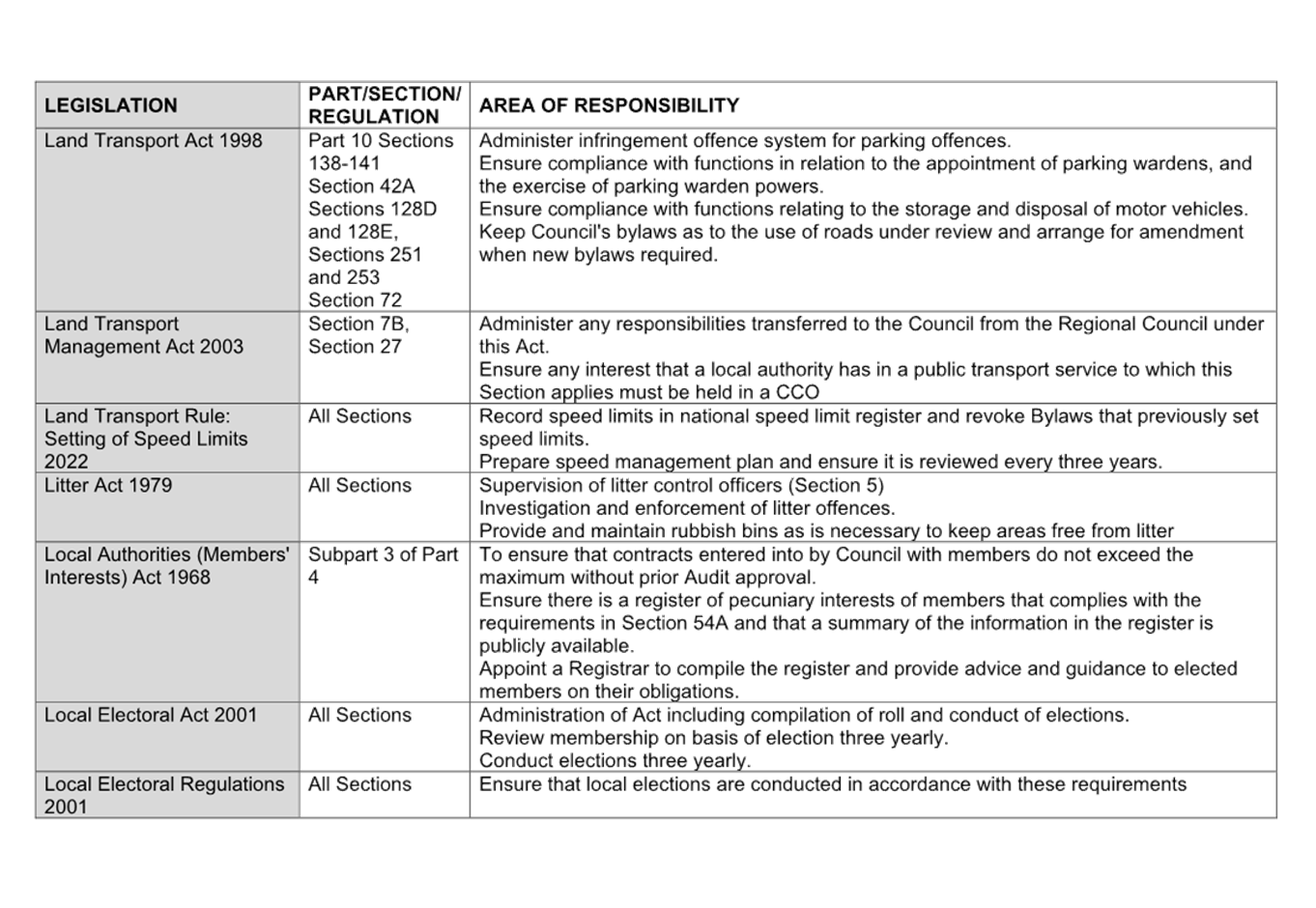
1. Legislative
Compliance Breaches and Updates 1 January to 31 March 2024 ⇩
2. Legislative
Compliance Schedule ⇩
|
Risk and Assurance Committee Meeting Agenda
|
23 May 2024
|
|
Risk and Assurance Committee Meeting Agenda
|
23 May 2024
|
|
Risk and Assurance Committee Meeting Agenda
|
23 May 2024
|
9.7 Quarterly Treasury Compliance
Kaituhi | Author: Jing
Zhou, Chief Financial Officer
Kaiwhakamana | Authoriser: Mark de Haast, Group Manager Corporate Services
Te pūtake | Purpose
1 This
report provides confirmation to the Risk and Assurance Committee of the
Council’s compliance with its Treasury Management Policy (Policy) for the
quarter ended 31 March 2024.
He whakarāpopoto | Executive summary
2 This is not required for this report.
Te tuku haepapa | Delegation
3 The Risk and Assurance Committee (Committee) has the delegation to
consider this matter under the section
of Part C.3 of the Governance Structure and Delegations 2022-2025 Triennium
which states: “This committee is responsible for monitoring the Council’s financial management,
financial reporting mechanisms and framework, and risk and assurance function,
ensuring the existence of sound internal systems.”
Taunakitanga | Recommendations
A. That the Risk and Assurance Committee:
A.1 Receives and notes this report.
A.2 Notes the Council’s
non-compliance with its current Treasury Management Policy Fixed/Floating Risk
Control limit in March 2024.
A.3 Notes that the Council’s
Fixed/Floating Risk Control Limit is fully compliant with its new draft
Treasury Management Policy, developed in conjunction with Bancorp, for the
reporting period, adopted by Council on 28 March 2024 together with its draft
2024-34 Long Term Plan.
A.4 Notes the Council has fully complied
with all other requirements of the current Treasury Management Policy for the
three months ended 31 March 2024.
Tūāpapa | Background
4 The Policy sets out a
framework for the Council to manage its borrowing and investment activities in
accordance with the Council’s objectives and incorporates legislative
requirements.
5 The Policy mandates
regular treasury reporting to management, the Strategy, Operations and Finance
Committee, as well as quarterly compliance reporting to the Risk and Assurance
Committee.
6 To assess the
effectiveness of the Council’s treasury management activities and
compliance to the Policy, certain performance measures and parameters have been
prescribed. These are:
· cash/debt position;
· liquidity/funding control limits;
· interest rate risk control limits;
· counterparty credit risk;
· specific borrowing limits; and
· risk management performance.
He kōrerorero | Discussion
Cash/Debt Position
7 Table
1 below shows the Council’s net debt position as at 31 March 2024 against the 2023/24 full year budget and
the prior year closing balance.
8 During the past three
months, the Council has issued $25 million of new debt. This was used to pre-fund
the April 2025 debt maturity ($20 million), and 2023/2024 capex programme costs
($5 million).
9 The table below shows
(a) the movement in the Council’s external debt balance, (b) the movement
in the Council’s pre-funding programme by debt maturity and (c), that
part of the Council’s Capex programme funded by new borrowings for the
nine months ended 31 March 2024.

10 As at 31 March 2024 the Council had
$103 million of cash, borrower notes and term deposits on hand. This is broken
down as follows:
11 For the three months ended 31 March
2024, the Council has not breached its net debt upper limit, as shown in the
chart below.
5
12 The Council targeted through its
LTP 2021-41 financial strategy to keep net borrowings below 280% of total
operating income with a preferred limit of 250%. As at 31 March 2024,
the Council’s net borrowings are 198.0% of forecasted 2024 total
operating income.
Liquidity/Funding control limits
13 Liquidity and funding management
focuses on reducing the concentration of risk at any point so that the overall
borrowings cost is not increased unnecessarily and/or the desired maturity
profile is not compromised due to market conditions. This risk is managed by
spreading and smoothing debt maturities and establishing maturity compliance
buckets.
14 Since October 2015 the
Council’s treasury strategy has included a debt pre-funding programme.
The Policy allows pre-funding of the Council debt maturities and Capex
programme up to 18 months in advance, including re-financing.
15 The following chart presents the
Council’s debt maturity dates in relation to the financial year in which
the debt was issued. This demonstrates that since
2016/17, the Council has actively reduced risk concentration by spreading debt
maturity dates and debt maturity values.
6
16 Debt maturities must fall within
maturity compliance buckets. These maturity buckets are as follows:
|
Maturity Period
|
Minimum
|
Maximum
|
|
0 to 3 years
|
10%
|
70%
|
|
3 to 5 years
|
10%
|
60%
|
|
5 to 10 years
|
10%
|
50%
|
|
10 years plus
|
0%
|
20%
|
17 For the three months ended 31 March
2024, the Council has been fully compliant with its debt maturity limits, as
shown by the chart below. The upper limits, as shown by dashed lines, relate to
the bars of the same colour. For example, the 0 to 3 years upper limit of 70% is in blue. Actual maturities in the 03-year bucket are represented by the
blue bars. The Council has no long-term debt maturing in ten years’ time
or beyond.
Interest rate risk control limits
18 The Council seeks endorsement from
Bancorp, its independent treasury advisor for all debt issuances. Typically,
Council issues debt on a floating rate basis and applies its fixed interest
rate swaps (hedges) to minimise its exposure at any one time to interest rate
fluctuations. This ensures more certainty of interest rate costs when setting
our Annual Plan and Long-Term Plan budgets.
19 Without such hedging, the Council
would have difficulty absorbing adverse interest rate movements. A 1% increase
in interest rates on $330 million of external debt would equate to additional
interest expense of $3.30 million per annum. Conversely, fixing interest rates
does however reduce the Council’s ability to benefit from falling and/or
more favourable interest rate movements.
20 The objectives of any treasury
strategy are therefore to smooth out the effects of interest rate movements,
while being aware of the direction of the market, and to be able to respond
accordingly.
21 The Policy sets out the following
interest rate limits:
Major control
limit where the total notional amount of all
interest rate risk management instruments (i.e. interest rate swaps) must not
exceed the Council’s total actual debt; and
Fixed/Floating
Risk Control limit, that specifies that at least
55% of the Council’s borrowings must be fixed, up to a maximum of 100%.
22 The table below shows that the
Council has breached its fixed/floating risk control limit in March 2024.
23 On the 28 March 2024, Council
adopted a new draft Treasury Management Policy together with its draft 2024-34
Long Term Plan. Developed in conjunction with Bancorp, new Fixed/Floating Risk
Control limits (ranging from 20% to 100%) are now applied to different maturity
buckets of Council’s borrowings. Under the new draft policy, Council was
fully compliant for the reporting period.
24 Like debt maturities,
hedging instrument maturities must also fall within maturity compliance
buckets. These maturity compliance buckets are as follows:
|
Period
|
Minimum
|
Maximum
|
|
1 to 3 years
|
15%
|
60%
|
|
3 to 5 years
|
15%
|
60%
|
|
5 to 10 years
|
15%
|
60%
|
|
10 years plus
|
0%
|
20%
|
25 The Council has been fully
compliant for the three months ended 31 March 2024, as shown by the following
chart. Note that maturities falling within 1 year are not included. The Council
has no hedging instrument maturities in ten years’ time or beyond.
Counterparty Credit Risk
26 The policy sets maximum limits on
transactions with counterparties. The purpose of this is to ensure the Council
does not over-concentrate its investments or risk management instruments with a
single party.
27 The policy sets the gross
counterparty limits as follows:
|
Counterparty/Issuer
|
Minimum Standard and Poor’s long
term
|
Investments maximum per counterparty
|
Risk management instruments maximum per
counterparty
|
Borrowing maximum per counterparty
|
|
NZ
Government
|
N/A
|
Unlimited
|
None
|
Unlimited
|
|
LGFA
|
AA-/A-1
|
$20m
|
None
|
Unlimited
|
|
NZ
Registered Bank
|
A+/A-1
|
60% of total investments or $25m; whichever is
greater
|
50% of total instruments or
$80m; whichever is greater
|
$50m
|
28 The Council was in full compliance with all
counterparty credit limits for the three months ended 31 March 2024. The
tables below show the Council’s investments and risk management
instruments holdings per counterparty for this period.
Term deposit & Cash investments

*Policy Limit: 60% of total investments or
$25 million; whichever is greater
Interest rate swaps

*Policy
Limit: 50% of total instruments or $80 million; whichever is greater
Specific Borrowing Limits
29 In managing debt, the Council is
required to adhere to the specific borrowing limits.
30 The
Council fully complied with these limits for the three months ended 31 March
2024 and the results are shown below:
Risk Management Performance
31 The following table shows the
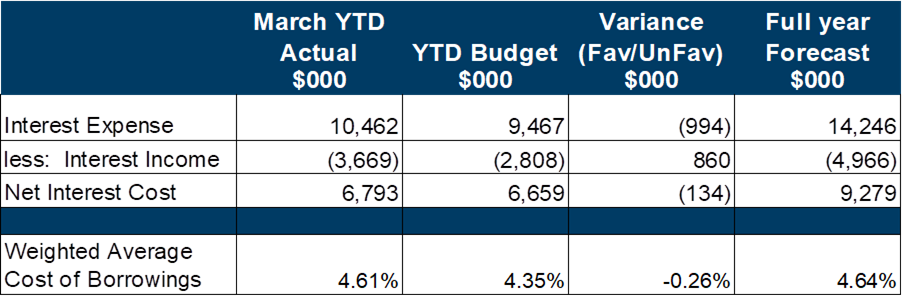
Council’s interest income and expense for the three months ended
31 March 2024 together with the weighted average cost of borrowing (WACB),
compared to year-to-date budget and full year forecast.
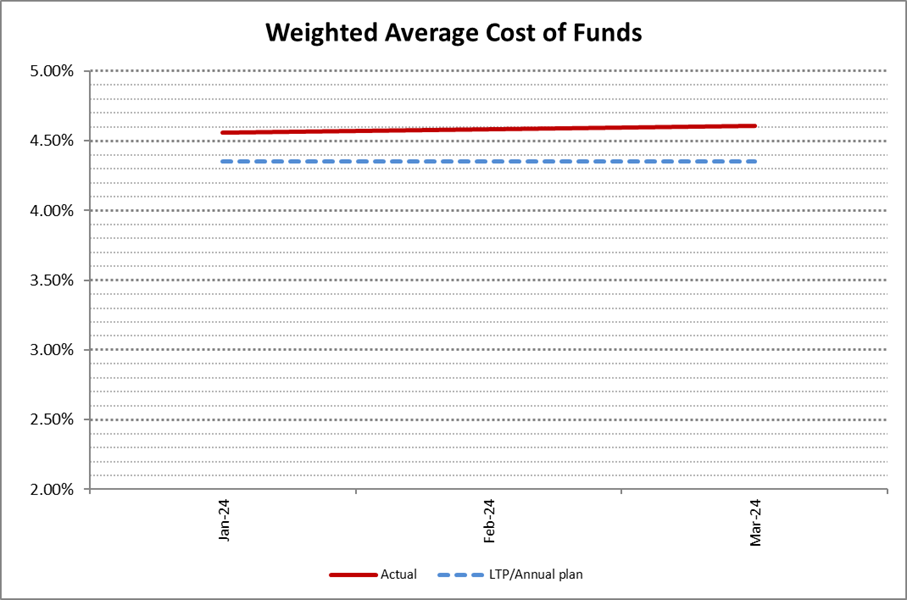
32 The following graph shows the
year-to-date average cost of borrowings, for each month of the quarter.
He take | Issues
33 This report
has a low level of significance under the Council’s Significance and
Engagement Policy).
Ngā kōwhiringa | Options
34 There are
no options to be considered.
Tangata whenua
35 There are
no tāngata whenua considerations arising directly from this report.
Panonitanga āhuarangi | Climate change and Environment
36 There are
no climate change considerations within this report.
Ahumoni me ngā rawa | Financial and resourcing
37 There are
no financial and resourcing considerations in addition to those already noted
in this report.
Ture me ngā Tūraru | Legal and risk
38 There are
no legal and risk considerations arising from this report.
Ngā pānga ki ngā kaupapa here | Policy impact
39 There are
no policy considerations in addition to those already noted in this report.
Te whakawhiti kōrero me
te tūhono | Communications & engagement
Te mahere tūhono | Engagement planning
40 An
engagement plan is not required for this report.
Whakatairanga | Publicity
41 There are
no publicity considerations arising from this report.
Ngā
āpitihanga |
Attachments
Nil
|
Risk and Assurance Committee Meeting Agenda
|
23 May 2024
|
9.8 2024
Council Insurance update
Kaituhi |
Author: Jing
Zhou, Chief Financial Officer
Kaiwhakamana
| Authoriser: Mark de Haast, Group Manager Corporate Services
Te pūtake | Purpose
1 This report provides the
Risk and Assurance Committee (Committee) with a summary of the Council’s
2024 insurance renewals as well as a progress update on alternate risk transfer
options currently being investigated.
He whakarāpopoto | Executive summary
2 Not
required for this report.
Te tuku haepapa | Delegation
3 The
Committee has the delegation to consider this matter under the section of Part C.3 of the Governance Structure and
Delegations 2022-2025 Triennium which states: “This committee is responsible for monitoring the Council’s financial management,
financial reporting mechanisms and framework, and risk and assurance function,
ensuring the existence of sound internal systems.”
Taunakitanga | Recommendations
A. That
the Risk and Assurance Committee notes the Council’s 2024 insurance
renewals and the progress update regarding alternative risk financing options.
Tūāpapa | Background
4 The Council, together with
Porirua City, Hutt City and Upper Hutt City councils (collectively known as the
Outer Wellington Shared Services Insurance Group (OWSS) has been purchasing
insurance for their respective assets on a combined basis since 2009. This
syndicate was established to provide the OWSS with the scale necessary to
access wider domestic and off-shore insurers. In July 2016 Greater Wellington
Regional Council joined the OWSS to insure their above ground assets only. This
wider collective for above ground assets is known as the Wellington Combined
Insurance Group (WCIG).
5 Over recent years,
insurance markets have continued to tighten. New Zealand, and particularly
Wellington, is seen as increasingly challenging for underwriters due to the
seismic and flooding risk.
2024 Insurance Renewal Update
6 Through Aon, the Council’s
property and underground infrastructure insurance, which accounts for the
majority of Council’s total insurance cover, renewed on 1 May 2024. Aon
provides the Council with independent expert insurance advisory and brokerage
services.
|
Risk and Assurance Committee Meeting Agenda
|
23 May 2024
|
7 Significant
asset insurances, as renewed for the year commencing 1 May 2024, are summarised
in the following table:
|
Asset
|
Type of insurance
|
Value of assets
insured
|
Limit of cover
|
Deductible
|
|
Infrastructure assets
|
Material damage and business interruption in the event of
natural catastrophe
|
~$705 million
|
$600 million OWSS combined material damage and business
interruption limit for an event involving more than one council for any loss
or series of losses arising out of any one event.
|
The deductible is $1million per event.
|
|
Limited to a $130 million sub-limit for the Council.
|
|
|
|
Property, plant and equipment
|
Material damage and business interruption (MDBI)
|
~$469 million
|
$600 million WCIG combined limit for any one loss or
series of losses arising out of any one event and applying to material damage
and business interruption combined.
|
The natural disaster deductible is 5% of sum insured, with
a minimum deductible of $100,000.
|
|
For other events the deductible is $50,000 (except for
landslip or subsidence which is $250,000).
|
|
|
|
Residential property
|
Earthquake Commission (EQC)
|
~$31 million
|
EQC: First $300,000 for each loss event per property to be
recovered from the EQC.
|
The EQC deductible is 1% of sum insured with a minimum
deductible of $200. If claim is for land, the deductible is 10% of sum
insured with minimum deductible of $500.
|
|
All other losses
|
(Included in $469 million MDBI)
|
As per MDBI policy above
|
All other deductibles: as per the MDBI policy above
|
|
Risk and Assurance Committee Meeting Agenda
|
23 May 2024
|
8 Current government policy
allows for central government to reimburse local government up to 60% of the
maximum probable loss (MPL) to underground infrastructure from natural
catastrophe damage, (known as the 60:40 cost sharing arrangement). This policy
has been in place for over 26 years. The Council’s 2024 insurance cover
has been based on the assumption that government will continue to provide a
full contribution of up to 60% of the Council’s MPL to underground
infrastructure damage from natural catastrophe, and therefore, insurance has
been placed which covers approximately 40% of the Council’s MPL to
underground infrastructure assets from natural catastrophe.
9 The Council’s
underground infrastructure assets have a total replacement value of $705
million. The Council’s MPL estimate is $130 million for natural
catastrophe damage to underground infrastructure assets, within a combined $600
million loss limit for OWSS. Of this $130 million loss limit, 40% is
insured with offshore insurers with central government responsible for the
remaining 60% of the costs. There is a $1 million deductible per claim per
event.
10 The Council has a total sum insured
value of $469 million, including residential property, for material damage and
business interruption (MDBI) insurance to above ground assets, with a
deductible of $50,000 per claim per event. Losses suffered to above ground
assets by natural catastrophe/s trigger a deductible of 5% of the site sum
insured with a minimum $100,000 deductible per claim per event. The total limit
of cover available to the WCIG is $600 million. The overall limit will be
shared among the five councils following an event.
11 Residential assets have a sum insured
of $31 million and are included in the MDBI policy. EQC covers up to $300,000
per dwelling, with the balance of any loss covered within the MDBI policy. The
EQC deductible is 1% of the sum insured value of the residential assets that
have sustained losses, with a minimum deductible of $200. If the claim is for
land, the deductible is 10% of sum insured value of the residential assets that
have sustained losses, with minimum deductible of $500. Losses sustained to
residential assets exceeding the EQC insurance cover are covered by
Council’s above ground asset MDBI cover and the same deductibles then
apply as noted above.
12 In addition to the above key policies,
the Council also carries motor vehicle, general liability, professional
indemnity, statutory and employer’s liability, crime, cyber risk,
personal accident and business travel insurances which renewed on 1 November
2023.
He kōrerorero | Discussion
premium and budget impacts of renewal
13 Renewal
premiums are summarised in the following table:
|
|
2024
premium
$000s
|
2023
premium
$000s
|
Change
$000s
|
Change
%
|
|
Underground Infrastructure
|
707
|
895
|
-188
|
-21.01%
|
|
Above ground asset (MDBI)
|
2,186
|
1,409
|
777
|
55.15%
|
|
FENZ (Material Damage
|
115
|
76
|
39
|
51.32%
|
|
EQC (Material Damage)
|
43
|
43
|
0
|
0.00%
|
|
Other policies
|
360
|
314
|
46
|
14.65%
|
|
Total
|
3,411
|
2,737
|
674
|
24.63%
|
14 Sum
insured values are summarised in the following table:
|
|
2024
Sum Insured Value
$000s
|
2023
Sum Insured Value
$000s
|
Change
$000s
|
Change
%
|
|
Underground Infrastructure
|
705,282
|
883,444
|
-178,162
|
(20.16)
|
|
Above ground assets MDBI
|
468,535
|
275,209
|
193,326
|
70.24
|
|
Total
|
1,173,817
|
1,158,653
|
15,164
|
1.31%
|
15 The
Council’s sum insured values over the last 12 months have increased by
$15.2 million or 1.31%. However, the total annual cost of the November 2023 and
May 2024 renewals is $3.41 million, an increase of $674,000 or 24.63% over the
previous year’s insurance premium.
16 This
premium increase is mainly due to a net premium increase of $725,000 directly
related to transferring the Council’s wastewater and water treatment
plants, (with a combined sum insured value of $166 million), from underground
infrastructure to above ground assets MDBI.
|
2024
Sum Insured Value of Treatment Plants
|
2024
Above Ground Assets MDBI premium increase for Treatment Plants
|
2024
Underground Infrastructure Premium saving from removing Treatment Plants
|
Net
Premium Increase of transferring Treatment Plants to Above Ground Assets MDBI
|
|
$000’s
|
$000’s
|
$000’s
|
$000’s
|
|
166,000
|
915
|
190
|
725
|
17 Treatment
plants house extensive electrical componentry. Losses to the Council’s
treatment plants could be sustained from fire damage caused by electric
fault(s). Underground infrastructure cover only covers losses from natural
catastrophe and excludes fire related damages. Given the current full
re-instatement cost of $166 million, these assets are now covered by above
ground MDBI to protect the Council from losses caused by natural catastrophe
and non-natural catastrophe damages. The premium increase largely reflects the
higher risk and loss of 60% central government underwriting from underground
infrastructure insurance cover.
18 The
total insurance budget for 2024/25 is $3.12 million, which includes a 20% cost
increase from the 2023/24 budget of $2.6 million. There is an insurance budget
shortfall of $291,000 for 2024/25. Given the draft 2024/25 Long Term Plan
includes an annual increase of 20% for insurance for years one to ten, there is
no intention to further increase the 2024/25 insurance budget before Council
adopts the 2024-34 Long Term Plan on 27 June 2024. Hopefully, anticipated
market flattening in the coming years will align actual insurance premiums
within Council’s insurance budget from 2025/26 onwards.
Alternate Risk Transfer Options
Update
19 Insurance rates are
flattening (especially globally), but inflation and new asset additions are
increasing sum insured values so premium increases are still assumed.
Uncertainty remains around inflation as there are global issues that could
affect this.
20 A
reduction in insurance availability is still a strategic risk to New Zealand,
especially in those areas more exposed to natural disasters, such as the
Greater Wellington region.
21 Options
to increase self-retention levels, thereby reducing the dependency on
traditional insurance and enhancements to physical loss mitigation should all
be included in an organisations long-term risk transfer strategy.
22 A
captive or protected cell company (PCC) remain as alternatives to a
self-managed fund, but the cost benefit of these options remains
marginal. A self-managed fund (that is ringfenced) remains a viable
long-term option for Council, assuming there are no losses that erode the fund
during its development. A retention vehicle arrangement also provides
some mitigation to the risk of insurance market contraction and alleviates some
of the cyclical pricing issues associated with traditional insurance.
23 WCIG
contracted AGRC to update its loss modelling to help inform prudent risk
financing decisions. The preferred methodology was RiskScape, using the
National Seismic Hazard Model 2022. However, the agreement with GNS to use
RiskScape was not quite finalised. AGRC’s contract therefore has two
phases. Phase one completed loss modelling using the global vendor model
Touchstone. This is an industry standard model but does not have the level of
granularity that RiskScape does. Phase one showed a group MPL of $478 million,
compared to the current WCIG limit of $600 million.
24 Phase
two includes an update to the loss modelling, using RiskScape. It is
anticipated that the MPL indications (for both Council and Group level) will
increase because of this work. Phase two will be completed in time to
inform decisions for 2025 insurance renewals.
He take |
Issues
25 This matter has a low level of
significance under the Council’s Significance and Engagement Policy.
Ngā kōwhiringa | Options
26 There
are no options in addition to those already noted in this report.
Tangata whenua
27 There
are no tāngata whenua considerations required with this
report.
Panonitanga āhuarangi | Climate change
and Environment
28 There
are no climate change considerations required with this report.
Ahumoni me ngā rawa | Financial
and resourcing
29 There are no financial and resourcing
considerations in addition to those already discussed in this report.
Ture me ngā Tūraru | Legal
and risk
30 There are no legal issues arising from
this report. There are no risk considerations in addition to those already
discussed in this report.
Ngā pānga ki ngā kaupapa here | Policy impact
31 This
report has no impact on the Council policies.
Te whakawhiti kōrero me te
tūhono | Communications &
engagement
Te mahere tūhono | Engagement
planning
32 There
are no engagement plans required for this report.
Whakatairanga |
Publicity
33 No
publicity is planned in relation to this report.
Ngā
āpitihanga | Attachments
Nil
10 Te
Whakaū i ngā Āmiki | Confirmation of Minutes
10.1 Confirmation
of Minutes
Author: Maria
Cameron, Advisor Democracy Services
Authoriser: Mark
de Haast, Group Manager Corporate Services
|
Taunakitanga |
Recommendations
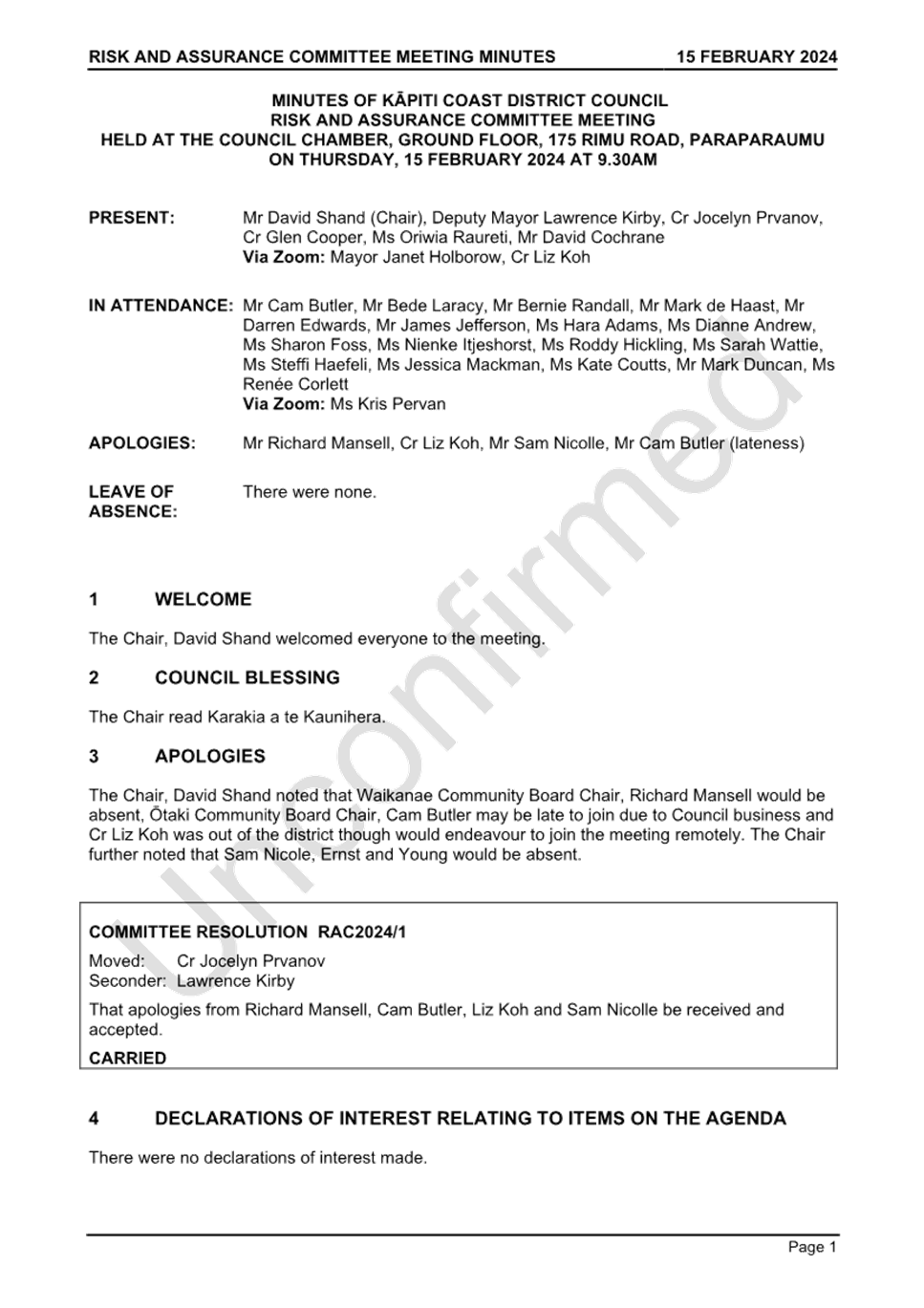
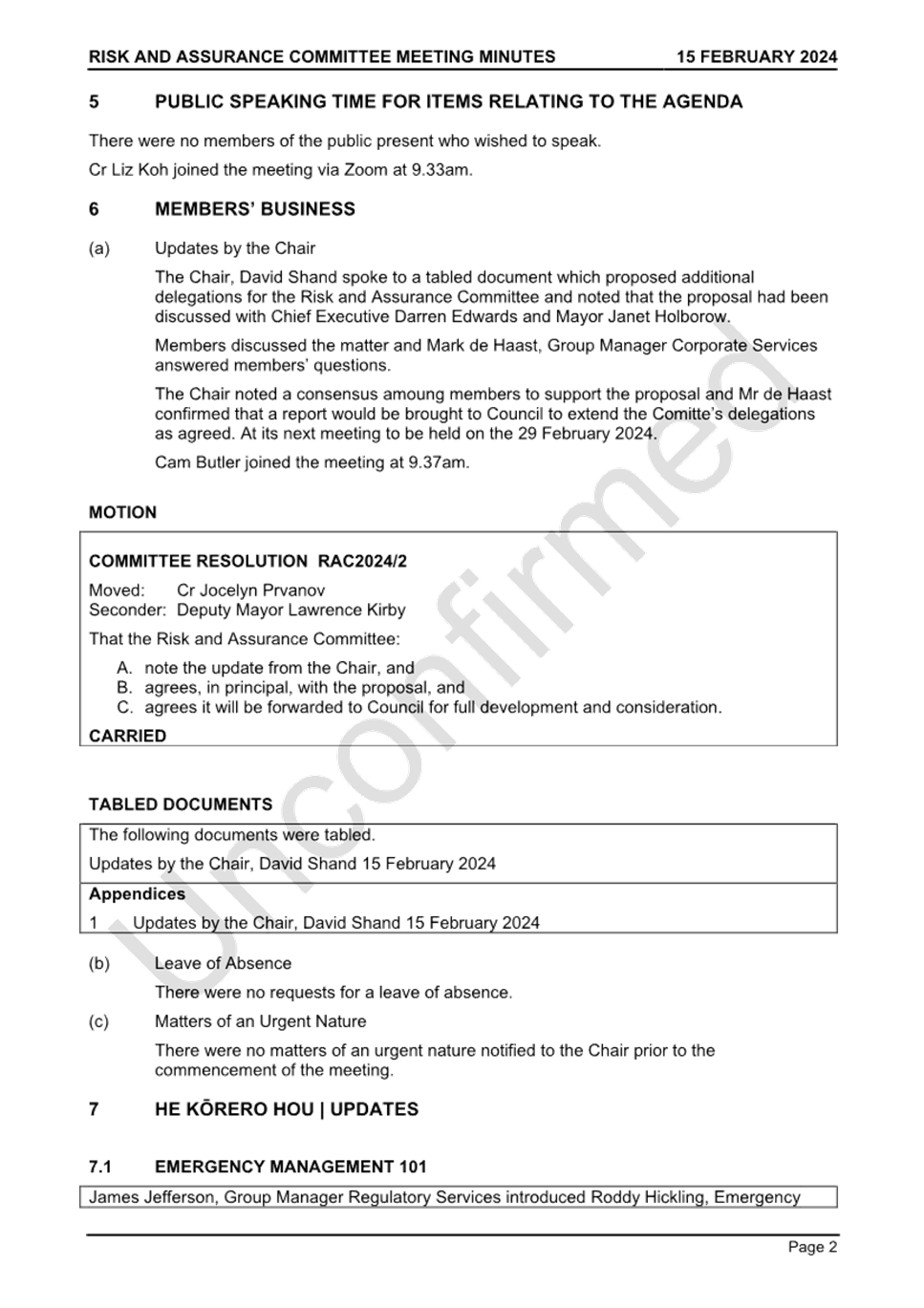
That the minutes of the Risk and
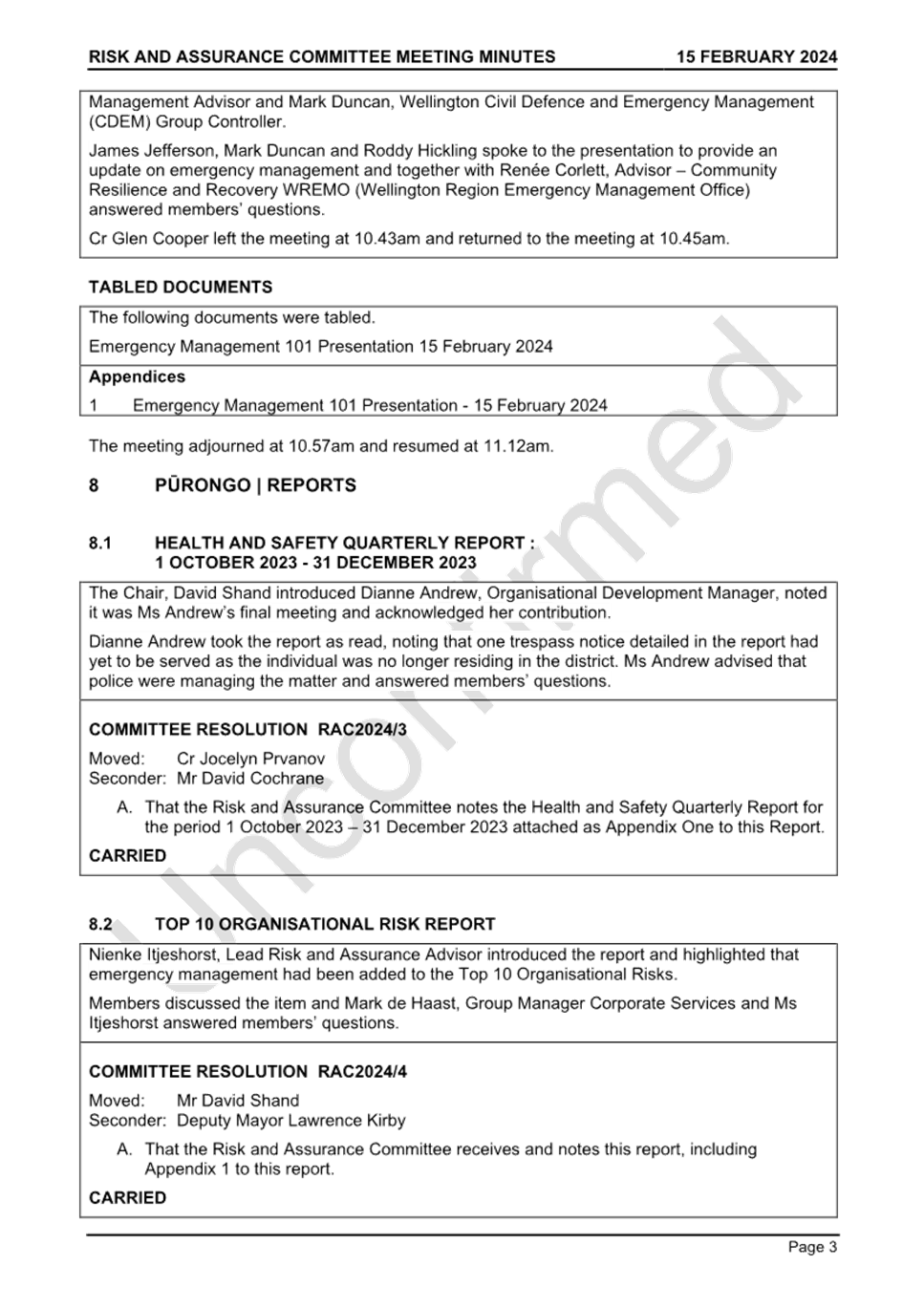
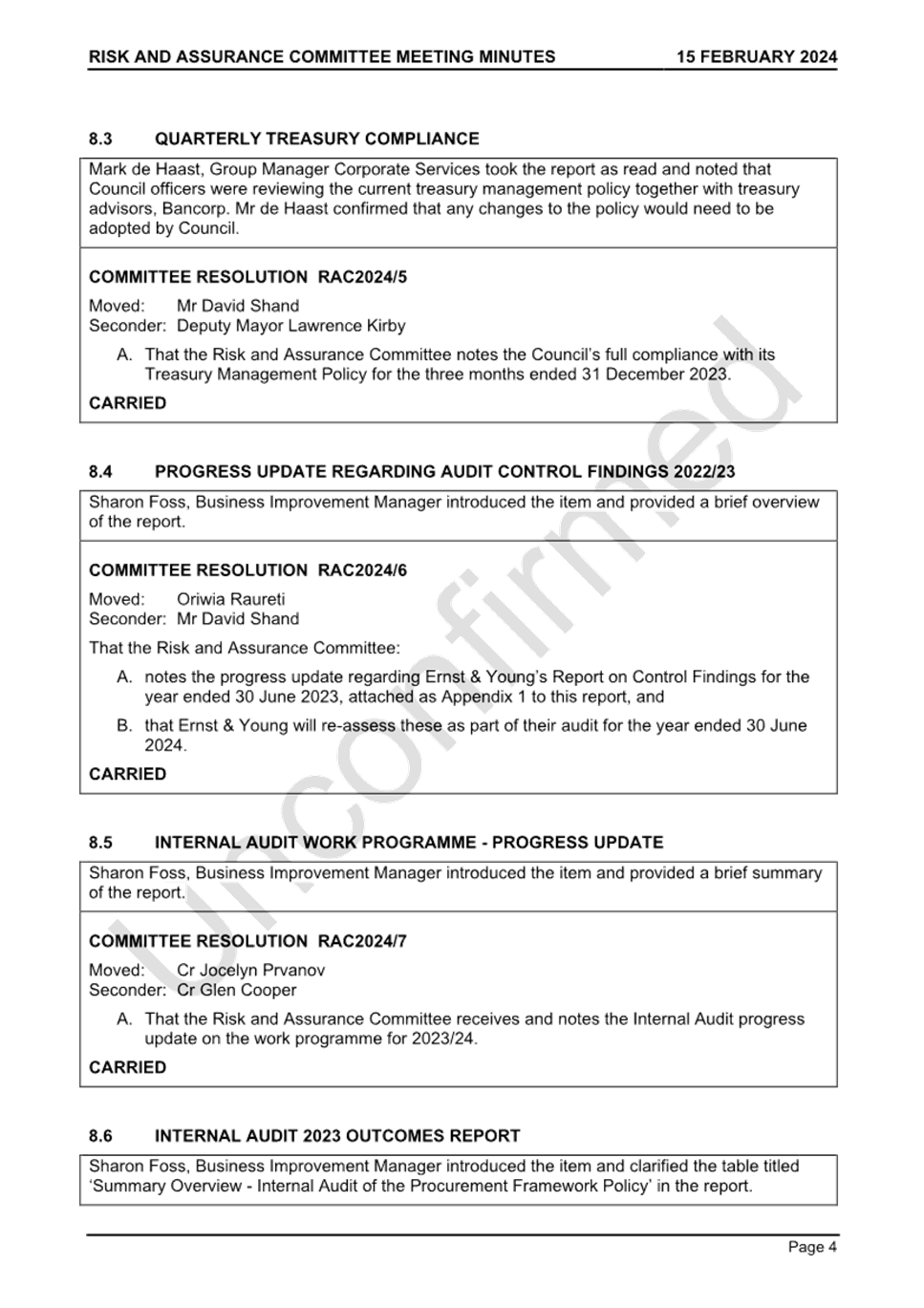
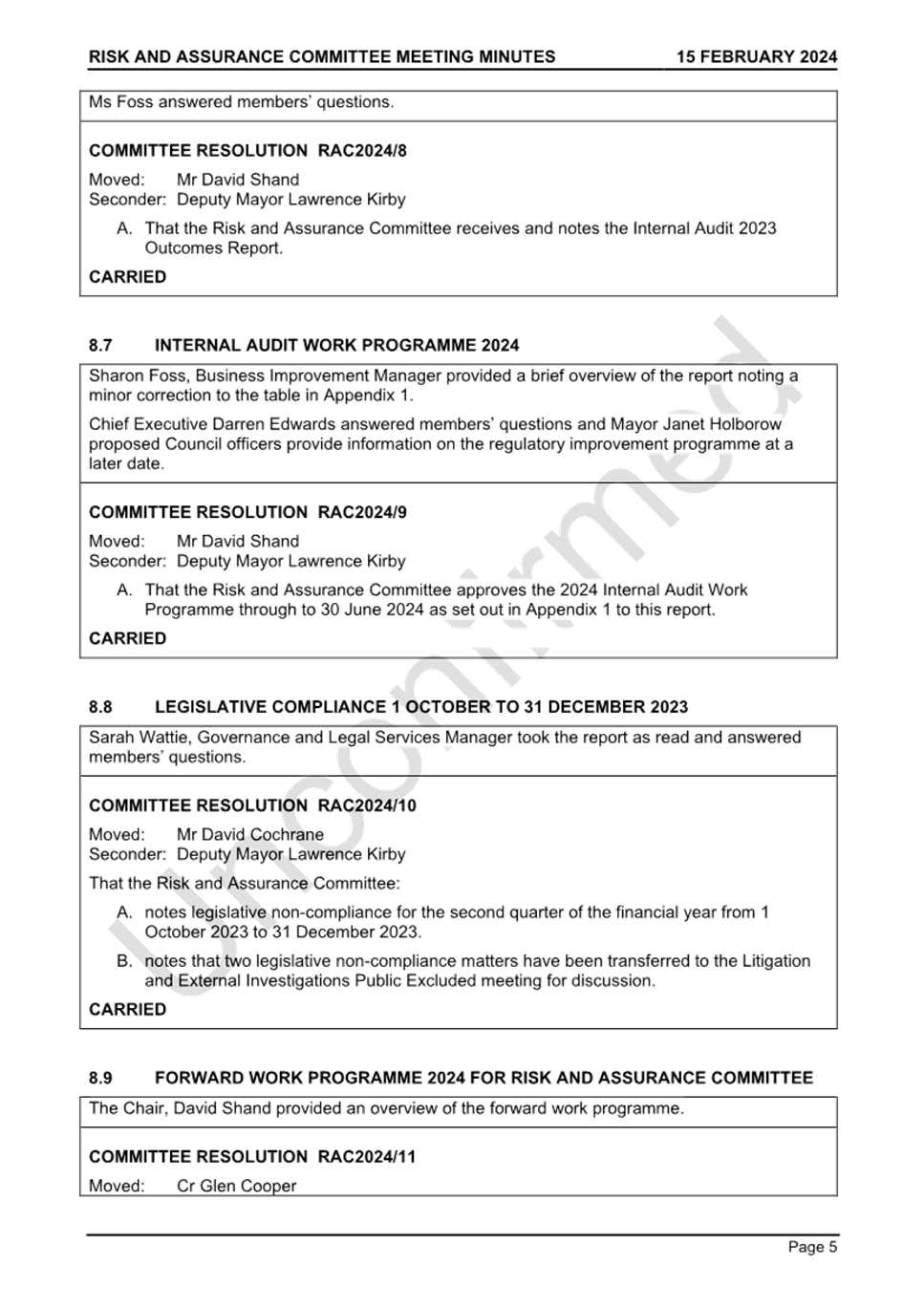
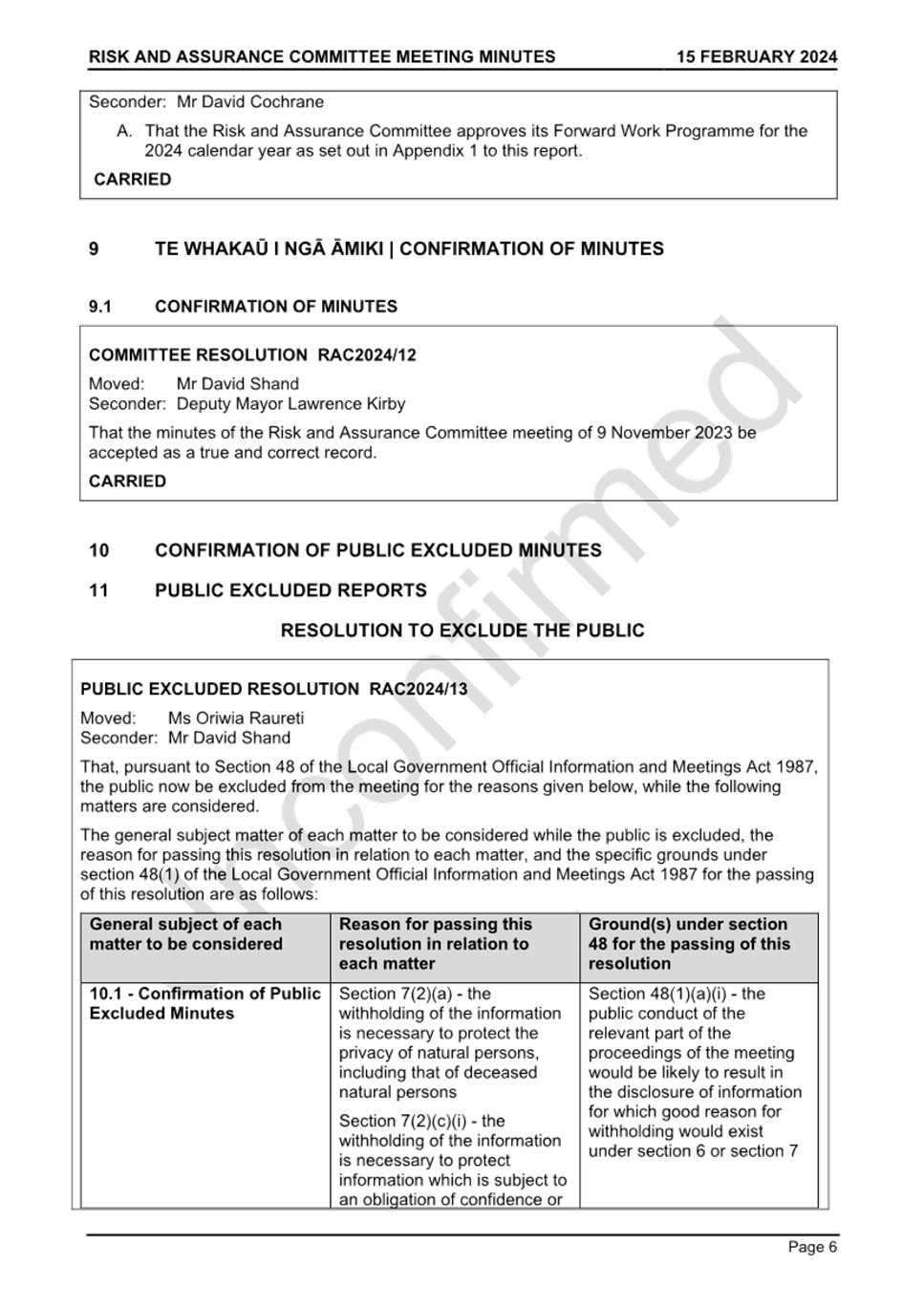
Assurance Committee meeting of 15 February 2024 be accepted as a true and
correct record.
|
Ngā āpitihanga | Attachments
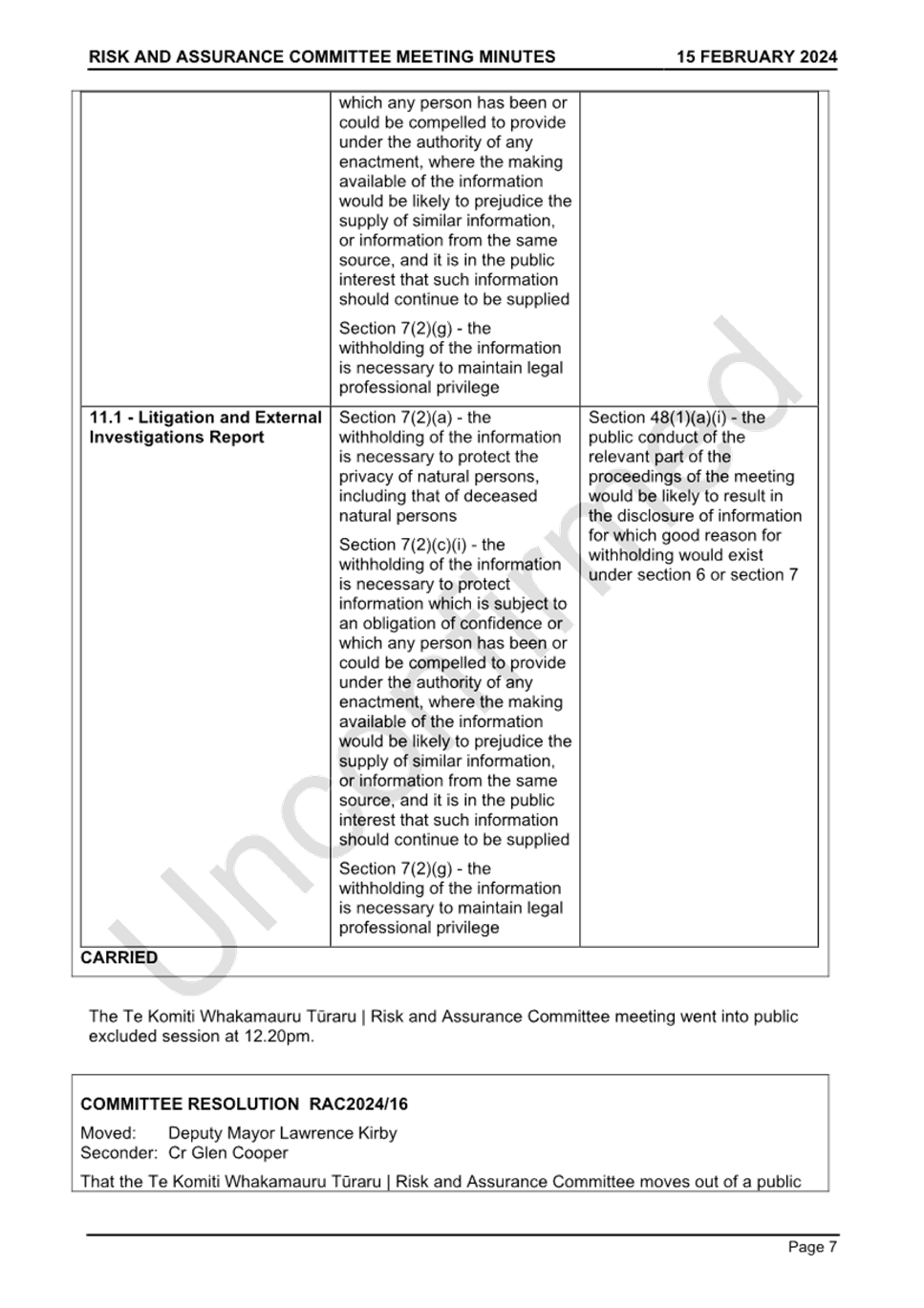
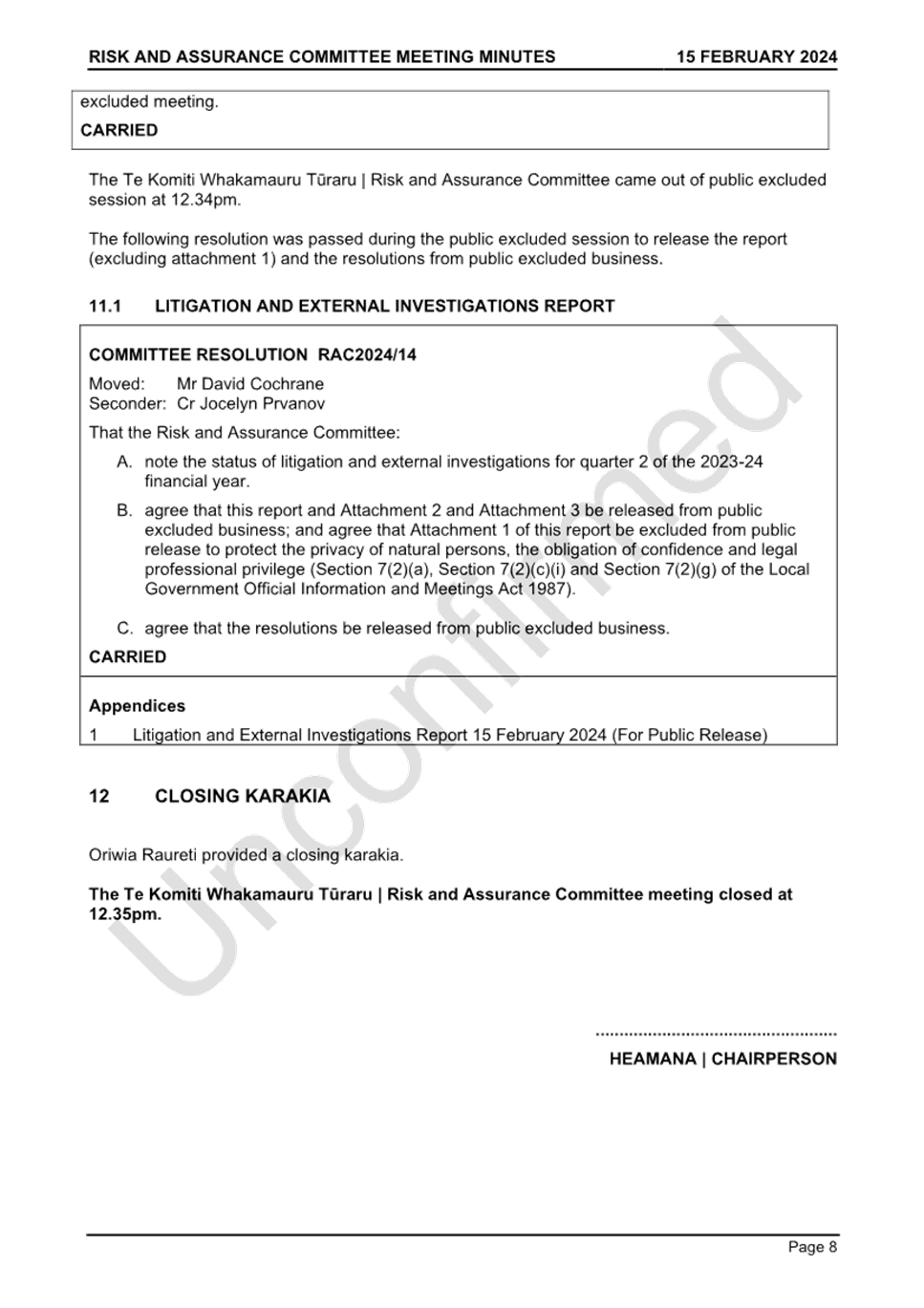
1. Risk
and Asurance Committee Minutes 15 February 2024 ⇩
|
Risk and Assurance Committee Meeting Agenda
|
23 May 2024
|
|
Risk and Assurance Committee Meeting Agenda
|
23 May 2024
|
11 Te
Whakaūnga o Ngā Āmiki Kāore e Wātea ki te Marea | Confirmation
of Public Excluded Minutes
12 Purongo
Kāore e Wātea ki te Marea | Public Excluded Reports
Resolution
to Exclude the Public
|
PUBLIC EXCLUDED ReSOLUtion
That, pursuant to Section 48 of the Local Government
Official Information and Meetings Act 1987, the public now be excluded from
the meeting for the reasons given below, while the following matters are
considered.
The general subject matter of each matter to be considered
while the public is excluded, the reason for passing this resolution in
relation to each matter, and the specific grounds under section 48(1) of the
Local Government Official Information and Meetings Act 1987 for the passing
of this resolution are as follows:
|
General subject of each
matter to be considered
|
Reason for passing this
resolution in relation to each matter
|
Ground(s) under section 48
for the passing of this resolution
|
|
11.1 - Confirmation of Public Excluded Minutes
|
Section 7(2)(a) - the withholding of the information is
necessary to protect the privacy of natural persons, including that of
deceased natural persons
Section 7(2)(c)(i) - the withholding of the information
is necessary to protect information which is subject to an obligation of
confidence or which any person has been or could be compelled to provide
under the authority of any enactment, where the making available of the
information would be likely to prejudice the supply of similar information,
or information from the same source, and it is in the public interest that
such information should continue to be supplied
Section 7(2)(g) - the withholding of the information is
necessary to maintain legal professional privilege
|
Section 48(1)(a)(i) - the public conduct of the relevant
part of the proceedings of the meeting would be likely to result in the
disclosure of information for which good reason for withholding would exist
under section 6 or section 7
|
|
12.1 - Litigation and External Investigations Report
|
Section 7(2)(a) - the withholding of the information is
necessary to protect the privacy of natural persons, including that of
deceased natural persons
Section 7(2)(c)(i) - the withholding of the information
is necessary to protect information which is subject to an obligation of
confidence or which any person has been or could be compelled to provide
under the authority of any enactment, where the making available of the
information would be likely to prejudice the supply of similar information,
or information from the same source, and it is in the public interest that
such information should continue to be supplied
Section 7(2)(g) - the withholding of the information is
necessary to maintain legal professional privilege
|
Section 48(1)(a)(i) - the public conduct of the relevant
part of the proceedings of the meeting would be likely to result in the
disclosure of information for which good reason for withholding would exist
under section 6 or section 7
|
|
|
Risk and Assurance Committee Meeting Agenda
|
23 May 2024
|
13 Karakia
whakamutunga | Closing Karakia
|
Kia tau ngā
manaakitanga ki runga i a tātou katoa,
Kia hua ai te
mākihikihi, e kī ana
Kia toi te kupu
Kia toi te reo
Kia toi te wairua
Kia tau te mauri
Ki roto i a
mātou mahi katoa i tēnei rā
Haumi e! Hui e! Taiki
e!
|
May blessings be upon us all,
And our business be successful.
So that our words endure,
And our language endures,
May the spirit be strong,
May mauri be settled and in
balance,
Among the activities we will
do today
Join, gather, and unite! Forward
together!
|