|
Te Whakaminenga o Kāpiti Agenda
|
9 May 2023
|
6 Pūrongo
| Reports
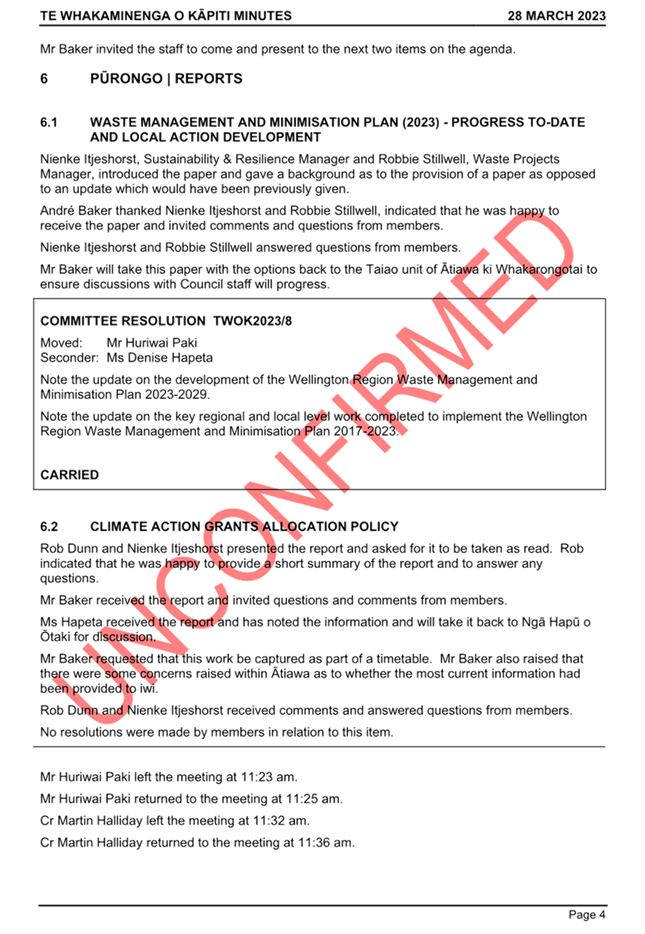
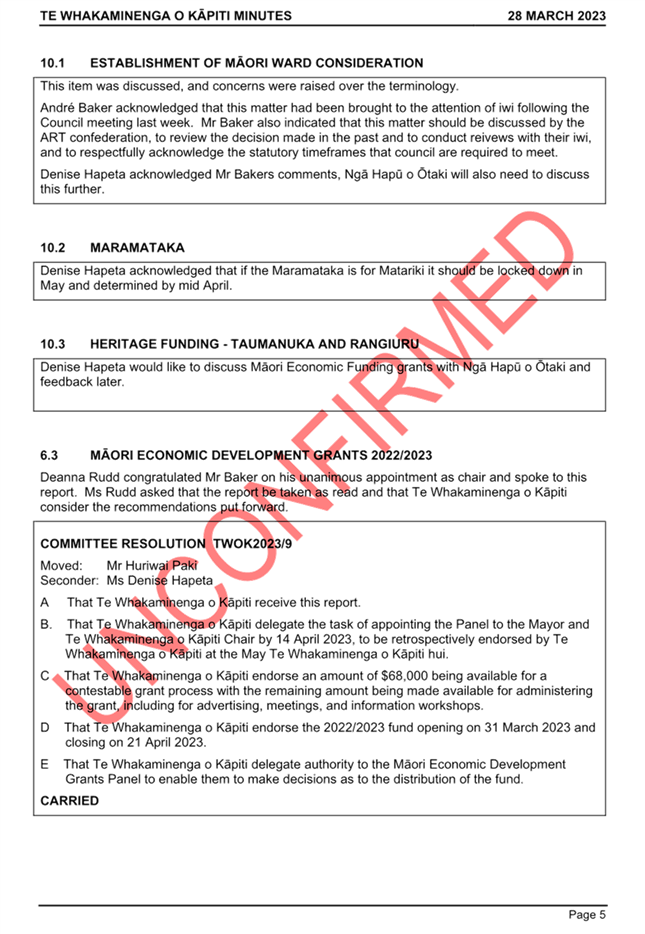
6.1 Establishment
of Māori Ward
Kaituhi |
Author: Steffi
Haefeli, Manager Democracy Services
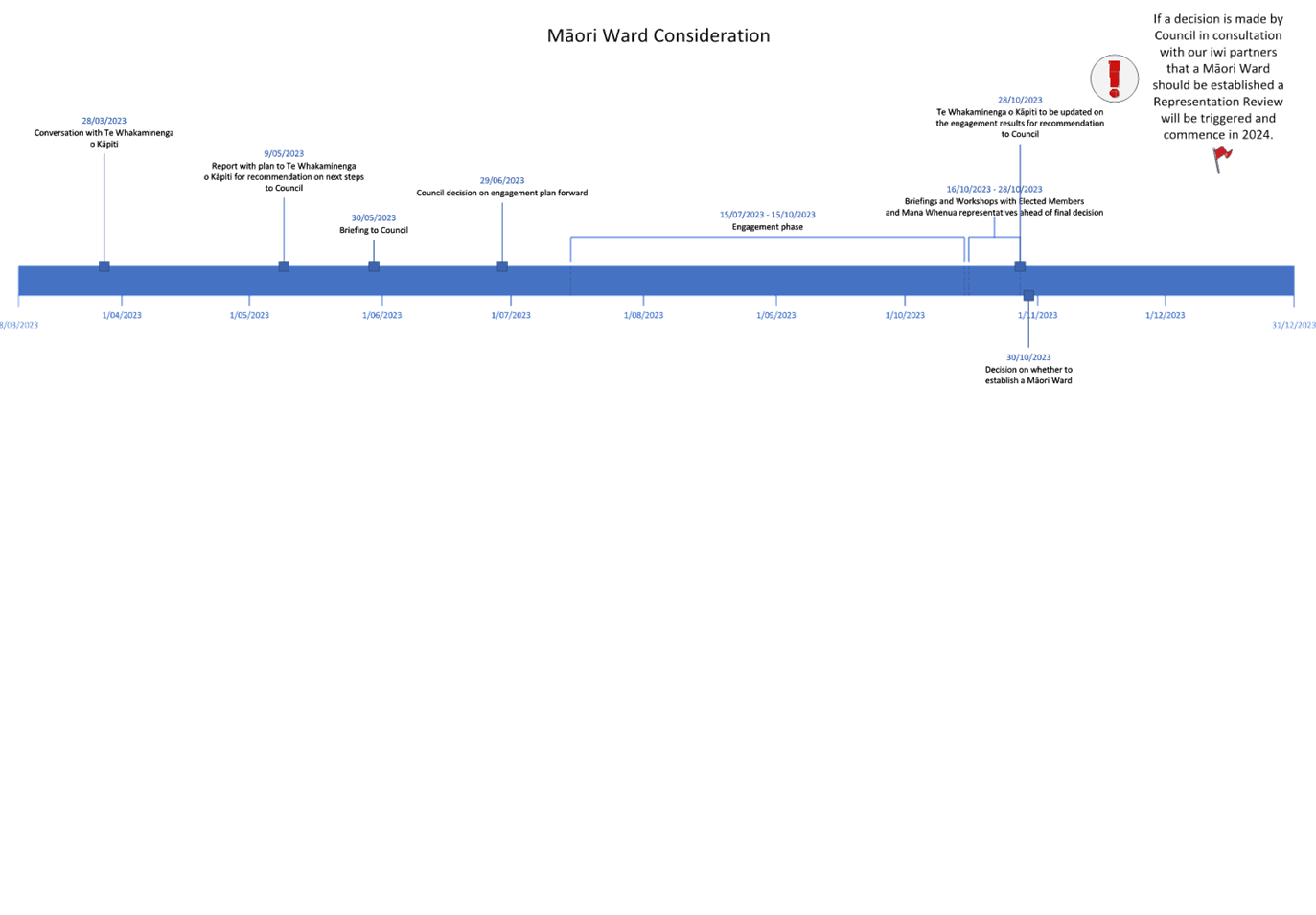
Kaiwhakamana
| Authoriser: Janice McDougall, Group Manager People and
Partnerships
Te pūtake |
Purpose
1 This
reports asks the mana whenua members of Te Wakaminenga o Kāpiti to:
1.1 consider
their position on the establishment of Māori ward for the
next Local Body Elections in 2025, and
1.2 provide input on how to plan apporiate community engagement,
especially in relation to engagement with tangata whenua.
He
whakarāpopoto | EXecutive summary
2 Not
required for this report.
Te tuku haepapa
| Delegation
3 Te
Whakaminenga o Kāpiti has the delegations and expertise to consider this
kaupapa.
Taunakitanga | RECOMMENDATIONS
A. That
Te Whakaminenga o Kāpiti note the content of the report.
B. That
the A.R.T confederation agree to discuss this kaupapa and provide Council
Officers with input by Friday 26 May 2023 on:
B.1.1 What
appropriate engagement with tangata whenua and other communities looks like;
B.1.2 If
it is known, what the preliminary view of mana whenua is on whether a
Māori ward should be established;
B.1.3 Any
other considerations to be taken into account in terms of engagement planning.
Tūāpapa | Background
Current Context
4 The
Local Government Electoral Legislation Bill (the Bill) is currently progressing
through Parliament and was expected to come into force mid-2023. Initially, if
passed, the Bill would have enacted amendments to the Local Electoral Act 2001 making
revisions to the process that local authorities are required to follow in
deciding their representation arrangements, making the consideration of a
Māori ward a fundamental step in the representation review process. Under
the new provisions of the Bill:
4.1 Local
authorities that have not established a Māori ward in the last triennium,
will be required to reconsider whether to create a Māori ward.
4.2 Local
authorities will be required to engage with ‘Māori and other
communities’ and to have regard to this engagement in deciding whether to
establish a Māori ward.
5 On
6 April 2023, after the Bill’s second reading, Parliament made changes to
timeframes proposed under the initial Bill and is delaying the Bill to reduce the impact of the new
requirements especially for those councils affected by the most recent floods.
Therefore, the proposed representation review requirements will not be in force
for 2025 elections. The intention is that they will be in force for the 2028
elections. Parliament announced that a Supplementary Order Paper (SOP)
will be introduced during the next stage of the Bill. The SOP will make some
changes to the Bill to delay the provisions requiring Councils to consider
Māori representation as part of their representation review until after
the 2025 Local Body Elections. Councils will still have the ability to
optionally consider Māori representation, but it will no longer be a legal
requirement ahead of the next elections. The SOP changes also pushed out the
due date for a final decision. The new due dates ahead of the 2028 Local Body
Elections have yet to be communicated with local authorities. The provisions
are expected to remain the same.
6 The
impact of the delay in provisions is that the legislative status quo under the
Local Electoral Act 2001 remains. This is that Council may, but is not required
to, resolve whether to establish a Māori ward ahead of the elections in
2025. In the last triennium, Council guided by mana whenua resolved not to
establish a Māori ward, however, committed to reconsidering the question
this triennium. As such, it is appropriate that Council and mana whenua
continue to consider this matter.
7 Under
the current provisions of the Local Electoral Act 2001, a resolution to
establish a Māori ward must be made by 23 November of the year that is 2
years before the next triennial general election to take effect for that next
election. The timing plan has been adjusted to account for this to ensure a
decision can be made within the statutory timeframes, and to allow time for a
representation review to take place in 2024 if needed ahead of the 2025
elections.
What is a Māori Ward?
8 The
Local Government Act 2002 requires Council to provide for Māori
participation in their decision-making, but it does not prescribe how this
should happen. The establishment of one or more Māori wards is one avenue
to be considered under the Local Electoral Act 2001.
9 A
Māori ward is a representation structure which would allow tangata whenua
electors enrolled on the Māori electoral role to directly elect a
Councillor to Council. The person standing for the Māori ward vacancy does
not have to identify as mana whenua or tangata whenua to stand; however, only
those on the Māori electoral role can nominate that person and vote for
the person to be elected.
10 The
Electoral Act 2001 sets out a formula to determine how many Māori wards
may be established which is based on population size of the territorial
authority area.
11 Previous
amendments to the Local Electoral Act 2001 under the Local Electoral
(Māori Wards and Māori Constituencies) Amendment Act 2021:
11.1 removed
the ability for electors to bring a petition requiring a poll on the
introduction of Māori wards (only the Council will be able to undo a
decision to establish a Māori ward or constituency);
11.2 removed
the ability for local authorities to resolve to hold binding polls on whether
to establish Māori wards or constituencies (although non-binding polls may
continue to be conducted);
11.3 provided
that past polls, or Council resolution to hold binding polls, on whether to
establish Māori wards or constituencies cease to have any effect.
Engagement
Planning
12 If
a decision is made by the A.R.T. confederation and Council that the
establishment of a Māori ward should be considered, a community engagement
plan will be drafted in line with mana whenua advice on what type of engagement
would be appropriate. Council officers have started working on a high-level
plan outlining the approximate milestones which has been attached at Appendix 1
– Timeline for consideration of a Māori Ward ahead of 2025
elections.
13 The
high-level plan outlines conversations with mana whenua and Council, first
through Te Whakaminenga o Kāpiti and then Council on what the proposed
engagement plan with mana whenua, tangata whenua and other communities should
look like in the lead up to a final decision on whether to establish a
Māori ward this triennium.
He
kōrerorero | Discussion
14 To
inform Council officers planning ahead of briefing Council and bringing a
report to Council, this report seeks our mana whenua partner’s views on:
14.1 what
appropriate engagement with tangata whenua and other communities for this
kaupapa would look like;
14.2 If
it is known, what the preliminary view of mana whenua is on whether a
Māori ward should be established.
15 As
set out in the attached visually displayed timeline, the A.R.T.
confederation’s views and input on this kaupapa are sought now and will
be utilised to draft an initial engagement plan that will then be presented to
Council and mana whenua representatives at the end of May. Council will then be
required to make a final decision on whether to proceed and agree on the
engagement plan by the end of June 2023.
16 Mana
whenua input is critical in shaping an appropriate engagement plan for this
kaupapa to ensure engagement communication is appropriate to ensure the right
voices are being heard.
He
take | Issues
17 Māori wards are just one way to provide for Māori
representation in governance. Council’s current governance structure
allows for the appointment of mana whenua representatives to its
committees and subcommittees with full voting rights which currently provides a
mechanism for all of Council’s mana whenua partners to be represented
around the Council and committee table.
18 Establishing
a Māori ward will have an impact on Māori electoral roll electors as
they would only be able to vote for one district-wide Māori ward
councillor and no general ward councillors (both district-wide and ward). They
would still be able to vote for the Mayor and the community board
representatives of the community they reside in. This could be perceived as
being able to vote for less representation as they were able to previously. In
comparison general roll electors would be able to vote for the Mayor, three
district-wide councillors, community board representatives and up to three ward
councillors depending on the ward they are able to vote for.
19 While
Māori electors are able to switch between the Māori electoral roll
and the general electoral roll easily due to a recent change in electoral
legislation, this can only be done up to three months before the relevant
elections. Messaging around this would be incorporating in pre-election
communications and engagement to ensure Māori are aware of the impacts of
the different rolls.
Ngā
kōwhiringa | Options
20 In
the last triennium, Council guided by mana whenua resolved not to establish a
Māori ward and committed to reconsidering the question this triennium. The
options for Te Whakaminenga o Kāpiti are:
20.1
to recommend to Council not to consider the establishment of a Māori ward
at this point in time (as there is no legislative requirement in force to
require Council to consider this kaupapa this triennium and as such this is
discretionary)
20.2 to
recommend to Council to consider the establishment of a Māori ward at this
point in time and advise what appropriate engagement with the community would
look like in their view.
Tangata whenua
21 Mana
whenua have been informed of this Kaupapa at the last Te Whakaminenga o
Kāpiti meeting held on 28 March 2023 by way of an update and via email
asking all mana whenua partners to consider their position on establishing a
Māori ward and what appropriate engagement with the community would
entail.
Panonitanga āhuarangi | Climate change
22 There
are no climate change considerations as part of this report.
Ahumoni me ngā rawa | Financial
and resourcing
23 There
are no direct financial and resourcing implications as a result of this report.
If the A.R.T confederation and Council supported the establishment of a
Māori ward, community engagement would need to be planned and implemented.
If a decision was made to establish a Māori ward, a representation review
would need to take place in 2024 with an associated budget impact.
Ture me ngā Tūraru | Legal
and risk
24 There
are no longer any legal considerations attached to this report. As Council
considered whether to establish a Māori last triennium, under the Local
Electoral Act 2001 Council is not required to consider the establishment of a
Māori ward until next triennium ahead of the 2028 Local Body Elections.
Consideration of this matter this triennium is optional (noting that Council
and mana whenua committed to revisiting this matter this triennium when they
resolve not to establish a Māori ward last triennium).
Ngā pānga ki ngā kaupapa here | Policy impact
25 There
will be no direct impact on any existing or planned policies as a result of
this decision.
TE whakawhiti kōrero me te
tūhono | Communications &
engagement
Te mahere tūhono | Engagement
planning
26 An
engagement plan will be drafted by Council Officers and presented to Council
for endorsement at a Council meeting at the end of June 2023. Any community
engagement will need to take place between mid-July and October 2023.
27 The
input provided by mana whenua partners as part of the discussions on this
report will be presented to Council to inform the proposed engagement
approach.
Whakatairanga |
Publicity
28 If
a decision is made to consider the establishment of a Māori Ward,
publicity will be in line with the agreed communications and engagement plan.
The decision on whether or not to establish a Māori ward will also be
publicly notified.
Ngā āpitihanga | Attachments
1. Timeline
for consideration of a Māori Ward ⇩