|

|
|
AGENDA
Audit and Risk Sub-committee Meeting
|
|
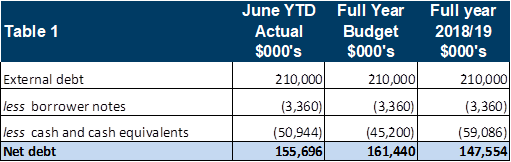
I hereby give notice that a Meeting of the Audit and Risk Subcommittee will be held on:
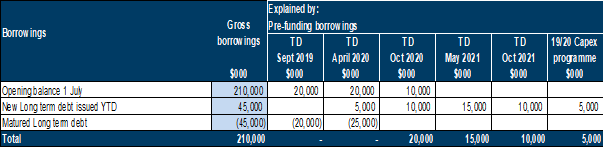
|
|
Date:
|
Thursday, 13 August 2020
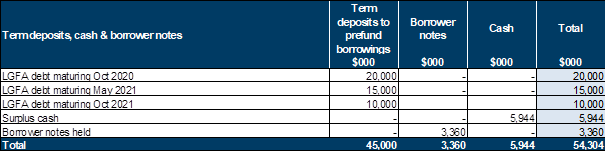
|
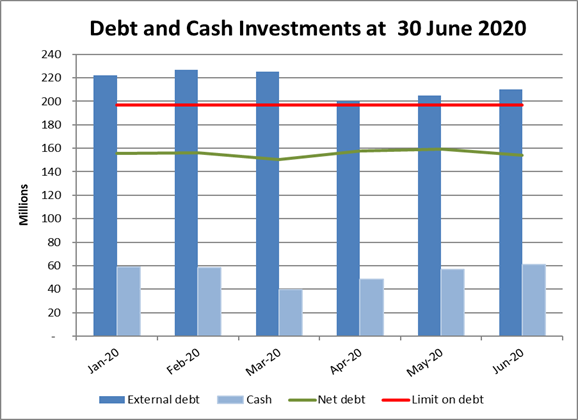
|
Time:
|
9.30am
|
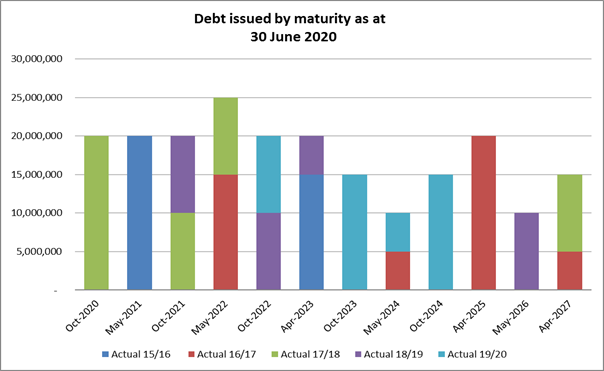
|
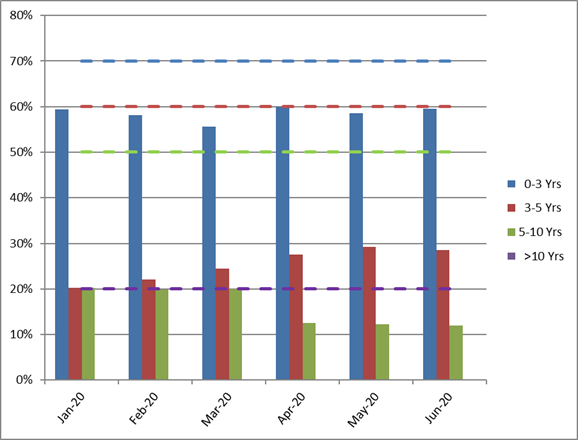
Location:
|
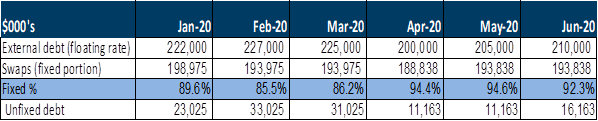
Council Chamber
Ground Floor, 175 Rimu Road
Paraparaumu
|
|
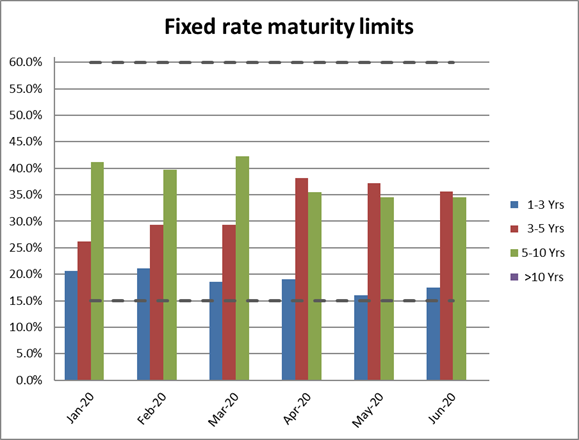
Mark de Haast
Group Manager Corporate
Services
|
|
Audit and
Risk Sub-committee Meeting Agenda
|
13 August 2020
|
Kapiti Coast District Council
Notice
is hereby given that a meeting of the Audit and Risk Subcommittee will
be held in the Council Chamber,
Ground Floor, 175 Rimu Road, Paraparaumu, on Thursday 13 August 2020, 9.30am.
Audit and Risk Subcommittee
Members
|
Mr Bryan
Jackson
|
Independent Chair
|
|
Mayor K Gurunathan
|
Member
|
|
Cr Angela Buswell
|
Deputy
|
|
Deputy Mayor Janet Holborow
|
Member
|
|
Cr Gwynn Compton
|
Member
|
|
Mr Gary Simpson
|
Independent
|
2 Council
Blessing
“As we deliberate on the
issues before us, we trust that we will reflect positively on the
communities we serve. Let us all seek to be effective and just, so that with
courage, vision and energy, we provide positive leadership in a spirit of
harmony and compassion.”
I a mātou e whiriwhiri ana
i ngā take kei mua i ō mātou aroaro, e pono ana mātou ka
kaha tonu ki te whakapau mahara huapai mō ngā hapori e mahi nei
mātou. Me kaha hoki mātou katoa kia whaihua, kia tōtika
tā mātou mahi, ā, mā te māia, te tiro whakamua me te
hihiri ka taea te arahi i roto i te kotahitanga me te aroha.
3 Apologies
4 Declarations
of Interest Relating to Items on the Agenda
Notification from Elected
Members of:
4.1 – any interests that
may create a conflict with their role as an elected member relating to the
items of business for this meeting, and
4.2 – any interests in
items in which they have a direct or indirect pecuniary interest as provided
for in the Local Authorities (Members’ Interests) Act 1968
5 Public
Speaking Time for Items Relating to the Agenda
6 Members’
Business
(a)
Public Speaking Time Responses
(b)
Leave of Absence
(c)
Matters of an Urgent Nature (advice to be provided to the Chair prior to
the commencement of the meeting)
7 Updates
Nil
8 Reports
8.1 Health
and Safety Quarterly Reports: 1 January 2020 - 30 March 2020; and 1 April 2020
- 30 June 2020
Author: Dianne
Andrew, Organisational Development Manager
Authoriser: Wayne
Maxwell, Chief Executive
Purpose of Report
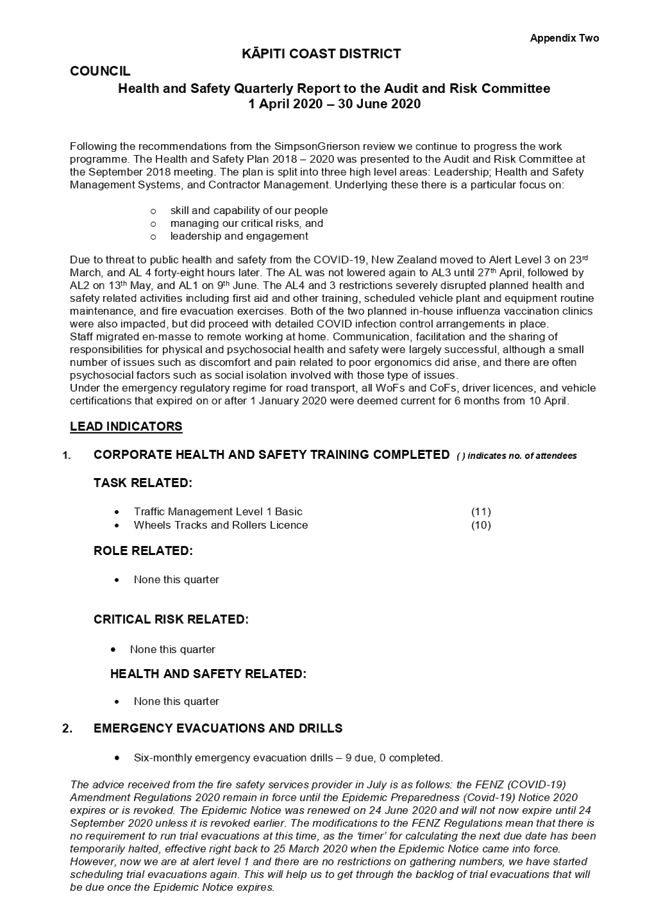
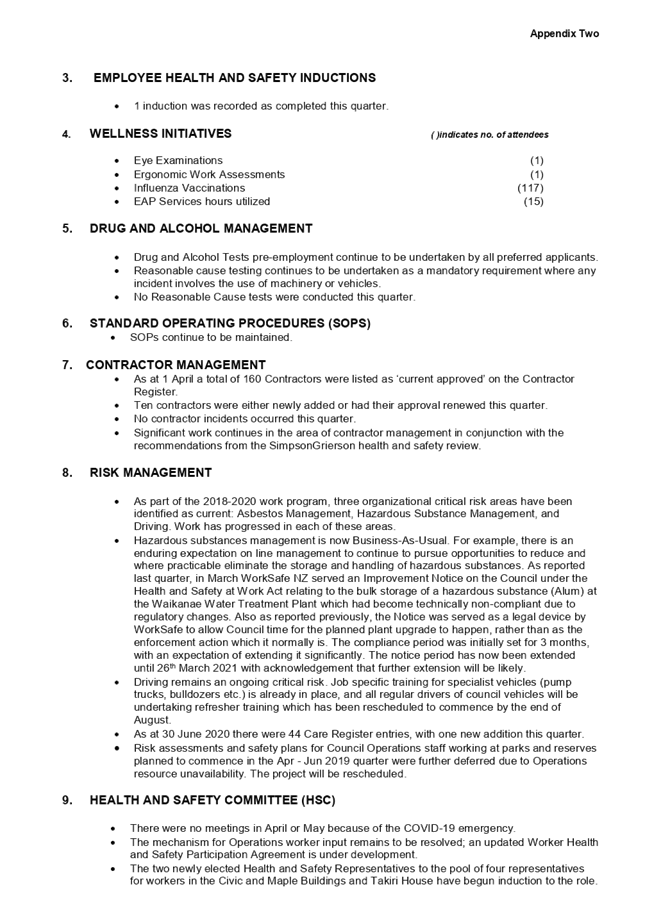
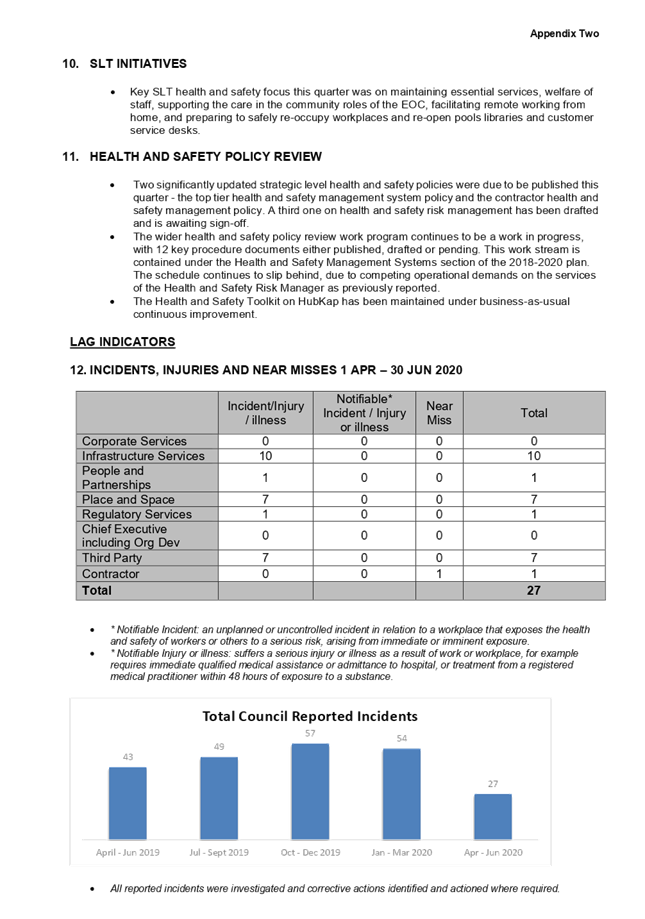
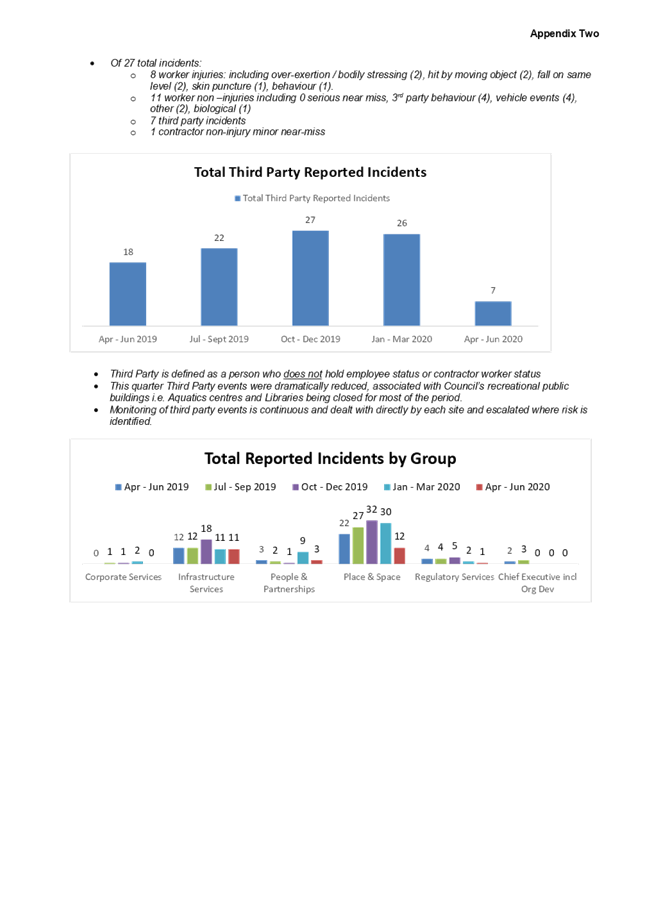
1 This
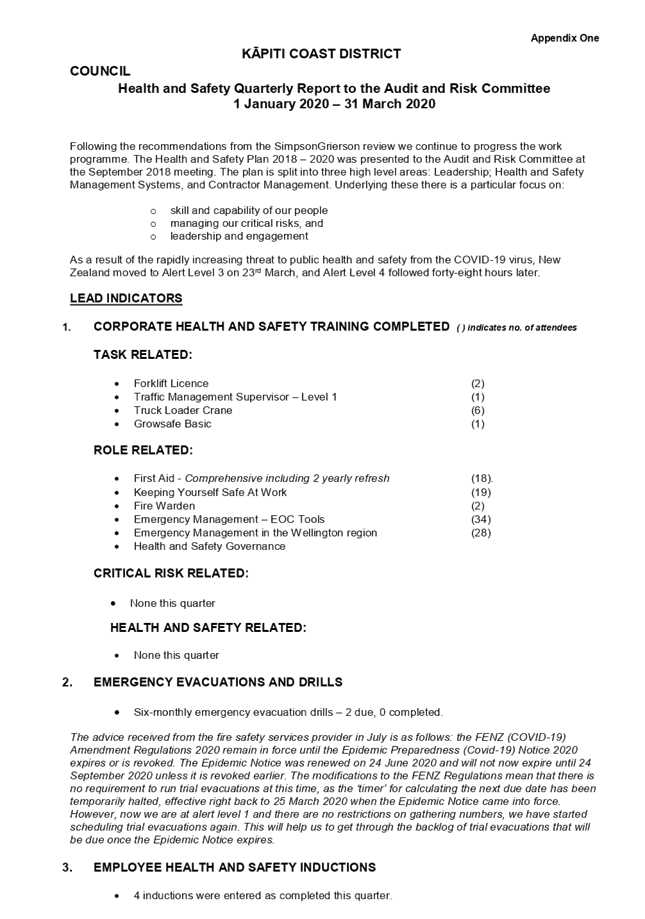
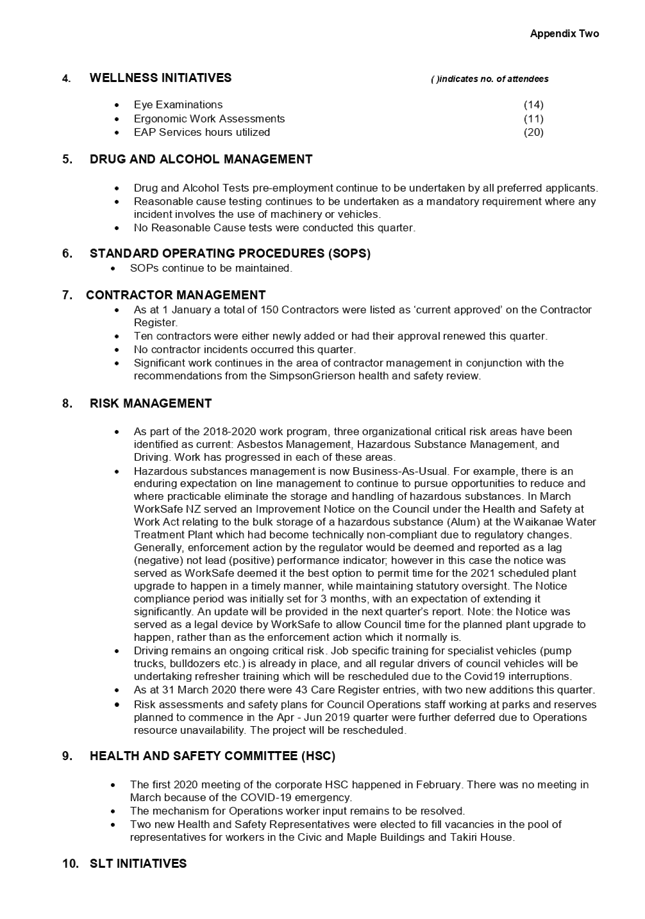
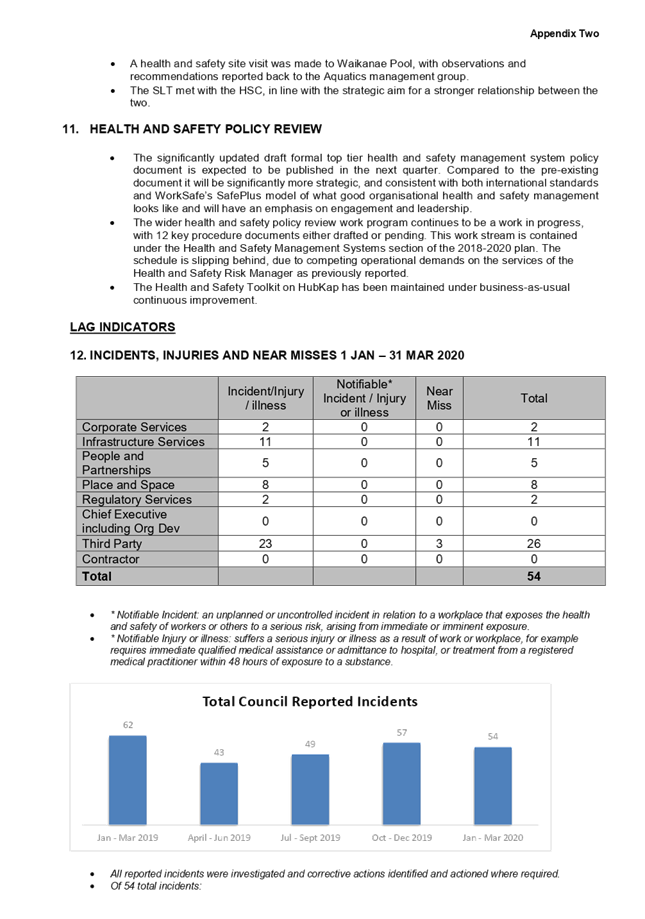
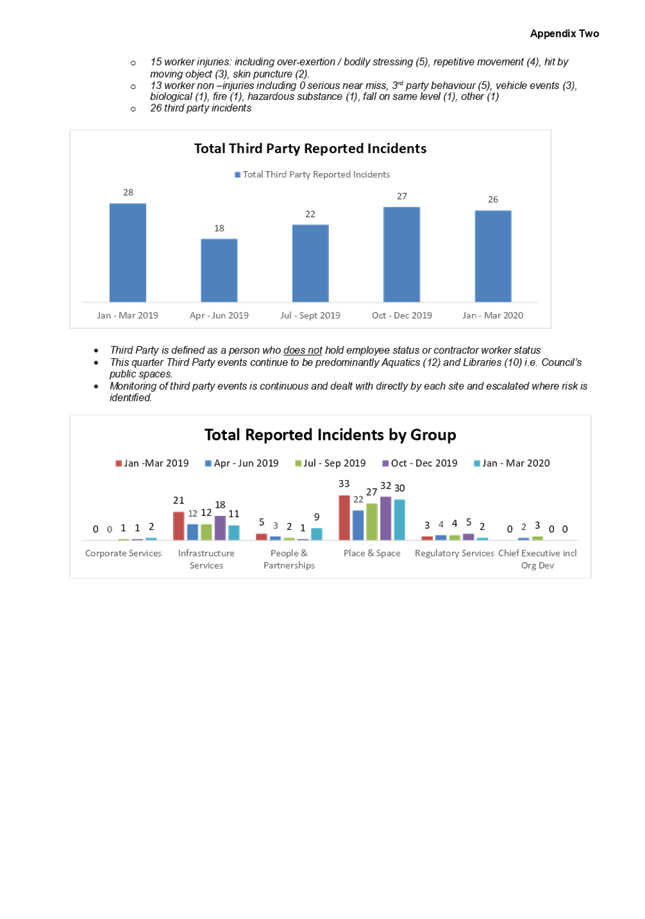
report presents Health and Safety reports for the periods 1 January 2020
– 31 March 2020 and 1 April 2020 – 30 June 2020.
Delegation
2 The
Audit and Risk Sub Committee has delegated authority to consider this report
under the following delegation in the Governance Structure, Section C.1:
· Ensuring
that the Council has in place a current and comprehensive risk management
framework and making recommendations to the Council on risk mitigation;
· Assisting
elected members in the discharge of their responsibilities by ensuring
compliance procedures are in place for all statutory requirements relating to
their role;
· Governance
role in regards to the Health and Safety Leadership Charter and Health and Safety
Plan.
Background
3 The
quarterly Health & Safety Performance Report is intended to provide the
Council with insight into initiatives and activities, and their progress, as
part of our organisations commitment to providing a safe and healthy place to
work. The contents and any subsequent discussions arising from this report can
support Council officers to meet their due diligence obligations under the
Health & Safety at Work Act (HSWA) 2015.
4 Between
July and September 2017 the Simpson Grierson Health and Safety team were
engaged to review how the Council was progressing with changes and planned
initiatives following the introduction of the Health and Safety at Work Act
(HSWA) 2015. The findings were presented back to the Audit and Risk Committee
in November 2017. This review identified areas for improvement, in particular
where we can improve some current processes to further strengthen our ability
to more effectively monitor and verify.
5 A
draft Health and Safety Plan 2018 – 2020 was provided to the Committee at
the meeting 13 September 2018 and has since been adopted by the Senior
Leadership Team.
6 Progress
on the 2018 – 2020 Health and Safety Plan has been incorporated into
quarterly reports going forward.
7 Two
reports are presented at this time due to the business interruptions as a
result of the Covid19 pandemic impact on ‘business as usual’.
Issues and Options
Issues
8 Progress
on the Health and Safety 2018-2020 Plan initiatives is progressing however the
alert level 4 and alert level 3 restrictions severely disrupted planned health
and safety related initiatives and training. Several time lines may be extended
and this will be updated through the reporting cycle.
Considerations
Policy
considerations
9 There
are no Policy considerations.
Legal considerations
10 There
are no legal considerations.
Financial
considerations
11 Budget
has been provided for implementation of the action plan initiatives as part of
the 2018-38 Long Term Plan.
Tāngata
whenua considerations
12 There
are no Tāngata whenua considerations.
Significance and Engagement
Significance
policy
13 This
report does not trigger the Council’s Significance and Engagement Policy.
Publicity
14 There
are no publicity considerations.
|
Recommendations
15 That
the Audit and Risk Sub Committee notes the two Health and Safety Quarterly
Reports for the periods: 1 January 2020 – 31 March 2020; and 1 April
2020 – 30 July 2020 attached as Appendix One and Appendix Two to this
Report.
|
Appendices
1. Appendix
One - H&S Quarterly Report Jan-March 2020 ⇩ 
2. Appendix
Two - H&S Quarterly Report April-June 2020 ⇩ 
|
Audit
and Risk Sub-committee Meeting Agenda
|
13 August 2020
|
|
Audit and Risk Sub-committee Meeting Agenda
|
13 August 2020
|
8.2 Update
on key 2018-19 Audit Findings
Author: Anelise
Horn, Manager Financial Accounting
Authoriser: Mark
de Haast, Group Manager Corporate Services
Purpose of Report
1 This
report provides the Audit and Risk Subcommittee with a progress update regards
Ernst & Young’s Report on Control Findings for the year ended
30 June 2019.
Delegation
2 The
Audit and Risk Subcommittee has delegated authority to consider this report
under the following delegation in the Governance Structure, Section C.1.
· Reviewing
and maintaining the internal control framework.
Obtaining from external auditors any
information relevant to the Council’s financial statements and assessing
whether appropriate action has been taken by management in response to the
above.Background
3 In
accordance with New Zealand Auditing Standards, Ernst & Young (Audit)
performed a review of the design and operating effectiveness of the
Council’s significant financial reporting processes as part of their
audit for the year ended 30 June 2019.
4 Control
risk matters and/or issues are classified as high, moderate or low. Control
risk definitions are as follows:
· High
Risk – matters and/or issues are considered to be fundamental to the
mitigation of material risk, maintenance of internal control or good corporate
governance. Action should be taken either immediately or within three months.
· Moderate Risk –
matters and/or issues are considered to be of major importance to maintenance
of internal control, good corporate governance or best practice for processes.
Action should normally be taken within six months.
· Low Risk – A weakness which does
not seriously detract from the internal control framework. If required, action
should be taken within 6 -12 months.
5 Audit
identified eight control risk issues for the year ended 30 June 2019, ranging
from low to moderate risk rankings. The table at the end of the report, details
the year to date progress against these control findings.
6 Unfortunately,
some of the planned work programmes to fully address Audit’s 2018/19
control findings have been delayed due to the Covid-19 restrictions.
7 As
part of their audit for the year ended 30 June 2020, Audit will consider this
progress update and in doing so, Audit will assess whether any existing control
findings can be formally closed-out.
Considerations
Policy
considerations
8 There
are no policy implications arising from this report.
Legal
considerations
9 There
are no legal considerations arising from this report.
Financial
considerations
10 Financial
issues have been covered as part of this report.
Tāngata
whenua considerations
11 There
are no direct tāngata whenua considerations arising from this report.
Significance and Engagement
Significance
policy
12 This
matter has a low level of significance under the Council’s Significance
and Engagement Policy.
Publicity
13 There
are no publicity considerations.
|
Recommendations
14 That
the Audit and Risk Subcommittee notes the progress update in regards to Ernst
& Young’s Report on Control findings for the year ended 30 June
2019 and that Ernst & Young will re-assess these as part of their audit
for the year ended 30 June 2020.
|
Appendices
Nil
Summary
of Control Findings for the year ended 30 June 2019
|
1.
Service requests - Accuracy of response and resolution times (Moderate)
|
|
Target date for completion and current status
|
31/03/2020
Complete
|
|
Ernst & Young Audit Observation
|
In completing our testing
of performance reporting information we identified multiple instances where
the response and resolution times used as a basis for calculating measures
were inconsistent with the times indicated on job sheets that were completed
for those jobs by the staff attending to the request.
One
particular issue we observed that occurred for multiple items tested was
requests being marked as responded to or resolved too early. This was
observed for both water supply and waste water when measuring response or
resolution times to urgent and non-urgent requests. This is primarily the
result of the first action logged in response to the request being treated as
either KCDC having responded to, or resolved, the matter when in actual fact
the action was a step towards either responding to, or resolving, the matter.
Since a number of performance measures
require reporting of response or resolution times discrepancies in the time
recorded will lead to incorrect outcomes being reported. Whilst this has
implications for Council’s non-financial performance reporting it also
impacts management’s ability to understand the team’s
responsiveness to ratepayer requests and any resourcing or process issues
that may need to be remedied to allow timely responses to requests.
|
|
EY Audit Recommendation
|
Requests logged in Council’s system
should be reviewed on a periodic basis to ensure the time to respond to, or
resolve, matters is being accurately reflected in the system.
|
|
Action Plan
|
We
agree with the observation. The MagiQ system allows multiple actions to be
recorded against a service request. In some cases, the final response
time is recorded on the second or later action. Our analysis found
that, although the correct response time is being entered in the system, the
automatic reports used to calculate the response time measures only capture
the time that the first action is completed. This has meant that in
cases when the final response time is not when the first action is completed,
the calculations of median response time are being made incorrectly.
The
issues have been documented and several solution options will be investigated
further:
· Re-design the service request system and
data capture process, to allow for reports to accurately calculate the
correct median response time. This is the most robust and long-term
solution, but would be the most complex to implement.
· Adopt a workaround whereby staff ensure
that only the first action can be used for the resolving action, allowing
existing reports to calculate the median response time accurately.
· Continue the current practice of cleaning
the report data manually to ensure that the measure is reported accurately,
but undertake this on a more regular basis throughout the year as recommended
above. This is a short-term solution that does not fix the root cause
of the problem. However, in advance of a more sustainable solution
being implemented, a review and cleaning of the first two months of data for
FY19/20 is already underway.
Responsibility:
Manager Corporate Planning and
Reporting and Chief Information Officer
|
|
Progress Update
|
In March 2020, we activated new fields on the Service
Request form to capture service
restored date and time which the Operations team are now using. The
median response time reports have been rewritten so they now calculate the
resolution KPI measures using the time elapsed from the date and time of
receipt to the date and time of service restored. This avoids the
previous risk of errors when calculating the resolution time by excluding the
action completed times from any calculation. The new field is included
on hard copy SR forms and in the MagiQ system. We have retrospectively
completed this field for SRs from July 2019 to March 2020 to ensure the data
is consistent for the full 2019/20 year.
The new report also excludes the following
requests:
· private site requests (coded as ‘Not
Council issue’).
· requests where no fault was found (coded
as ‘Not Council issue’).
· requests generated by staff (coded as internal
requests) per control finding 3 below.
|
|
2. Service requests - Monitoring of roading requests for service
(Moderate)
|
|
Target date for completion and current status
|
31/03/2020
Proposed solution in operation, testing in
progress.
|
|
Ernst & Young Audit
Observation
|
For the
access and transport measure relating to the Council’s response time to
requests for service for roads and footpaths, Council were unable to
accurately determine if requests for service had been responded to within the
target timeframes. The information for this measure is sourced from two
separate systems, MagiQ which holds the details of requests, and RAMM, which
holds the details of work and actions undertaken. The primary issue is that
there is insufficient clarity of how some requests in MagiQ can be linked to
actions taken recorded in RAMM.
Because requests for service in MagiQ are
unable to be fully mapped to work undertaken and recorded in RAMM, Council is
unable to report an outturn for the year against this target. The issue also
limits Council’s ability to measure responsiveness from the perspective
of managing operations and considering performance on a regular basis and how
resource should be allocated.
|
|
EY Audit Recommendation
|
We recommend that work is
completed to improve the interfacing or flow of data between these two
systems. Alternatively work completed could be recorded in MagiQ against each
of the relevant requests for service.
|
|
Action Plan
|
Investigative
work will be needed to determine the best way forward to accurately measure
response time to service requests for road and footpath work. The ideal would
be an automated flow of data between MagiQ and RAMM where the interface is
seamless and error-free. However, if that proves unattainable we will
have to look at establishing systems to achieve manual updates of service
request response time information from RAMM to MagiQ at the same time that
completion times are entered into MagiQ from RAMM. This may require
additional consistency checks between the two databases to ensure that
request types and priority assignments are the same in the two systems so
that response time targets are equivalent. At first glance this appears to be
a substantial piece of work and will probably exceed the recommended
six-month timeframe.
Responsibility:
Chief Information Officer and
Manager Corporate Planning and Reporting
|
|
Progress Update
|
Council’s road maintenance
contractor Higgins has identified a solution to automate service requests
data from Council’s MagiQ system into RAMM to ensure the data is
consistent across both systems. Currently this is a one-way data transfer,
and solutions to enable two-way data transfer are being investigated.
A new process whereby Higgins update MagiQ
directly using their remote access has been documented and is now in place.
Test Reports need to be run to check whether there is a need for any
improvements in data quality.
|
|
Audit
and Risk Sub-committee Meeting Agenda
|
13 August 2020
|
|
3. Service requests – Duplicate
requests for services (Low)
|
|
Target date for completion and current status
|
30/06/2020
Complete
|
|
Ernst & Young Audit
Observation
|
When
reviewing requests for service data for the water supply and wastewater
management activities we identified duplicate requests for service for the
same matter. In some instances, requests for service were closed with zero
response times if they were confirmed as duplicates. This has an impact on
median response times through reducing this measure incorrectly.
We also noted instances
where Council initiated requests for service for planned work and these were
included in the calculation of median response times. The request for service
based metrics are primarily intended to measure response times to ratepayer requests
as opposed to Council’s internal work program.
Duplicate
requests included in the system impact the reported results especially in
instances where duplicates have a response time set to zero and have been
included in the calculation of the median.
The inclusion of requests
for service from Council employees means the measures become less focused on
Council’s responsiveness to ratepayer requests.
|
|
EY Audit Recommendation
|
We recommend implementing
controls that prevent duplicate requests for service being recorded in the
system. Alternatively, a periodic review of requests within the system could
be undertaken to identify and remove duplicate requests. The same review
could ensure Council generated requests are clearly labelled as such and
excluded from the calculation of the measure.
|
|
Action Plan
|
We agree
with the observation.
Several
solution options will be investigated further in conjunction with the
response in 2.1.1:
1. Re-design
the service request system and data capture process, to ensure that duplicate
requests, internal requests, planned work, and other non-applicable requests
can be excluded from the calculation of the performance measure.
2. Continue
the current practice of cleaning the report data manually to ensure that the
measures are reported accurately, but undertake this on a more regular basis
throughout the year as recommended above.
As noted in
2.1.1, we have already begun a review and cleaning of the report data for
FY19/20. As well as correcting the response times, this task also
includes removing duplicates and non-applicable service requests from the
calculated median response times.
Responsibility:
Manager Corporate Planning and
Reporting, and Chief Information Officer
|
|
Progress Update
|
The process for managing duplicate
requests within MagiQ was updated in March 2020. Staff are now using
the system’s ability to add multiple callers to one request (rather
than raising multiple requests for the same issue). Process
documentation for dealing with multiple callers & duplicate requests has
also been developed.
A report to identify all duplicate
requests (more than one request for a single issue) is now being circulated
to the business activity areas at month end for review, so that these can be
rectified prior to month-end reporting. Records that are duplicated in
error are being deleted from the system to ensure accuracy of the median
response time determinations. A few key staff have been selected
to be given access to do this. This work is ongoing, however, all
duplicates for 2019/20 service requests have been removed.
Requests that are raised internally (between
departments) are flagged as INTERNAL within the system and the DIA report has
been amended to exclude these.
|
|
4.
Service requests – Manual reorganisation of requests for services (Low)
|
|
Target date for completion and current status
|
30/06/2020
Solution development in progress but delayed due to
COVID-19. Expect new process to be in place from August 2020.
|
|
Ernst & Young Audit
Observation
|
To
calculate outcomes for some measures, data was extracted from the system and
put through a further manual process to determine the category of the
request. This involved adjusting the category of the request per the system
and then calculating the measure to be reported based on the excel
spreadsheet with updated categorisations.
We
identified instances where information extracted from the system was
subjected to further manual categorisation and was incorrectly categorised,
affecting the reported results. For example, requests for service that did
not relate to the particular activity or urgency categorisation were included
in calculating the outcome for that measure.
We also identified
instances where subsequent to information being extracted from the system,
changes were made to the information in the system and the associated
spreadsheet wasn’t updated to reflect these changes. Because the
measures are calculated based on the data in the spreadsheet this results in
information relevant to the request for service being excluded.
Incorrect categorisation
of data could lead to measures being incorrectly calculated.
|
|
EY Audit Recommendation
|
We recommend that
processes be updated to allow for correct classification of requests for
service at the point the requests are received. If this is impractical we
would suggest that requests for service be reviewed on a periodic basis and
reclassified within the system when a reclassification is required.
|
|
Action Plan
|
The points
above appear to refer to the current system for assessing and reporting on
Stormwater and Coastal service requests.
We agree
that this system should be amenable to significant improvement.
However, following our own analysis we have further characterised the issue:
Firstly,
our understanding is that ‘instances where information extracted
from the system subjected to further manual categorisation was incorrectly
categorised affecting the reported results’ relates to two separate
matters;
i) Where instances of service requests
related to stormwater outlets were included in calculations of the Coastal
measure for ‘Urgent requests to repair sea walls or rock
revetments’ when they should only be accounted for in the Coastal
measure for ‘Stormwater beach outlets are kept clear’. This has
been fixed in the current reporting and is a straightforward fix even in the
existing ‘manual’ spreadsheet method of reporting on Coastal KPI
measures.
ii) There were three instances of stormwater
service requests (out of 89) which were classified as urgent in error. This
error rate is unlikely to be improved by adopting the suggestion that ‘processes
be updated to allow for correct classification of request for service at the
point requests are received’. Requests are received at the
call centre for the most part and staff often either a) do not have
sufficient or accurate enough information from the caller to correctly
classify the request, or b) do not have the experience to be able to do so.
This is why we rely on a subsequent, secondary, classification process by our
stormwater team, who occasionally make errors.
Secondly,
it was identified that ‘instances where subsequent to information
being extracted from the system changes were made to the information in the
system and the associated spreadsheet wasn’t updated to reflect these
change’. It isn’t clear how many instances of this were
found but to our knowledge there weren’t many and we expect they would
be largely immaterial to the measures being reported on or the response time
calculations. Many of the changes made to request types subsequent to data
being extracted from the system do not have any material bearing on the
secondary categorisation made by the stormwater team and to revisit MagiQ on
a regular basis to update these would be both time-consuming and probably not
very productive.
A full
improvement solution to MagiQ to enable it to generate more stream-lined and
efficient Coastal and Stormwater service request reporting will take
significant investigation and discussion with both MagiQ, regarding the system’s
capabilities, and the Coastal and Stormwater team, regarding their
requirements. We envisage the following:
i) introducing a pro-forma report that
doesn’t require manual set-up each week and only needs date ranges
entered to provide the appropriately filtered list of service requests each
week.
ii) ideally, we would then like to see
enhancements to the system so that there are a range of drop-down or
pick-list categories that the Coastal and Stormwater team can use for
providing secondary and tertiary categorisations to each service request (so
that this is done in MagiQ rather than on a separate spreadsheet). This
categorisation process would include categorisations as to which service
requests are Coastal or Stormwater requests, and further to that, which are
urgent/non-urgent, council/private issues, affect buildings/or don’t
etc.
iii) if such improvements are feasible then
when that secondary categorisation process is complete each week, a report
should be able to be generated from MagiQ which generates the equivalent of
the current Stormwater and Coastal service request spreadsheets.
This
approach would significantly improve the efficiency of the current process
and improve the audit trail. It would not remove the human judgement
factor behind the categorisation process as that is how the categorisations
are currently made in MagiQ in any case. We would need to investigate whether
there is an efficient process for checking whether subsequent changes to
categorisations of service requests not initially identified as relevant for
Coastal or Stormwater reporting purposes have, as a result of a
re-categorisation in MagiQ, become relevant for those purposes.
This will
be a significant piece of work and will need to be undertaken in concert with
the planned upgrade to MagiQ and other proposed improvements recommended to
improve reporting of actual resolution times and avoidance of counting
duplicate service requests in those calculations.
Responsibility:
Manager
Corporate Planning and Reporting, and Chief Information Officer
|
|
Progress Update
|
The management of Coastal & Stormwater
service requests and manual data manipulation was reviewed as part of a
previous KPI project. The BI team and Coastal & Stormwater team
reviewed the proposed changes from that project and agreed the following:
• amend
SR request “types” to align with KPI reporting requirements
• update
Kbase instructions for Customer Engagement staff
• create
new reports in MagiQ to align with KPI reporting requirements
Due to key resources being allocated to the EOC to
assist with Covid-19 response, this work has been delayed. For the
2019/20 audit the current manual categorisation and quality checking will
remain. The above changes are planned to be implemented in August 2020.
|
|
5.
Corporate policies due for review (Low)
|
|
Target date for completion and current status
|
30/12/2020
On-track but progress delayed by COVID-19
|
|
Ernst & Young Audit
Observation
|
We
observed various employee manuals and policy documents were last updated over
3 years ago. Specifically, we noted the below policies are currently overdue
for review and update:
a. Receipt
of gifts and hospitality
b. Rewards
and recognition policy
c. Mitigation
of fraud
d. Employee
code of conduct
e. Elected
member code of conduct
Policies and other guidance documents should be
updated on a regular basis to ensure any changes in circumstances that
require additional guidance are incorporated on a timely basis.
|
|
EY Audit Recommendation
|
We recommend that
corporate policies be monitored and updated on a regular basis.
|
|
Action Plan
|
We accept
the findings and recommendation from audit. The register of corporate
policies, including review dates, will be updated and monitored by Corporate
Services going forward as part of the wider policy programme.
Responsibility:
Manager
Research and Policy, Corporate Services
|
|
Progress Update
|
The Research and Policy team are currently developing
a programme of work to review, update and maintain all corporate policies.
This includes prioritising the review of the policies identified above. This
programme has been delayed by COVID-19 restrictions, however, work has now
resumed on this programme.
|
|
6.
Timeliness of purchase order initiation (Low)
|
|
Target date for completion and current status
|
30 September 2020
Delayed but on-track
|
|
Ernst & Young Audit
Observation
|
During our testing of the expenditure and payments
process we observed that some purchase orders were generated subsequent to
the receipt of invoices.
Without adequate controls for processing and
reconciling purchase orders, invoices and the receipt of goods and services,
there is an increased risk that inappropriate or erroneous expenditure is
incurred or reported. A
purchase order system works most effectively when purchase orders are
approved prior to goods or services being purchased. After the transaction
has occurred there may be less opportunity to change the agreement that has
been entered into.
|
|
EY Audit Recommendation
|
We recommend purchase
orders are raised and appropriately approved prior to placing orders with
suppliers.
|
|
Action Plan
|
Management
accepts the recommendation and is currently working on a programme for
induction and increased training for staff to ensure there is a consistent
high standard of compliance with the Procurement Policy across all areas of
the Council. The Finance team worked with the suppliers during the
2018/19 year to highlight the importance of requesting an EPO number from
Council before beginning any work.
Responsibility:
Chief Financial
Officer/ Manager, Financial Accounting
|
|
Progress Update
|
Finance is implementing an Accounts Payable
Automation function across the Council and engaged CSG technologies Limited
in February 2020 to implement a Scanning and Optic character recognition
(SOCR) solution to streamline our supplier payment process. Council is
currently testing the solution functionality and its integration with our
current Financial Management Information System (MagiQ).
The delivery of the project was delayed by the
COVID-19 restrictions and full implementation has been delayed to the end of
August 2020. As part of this project, EPO training will be rolled out to all
EPO users within Council.
Automation will strengthen the discipline of
initiating an EPO when the goods or services are ordered as the EPO number
will be a key field on the supplier invoice required by the payment solution.
Council suppliers will be informed, before the “go-live” date, of
the changes to our systems and the importance of the EPO reference on their
invoices to ensure prompt payment.
Council-wide procurement training continues.
|
|
7.
Approval of expenditure (Low)
|
|
Target date for completion and current status
|
30/06/2020
On-going
|
|
Ernst & Young Audit
Observation
|
KCDC’s
General Expenses policy states “one-up” authorisation must be
given to the person who will benefit or might be perceived to benefit from
the expenditure.”
We noted two instances where an expense
claim was either authorised by a person who was not one up from the
individual that incurred the cost or was not one up from the most senior
individual that benefited or might be perceived to have benefited from the
expenditure. In both instances we are satisfied that the expenditure was
appropriate but have recommendations regarding the execution of the relevant
controls.
This may increase the risk
that inappropriate expenditure goes undetected.
This policy also serves to safeguard
staff in that in instances where they may have been perceived to have benefited
from Council expenditure an independent member of staff has concurred with
their judgement that the costs are appropriate.
|
|
EY Audit Recommendation
|
We recommend that
expenses incurred are approved in a manner that is in line with KCDC’s
policies
|
|
Action Plan
|
Management
accepts the findings and recommendation from Audit. Corporate Services will
seek to increase Council-wide access to and awareness of all corporate
policies
Responsibility:
Chief Financial
Officer / Manager, Financial Accounting
|
|
Progress Update
|
The Accounts Payable team are manually reviewing
each expense claim submitted for payment to ensure that it has been approved
in accordance with the General Expenses policy. If not, the claim is returned
to the relevant staff members to be corrected.
The General Expense policy is included in the
programme of work being developed by the Research and Policy team to review,
update and maintain Corporate Policies, as noted in control finding No. 5
above.
|
|
8.
Review of useful life of landfill asset (Low)
|
|
Target date for completion and current status
|
30/06/2020
Completed
|
|
Ernst & Young Audit
Observation
|
The useful life of the Otaihanga landfill
asset has not been thoroughly re-assessed recently. The asset is nearing the
end of its capacity and is only able to accept clean-fill going
forwards. There is currently an asset recorded on balance sheet for the
Otaihanga landfill that has a residual useful life spanning a number of
years. If the landfill is near to the end of its useful life and the asset
has limited remaining value the residual useful life used for accounting
purposes may need to be reduced or the value attributed to the asset may need
to be decreased.
|
|
EY Audit Recommendation
|
The
current useful life of the landfill suggests that benefit will continue to be
derived from the landfill over a number of years going forward. We recommend
that Council consider the nature and timing of the expected benefits from the
landfill and use this as context for evaluating if the current useful life is
still appropriate and if Council is likely to receive future benefit from the
landfill that broadly equates to the current carrying value of the landfill
asset.
|
|
Action Plan
|
Management
accepts the findings and will assess the economic life of the asset during
the 2019/20 year.
Responsibility:
Chief Financial
Officer /Manager, Financial Accounting
|
|
Progress Update
|
Council
reviewed the current useful life and future benefit/service potential of the
Otaihanga landfill asset during June 2020.
The
capping of the landfill has progressed faster than initially anticipated.
Therefore, the final closure date of the landfill has been brought forward
from the resource consent closure date of June 2026 to June 2022.
While the
landfill will be in-use for another 2 years, it has been determined that the
future income generated from accepting clean-fill is negligible.
In accordance
with IPSAS (International Public Sector Accounting Standards) an asset should
be held at its recoverable service amount. As negligible service value
will be delivered by the asset, the full value of this asset at year-end
($2,998,259) has been impaired to the statement of comprehensive revenue and
expense.
|
8.3 Quarterly
Treasury Compliance Report
Author: Anelise
Horn, Manager Financial Accounting
Authoriser: Mark
de Haast, Group Manager Corporate Services
Purpose of Report
1 This
report provides confirmation to the Audit and Risk Subcommittee of the
Council’s compliance with its Treasury Management Policy (Policy) for the
six months ended 30 June 2020.
Delegation
2 The
Audit and Risk Subcommittee has delegated authority to consider this report
under the following delegation in the Governance Structure, Section C.1.
Ensuring that
the Council has in place a current and comprehensive risk management framework
and making recommendations to the Council on risk mitigation.
Background
3 The
Policy sets out a framework for the Council to manage its borrowing and
investment activities in accordance with the Council’s objectives and
incorporates legislative requirements.
4 The
Policy mandates regular treasury reporting to management and the Strategy and
Operations Committee, as well as quarterly compliance reporting to the Audit
and Risk Subcommittee.
5 In
order to assess the effectiveness of the Council’s treasury management
activities and compliance to the Policy, certain performance measures and
parameters have been prescribed. These are:
· cash/debt
position;
· liquidity/funding
control limits;
· interest
rate risk control limits;
· counterparty
credit risk;
· specific
borrowing limits; and
· risk
management performance.
6 Due
to the cancellation of the Audit and Risk Subcommittee meeting on 24 May 2020
due to COVID-19, this report covers the compliance reporting for both the third
quarter (January to March) and the fourth quarter (April to June) of the
2019/2020 financial year.
discussion
Cash/Debt Position
7 Table
1 below shows the Council’s net debt position as at 30 June 2020 against
the 2019/20 full year budget and the prior year closing balance.
8 During
the past six months, the Council has issued $20 million of new debt.
9 $15
million was issued to pre-fund the May 2021 and October 2021 debt
maturities. As part of the Council’s prefunding programme, all
prefunding is placed on term deposit, at the most favourable market rates
available at that time.
10 $5
million was issued to part fund the 2019/20 planned capex work programme.
11 During
the same period, $25 million of long term debt matured during April 2020. This
was fully funded through the Council’s prefunding programme and was
repaid from term deposits maturing on the day.
12 The
table below shows (a) the movement in the Council’s external debt balance
and (b) the movement in the Council’s pre-funding programme by debt
maturity, for the year ended 30 June 2020.
13 As
at 30 June 2020, the Council had $54.3 million of cash, borrower notes and term
deposits on hand, relating mainly to the Council’s debt pre-funding
programme. This is broken down as follows:
14 For
the six months ended 30 June 2020, the Council has not breached its net debt
upper limit, as shown in the chart below:
15 The
Council is however targeting ,through its financial strategy, to keep net
borrowings below 200% of total operating income. At 30 June 2020, the
Council’s net borrowings are 184.8% of total operating income.
Liquidity/Funding control limits
16 Liquidity
and funding management focuses on reducing the concentration of risk at any
point so that the overall borrowings cost is not increased unnecessarily and/or
the desired maturity profile is not compromised due to market conditions. This
risk is managed by spreading and smoothing debt maturities and establishing
maturity compliance buckets.
17 Since
October 2015 the Council’s treasury strategy has included a debt
pre-funding programme. The Policy allows pre-funding of the Council debt
maturities up to 18 months in advance, including re-financing. Market
conditions have been favourable for this approach, where the Council draws down
debt early and is able to invest the funds on term deposit for a positive net
return.
18 The
strength of the Council’s debt pre-funding programme was again
highlighted by the Council’s independent Credit Rating Agency, Standard
& Poor’s (S&P), during their July 2020 review. This has resulted
in the Council’s credit rating remaining at AA with a stable outlook for
the following year. S&P noted that the Council’s liquidity coverage
remains exceptional.
19 The
following chart presents the Council’s debt maturity dates in relation to
the financial year in which the debt was issued. This demonstrates that since
2016/17, the Council has actively reduced risk concentration by spreading debt
maturity dates and debt maturity values.
20 Debt
maturities must fall within maturity compliance buckets. These maturity buckets
are as follows:
|
Maturity Period
|
Minimum
|
Maximum
|
|
0 to 3 years
|
10%
|
70%
|
|
3 to 5 years
|
10%
|
60%
|
|
5 to 10 years
|
10%
|
50%
|
|
10 years plus
|
0%
|
20%
|
21
For the six months ended 30 June 2020, the Council has been fully compliant
with its debt maturity limits, as shown by the chart below. The upper limits,
as shown by dashed lines, relate to the bars of the same colour. For example,
the 0 to 3 year upper limit of 70% is in blue. Actual maturities in the 03 year
bucket are represented by the blue bars. The Council has no long term debt
maturing in ten years’ time or beyond.
Interest rate risk control limits
22 The
Council issues all debt on a floating rate basis, as lower interest rates are
realised this way, and uses fixed interest rate swaps (hedges) to minimise
exposure at any one time to interest rate fluctuations. This ensures more
certainty of interest rate costs when setting our Annual Plan and Long Term
Plan budgets.
23 Without
such hedging, the Council would have difficulty absorbing adverse interest rate
movements. A 1% increase in interest rates on $210 million of external debt
would equate to additional interest expense of $2.1 million per annum.
Conversely, fixing interest rates does however reduce the Council’s
ability to benefit from falling and/or more favourable interest rate movements.
24 The
objectives of any treasury strategy are therefore to smooth out the effects of
interest rate movements, while being aware of the direction of the market, and
to be able to respond accordingly.
25 The
Policy sets out the following interest rate limits:
Major control limit where
the total notional amount of all interest rate risk management instruments
(i.e. interest rate swaps) must not exceed the Council’s total actual
debt, and;
Fixed/Floating Risk Control
limit, that specifies that at least 55% of the Council’s borrowings
must be fixed, up to a maximum of 100%.
26 The
Council has been fully compliant for the six months ended 30 June 2020, as
shown by the table below.
27 Similar to debt maturities, hedging
instrument maturities must also fall within maturity compliance buckets.
These maturity compliance buckets are as follows:
|
Period
|
Minimum
|
Maximum
|
|
1 to 3 years
|
15%
|
60%
|
|
3 to 5 years
|
15%
|
60%
|
|
5 to 10 years
|
15%
|
60%
|
|
10 years plus
|
0%
|
20%
|
28 The
Council has been fully compliant for the six months ended 30 June 2020, as
shown by the following chart. Note that maturities falling within 1 year are
not included.
Counterparty Credit Risk
29 The
policy sets maximum limits on transactions with counterparties. The purpose of
this is to ensure the Council does not concentrate its investments or risk
management instruments with a single party.
30 The
policy sets the gross counterparty limits as follows:
|
Counterparty/Issuer
|
Minimum Standard and
Poor’s long term
|
Investments maximum per
counterparty
|
Risk management
instruments maximum per counterparty
|
Borrowing maximum per
counterparty
|
|
NZ Government
|
N/A
|
Unlimited
|
None
|
Unlimited
|
|
LGFA
|
AA-/A-1
|
$20m
|
None
|
Unlimited
|
|
NZ Registered Bank
|
A+/A-1
|
60% of total investments or
$25m; whichever is greater
|
50% of total instruments or
$80m; whichever is greater
|
$50m
|
31 The
Council was in full compliance with all counterparty credit limits for the six
months ended 30 June 2020. The tables below show the Council’s
investments and risk management instruments holdings per counterparty for this
period.
Term deposits
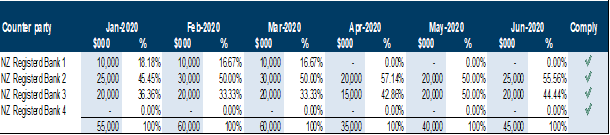
*Policy Limit: 60% of total investments or $25 million;
whichever is greater
Interest rate
swaps
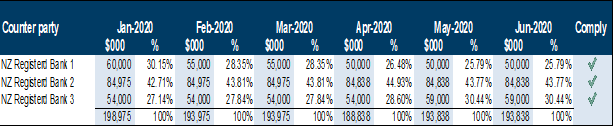
*Policy
Limit: 50% of total instruments or $80 million; whichever is greater
Specific Borrowing Limits
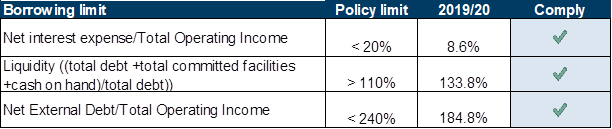
32 In
managing debt, the Council is required to adhere to the limits below. The
Council fully complied with these limits for the 6 months ended 30 June 2020
(or a period as otherwise specified) and the results are shown below:
Risk Management Performance
33 The
following table shows the Council’s interest income and expense for the
year ended 30 June 2020, together with the weighted average cost of
borrowing (WACB)
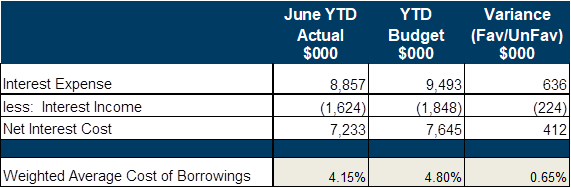
34 The
Council’s net interest cost for the year is $412,000 favourable to
budget. This is mainly due to less external borrowings at the start of the
2019/20 financial year than planned and delays to the Council’s capital
works programme due to Covid-19 restrictions.
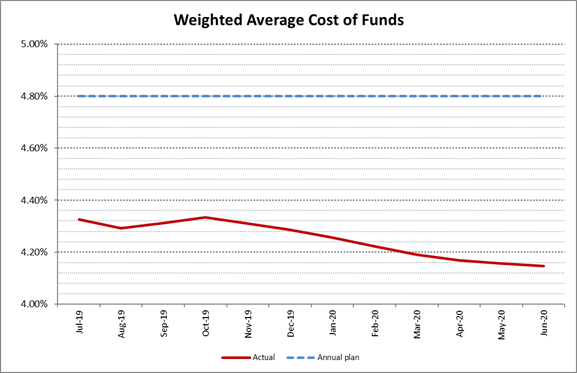
35 The
Council has been effective in its treasury management with its weighted average
cost of funds being 0.65% lower than planned as at the 30 June 2020.
36 The
following graph shows the cost of borrowing each month.
Considerations
Policy considerations
37 There
are no policy considerations in addition to those already noted in this
report.
Legal
considerations
38 There
are no legal considerations arising from this report.
Financial
considerations
39 There
are no financial considerations in addition to those already noted in this
report.
Tāngata
whenua considerations
40 There
are no tāngata whenua considerations arising directly from this
report.
Significance and Engagement
Significance
policy
41 This
matter has a low level of significance under the Council’s Significance
and Engagement Policy.
Publicity
42 There
are no publicity considerations arising from this report.
|
Recommendations
43 That
the Audit and Risk Subcommittee notes the Council’s full compliance
with its Treasury Management Policy for the six months ended 30 June 2020.
|
Appendices
Nil
8.4 Risk
Management - Business Assurance Update
Author: Sharon
Foss, Business Improvement Manager
Authoriser: Mark
de Haast, Group Manager Corporate Services
Purpose of Report
1 This
report primarily updates the Audit and Risk Subcommittee on the on-going
implementation of the Enterprise Risk Management (ERM) framework.
Delegation
2 The
Audit and Risk Subcommittee has delegated authority to consider this report
under the following delegation in the Governance Structure, Section C.1.
Ensuring that Council has in
place a current and comprehensive risk management framework and making
recommendations to the Council on risk mitigation.
Background
3 The
key elements of the Enterprise Risk Management Framework include:
· Risk
Management;
· Business
Continuity Management;
· Business
Assurance; and
· Procurement
Improvement Programme.
4 The
key work streams within this area are:
· Regularly
discuss risks with the Council’s business groups and Senior Leadership
Team and embed the day-to-day management of risks in the more routine activities;
· develop
a risk communication/reporting process at, and between, the following levels:
− Council/Committees;
− Senior
Leadership Team (SLT);
− Business
Units/Groups; and
− Projects,
Asset Management.
· develop
a Business Continuity Management System for effective response to a range of
potential business disruptions;
· provide
fraud awareness training;
· provide
business assurance oversight and complete business assurance work; and
· improve
the understanding and tools to support good procurement practices.
5 As
previously reported, the intended outcomes from performing this programme well
will include:
· stakeholders,
external auditors, Council and management achieve high levels of assurance that
the real risks are being identified and managed effectively;
· better
decision making throughout the business through greater awareness of the real
risks (threats and opportunities); and
· clarification
and socialisation of the Council’s risk appetite and tolerance.
Enterprise Risk Management Progress Update
6 Guidance
for the risk management, procurement and assurance work has been established
through a collaborative process with Council staff.
7 The
work has focussed primarily on tangible outputs, as discussed separately below.
Corporate Risk Profile
– Status Update
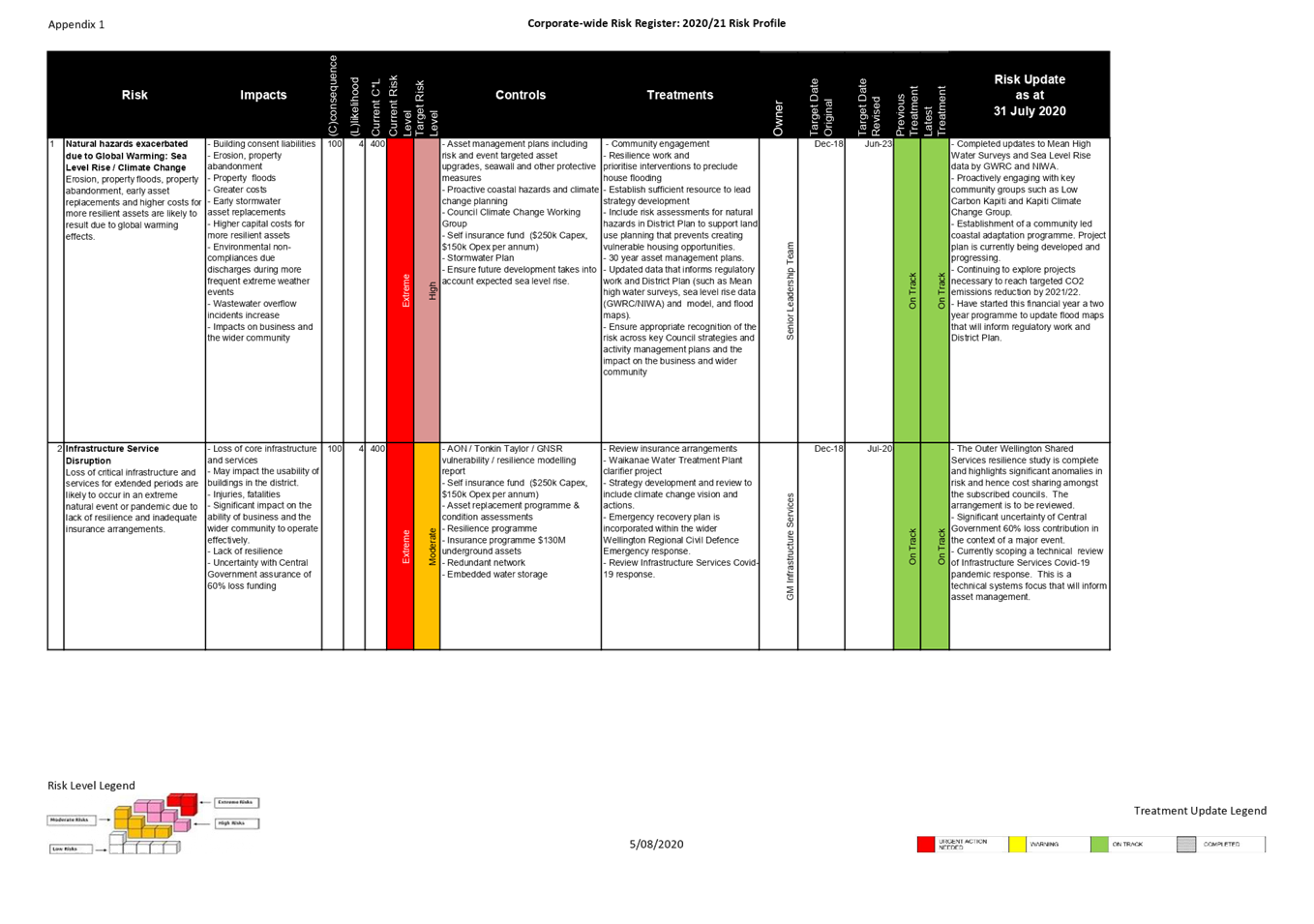
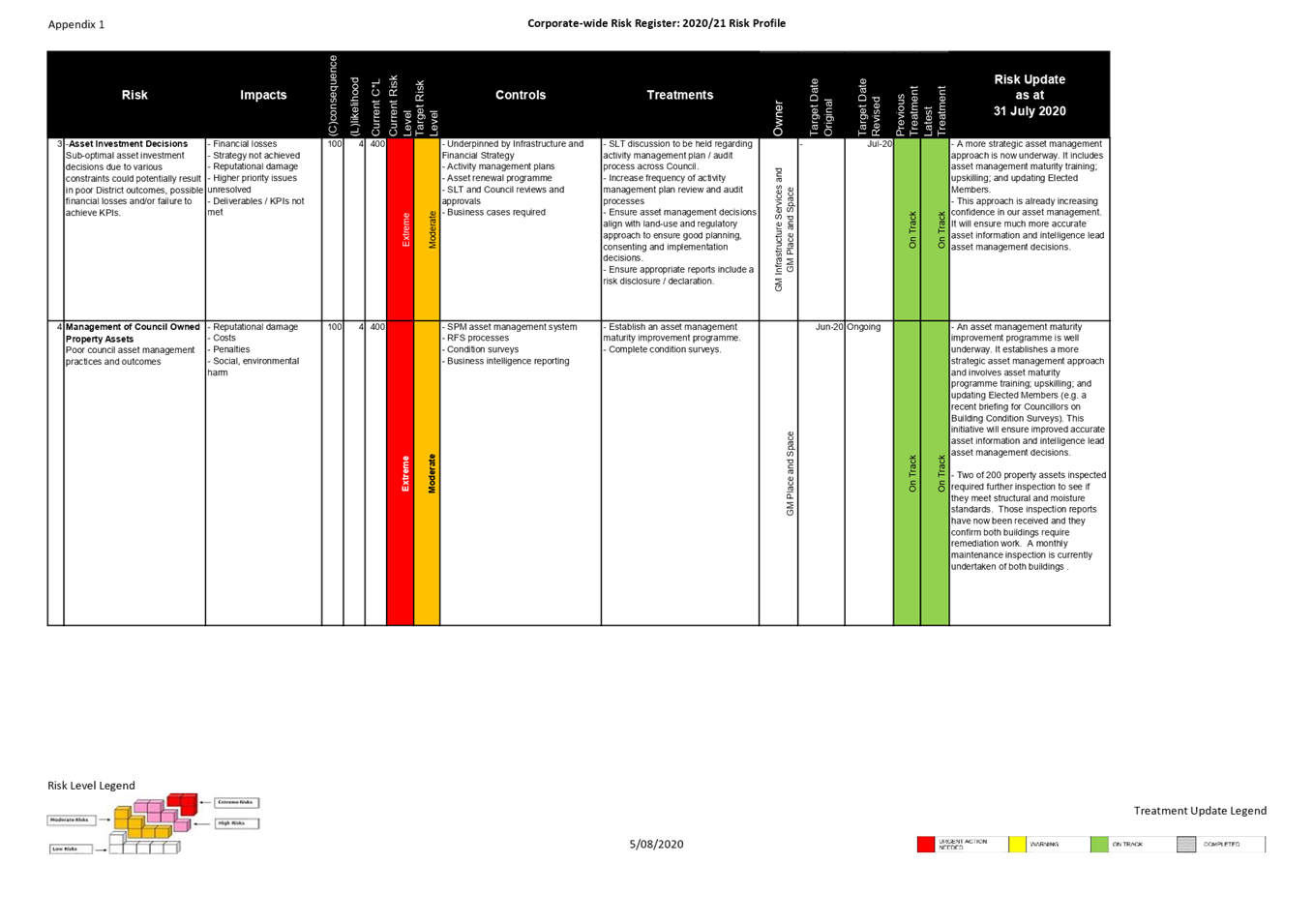
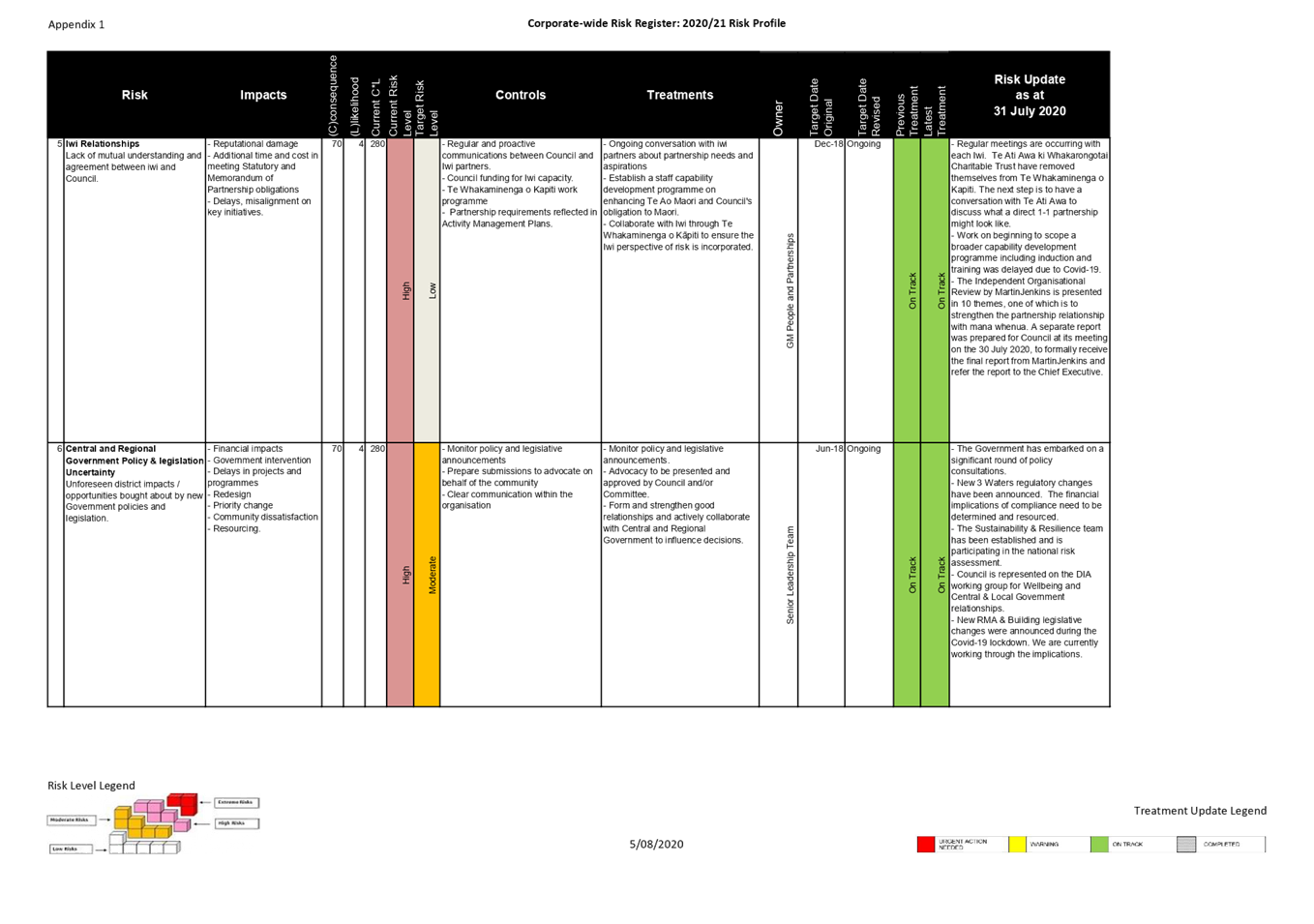
8 As
part of Enterprise Risk Management (ERM) a risk profile, comprising a risk
register and risk treatment plan, was established. This is subject to
approximately quarterly updates by management and is then reported to the
Subcommittee. The focus is on identifying, managing and communicating the very
highest strategic and operational risks that the Council faces.
9 Engagement
on the risk profile now routinely includes conversation with activity managers
as well as Group Managers. The overall risk management culture and practice is
improving and risk conversations are widening.
10 The
concept of risk acceptance is being further embedded across the organisation,
i.e. certain moderate level risks may be overtly tolerated by the business in
the context of the costs or impracticalities to further mitigate the risk.
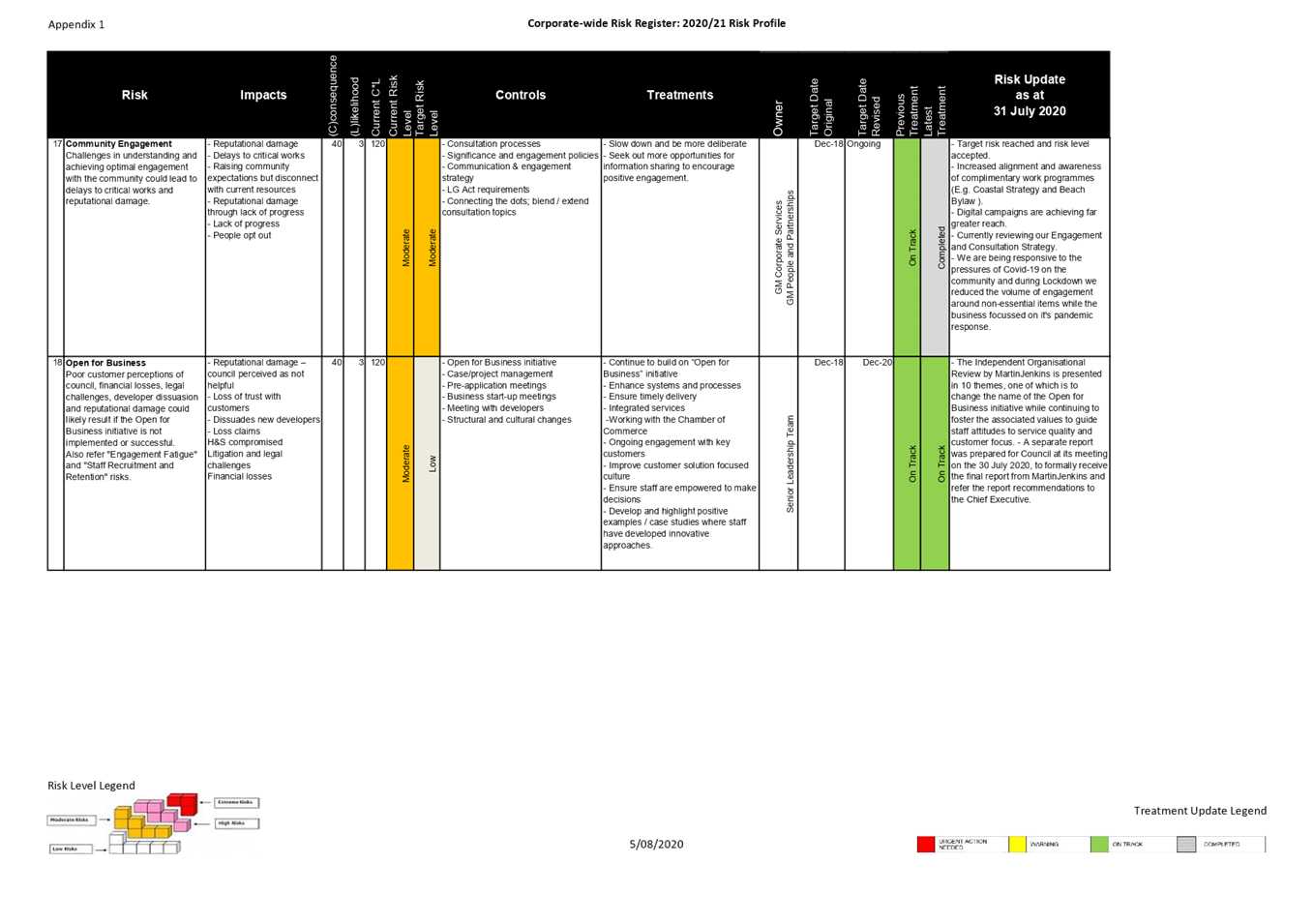
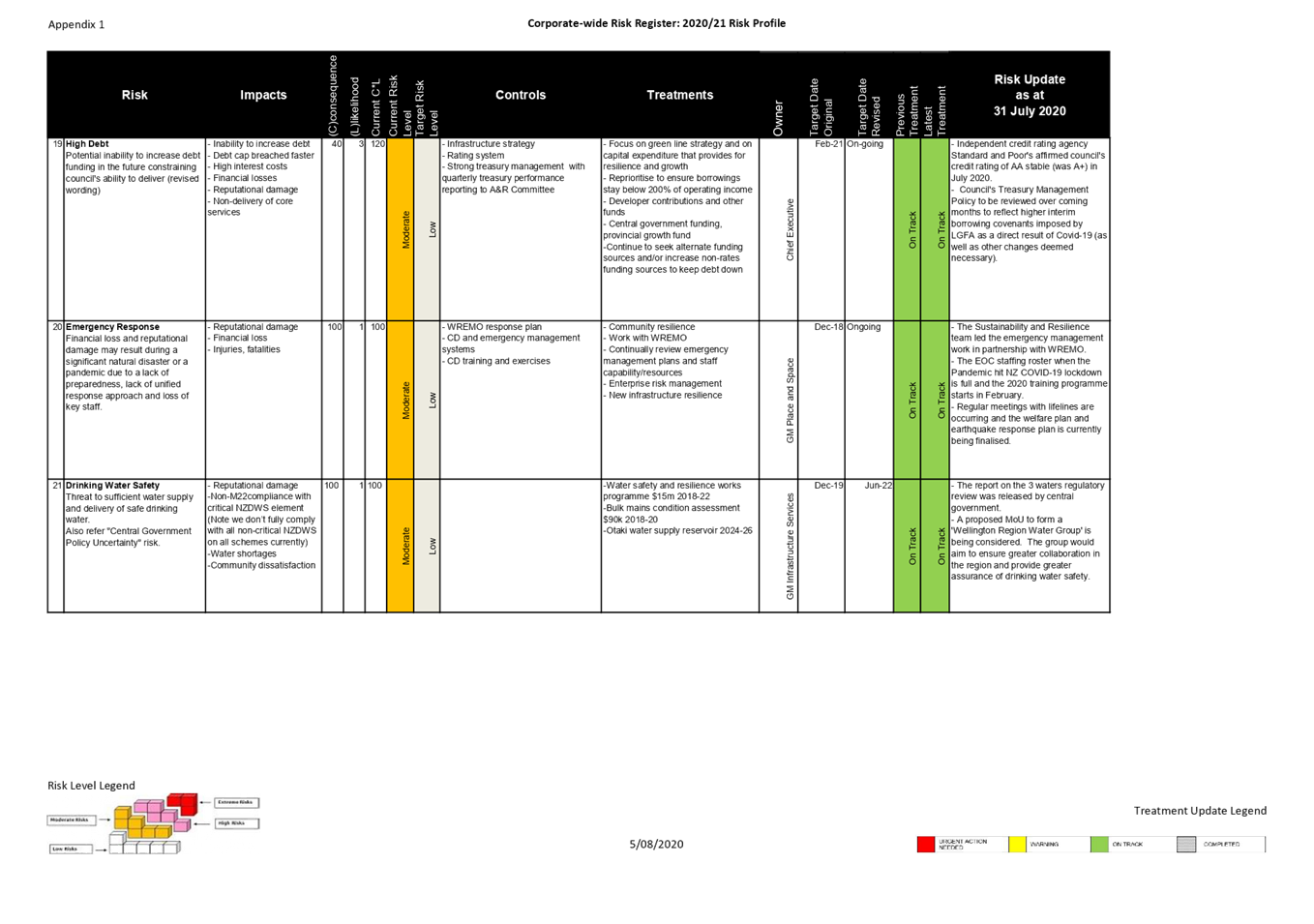
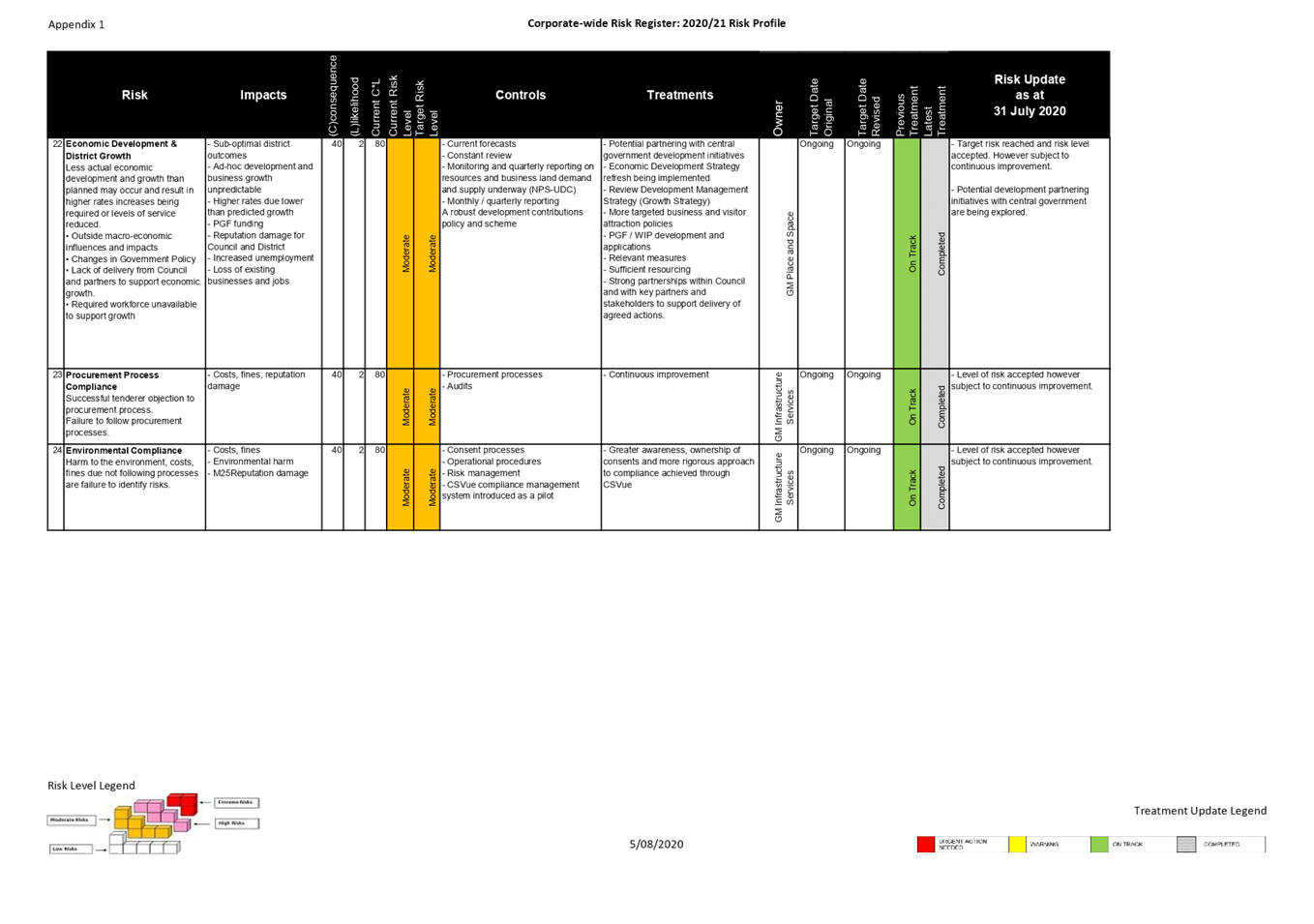
11 The
risk profile has been reviewed and updated by the Group Managers and the
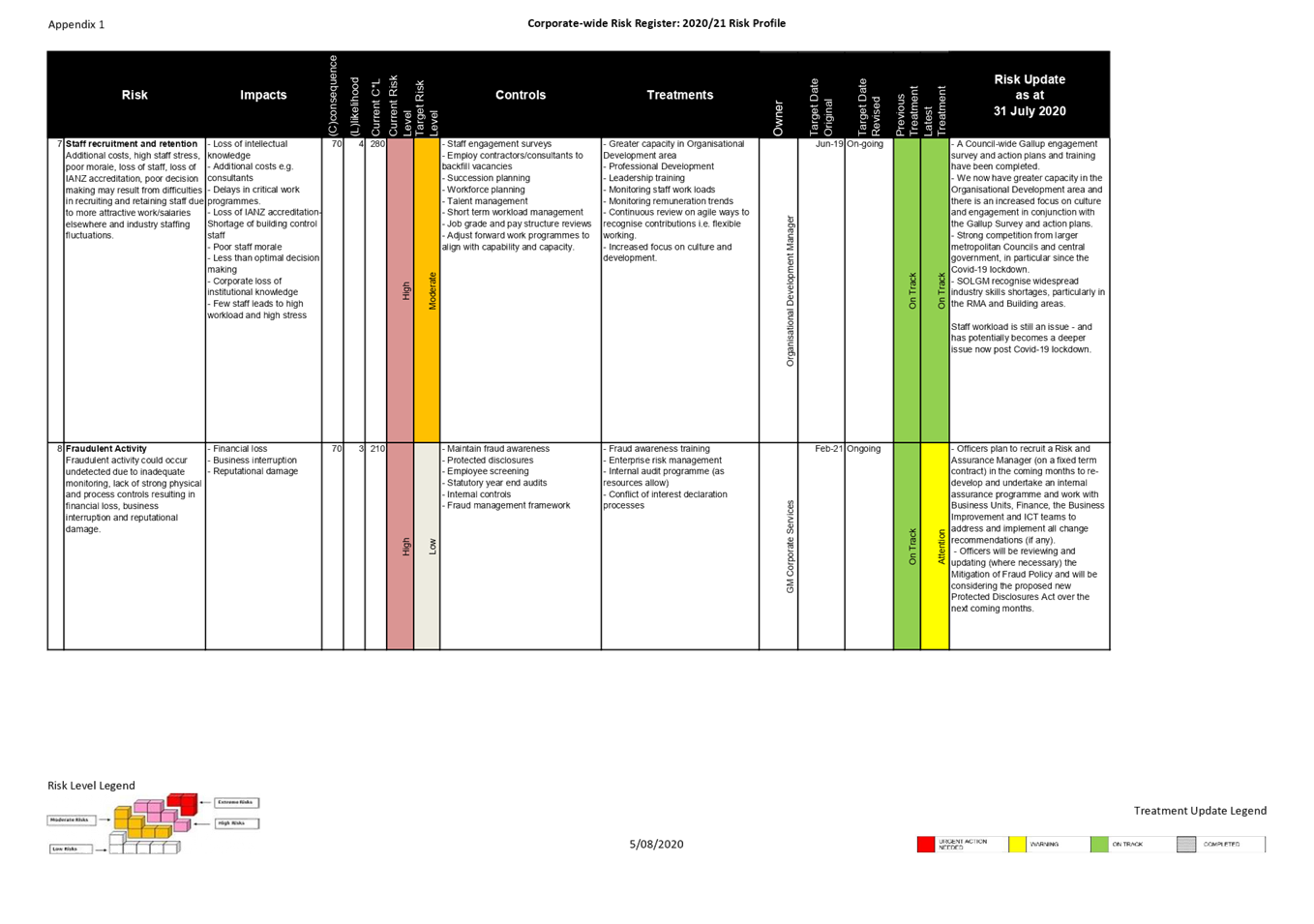
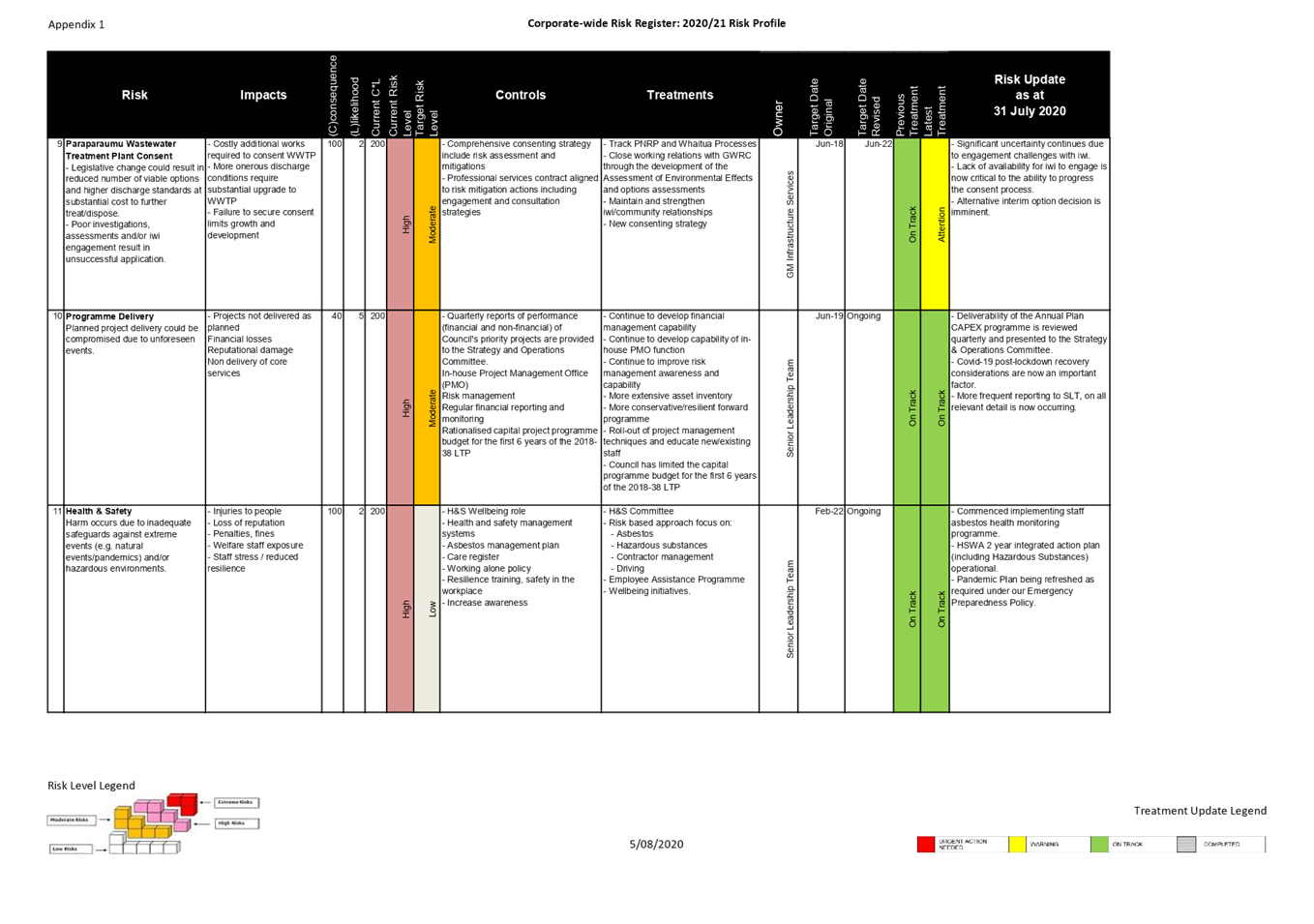
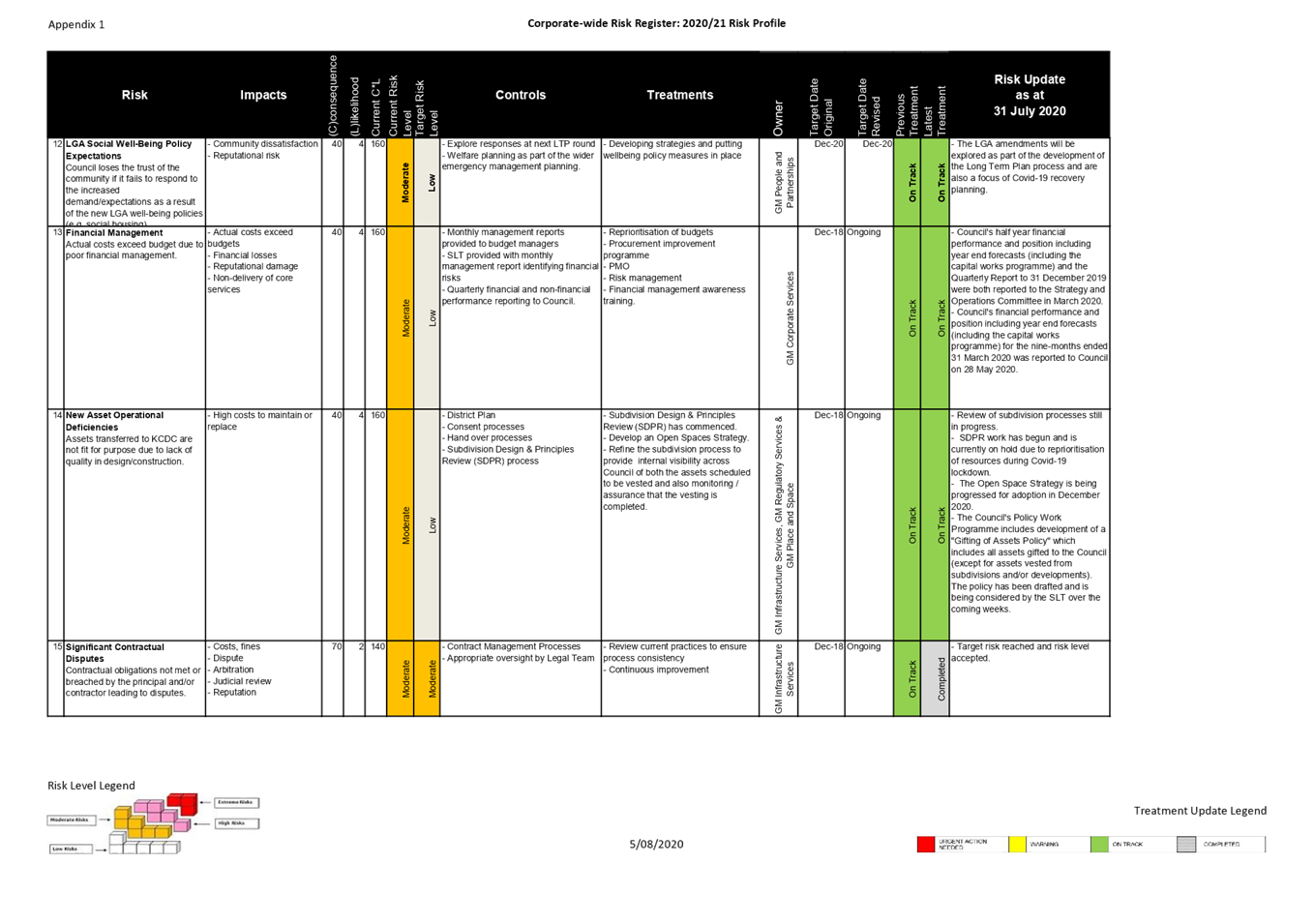
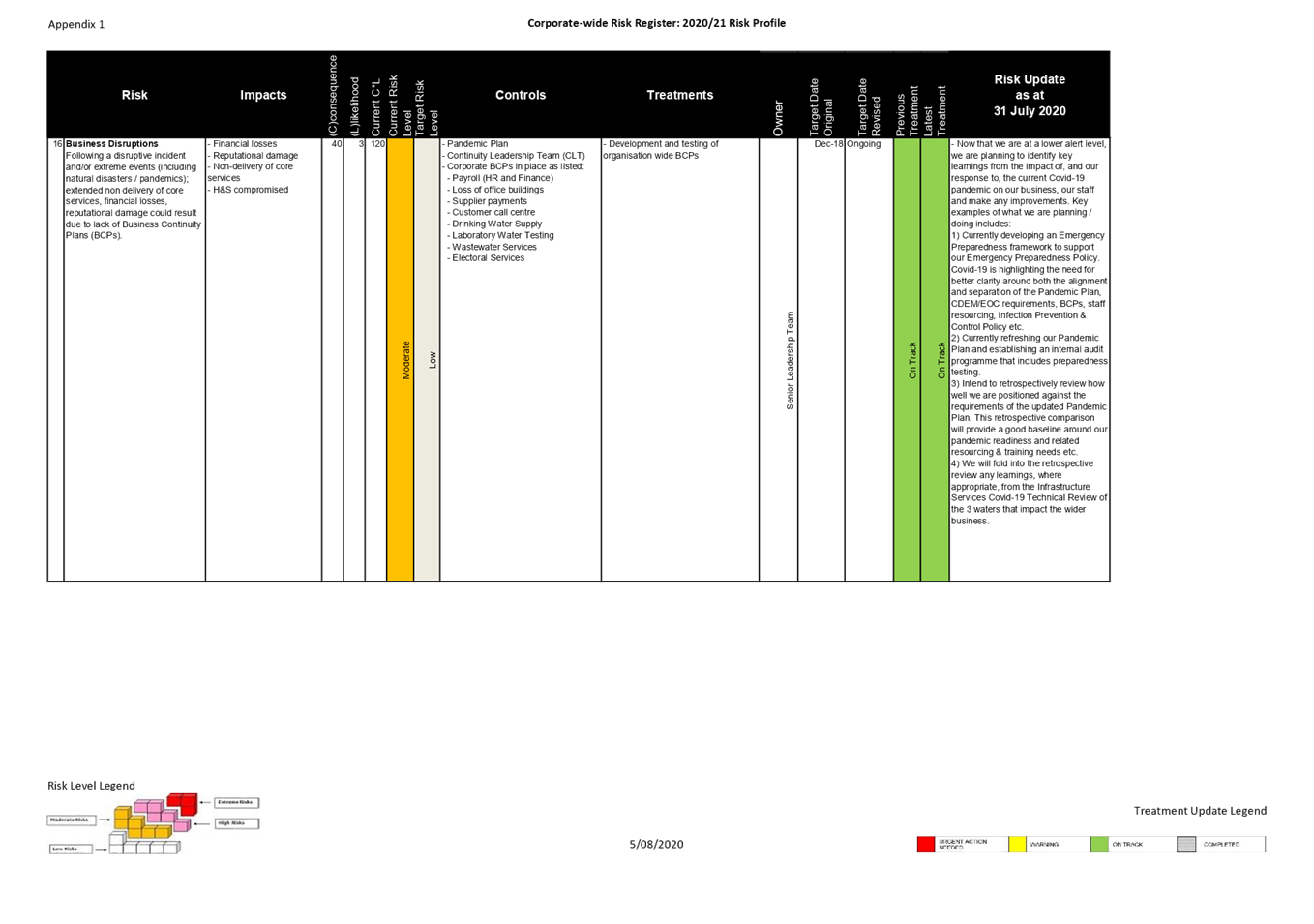
relevant Activity Managers. The Corporate Risk Register is attached as Appendix
1 to this report.
12 The
intention is for the Subcommittee to first familiarise themselves with the
Corporate Risk Register and thereafter, to nominate any risk/s for “deep
dive” discussions at future Subcommittee meetings. Risk “deep
dives” provide an opportunity for Subcommittee members to engage and gain
a deeper insight on a specific risk/s.
13 Whilst
there is no specific “deep dive” included in this report, it is
appropriate to provide the Subcommittee with an overview of the Council’s
response to date to the challenges brought about by Covid-19.
14 On
11 March 2020, the World Health Organization declared the outbreak of a
coronavirus (Covid-19) pandemic and two weeks later, the New Zealand Government
declared a State of National Emergency. From this, the country went into Alert
Level 4 lockdown. As a result, the Council implemented its pandemic plan
and responded in line with government Alert Level guidelines.
15 The
Council moved quickly to open the Emergency Operations Centre and comply with
the Health Order. Services deemed essential continued and non-essential
services ceased and/or were delivered in accordance with the Health Order and
the appropriate Alert Level. Examples of some key changes to service
delivery made at Alert Levels 4 and 3 are shown in the table below:
|
Example
of changes made to Service Levels
|
Alert Level 4 - 25 March 2020
|
Alert Level 3 - 27 April 2020
|
|
Council
Offices
|
Closed.
Staff working remotely
|
Closed.
Staff working remotely
|
|
Transfer /
recycling stations and kerbside recycling
|
Closed. No
kerbside collection.
|
Open for
rubbish drop off only.
Kerbside
recycling collection resumed.
|
|
Sewer/water/stormwater
maintenance
|
Emergency
repairs and maintenance as required.
|
Emergency
repairs and maintenance as required.
|
|
Reserves,
playgrounds and sportsgrounds
|
Closed. No
mowing or planned maintenance undertaken.
|
Closed.
High priority mowing and maintenance undertaken.
|
|
Roads and
coastal infrastructure
|
Emergency repairs and maintenance
as required.
|
Emergency repairs and maintenance as required. Planning and higher
priority work undertaken.
|
|
Resource
and building consents
|
Processing
continued but no building inspections undertaken.
|
Processing continued. Building and subdivision site inspections
undertaken. Virtual hearings for resource consents.
|
|
Noise
control
|
Very limited
service.
|
Excessive noise complaints investigated.
|
|
Libraries
|
Closed.
Virtual services available.
|
Closed. Virtual services available.
|
|
Pools,
Halls, Public Toilets
|
Closed.
|
Closed.
|
16 A
considerable amount of effort went into establishing working from home
arrangements for staff where possible. This included using technology for
remote communication and meetings. Covid-19 necessitated $115,000 of critical
IT expenditure planned for 2020/21 to be brought forward to March 2020 in order
to fully support staff during the lockdown. Travel was reduced to an absolute
minimum.
17 Services
for ratepayers and businesses were provided remotely, therefore the impact on
customers was largely limited to changing meetings from in-person to virtual
meetings, and from walk-ins to phone calls or emails. A point to note is that
our customers were also subject to lockdown rules.
18 The
Council offices and facilities including service centres, libraries, aquatic
facilities, community centre, halls and venues started reopening at Alert Level
2 on 13 May 2020 with contact tracing and appropriate Covid-19 safety measures
in place. Up to 50% of our office-based staff continued to work remotely
from home to enable us to maintain physical distancing requirements.
19 For
Alert Level 1, staff began the transition back into the office from 9 June
2020.
Corporate Business Continuity Management System (BCMS) – Status
Update
20 Business
Disruptions are currently assessed as a “moderate” level risk (with
a target risk level of “Low”), on the Corporate Risk Register,
attached as Appendix 1 to this report.
21 To
address this risk, the Council is actively progressing its BCMS development
programme. The objective of the programme is to ensure that following a disruptive
incident, the Council has the systems and capability to continue the delivery
of its critical activities and services within acceptable, predefined levels
and timeframes.
22 We
intend to review all aspects of the Council’s Covid-19 lockdown experience.
The aim is to identify the key learnings from the impacts of, and the
Council’s response to the Covid-19 pandemic on our business, our staff
and our customers and stakeholders and make all necessary improvements where
needed. Some examples of what we are already planning / doing are listed below:
i. We
are currently developing an Emergency Preparedness framework to support our
Emergency Preparedness Policy. Covid-19 is highlighting the need for better
clarity around both the alignment and separation of the Pandemic Plan, CDEM/EOC
requirements, BCPs, staff resourcing, Infection Prevention and Control Policy
etc.
ii. We
are currently refreshing our Pandemic Plan and we will retrospectively review
how well we are positioned against the requirements of the updated Pandemic
Plan. This retrospective comparison will provide a good baseline around our
pandemic readiness and related resourcing and training needs etc.
iii. An
independent technical review of Infrastructure Service’s preparedness,
readiness and security of supply of essential infrastructure services, (water,
wastewater and stormwater), following localised natural disasters and pandemic
events, is currently underway to identify any service delivery risks that need
to be further mitigated.
Procurement Improvement
Programme – Status Update
23 A
procurement improvement programme commenced in 2017. Significant improvements
have been made to date. The Council established its own procurement framework
in 2018, modelled on the latest public sector procurement materials, customised
for the local government environment. This framework comprises a procurement
policy containing key principles and rules, a procurement manual setting out
procurement procedures, along with a set of templates, forms and guides to
support good procurement practice.
24 However,
further progress on the framework has been constrained by limited staff
capacity and resources and variable quality of data and information. As
previously reported to the Council, progress on the framework was particularly
delayed when the Procurement Specialist was reassigned in the previous
triennium to advise and lead the procurement process required by the
Independent Organisational Review.
25 However,
progress toward better procurement maturity has recommenced now and further
work is planned to meet the improvement targets, addressing the barriers to
progress, and adjusting the sequencing of work.
Business Assurance – Status Update
26 The
Council has contracted PricewaterhouseCoopers (PwC) to complete a PAYE tax
compliance review. Originally this was planned in March 2020 but has been
delayed due to Covid-19 restrictions. Officers are working with PwC to finalise
a new review date and a report back will be provided to the Subcommittee once
the review has been completed.
27 In
addition, Officers are planning to recruit a dedicated Risk and Assurance
Manager on a two year fixed term contract to develop and implement a risk
assurance and monitoring programme. This position will work with the Business Units,
as well as Finance, Legal, Business Improvement and IT, to identify any
internal control risks and implement all steps necessary to satisfactorily
mitigate those risks. Report backs will be provided to the Subcommittee when
internal assurance reviews have been completed.
Considerations
Policy
considerations
28 There
are no further policy implications arising from this report.
Legal
considerations
29 There
are no further legal considerations arising from this report.
Financial
considerations
30 The
work described above is planned to be funded from the 2020/21 Annual Plan
budget by way of prioritised spending.
Tāngata
whenua considerations
31 There
has been no direct engagement with tāngata whenua regarding this report.
Strategic
considerations
32 This
enterprise risk management framework contributes to ensuring that the Council
is continuing to improve its financial position against financial constraints.
Significance and Engagement
33 This
matter has a low level of significance under the Council Policy.
|
Recommendations
34 That
the Audit and Risk Subcommittee receives and notes this report, including
Appendix 1 to this report.
|
Appendices
1. Corporate-wide
Risk Register 2020/21 ⇩ 
|
Audit
and Risk Sub-committee Meeting Agenda
|
13 August 2020
|
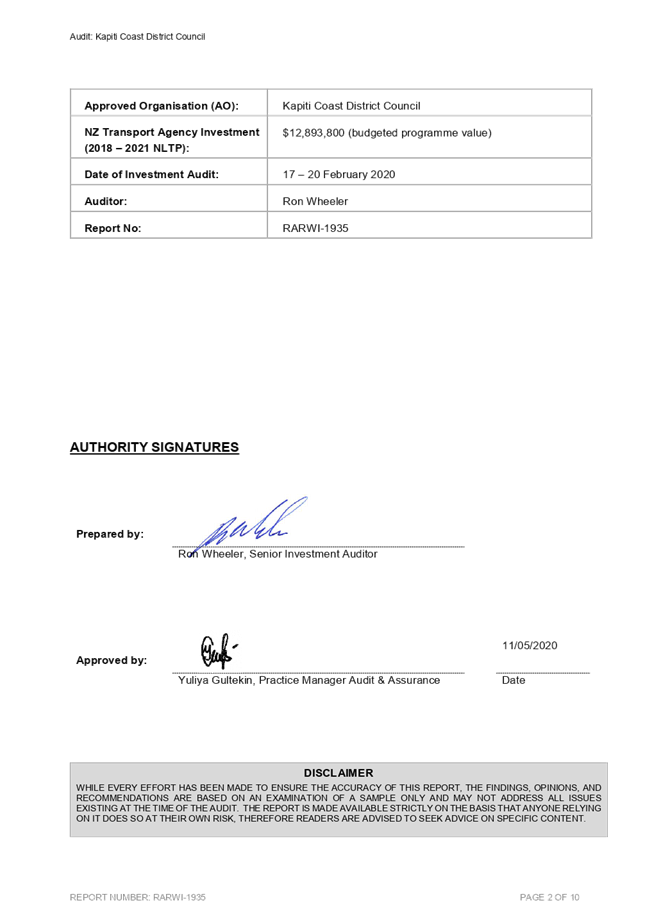
8.5 Waka
Kotahi NZ Transport Agency Procedural Investment Audit Report
Author: Glen
O'Connor, Access and Transport Manager
Authoriser: Sean
Mallon, Group Manager Infrastructure Services
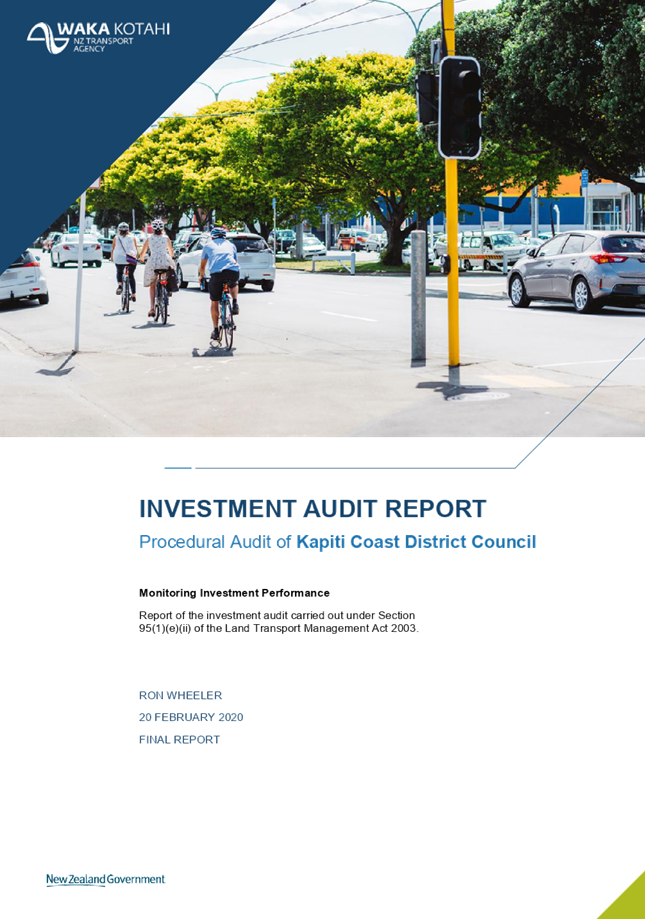
PURPOSE OF REPORT
1. To
present the findings of the Waka Kotahi NZ Transport Agency (Waka Kotahi)
Procedural Investment Audit undertaken in February 2020.
DELEGATION
2. Section
C.1 of the Governance Structure and Delegations 2019-22 Triennium provides that
the Audit and Risk Committee will monitor Council’s financial management
and report mechanisms and framework and review the audit and risk function,
ensuring the existence of sound internal systems.
BACKGROUND
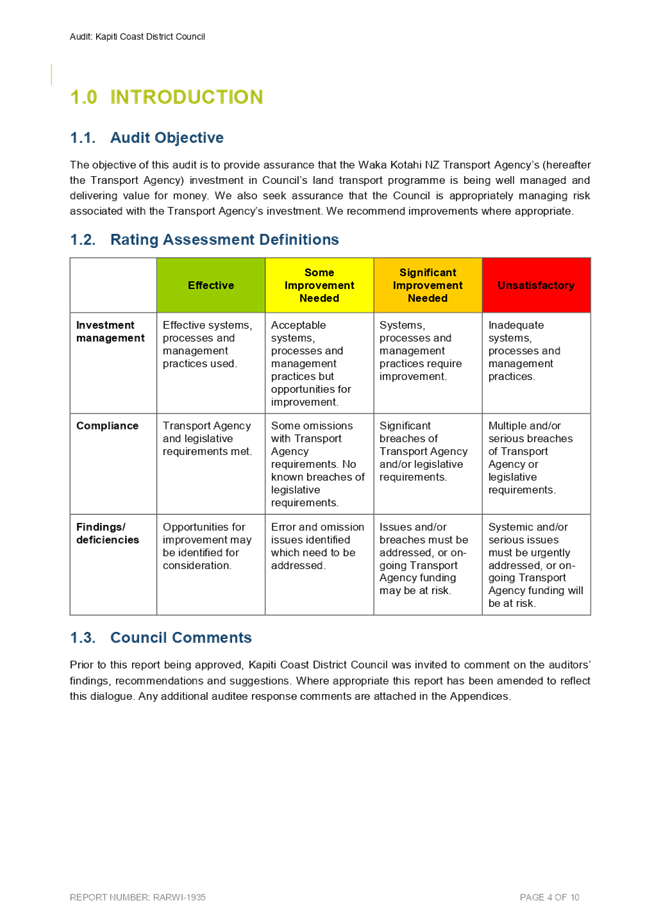
3. Waka
Kotahi undertake investment audits every three to six years on Local
Authorities. The audits provide assurance that Waka Kotahi’s investment
in land transport programmes (roading) is being well managed and is delivering
value for money. Further, Waka Kotahi seek assurance that Council are
appropriately managing risk associated with the Transport Agency’s investment.
4. Waka
Kotahi carry out two types of audit for Local Authorities which are:
a. Investment audits; and
b. investment procedural audits.
5. The
investment audit monitors investment performance and is technical in
nature focusing on physical works such as road resealing, network condition and
minor works programmes. Council was audited in 2019 and was rated as
effective, which is the highest rating. This was reported to the Operations
and Finance Committee on 15 August 2019.
6. The
investment procedural audit examines the financial administration and
processes associated with the funding claimed from Waka Kotahi The audit
focuses on reviewing documents/ledgers, ledger transactions, procedures for
claiming Waka Kotahi funds and the procurement and management of roading
related works and services contracts. Waka Kotahi previously carried out a
procedural audit in 2017.
7. The
items covered in the February 2020 Investment Procedural Audit included:
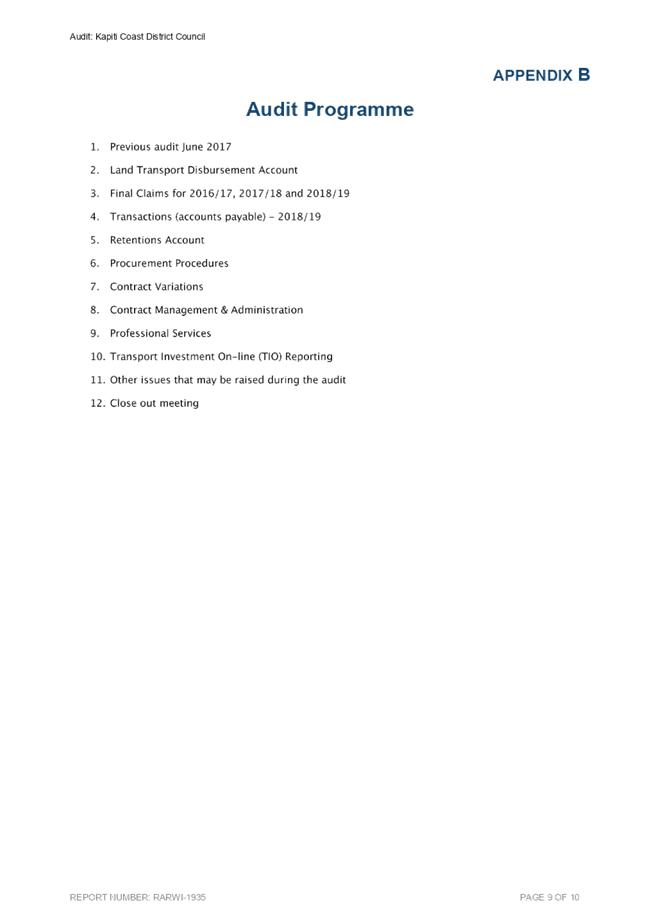
· Previous
Audit Issues – review of recommendations from the previous procedural
audit.
· Financial
Processes – review of financial management/controls and alignment of
funds claimed with the Transport Agency’s activity classes.
· Procurement
Procedures – examination of procured services/physical works and compliance
with Council and Waka Kotahi procurement procedures and requirements.
· Contract
Management – review of contracts with regard to contract administration,
management and control procedures and processes.
· Professional
Services – review of council’s approach to providing and funding
professional services in accordance with Waka Kotahi requirements.
8. Waka
Kotahi’s investment into our district is typically 51% of our
approximately $6-8m per year (depending on the amount of works undertaken) land
transport programme.
9. The
investment procedural audit was undertaken at Council offices over four days
and involved Waka Kotahi ‘s auditors and Councils roading and finance
staff.
ISSUES AND OPTIONS
Issues
10. The
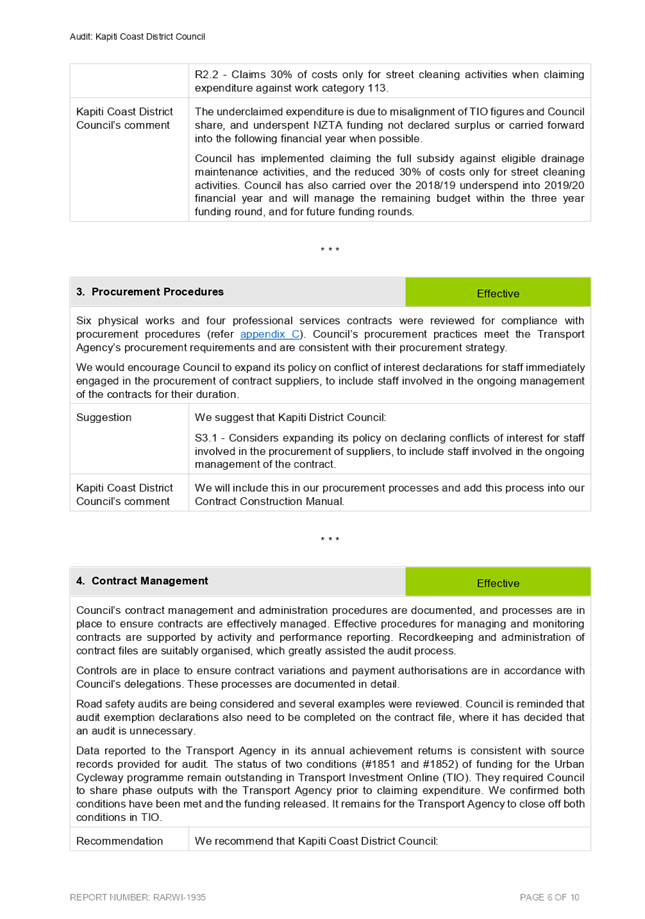
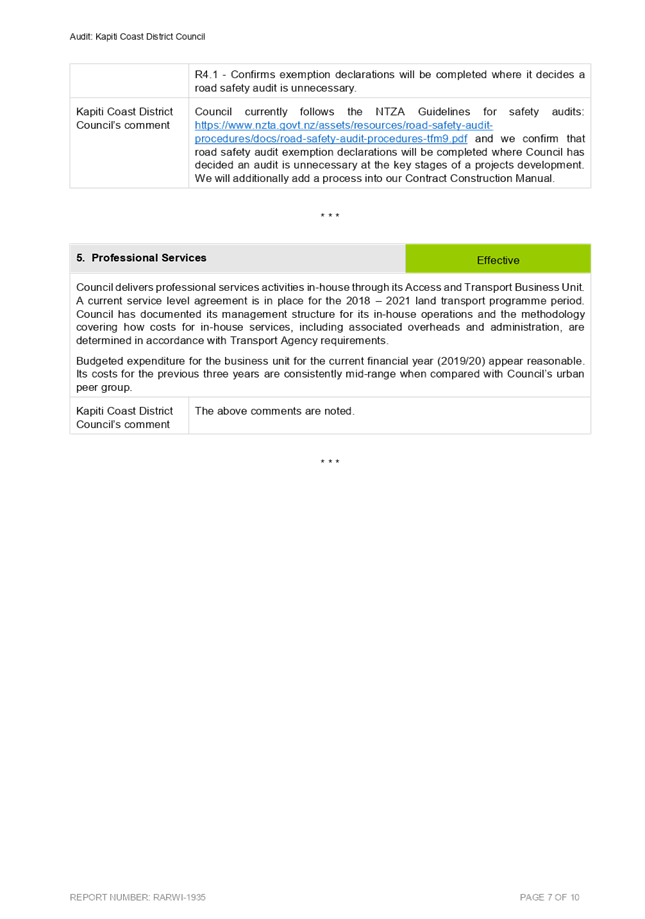
key findings of the audit are as follows:
· Previous
Audit Issues
There were no issues outstanding
from the previous audit.
|
· Financial
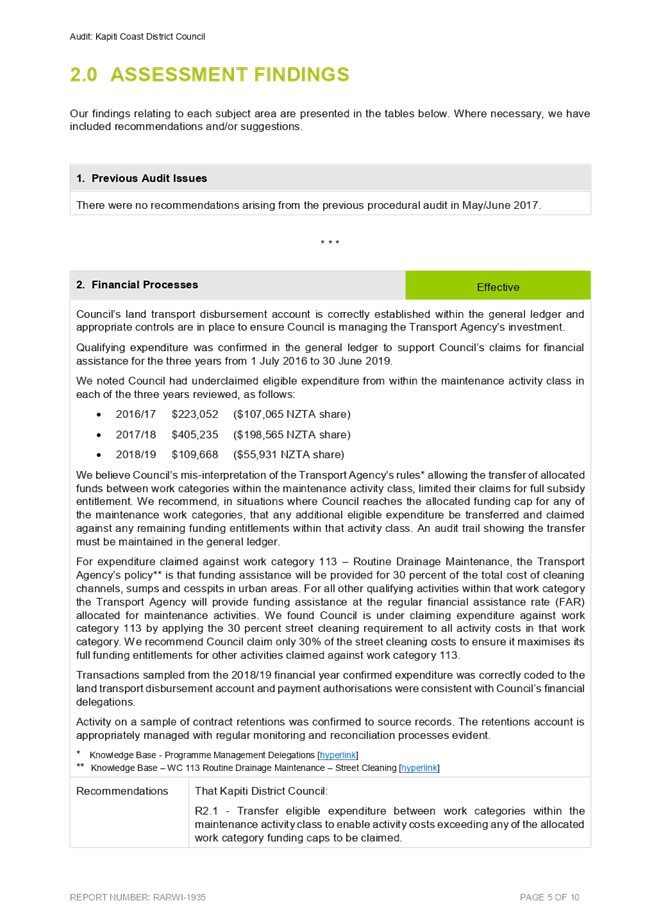
Processes
Council’s
land transport disbursement account is correctly established within the
general ledger and appropriate controls are in place to ensure Council is
managing the Transport Agency’s investment. Qualifying
expenditure was confirmed in the general ledger to support Council’s
claims for financial assistance for the three years from 1 July 2016 to 30
June 2019.
· Procurement
Procedures
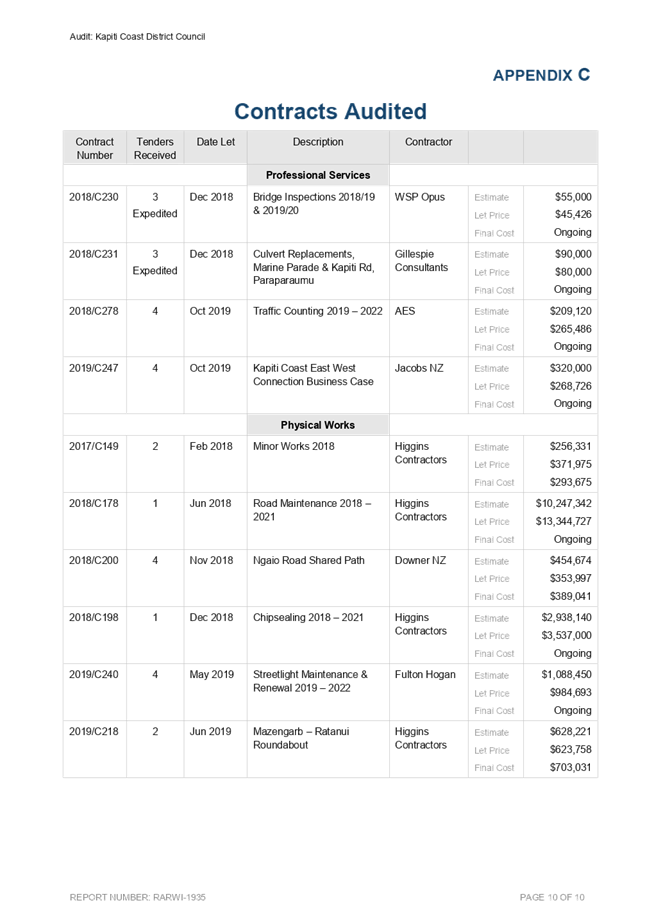
Six physical
works and four professional services contracts were reviewed for compliance
with procurement procedures. Council’s procurement practices meet the
Transport Agency’s procurement requirements and are consistent with
their procurement strategy.
· Contract
Management
Council’s
contract management and administration procedures are documented, and
processes are in place to ensure contracts are effectively managed. Effective
procedures for managing and monitoring contracts are supported by activity
and performance reporting. Recordkeeping and administration of contract files
are suitably organised, which greatly assisted the audit process. Controls
are in place to ensure contract variations and payment authorisations are in
accordance with Council’s delegations. These processes are documented
in detail.
· Professional
Services
Council has
documented the management structure for its in-house operations and the
methodology covering how costs for in-house services, including associated
overheads and administration, are determined in accordance with Transport
Agency requirements. Budgeted expenditure for the business unit for the
current financial year (2019/20) appear reasonable. Council’s costs for
the previous three years are consistently mid-range when compared with
Council’s urban peer group.
|
11. The
overall audit rating for our Council was effective, which is the highest
obtainable rating. All subject areas assessed were also rated as effective.
12. The
audit identified minor issues for Council to address, and these were identified
as recommendations or suggestions in the audit and are listed as follows:
· Financial
Processes
Recommendation
1 - Transfer eligible expenditure between work categories within the
maintenance activity class to enable activity costs exceeding any of the
allocated work category funding caps to be claimed.
Recommendation
2 - Claim 30% of costs only for street cleaning activities when claiming
expenditure against work category 113.
These
recommendations were made so to ensure that Council claimed the allowable
funding entitlements. Following this recommendation Council has implemented
changes to allow the full subsidy to be claimed.
· Procurement
Procedures
Suggestion -
Consider expanding the policy on declaring conflicts of interest for staff
involved in the procurement of suppliers, to include staff involved in the
ongoing management of the contract.
This suggestion will be considered by
Council.
· Contract
Management
Recommendation - Confirm exemption
declarations will be completed where it decides a road safety audit is
unnecessary.
This recommendation will be
implemented by Council.
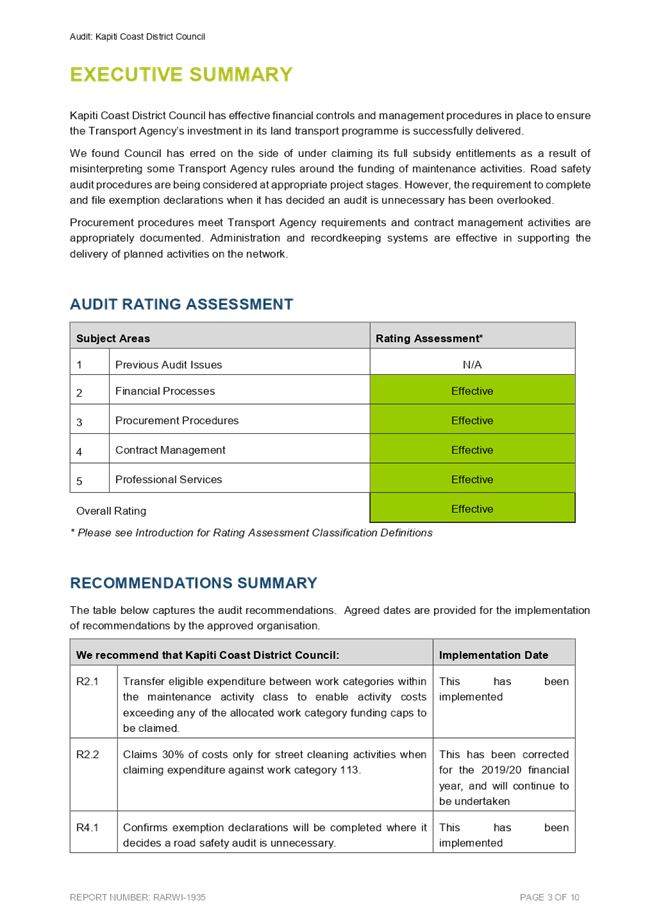
13. The
executive summary of the audit report reads:
Kapiti Coast District Council has
effective financial controls and management procedures in place to ensure the
Transport Agency’s investment in its land transport programme is
successfully delivered.
We found Council has erred on the
side of under claiming its full subsidy entitlements as a result of
misinterpreting some Transport Agency rules around the funding of maintenance
activities. Road safety audit procedures are being considered at appropriate
project stages. However, the requirement to complete and file exemption
declarations when it has decided an audit is unnecessary has been overlooked.
Procurement procedures meet
Transport Agency requirements and contract management activities are
appropriately documented. Administration and recordkeeping systems are effective
in supporting the delivery of planned activities on the network.
CONSIDERATIONS
Policy considerations
14. There
are no policy considerations from this report.
Legal considerations
15. There
are no legal considerations from this report.
Financial considerations
16. Any
financial considerations are accommodated under current budgets.
Tāngata whenua considerations
17. There
are no Iwi considerations from this report.
Strategic considerations
18. This
audit relates to infrastructure investment that supports resilience and agreed
growth projections, and improved accessibility of Council services.
SIGNIFICANCE AND ENGAGEMENT
Significance policy
19. This
matter has a low level of significance under Council’s Significance and
Engagement Policy.
Consultation already undertaken
20. Consultation
was not required for this report.
Engagement planning
21. Engagement
was not required for this report.
Publicity
22. A
media release will be developed around the findings of this audit.
.
|
Recommendations
That the Operations and Finance Committee notes the
findings from the February 2020 Waka Kotahi Procedural Investment Audit
Report.
|
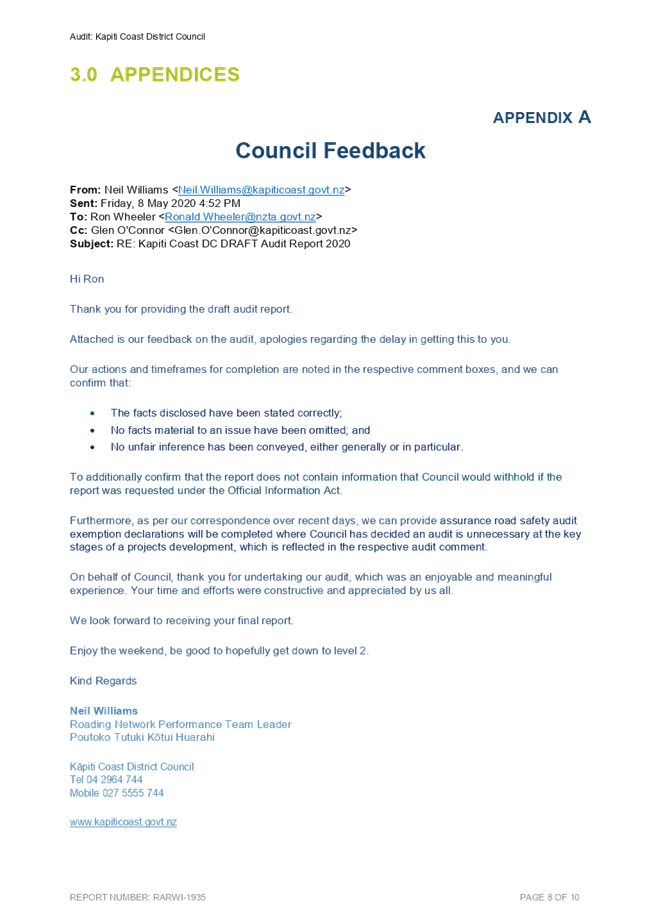
Appendices
1. Kapiti
Coast 2020 Audit ⇩ 
|
Audit
and Risk Sub-committee Meeting Agenda
|
13 August 2020
|
9 Confirmation
of Minutes
9.1 Confirmation
of minutes
Author: Tanicka
Mason, Democracy Services Advisor
Authoriser: Leyanne
Belcher, Democracy Services Manager
|
Recommendations
That the minutes of the Audit
& Risk Subcommittee meeting on 20 February 2020 be accepted as a true and
accurate record of the meeting.
|
Appendices
1. Minutes
20 February 2020 ⇩ 
|
Audit
and Risk Sub-committee Meeting Agenda
|
13 August 2020
|
MINUTES OF Kapiti Coast District Council
Audit and Risk
Sub-committee Meeting
HELD AT THE Council
Chamber, Ground Floor, 175 Rimu Road, Paraparaumu
ON Thursday, 20
February 2020 AT 9.30am
PRESENT: Cr
Angela Buswell, Deputy Mayor Janet Holborow, Cr Gwynn Compton, Mr Gary Simpson,
Mr Bryan Jackson
IN
ATTENDANCE: Wayne Maxwell (Mr), Mark de Haast (Mr), Natasha Tod (Ms), Glen
O’Connor (Mr), Janice McDougall (Mrs), Tim Power (Mr), Jacinta Straker
(Ms), Anelise Horn (Ms),Tanicka Mason (Mrs), David Borrie (Mr), Grayson Rowse
(Mr), Dan O’Connel (Mr), Jill Griggs (Mrs).
APOLOGIES: Mayor
K Gurunathan
LEAVE OF Nil
ABSENCE:
1 Welcome
2 Council
Blessing
The Chair welcomed everyone to the meeting and read the
Council blessing.
3 Apologies
|
Committee Resolution 2020/1
Moved: Cr
Gwynn Compton
Seconder: Mr Gary Simpson
That the apology received from Mayor K Gurunathan be
accepted.
Carried
|
4 Declarations
of Interest Relating to Items on the Agenda
Nil
5 Public
Speaking Time for Items Relating to the Agenda
Nil
6 Members’
Business
(a) Public
Speaking Time Responses
Nil
(b) Leave
of Absence
Nil
(c) Matters
of an Urgent Nature (advise to be provided to the Chair prior to the
commencement of the meeting)
Nil
7 Updates
Nil
8 Reports
|
8.1 Proposal
to conduct the audit of the Council on behalf of the Auditor-General for
2020, 2021 and 2022 financial years
|
|
Anelise Horn, Finance and Accounting Manager, introduced
herself and David Borrie to the sub-
Committee.
David Borrie spoke to the report and answered questions
from the members.
|
|
Committee Resolution 2020/2
Moved: Cr
Angela Buswell
Seconder: Deputy Mayor Janet Holborow
That the Audit and Risk Subcommittee receives and accepts
Ernst & Young’s proposal to conduct the audit of Council on behalf
of the Auditor-General for the 2020, 2021 and 2022 financial years.
Carried
|
|
8.2 Ernst
and Young Audit Plan for the year ended 30 June 2020
|
|
Ms Horn
handed over to David Borrie who spoke to the report and answered questions
from the members.
|
|
Committee Resolution 2020/3
Moved: Cr
Angela Buswell
Seconder: Deputy Mayor Janet Holborow
That the Audit and Risk Subcommittee receives and notes
the Ernst & Young Audit Plan for the year ended 30 June 2020 attached as
Appendix 1 to this report.
Carried
|
|
8.3 Timetable
for the Audit Plan for the year ended 30 June 2020
|
|
Ms Horn spoke to the report, informed members of reports
timelines and answered members questions.
|
|
Committee Resolution 2020/4
Moved: Cr
Angela Buswell
Seconder: Cr Gwynn Compton
That the Audit and Risk Subcommittee notes the timetable
for the audit of the Council’s Annual Report and the Council’s
Debenture Trust Deed for the year ended 30 June 2020.
Carried
|
|
8.4 Update
on key 2018-19 Audit Findings
|
|
Ms Horn spoke to the update. Members questions were
answered.
|
|
Committee Resolution 2020/5
Moved: Cr
Gwynn Compton
Seconder: Deputy Mayor Janet Holborow
That the Audit and Risk Subcommittee notes the progress
update in regards to Ernst & Young’s Report on Control findings for
the year ended 30 June 2019 and that Ernst & Young will re-assess these
as part of their audit for the year ended 30 June 2020.
Carried
|
|
8.5 Quarterly
Treasury Compliance Report
|
|
Ms Horn speaks to the report.
She advises members that it is for six months rather than the usual 3 months.
Ms Horn and Mr de Haast, Group
Manager, Corporate Services answered members questions.
Mr Simpson noted that this
report is consistenly good and useful.
|
|
Committee Resolution 2020/6
Moved: Cr
Angela Buswell
Seconder: Mr Gary Simpson
That the Audit and Risk Subcommittee notes the
Council’s compliance with its Treasury Management Policy for the six
months ended 31 December 2019.
Carried
|
|
8.6 Ombudsman
Investigation into Christchurch City Council LGOIMA Practices
|
|
Tim Power, Senior Legal Counsel speaks to the report.
Questions were asked and answered.
|
|
Committee Resolution 2020/7
Moved: Cr
Gwynn Compton
Seconder: Deputy Mayor Janet Holborow
That the Audit and Risk Subcommittee:
Notes the CCC Ombudsman report;
Notes the areas highlighted for
improvement set out in paragraph 28 to this report.
Carried
|
|
8.7 Risk
Management - Business Assurance Update
|
|
Jacinta Straker, Chief Financial
Officer spoke to the report and answered members questions.
|
|
Committee Resolution 2020/8
Moved: Cr
Angela Buswell
Seconder: Mr Gary Simpson
That the Audit and Risk Committee notes the progress on
the Council’s Enterprise Risk Management Framework.
Carried
|
|
8.8 Health
and Safety Quarterly Reports: 1 July 2019 - 30 September 2019; and 1 October
2019 - 31 December 2019
|
|
Mark de Haast, Group Manager Corporate Services talked to
the report on behalf of Diane Andrews, Organisational Development Manager.
|
|
Committee Resolution 2020/9
Moved: Deputy
Mayor Janet Holborow
Seconder: Cr Angela Buswell
That the Audit and Risk Sub Committee notes the two Health
and Safety Quarterly Reports for the periods: 1 July 2019 – 30
September 2019; and 1 October 2019 – 31 December 2019 attached as
Appendix One and Appendix Two to this Report.
That the Audit and Risk Sub Committee note the Health and
Safety Leadership Charter which is attached for members’ future
reference as Appendix Three to this Report.
Carried
|
Meeting
adjourned at 10:40am
Meeting
resumed at 10:50am
9 Public
Excluded Reports
Resolution
to Exclude the Public
|
Public Excluded Resolution 2020/10
Moved: Cr
Gwynn Compton
Seconder: Mr Gary Simpson
That, pursuant to Section 48 of the Local Government
Official Information and Meetings Act 1987, the public, with the exception of
Council’s auditor and Community Board Members present now be excluded
from the meeting for the reasons given below, while the following matters are
considered.
The general subject matter of each matter to be considered
while the public is excluded, the reason for passing this resolution in
relation to each matter, and the specific grounds under section 48(1) of the
Local Government Official Information and Meetings Act 1987 for the passing
of this resolution are as follows:
|
General subject of each matter to be considered
|
Reason for passing this resolution in relation to
each matter
|
Ground(s) under section 48 for the passing of this
resolution
|
|
10.1 - Update on Ombudsman
and Privacy Commissioner Investigations and Litigation Status Report
|
Section 7(2)(a) - the withholding of the information is
necessary to protect the privacy of natural persons, including that of
deceased natural persons
Section 7(2)(b)(ii) - the withholding of the information
is necessary to protect information where the making available of the
information would be likely unreasonably to prejudice the commercial
position of the person who supplied or who is the subject of the
information
Section 7(2)(g) - the withholding of the information is
necessary to maintain legal professional privilege
Section 7(2)(h) - the withholding of the information is
necessary to enable Council to carry out, without prejudice or
disadvantage, commercial activities
|
Section 48(1)(a)(i) - the public conduct of the relevant
part of the proceedings of the meeting would be likely to result in the
disclosure of information for which good reason for withholding would exist
under section 6 or section 7
|
Carried
|
The Audit and Risk Subcommittee meeting went into public excluded
session at 10:54 am.
|
Committee Resolution 2020/11
Moved: Cr
Angela Buswell
Seconder: Deputy Mayor Janet Holborow
That the Audit and Risk Subcommittee
moves out of a public excluded meeting.
Carried
|
|
The Audit and Risk Subcommittee came out of public excluded
session at 11.36 am having resolved that the following resolution and the
report Update on Ombudsman and Privacy Commissioner
Investigations and Litigation Status Report be released from publically
excluded business.
Committee
Resolution 2020/12
Moved: Cr
Gwynn Compton
Seconder: Deputy
Mayor Janet Holborow
That the Audit and Risk
Subcommittee:
notes the current status of
Ombudsman and Privacy Commissioner investigations and litigation;
agrees that this report and
resolutions only be released from public excluded business; and
agrees that Appendix A and
Appendix B to this report be excluded from public release.
Carried
|
|
Appendices
1 Update
on Ombudsman and Privacy Commissioner investigations and litigation status
report
|
The Audit and Risk Subcommittee
meeting closed at 11.36 am.
...................................................
CHAIRPERSON
11 Public
Excluded Reports
Resolution
to Exclude the Public
|
PUBLIC EXCLUDED ReSOLUtion
That, pursuant to Section 48 of the Local Government
Official Information and Meetings Act 1987, the public now be excluded from
the meeting for the reasons given below, while the following matters are
considered.
The general subject matter of each matter to be considered
while the public is excluded, the reason for passing this resolution in
relation to each matter, and the specific grounds under section 48(1) of the
Local Government Official Information and Meetings Act 1987 for the passing
of this resolution are as follows:
|
General subject of each matter to be considered
|
Reason for passing this resolution in relation to
each matter
|
Ground(s) under section 48 for the passing of this
resolution
|
|
10.1 - Confirmation of Public Excluded Minutes
|
Section 7(2)(a) - the withholding of the information is
necessary to protect the privacy of natural persons, including that of
deceased natural persons
Section 7(2)(b)(ii) - the withholding of the information
is necessary to protect information where the making available of the
information would be likely unreasonably to prejudice the commercial
position of the person who supplied or who is the subject of the
information
Section 7(2)(g) - the withholding of the information is
necessary to maintain legal professional privilege
Section 7(2)(h) - the withholding of the information is
necessary to enable Council to carry out, without prejudice or
disadvantage, commercial activities
|
Section 48(1)(a)(i) - the public conduct of the relevant
part of the proceedings of the meeting would be likely to result in the
disclosure of information for which good reason for withholding would exist
under section 6 or section 7
|
|
11.1 - Update on litigation status, statutory
compliance issues and investigations
|
Section 7(2)(a) - the withholding of the information is necessary
to protect the privacy of natural persons, including that of deceased
natural persons
Section 7(2)(b)(ii) - the withholding of the information
is necessary to protect information where the making available of the
information would be likely unreasonably to prejudice the commercial
position of the person who supplied or who is the subject of the
information
Section 7(2)(g) - the withholding of the information is
necessary to maintain legal professional privilege
Section 7(2)(h) - the withholding of the information is
necessary to enable Council to carry out, without prejudice or
disadvantage, commercial activities
|
Section 48(1)(a)(i) - the public conduct of the relevant
part of the proceedings of the meeting would be likely to result in the
disclosure of information for which good reason for withholding would exist
under section 6 or section 7
|
|