|
Additional Kaunihera | Council Meeting Agenda
|
30 July 2024
|
7 Pūrongo
| Reports
7.1 Representation
Review 2024 - Initial Proposal
Kaituhi |
Author: Steffi
Haefeli, Manager Governance
Kaiwhakamana
| Authoriser: Mark de Haast, Group Manager Corporate Services
Te pūtake |
Purpose
1 This
report asks Council to:
1.1 formally
receive the analysis of the preliminary community engagement conducted to
understand the community’s views around how it would like to be
represented, and
1.2 resolve
its initial proposal for the representation arrangements for the 2025 local
body elections in line with the provisions of section 19K of the Local
Electoral Act 2001.
He
whakarāpopoto | EXecutive summary
2 As a
result of Council resolving on 14 November 2023 (ahead of the statutory
deadline of 23 November 2023) to establish a Māori ward for the 2025 local
body elections, under clause 1 schedule 1A of the Local Electoral Act 2001 a
representation review must be carried out in 2024. The parameters, deliverables
and timeline for this review are mandated through legislation, the Local
Electoral Act 2001 (LEA) and the Local Government Act 2002 (LGA).
3 On
14 December 2023, Council approved a staff-led approach to the representation
review and approved that a preliminary community engagement process be
undertaken to get an insight into the views of the community on how they would
like to be represented.
4 As
a result, preliminary community consultation was undertaken in March 2024 and
the results of the engagement highlighted that the majority of submitters
supported retaining the current representation arrangements and for Council to
consider the inclusion of the Māori ward with minimal alterations to other
arrangements in place.
5 This
report asks Council to formally receive the submissions and confirm its initial
representation proposal, which under the current provisions of the LEA must be
confirmed no later than 31 July 2024. Once made, the initial representation
proposal decision by Council must be publicly notified no later than 8 August
2024, which will commence a formal consultation process seeking public
submissions on the proposal.
Te tuku haepapa
| Delegation
6 Council
has the authority to resolve an initial representation proposal under the Local
Government Act 2002, section 19K of the Local Electoral Act 2001 and section
A.2 of Council’s Governance Structure and Delegation 2022 – 2025
document.
Taunakitanga | RECOMMENDATIONS
A. That
Council formally receives the 285 submissions received in response to the
preliminary community engagement conducted in relation to the 2024
representation review attached in Appendix 1 and notes the analysis of the
submissions report attached in Appendix 2.
B. That
Council, in accordance with sections 19H and 19J of the Local Electoral Act
2001, agrees to adopt its initial representation proposal for the 2025 local
body elections as follows:
B.1 The
Kāpiti Coast District Council will comprise of the Mayor elected at large
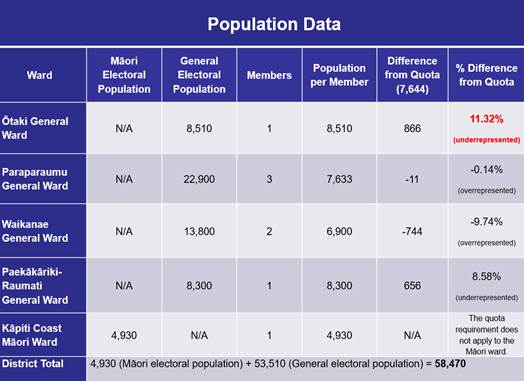
and ten councillors, two elected at large, seven elected form four general
wards and one Māori ward councillor elected by the district’s
Māori electoral roll voters.
B.2 The
Kāpiti Coast District will be divided into five wards with the proposed
boundaries as shown in Appendix 3:
B.2.1 Kāpiti
Coast Māori Ward represented by one Māori ward councillor with the
ward boundaries aligning with the district’s boundaries.
B.2.2 Ōtaki
General Ward represented by one general ward councillor.
B.2.3 Waikanae
General Ward represented by two general ward councillors.
B.2.4 Paraparaumu
General Ward represented by three general ward councillors.
B.2.5 Paekākāriki-Raumati
General Ward represented by one general ward councillor.
B.2.6 In
addition, all electors of the Kāpiti Coast District (both
general electoral and Māori electoral voters) will elect two
councillors at large.
B.3 The
Kāpiti Coast District will be divided into five community board areas with
the proposed boundaries as shown in Appendix 3 and the community board
membership will comprise four members elected from their relevant areas and a
specified number of ward councillors as follows:
B.3.1 The Ōtaki Community Board will
comprise four members elected from the Ōtaki Community Board area, and one
appointed member of Council from either the Ōtaki General Ward or
Kāpiti Coast Māori Ward.
B.3.2 The
Waikanae Community Board will comprise four members elected from the Waikanae Community
Board area, and one appointed member of the Council from either the Waikanae
General Ward or Kāpiti Coast Māori Ward.
B.3.3 The
Paraparaumu Community Board will comprise four members elected from the
Paraparaumu Community Board area, and two appointed members of the Council from
either the Paraparaumu General Ward or Kāpiti Coast Māori Ward.
B.3.4 The
Raumati Community Board will comprise four members elected from the Raumati
Community Board area, and one appointed member of the Council from either the
Paekākāriki-Raumati General Ward or Kāpiti Coast Māori
Ward.
B.3.5 The
Paekākāriki Community Board will comprise four members elected from
the Paekākāriki Community Board area, and one appointed member of the
Council from either the Paekākāriki-Raumati General Ward or
Kāpiti Coast Māori Ward.
C. That Council notes that the total
number of councillors will remain at 10 with a mixed representation model,
comprising eight ward councillors (seven general ward and one Māori ward)
and two councillors elected at-large, plus the Mayor, to provide effective and
fair representation for the Kāpiti Coast District.
D. That Council notes:
D.1 That
the Ōtaki Ward as proposed above is non-complaint with the fair
representation criteria (+/-10% rule), and if retained in the final proposal
this must be automatically referred to the Local Government Commission for a
binding determination under section 19V(4) of the Local Electoral Act 2001.
D.2 That
the rationale for non-compliance with the fair representation rule for the
Ōtaki Ward as proposed is to ensure that the Te Horo community of
interest, which community feedback suggests identifies more closely with the
Ōtaki Ward, is not separated by ward boundaries.
E. That Council notes that if no
submissions are received on the initial proposal, in accordance with section
19Y(1) of the Local Electoral Act 2001, this proposal must become the final
proposal.
F. That Council confirms that the
initial proposal is publicly notified within 14 days of this decision (no later
than 8 August 2024), in accordance with section 19M(1) of the Local Electoral
Act 2001 and submitted for formal public consultation inviting submissions from
8 August to 12 September 2024.
G. That Council confirms the
establishment of a representation review editorial committee constituting the
Mayor, Deputy Mayor and Chair of the Strategy and Operations Committee with the
delegated authority to approve the consultation material ahead of the public
notice on 8 August 2024.
H. That Council notes the information
provided in the report in relation to the Local Government (Electoral
Legislation and Māori Wards and Māori Constituencies) Amendment Bill
and that, once the Bill is enacted (expected by the end of July 2024), Council
will be provided with a further report to consider its options (whether to hold
a poll at the same time as the 2025 local body elections OR rescind the
decision to establish a Māori ward and cease the representation review
process).
Tūāpapa | Background
What is a representation review
7 The
Local Electoral Act 2001 (LEA) requires all local authorities to review their
representation arrangements at least once every six years to ensure the
arrangements continue to provide fair and effective representation of their
district’s communities of interest. The process and timeframes to carry
out a representation review are mandated through the LGA and the LEA (primarily
section 19 - attached in Appendix 7). To aid councils with their representation
reviews, the Local Government Commission (LGC) publishes detailed guidelines
identifying the factors and considerations that territorial authorities must
take into account and what the associated timeframes are (guidelines attached
in Appendix 8).[1]
8 Best
practice provided by the LGC provides that the following should be considered
in a representation review process:
8.1 What the district’s
communities of interest are and/or whether they have changed since the last
review.
8.2 Representation
arrangements need to be fair and effective and comply with the ‘fair
representation rule.’ The guidance suggests that effective and fair
representation is achieved if all elected members represent roughly the same
number of constituents. This is called the +/- 10% rule.
8.3 Questions
that will need to be answered are:
8.3.1 Has
the population grown and is there significant change impacts to consider?
8.3.2 Do
the current arrangements have the right number of councillors and how should
these councillors be elected (by ward or districtwide, or should there be a mixed
system of both), and how does the Māori ward fit into these arrangements?
8.3.3 Are
the names and boundaries of the wards still fit for purpose and do they comply
with the fair representation rule of +/- 10%?
8.3.4 How
do community boards fit into the current arrangements and what is their role?
And are their boundaries, names and membership still fit for purpose?
9 To review
and confirm this, the LGC recommends as best practice that Councils conduct
preliminary community engagement to inform Council’s initial
representation proposal. This preliminary engagement process is not mandated by
legislation and consultation takes place before beginning the formal statutory
process outlined in the LEA. It aims to engage with the community early to
inform the initial proposal rather than elected members considering their
initial proposal without insights into the views of the community. This step is
not a substitute for the formal statutory consultation process which are the
minimum mandatory requirements that need to be met by councils when conducting
representation reviews.
10 Council
carried out its last representation review in 2021 ahead of the 2022 local body
elections. Under the standard 6-yearly cycle of representation reviews under
the LEA, another review was scheduled for 2027 ahead of the 2028 local body
elections.
11 However,
the LEA sets out circumstances where a review may be required earlier,
including where a territorial authority resolves to establish a Māori ward
under section 19Z of the LEA by the 23 November two years before the next local
body elections.
12 On
14 November 2023, within the statutory timeframes, Council resolved to
establish a Māori ward which, under clause 1 schedule 1A of the LEA,
triggers a representation review ahead of the next local body elections. This
is to determine how a Māori ward fits within a district’s wider
representation arrangements taking into account the factors set out above.
Under the current version of the LEA, the Māori ward will be in effect for
both the 2025 and 2028 elections unless there is a change to relevant provisions
in legislation.
13 Council’s
last representation review process undertaken in 2021 was very comprehensive
and included qualitative preliminary engagement. As a result of the qualitative
preliminary engagement results, the initial and final representation proposal
included significant changes to the representation structure in place at the
time. After Council resolved its final representation proposal on 11 November
2021, objections by the community and non-compliance of the proposal with the
fair representation criteria meant that the decision on Council’s
representation arrangements was referred to the LGC who in its determination
dated 11 April 2022, determined the district’s representation
arrangements. The final representation arrangements set by the LGC were more
aligned with the status quo at the time with some boundary alterations, a
reduction of councillors elected at large and an increase in the number of ward
councillors.
What is a Māori ward?
14 A
Māori ward is a distinct form of representation under the LEA which is
different to the appointment of mana whenua representatives to Council’s
governance structure. While these two forms of representation are distinct,
they are not mutually exclusive and can co-exist.
15 A
Māori ward is a representation structure which allows Māori electors
enrolled on the Māori electoral roll to directly elect a councillor to
Council. The person standing for the Māori ward vacancy does not have to
identify as mana whenua or tangata whenua to stand; however, only those on the
Māori electoral roll can nominate that person and vote for the person to
be elected.
16 Once
the Māori ward vacancy has been created, Māori electors enrolled on
the Māori electoral roll will vote for the Māori ward candidates in
place of voting for the general ward candidates as has been the case to date. Māori electoral roll electors will be able to cast the same
number of votes as electors on the general roll as illustrated in the table
below:
|
Māori
electoral roll electors can vote for
|
General
electoral roll electors can vote for
|
|
Mayoral seat
|
|
District-wide seats
|
|
Māori ward seat
|
General ward seat(s)[2]
|
|
Community Board seats (in the community
they reside in)
|
17 As
Council has made the decision to introduce a Māori ward at the 2025 local
body elections, under the current provisions of the LEA, Council is required,
as part of the representation review process, to confirm the number of
Māori wards, their names and boundaries.
18 The
LEA sets out a formula to determine how many Māori wards may be
established which is based on the Māori electoral population relative to
the total electoral population of the territorial authority area and the total
number of ward councillors in proportion to Māori ward councillors. Based on 2023 electoral population data from Statistics New Zealand,
a total of 6-17 general ward councillors would result in 1 Māori ward
councillor. A total of 18 general ward councillors would result in 2 Māori
ward councillors. As Council is not considering increasing the total number of
general ward councillors to 18 or more, the initial proposal includes one
Māori ward councillor seat.
What are the existing representation
arrangements
19 The
current representation arrangements in the Kāpiti Coast district comprises
ten councillors plus the Mayor, with the Mayor and three of the councillors
elected ‘at large’ (district-wide) and seven councillors elected
from four general wards:
19.1 Paekākāriki-Raumati
ward – represented by one ward councillor
19.2 Paraparaumu
ward – represented by three ward councillors
19.3 Waikanae
ward – represented by two ward councillors
19.4 Ōtaki
ward – represented by one ward councillor
20 The
district’s representation arrangements also include 20 community board
representatives elected from five community boards (four members each), all
elected from their community board areas: Paekākāriki, Paraparaumu,
Raumati, Waikanae and Ōtaki.
21 Each
community board also has a determined number of ward councillors appointed back
by Council to the community board to ensure an effective relationship between
Council and the community boards is in place. To give effect to that principle:
21.1 the
Paekākāriki-Raumati ward councillor is appointed back to the
Paekākāriki and Raumati Community Boards;
21.2 two
of the three ward councillors are appointed back to the Paraparaumu Community
Board;
21.3 one
of the two ward councillors is appointed back to the Waikanae Community Board;
and
21.4 the
Ōtaki ward councillor is appointed back to the Ōtaki Community Board.
22 A
map of the current ward and community board boundaries determined by the LGC in
2022 has been attached to this report in Appendix 9.
What is the impact of the Local
Government (Electoral Legislation and Māori Wards and Māori
Constituencies) Amendment Bill
23 On 4 April 2024, the
Minister for Local Government announced the introduction of a Bill to amend the
LEA. The Local Government (Electoral Legislation and Māori Wards and
Māori Constituencies) Amendment Bill (as attached in Appendix 10) was introduced
into the House on 20 May 2024 and referred to the Justice Select Committee and
the submission period concluded with an oral submission hearing on 4 June 2024.
On 21 June 2024, the Justice Select Committee reported back to the House on the
Bill after considering all written and oral submission material and recommended
that the amendments suggested in the Bill be passed. Once passed, the Bill
proposes the following amendments:
23.1 Re-introducing
the ability for electors to demand polls for councils wishing to establish a
Māori ward and requiring all councils that have established a Māori
ward without a poll to hold a poll at the next local body elections in 2025.
23.2 Allowing
councils that have resolved to establish a Māori ward without a poll to
rescind this decision (or disestablish their Māori ward) and:
23.2.1 Discontinue
the representation review process currently underway and revert to existing
representation arrangements; OR
23.2.2 Decide
to conduct a shortened representation review process instead.
24 The
introduction of the Bill directly affects 45 New Zealand councils’
representation review processes currently underway.
25 While
the introduction of the Bill has occurred, current legislative provisions
remain in force until the Bill is enacted.
26 Under
section 19Z of the current version of the LEA, a local authority may resolve
whether to establish a Māori ward no later than 23 November of the year
that is two years before the next local body elections. The exact wording in
the Act provides that a decision under section 19Z “takes effect, for two
triennial elections”. Further, under clauses 1 and 3 schedule 1A of the
LEA, if a territorial authority decides to establish a Māori ward, a
representation review must be carried out.
27 As
such, under the current provisions of the LEA, territorial authorities do not
have the ability to change their position on whether to establish a Māori
ward or carry out a representation review once it is triggered under the LEA,
until legislation is changed.
28 The
LEA sets out strict timeframes for conducting representation reviews and
non-adherence to the LEA requirements may be subject to judicial review and
further present a reputational risk to Council and its partnership with mana
whenua.
29 The
Bill is expected to come into effect in late July 2024 which coincides with the
deadline, under the current legislation, for councils to resolve their initial
representation proposals. Once the Bill is enacted, Council will have the
following options:
29.1 to
continue to establish a Māori ward as planned and hold a poll on the
future of the Māori ward at the 2025 local body elections. The
representation review timeframes would remain the same as previously
communicated to Council.[3]
29.2 to
rescind the decision to establish a Māori ward and either:
29.2.1 conduct
a shortened representation review;[4]
or
29.2.2 cease
the representation review process and revert to the existing representation
arrangements.[5]
30 The
Bill indicates that the decision under clause 29 Part 3 above will be possible
during a transition period from the day after the Bill receives royal assent to
the 6 September 2024.
31 The
shortened review process, as prescribed in the Bill, would require Council to:
31.1 rescind
its decision to establish a Māori ward by 6 September 2024
31.2 resolve
its initial representation proposal by 13 September 2024
31.3 provide
an opportunity for community submissions on the proposal for a minimum of three
weeks in September/October (by 11 October 2024)
31.4 within
six weeks of the closing of submissions to resolve its final representation
proposal
31.5 provide
an opportunity for community appeals/objections for a minimum of three weeks
(latest date for appeal/objection period to close is 13 December 2024)
31.6 forward
any objections/appeals to the Local Government Commission by 23 December 2024.
32 The
below table summarises the options Council can consider and the implications of
each option:
|
Option
|
Description
|
Impact
|
|
1
|
Continue the current course, establish a Māori ward for
the 2025 local body elections and finish the representation review process as
planned.
|
This option would mean the newly established Māori
ward would be in place for the 2025 local body elections and a councillor
would be elected into the vacancy at the next elections. If Council choses
this option, a poll is required to be held at the same time as the next
elections in 2025 to determine whether the Māori ward would still be in
place at the 2028 local body elections. If the poll outcome was to
disestablish the ward again, the Māori ward would not be in place for
the 2028 local body elections and a further representation review would be
required in 2027. If the outcome was to retain the ward, a further review is
not required until 2030.
|
|
2
|
Rescind* the decision to establish a Māori ward and
not further conduct a representation review this year and instead revert back
to the existing representation arrangements as per the Local Government
Commission determination from 2022.
* The Bill confirms that the special
consultative procedures under section 83 of the Local Government Act 2002 are
not triggered and there is no requirement for councils to consult with the
community on this decision.
|
The Bill provides councils with the option to consider
rescinding their decisions to establish a Māori ward during a transition
period. The transition period commences the day after the Bill receives royal
assent until 6 September 2024.
This option would mean the Māori ward would no longer
be established for the 2025 local body elections and the current
representation review process would cease. A poll would also not be required
at the next local body elections.
A Māori ward councillor would not be elected at the
2025 local body elections and Council would instead conduct a representation
review again in 2027 as part of the six yearly cycle.
The representation arrangements that are currently in
place would be used for the 2025 local body elections.
|
|
3
|
Rescind* the decision to establish a Māori ward and
conduct a shortened representation review ahead of the 2025 local body
elections to determine the representation arrangements.
* The Bill confirms that the special
consultative procedures under section 83 of the Local Government Act 2002 are
not triggered and there is no requirement for councils to consult with the
community on this decision.
|
This option would mean Council is, during the transition
period, exercising the option to rescind its decision to establish a
Māori ward and the Māori ward would no longer be established for
the 2025 local body elections and the current representation review process
would not proceed as planned and communicated. Instead, a shortened
representation review process would be conducted to determine the
representation arrangements for the 2025 local body elections which would not
contain a Māori ward. This option would give Council an opportunity to
consider minor boundary alterations that would otherwise remain in place for
the 2025 local body elections.
The shortened representation review process and timeframes
are prescribed in the Bill.
To conduct the shortened representation
review within the required timeframes, Council would need to:
· Rescind its decision
to establish a Māori ward by 6 September 2024
· Resolve its
initial representation proposal by 13 September 2024
· Provide an
opportunity for submissions (minimum of three weeks) in September/October
· Within 6 weeks of
close of submissions (date would have to be confirmed) resolve its final
proposal
Considering the short timeframes another preliminary
community engagement phase would not be feasible. Preliminary engagement is
not mandatory and the insights from the engagement conducted in March 2024
can still be considered by councillors.
|
33 Once
the Bill is enacted, Council would be able to consider these three options. A
summary of whether a poll would be required and whether the current
representation review process would continue and whether a further
representation review would need to be conducted next triennium, has been
summarised below:
|
Option
|
What would happen/not happen
|
|
Option 1
|
o a poll would be required at
the 2025 local body elections, and
o the current representation
review would continue in line with the provsions in the LEA
and the previously communicated timelines.
o Whether a
representation review would need to be carried out next triennium, would
depend on the outcome of the poll. If the poll result confirmed the retention
of the Māori ward, no further representation review would be required
until 2030. If the poll outcome requested the diestablishment of the ward, a
further review would be required in 2027.
|
|
Option 2
|
o a poll would not be
required, and
o the current
representation review process would cease and for the 2025 local body
elections Council would revert to its existing representation arrangements.
o Council conducted its
last full representation review in 2021 and is required to conduct a
representation review every six years. If the 2024 representation review was
stopped, Council would be required to conduct the next one in 2027.
|
|
Option 3
|
o a poll would not be
required, and
o the current
representation review process would be replaced with a shortened representation
review process as prescribed in the Bill.
o As Council would
conduct a full representation review this year, another one would not be
required until 2030.
|
He
kōrerorero | Discussion
34 This report
seeks Council’s confirmation of its initial proposal, which will be
publicly notified on 8 August 2024. As per the provisions of the LEA (sections
19M(1) and (2)), the public notice will then commence a formal consultation
process seeking public submissions on the proposal.
35 After the
formal consultation, Council will be required to resolve a final proposal
(which can be the same as the initial proposal or reflect changes resulting
from the submissions process) no later than 3 November 2024. The final proposal
will need to be referred to the Local Government Commission if any appeals or
objections are received or if the proposal does not comply the fair
representation criteria (+/-10% rule).
36 If no
submissions are received through the formal consultation process and there is
compliance with the fair representation criteria, the initial proposal will
automatically become the final proposal and the basis of election.
37 If no
objections/appeals are received, and there is compliance with the fair
representation criteria, the final proposal also becomes the basis of election.
He
take | Issues
What needs to be considered in a representation
review?
38 The representation
review process is mandated by legislation (primarily section 19 of the LEA),
meaning that Council’s ability to change its approach at different stages
of the process is limited.
39 The purpose of a
representation review under Part 1A of the LEA is to determine the electoral
representation arrangements which include determining:
39.1 the number of wards (if any) and, if there are
wards, their boundaries, names and number of members (the total number of
elected members, excluding the Mayor, must be between 5 and 29)[6]
39.2 how elected members are elected (district-wide,
wards, or a mix of both)
39.3 whether to have community boards and, if so, how
many and what their boundaries and membership should be.
40 Under
sections 19T and 19V of the LEA, when reviewing its representation arrangements, Council must provide for
‘effective representation of its communities of interest’ and
‘fair representation of electors’. To achieve this, Council must
take into account the nature and locality of those communities of interest and
the size, nature and diversity of the district as a whole.
41 If the
district is divided into wards, the membership of the general wards is required
to provide approximate population equality per member, which means each elected
member representing a general ward should represent about the same number of
people. This is referred to as the fair representation ‘+/-10%
rule’. To calculate this each general ward’s general electoral
population is divided by the number of general ward councillors elected in each
general ward, which should produce a figure no more than 10% greater or smaller
(+/-10%) than the total general electoral population of the district divided by
the total number of general ward councillors (the quota). The quota requirement
does not apply to the Māori ward and as mentioned earlier, the LEA provides
the calculation to determine whether a Council can establish a Māori ward
based on its Māori electoral population compared to its general electoral
population.
42 Under the
LEA, there are grounds for not complying with the ‘+/-10% rule’ if
there are good reasons such as:
42.1 to provide effective representation of communities
of interest within island communities or isolated communities
42.2 where compliance would limit effective
representation by either dividing a community of interest or grouping together
communities of interest with few commonalities.
43 Further,
under section 19J and 19W of the LEA, Councils must also determine whether
there should be community boards in the district and, if so, the nature and
structure of the community boards.
44 Ward
boundaries and community board boundaries must coincide with current
statistical meshblock areas determined by Statistics New Zealand. This also
applies to the boundaries of community boards.
Communities of Interest
45 While the
term ‘communities of interest’ is not defined in the LEA, the LGC
guidelines include a definition describing it as a three-dimensional concept of
perceptual, functional and political interests that make up a community.
45.1 The perceptual interest of a community is its sense
of belonging to a clearly defined area or locality.
45.2 The functional interest of a community is its
ability to meet requirements for comprehensive physical and human services with
reasonable economy.
45.3 The political interest of a community is the
ability of the elected body to represent the community’s interests and
reconcile conflicts of all its members.
46 Communities
of interest take into account distinct and recognisable geographical
boundaries, similarities in activities and characteristics of a community and
services in an area. Wards may contain more than one distinct community of
interest, but these communities must have sufficient commonalities to be
grouped together.
47 The LGC
recognises that communities of interest may alter over time, and as a result
requires local authorities to identify their current communities of interest,
and then determine whether these communities of interest are located in
identifiable geographical areas, justifying the establishment of wards, or are
spread across the district.
Community Boards
48 As part of
the representation review Council must further determine whether there should
be community boards in the district and, if so, the nature of those communities
and the structure of the community boards.
49 The
legislative functions of a community board are to:
49.1 represent and advocate for the interests of its
community
49.2 consider and report on matters referred to it by
its council
49.3 maintain an overview of council services provided
in its community
49.4 prepare an annual submission to the council for
expenditure within its community
49.5 communicate with community organisations and
special interest groups within its community
49.6 undertake any other responsibilities delegated to
it by its parent council.
What process steps and
timeline milestones are required to be met as part of the representation review
process?
50 While not mandatory
under legislation, the LGC recommends in its guidance that early community
engagement be undertaken to engage with the community to determine their views
on effective and fair representation arrangements for our district and shape
the options for Council’s initial proposal.
51 Once
early engagement has been considered by councillors, options must be developed
for the initial proposal and Council will be asked to approve an initial
proposal which must occur before 31 July 2024 (final date). Once an initial
proposal has been approved by Council, the proposal must be publicly notified,
and the community will have the opportunity to submit on the proposal in
accordance with the consultation requirements in the LEA.
52 Following
this, Council will be required to consider the formal consultation submissions
and approve a final proposal that reflects the community’s views on fair
and effective representation. The final proposal will also be publicly
notified, and the community has the opportunity to appeal or object to the
final proposal. If such an objection or appeal is received, or the approved
arrangements do not comply with the fair representation rule of +/-10%, the
decision on the final representation arrangements for the 2025 local body
elections must be referred to the LGC, who will determine the final
representation arrangements by 10 April 2025.
53 The
table below sets out key milestones and timeframes in the representation review
process. The statutory part of the process (from initial proposal decision
onwards) must be completed within mandated timeframes and there is very little
discretion for Council to adjust dates and timeframes.
|
Key
Milestones (as per section 19H to 19R of the LEA)
|
Delivery
dates (including statutory timeframes)
|
|
Council
decision on initial proposal
|
30 July 2024 (no later than
31 July 2024)
|
|
Public
notice of initial proposal within 14 days
|
8 August 2024 (no later
than 8 August)
|
|
Community
submission period (minimum 1 month)
|
8 August to 12 September
2024
|
|
Community
submissions close
|
12 September 2024
|
|
Analysis of
submissions (maximum 8 weeks)
|
September/October 2024
|
|
Council
decision on final proposal (within 8 weeks of submissions closing)
|
31 October 2024
|
|
Public
notice of final proposal (within 8 weeks of submissions closing, and no later
than 3 November)
|
1 November 2024
|
|
Appeal/Objection
period (Council could set a different closing date but must not give less
than 1 month)
|
1 November to 6 December
2024
|
|
Latest date
for Council to forward objections/appeals to LGC (if required)
|
By 20 December 2024
|
|
LGC
considers proposals and determines representation arrangements (if required)
|
By 10 April 2025
|
54 The
Local Government (Electoral Legislation and Māori Wards and Māori
Constituencies) Amendment Bill, while not proposing to amend the relevant
sections of the Act setting out the above timeframes, will need to be adjusted
if Council, once the Bill is enacted, wishes to rescind its decision to
establish a Māori ward. If Council made a decision to rescind, then the
proposed timeframes in paragraph 31 would have to be met instead.
Ngā
kōwhiringa | Options
Approach
to preliminary engagement and initial proposal development
55 On 14 December 2023,
Council approved a staff-led preliminary community engagement approach for the
representation review. As Council
undertook a comprehensive representation review in 2021, reconsidering all
possible representation arrangements so soon was not seen as necessary. This
aligns with discussions had by Council in the lead up to the decision to
establish a Māori ward. In view of this, a streamlined preliminary
engagement approach was suggested to balance the requirements mandated by
legislation with reducing staff time, budget and resources spent to facilitate
the process.
56 To conduct the preliminary community engagement, the following
activities were undertaken:
56.1 a survey questionnaire (as attached in Appendix 11) was
available to members of the public from 4 March to 2 April (5pm) 2024. The
survey and an accompanying frequently asked questions document were available
in both Te Reo Māori and English in hard copy at our libraries and service
centres as well as online on Council’s website.
56.2 drop-in
sessions were held in each of the community board areas to provide the
community with an opportunity to ask questions and get clarification ahead of
responding to the survey questions.
56.3 early
engagement with mana whenua representatives to understand mana whenua views on
representation arrangements.
57 The
drop-in sessions and the survey questionnaire were advertised through
Council’s website, media releases, Council’s Everything Kāpiti
newsletter, newspaper advertisements and social media posts.
58 The
survey aimed to understand the community’s views on how it would like to
be represented and specifically asked:
58.1 Whether
the community thought that the existing representation arrangements provided
fair and effective representation and whether anything did not work well with
the current arrangements.
58.2 How
the Māori ward should be included in the representation arrangements.
58.3 Whether
Ward councillors should be appointed back to community boards and, if so, how.
59 After
the close of submissions, the survey responses (attached in Appendix 1) were
analysed by Public Voice and summarised in an analysis report (attached in
Appendix 2).
Summary of Submissions
60 Council
received 285 submissions[7]
and the key finding was that the majority of respondents support the status quo
and do not believe that adjustments to the representation arrangements set in
2022 are required and would prefer minimal adjustments for the inclusion of the
Māori ward.
60.1 74%
of respondents agreed that existing representation arrangements provide fair
and effective representation (26% disagreed),
60.2 61%
of respondents said that things are working well with the current arrangements
(39% though that there are things that do not work well with the current
arrangements),
60.3 In
total 63% of respondents preferred the concepts with minimal changes required
for the inclusion of the Māori ward, and
60.4 51%
of respondents prefer to retain the current structure of appointing a defined
number of ward councillors back to community boards.
61 In
relation to what the community thought did not work well with the current
structure that Council should consider as part of the representation review
process, key comments were in relation to:
61.1 respondents
supporting a more/fully ward-based representation model to ensure equitable
representation of all localities
61.2 respondents
supporting a more/fully districtwide representation model instead of a
ward-based model to ensure matters of significance to the entire district are
effectively represented
61.3 respondents
scrutinising community board representation with some suggesting the
appointment of councillors to community boards enhances governance whereas
others advocated for a clear separation of roles and influence by only having
directly elected representatives on boards.
62 These
comments are not supported by the majority of respondents but provide an
insight into the community’s views on what adjustments could be
considered by elected members.
63 Public
briefings were held on 23 April 2024 and 21 May 2024 to share the key findings
from the preliminary community engagement with elected members and mana whenua
representatives and to provide them with the detailed population data and
boundary maps to consider practicable representation arrangement options
reflecting the feedback received.
64 During
the public briefings outlined above, councillors raised that a member of the
community with expertise in representation reviews had provided an alternative
representation option. This option, as it is practicable and meets legislative
requirements, has been included in the options presented in this report. It is
unclear whether the wider community would support this option as the analysis
of the submissions suggests a majority support of the status quo.
Consideration
of options
65 When
resolving its initial proposal, Council is required to do so in accordance with
the requirements of the LEA and the consultation and decision-making provisions
of the LGA.
Proposed Council Representation
Structure Options
66 The
following practicable and lawful options are provided for consideration by
councillors:
|
Option
|
Details
|
|
Based on existing ward
structure (2 districtwide councillors, 7 general ward councillors) and one
Māori ward
|
|
1
|
10 Councillors and the Mayor (recommended option)
Retain the same number of councillors by reducing the
number of districtwide councillors and including the Māori ward
councillor.
The Māori ward boundaries will align with the
district’s boundaries.
|
One Mayor elected at large
Two districtwide councillors elected at large
Seven general ward councillors elected from four general
wards
One Māori ward councillor elected by voters on the
Māori electoral role from the entire district
Five community boards consisting of four elected
representatives elected by the community board area plus councillor
appointments
(Refer to Appendix 3 for a map of the ward and
community board boundaries for this option)
|
|
Based on existing ward
structure (3 districtwide councillors, 7 general ward councillors) and one
Māori ward
|
|
2
|
11 Councillors and the Mayor
Increase the number of councillors to 11 by adding the
Māori ward councillor to the existing arrangements.
The Māori ward boundaries will align with the
district’s boundaries.
|
One Mayor elected at large
Three districtwide councillors elected at large
Seven general ward councillors elected from four general
wards
One Māori ward councillor elected by voters on the
Māori electoral role from the entire district
Five community boards consisting of four elected
representatives elected by the community board area plus councillor
appointments
(Refer to Appendix 4 for a map of the ward and
community board boundaries for this option)
|
|
General ward (9 general ward
councillors); Māori ward (1 Māori ward councillor)
|
|
3
|
10 Councillors and the Mayor
Retain the same number of councillors but change the ward
structure to one general ward and one Māori ward. This would remove
current ward boundaries and all councillors would be elected by all voters in
the district (Māori and general roll respectively).
The Māori ward boundaries will align with the
district’s boundaries.
The Māori ward councillor would be elected by those
on the Māori electoral roll and the nine general ward councillors by
those on the general electoral roll.
|
One Mayor elected at large
Nine general ward councillors elected by the voters on the
general electoral roll of the entire district
One Māori ward councillor elected by voters on the
Māori electoral roll from the entire district
Five community boards consisting of four elected
representatives elected by the community board area plus councillor
appointments
(Refer to Appendix 5 for a map of the ward and
community board boundaries for this option)
|
|
|
|
|
67 Option
3 was presented to elected members by a member of the community on 16 May 2024
and it is unclear whether the majority of the community would support this
option as it did not come through as a preferred representation structure
through comments received. Over the past few representation review cycles, the
community has generally been more supportive of a ward-based model to
representation which the LGC has confirmed in each of their determinations (in
2015 and 2022). The option has been included as it is legislatively compliant
and practicable and is another feasible option to structure the
district’s representation arrangements. A number of comments received
through the preliminary engagement would suggest that there is some support for
a more districtwide approach to representation. However, as outline earlier in
the report, these comments were not supported by the majority of respondents.
Proposed Ward and Community Board Boundary Adjustments
68 For
both Council representation structure option 1 and 2 proposed above, the ward
boundaries at Te Horo and Emerald Glen/Valley Road are proposed to be adjusted
to incorporate Te Horo into the Ōtaki ward and Emerald Glen/Valley Road
into the Paekākāriki-Raumati ward. These boundary changes reflect
concerns raised by members of the community in response to the determination
made by the LGC in 2022 in relation to these two boundaries and the changes are
supported by the qualitative findings of the comprehensive community engagement
undertaken as part of the 2021 representation review. Therefore, the
adjustments are considered to align with the community’s views on where
the boundaries should be drawn.
69 In
detail, the following adjustments to the ward and community board boundaries
are proposed (and recommended):
Ōtaki and Waikanae Ward boundary
69.1 The
boundary between the Ōtaki Ward and the Waikanae Ward (and the respective
community boards) is to move south to include the 15 meshblocks numbered
1883901, 1883902, 1884001, 1884002, 1884003, 1884004, 1884006, 1884100,
1884600, 1884701, 1884702, 1884802, 4011904, 4018272 and 4018273. This boundary
change addresses concerns raised around the 2022 LGC determination to move the
then existing boundary north and only include half of Te Horo (north of Te Horo
Beach Road) in the Ōtaki Ward and the other half in the Waikanae Ward.
Given Te Horo has traditionally identified more strongly with Ōtaki, this
arrangement provides more appropriate representation for Te Horo within the
ward structure considering specific communities of interest in the area. In
2015, the LGC directed Council to specifically look into three roads (Derham
Road, Paul Faith Lane and Pukenamu Road) dissected by the ward boundary and as
a result, in the 2021 final representation proposal it was suggested that these
meshblocks be moved into the Ōtaki Ward.
69.2 In
relation to the community board boundaries, it is proposed that the above
adjustments at Te Horo are also reflected for the community board areas of
Ōtaki and Waikanae.
69.3 A
detailed map of the proposed ward and community board area changes has been
attached in Appendix 6.
Paekākāriki-Raumati and Paraparaumu Ward
boundary
69.4 The
boundary between the Paekākāriki-Raumati Ward and the Paraparaumu
Ward is to move east to include the five meshblocks numbered 2010100, 4013496,
4013497, 1997802 and 1997902. This boundary change addresses concerns raised by
residents on Emerald Glen Road around the 2022 LGC determination to move these
three meshblocks into the Paraparaumu ward when this community of interest has
traditionally identified more strongly with Paekākāriki.
69.5 It
is further proposed that the five meshblocks also be moved into the
Paekākāriki Community Board area to and reflect the
Paekākāriki community of interest.
69.6 A
detailed map of the proposed ward and community board constituency changes has
been attached in Appendix 6.
70 For
Council representation structure Option 3 presented above, the existing ward
boundaries would be completely removed and replaced with one general ward and
one Māori ward with both ward boundaries aligning with the
district’s boundaries. Under this option, distinct communities of
interest would be represented by:
70.1 nine
councillors elected by all voters on the general electoral roll of the entire
district, and
70.2 one
Māori ward councillor elected by all voters on the Māori electoral
roll of the entire district.
71 For
option 3, distinct communities of interest would be represented through the
five community boards. It is therefore proposed that the community board
boundaries are also amended as suggested in paragraph 69.
Population data supporting boundary alterations
72 The
boundary changes to include Emerald Glen/Valley Road in the
Paekākāriki-Raumati ward are legislatively compliant with the
effective and fair representation requirements. However, the boundary changes
proposed above to include Te Horo in the Ōtaki ward are not compliant with
the requirements as depicted in the table containing the relevant population
data and statistics below:
73 The
table outlines the per general ward councillor representation quota for the
proposed representation arrangements based on the 2023 population data provided
by Statistics New Zealand[8].
As per provisions in the LEA (section 19V), the quota is calculated by dividing
the general population of the district by the total number of general ward
councillors in the district.
74 The
quota requirement does not apply to the Māori ward as the LEA provides a
separate calculation to determine whether a council can establish a Māori
ward based on its Māori electoral population compared to its general
electoral population.
75 Although
the recommended boundary changes at Te Horo are not compliant as proposed,
adopting the initial proposal with these adjustments would benefit the
communities of interest in the area that have historically been split to some
extent between two wards. The proposed adjustment would ensure the communities
of interest identifying with Te Horo are more appropriately presented as one
community while largely retaining the current ward structure.
76 For
option 3, as both the general ward boundaries and the Māori ward
boundaries align with the district’s boundaries, the fair representation
requirement prescribed in the LEA is not relevant.
Proposed Councillor to Community Board Appointment
Structure
77 The
preliminary community engagement results show the community supports the
current councillor appointment to community board structure and elected members
also signalled an interest to largely retain this structure. During public
briefings, elected members have raised an interest in exploring whether the new
Māori ward councillor could be appointed to the community boards in a way
to make the current appointment structure fair and equitable considering the
Paekākāriki-Raumati Ward councillor is currently appointed back to
two community boards (Paekākāriki Community Board and Raumati
Community Board) whereas other ward councillors are appointed to a maximum of
one community board and in some cases to none.
78 Further
to the above, all community board areas in the Kāpiti Coast area have a
concentrated Māori population, or facilities, projects, sites or taonga of
significance to the Māori population. So, there is not an identified
rationale for why one community board area that would benefit more than others
from the appointment of the Māori ward councillor to that community board.
79 To
achieve a more fair and equitable appointment structure, it is proposed that
the current structure be retained, which is supported by the community, and the
Māori ward councillor be appointable to community boards as an
‘and/or’ option. This would mean the membership of the community
boards would comprise four members directly elected from their relevant areas
and a specified number of ward councillors as follows:
79.1 The
Ōtaki Community Board will comprise four members elected from the
Ōtaki Community Board area, and one appointed member of the Council from
either the Ōtaki General Ward or the Kāpiti Coast Māori Ward.
79.2 The
Waikanae Community Board will comprise four members elected from the Waikanae
Community Board area, and one appointed member of the Council from either the
Waikanae General Ward or the Kāpiti Coast Māori Ward.[9]
79.3 The
Paraparaumu Community Board will comprise four members elected from the
Paraparaumu Community Board area, and two appointed members of the Council from
the Paraparaumu General Ward and/or the Kāpiti Coast Māori Ward.[10]
79.4 The
Raumati Community Board will comprise four members elected from the Raumati
Community Board area, and one appointed member of the Council from either the
Paekākāriki-Raumati General Ward or the Kāpiti Coast Māori
Ward.
79.5 The
Paekākāriki Community Board will comprise four members elected from
the Paekākāriki Community Board area, and one appointed member of the
Council from either the Paekākāriki-Raumati General Ward or the
Kāpiti Coast Māori Ward.
80 This
community board appointment structure works with all three representation
options and the ward boundary adjustments proposed earlier in the report and
would allow Council to consider the most appropriate appointments to community
boards at the start of each triennium based on councillors elected while
balancing workloads. This arrangement allows flexibility that is not further
set and restricted at this point by the representation arrangement proposal.
Council would be able to appoint the Māori ward councillor to all or none
of the community boards as it considers most appropriate at the start of the
triennium.
Mana whenua
81 At the 18 June 2024 Te Whakaminenga o Kāpiti hui, mana whenua
partners affirmed their strong support for Council to proceed with the review
process and not to rescind their decision to establish a Māori ward once
permitted under amended legislation.
82 In accounting for the views of tāngata whenua, Council is
guided by the partnership between elected members and mana whenua of the
Kāpiti Coast District, namely, the iwi and hāpu of Te Āti Awa ki
Whakarongotai Charitable Trust, Ngā Hapū o Ōtaki and Ngāti
Toa Rangatira (the A.R.T Confederation).
83 As
part of the representation review process, to understand what fair and
effective representation arrangements for the Kapiti Coast district looks like,
the project team sought early advice from Council’s iwi
partners on the level of involvement on this project and to understand
their views, in particular in relation to appropriate engagement and feedback
on key conversations.
84 In addition to engaging with mana whenua on the same questions posed
to the wider community around representation, Council’s iwi partners have
been specifically asked about two additional aspects of representation in the
Kāpiti Coast district:
84.1 what
the Māori ward’s name should be, and
84.2 where
the boundary lines between the Ōtaki General Ward and Waikanae General
Ward (at Te Horo) should lie.
85 Mana whenua have been invited to attend all Council briefings and
meetings and can participate in the discussions around representation
arrangements. Council will continue to engage with mana whenua and incorporate
feedback received through the formal consultation process.
Panonitanga Āhuarangi me te Taiao | Climate change
and Environment
86 There
are no climate change and environment considerations relevant to this report.
Ahumoni me ngā rawa | Financial
and resourcing
87 Conducting
a representation review has an impact on the budget which has been factored
into the planning for the long-term plan. The total cost for the representation
review is estimated at $240,000 which includes preliminary community engagement
costs and formal consultation.
88 The
cost of the formal consultation is estimated at approximately $15,000.00 which
includes the design of a survey questionnaire, radio and newspaper advertising
as well as printing and distribution of the collateral.
89 This
overall budget also covers costs incurred for technical advice being sought
from our Electoral Officer (Election Services) as well as administration costs
to cover printing, advertising, venue hire and catering for community
engagement sessions during the preliminary community engagement phase.
90 Once
the Local Government (Electoral Legislation and Māori Wards and Māori
Constituencies) Amendment Bill is enacted, Council will have the opportunity to
consider rescinding its decision to establish a Māori ward. The financial
and resourcing impacts differ slightly for each of the options:
90.1 If
Council decides to continue with the current representation review and the
establishment of the Māori ward, the resourcing and budget requirements
communicated remain unchanged. The total cost for the representation review is
estimated at $240,000.
90.2 If
Council decides to rescind its decision to establish a Māori ward and
revert to existing representation arrangements, the current representation
review process would cease. Once this decision has been publicly notified,
further budgetary or resourcing requirements are not needed for this option.
90.3 If
Council decides to rescind its decision to establish a Māori ward and
conduct a shortened representation review process, the current representation
review process will cease. The shortened representation review process
comprises the same steps as the standard representation review process and
therefore the same resourcing and budget requirements communicated to Council
as part of the current full representation review process would be required.
The total cost to revert to a shortened representation review process is
therefore also estimated at $240,000.
Tūraru ā-Ture me te Whakahaere
| Legal and Organisational Risk
91 The
parameters, deliverables and timeframes of the representation review are
mandated by legislation under the LGA and LEA (primarily section 19).
92 The
representation review plan includes mitigations to ensure any risks to Council
are addressed. One of the main mitigations is for the communications and
engagement plan to contain the right information to ensure that constituents
understand how to participate in the review process and to provide for high
levels of engagement during the formal submission phase. This also aims to
decrease the likelihood of opposition and objection to the final proposal
agreed by Council.
93 While
the introduction of the Local Government (Electoral Legislation and Māori
Ward and Māori Constituencies) Amendment Bill which, once enacted, will
amend legislation relevant to this matter, until the amendments have passed
through the house and have received royal assent, current legislation remains
in force and will guide the conduct of the representation review process. The
enactment of the Local Government (Electoral Legislation and Māori Wards
and Māori Constituencies) Amendment Bill will require councils that have
established a Māori ward without a poll to hold a poll at the next local
body election in 2025. Alternatively, to avoid a poll, the Bill also provides
councils with the option to rescind their decision to establish a Māori
ward and either revert back to existing representation arrangements (if certain
criteria are met) or conduct a shortened representation review to determine the
representation arrangements for electoral purposes ahead of the 2025 local body
election.
94 If
Council does not make a decision in relation to this matter, the current
representation review underway to establish a Māori ward will continue and
Council will be required to hold a poll at the next local body election in
2025.
95 The
report has been reviewed by Council’s legal team.
Ngā pānga ki ngā kaupapa here | Policy impact
96 There
will be no direct impact on any existing or planned policies as a result of
this decision.
TE whakawhiti kōrero me te
tūhono | Communications &
engagement
97 Once
a decision on initial representation arrangements has been made by Council a
formal community consultation process is triggered under provisions of the LEA.
Te mahere tūhono | Engagement
planning
98 A
communications and engagement plan has been developed by Council Officers for
the representation review underway. Any input provided by mana whenua as part
of the discussions on this report has been/will be incorporated in the
communication and engagement plan.
99 Formal
community consultation on the initial representation proposal will take place
in August/September 2024, in line with legislative provisions in the LEA. The
formal engagement process will provide the community with an opportunity to
submit on the proposal and for Council to consider the feedback ahead of
considering and resolving its final representation arrangements in October 2024
ahead of the legislated due date of 3 November 2024.
100 The consultation process will include:
100.1 a Statement of Proposal (explaining the submission process,
outlining the proposal and rationale including maps to show changes)
100.2 a formal submission form
100.3 a media advisory, and newspaper, radio and online advertising
100.4 a consultation webpage using Have Your Say
100.5 Everything Kāpiti e-newsletter
100.6 targeted communications for residents in areas affected by boundary
changes.
101 The proposed timeline for the consultation is set out below in
accordance with sections 19H, 19M and 19N of the LEA.
|
Timeframe
|
Milestone/Decision
|
|
Tuesday 30 July
2024
|
Council decision approving initial
proposal
|
|
Thursday 8 August
2024
|
Public notice on Council’s website
to notify the initial proposal and advise that submissions are open
|
|
Thursday 12
September 2024
|
Submissions close
|
|
Tuesday 24
September 2024
|
Submission hearing
|
|
Thursday 31
October 2024
|
Council decision approving final proposal
|
|
Friday 1 November
2024
|
Public notice of final proposal
–appeal/objection period opens
|
|
Friday 6 December
2024
|
Appeal/objection period closes
|
102 If
Council wanted to rescind its decision to establish a Māori ward once the
Local Government (Electoral Legislation and Māori Wards and Māori
Constituencies) Amendment Bill has been enacted, the Bill confirms that the
special consultative procedures under section 83 of the Local Government Act
2002 are not triggered and there is no requirement for councils to consult with
the community for this decision. While wider community engagement in
relation to this decision has not occurred and is not planned, engagement with
Council’s mana whenua partners has taken place through Te Whakaminenga o
Kāpiti.
Whakatairanga |
Publicity
103 Community
interest in this decision is likely high. The decision will be published
through Council’s usual channels and notified publicly in line with
provision in the LEA. The LEA mandates that Council’s decision on its
initial representation proposal must be publicly notified within 14 days (no
later than 8 August 2024) of the decision (as per section 19M(1) of LEA).
Council is also required to notify the Local Government Commission, the
Surveyor General, the Government Statistician and the Remuneration Authority of
the initial proposal decision.
104 The public notice will be
followed by a formal submission period between 8 August and 12 September 2024.
During this period, the public will have an opportunity to consider and make
submissions on the initial proposal ahead of an oral hearing process and a
final proposal decision which must be made no later than 3 November 2024.
105 If
Council decides to rescind its decision to establish a Māori ward ahead of
the 2025 local body election and decides to revert to the existing
representation arrangements for electoral purposes, this decision will also be
publicly notified in line with provisions in the Bill.
Ngā āpitihanga | Attachments
1. Appendix
1 - Preliminary Community Engagement Detailed Submissions (under separate
cover) 
2. Appendix
2 - Preliminary Community Engagement Submissions Analysis Report (under
separate cover) 
3. Appendix
3 - Option 1 - Māori Ward, General Ward and Community Board boundaries
(under separate cover)
4. Appendix
4 - Option 2 - Māori Ward, General Ward and Community Board boundaries
(under separate cover)
5. Appendix
5 - Option 3 - Māori Ward, General Ward and Community Board boundaries
(under separate cover)
6. Appendix
6 - Detailed GIS map of proposed boundary changes (under separate cover) 
7. Appendix
7 - Section 19 of Local Electoral Act 2001 (under separate cover) 
8. Appendix
8 - Local Government Commission Representation Review Guidelines 2023 (under
separate cover)
9. Appendix
9 - Current Representation Arrangements (under separate cover)
10. Appendix 10 -
Local Government (Electoral Legislation and Māori Wards and Māori
Constituencies) Amendment Bill 2024 (under separate cover)
11. Appendix
11 - Preliminary Community Engagement Survey Questionnaire (under separate
cover)